Unit 6: Industrialization and Its Effects (1815–1914)
6.1 Contextualizing Industrialization and Its Origins
The Roots of Industrialization
Industrialization was not a single event but a fundamental shift in how human society produced goods, moving from hand production methods to machines, new chemical manufacturing and iron production processes, the increasing use of water power and steam power, the development of machine tools, and the rise of the mechanized factory system.
Origins in Great Britain
The Industrial Revolution began in Great Britain around 1750 due to a confluence of geographic, cultural, and economic factors:
- Agricultural Revolution: Advancements like the seed drill (Jethro Tull) and crop rotation increased food supply, leading to population growth and a surplus labor force.
- Geography: Britain had abundant coal and iron ore deposits, navigable rivers for transport, and an irregular coastline creating natural harbors.
- Capital & Banking: A highly developed central banking system (Bank of England) and a stable government willing to protect private property encouraged investment.
- Colonial Empire: Access to raw materials (cotton) and markets for finished goods.
The Shift to Mechanized Production
- Mechanization: The transition from the Cottage Industry (putting-out system), where families worked at home, to the Factory System.
- Key Textiles: It began in textiles. Inventions like the Spinning Jenny and Water Frame made production too large for homes, necessitating factories near water sources.
Social and Economic Impact Overview
Industrialization fundamentally altered the European balance of power and social structure:
- Urbanization: Rapid migration from rural villages to cities (e.g., Manchester, Liverpool).
- Class Structure: Emergence of the Bourgeoisie (owners of capital) and the Proletariat (wage laborers).
- Global Power: Industrialized nations used their economic and military dominance to establish transoceanic empires (New Imperialism).
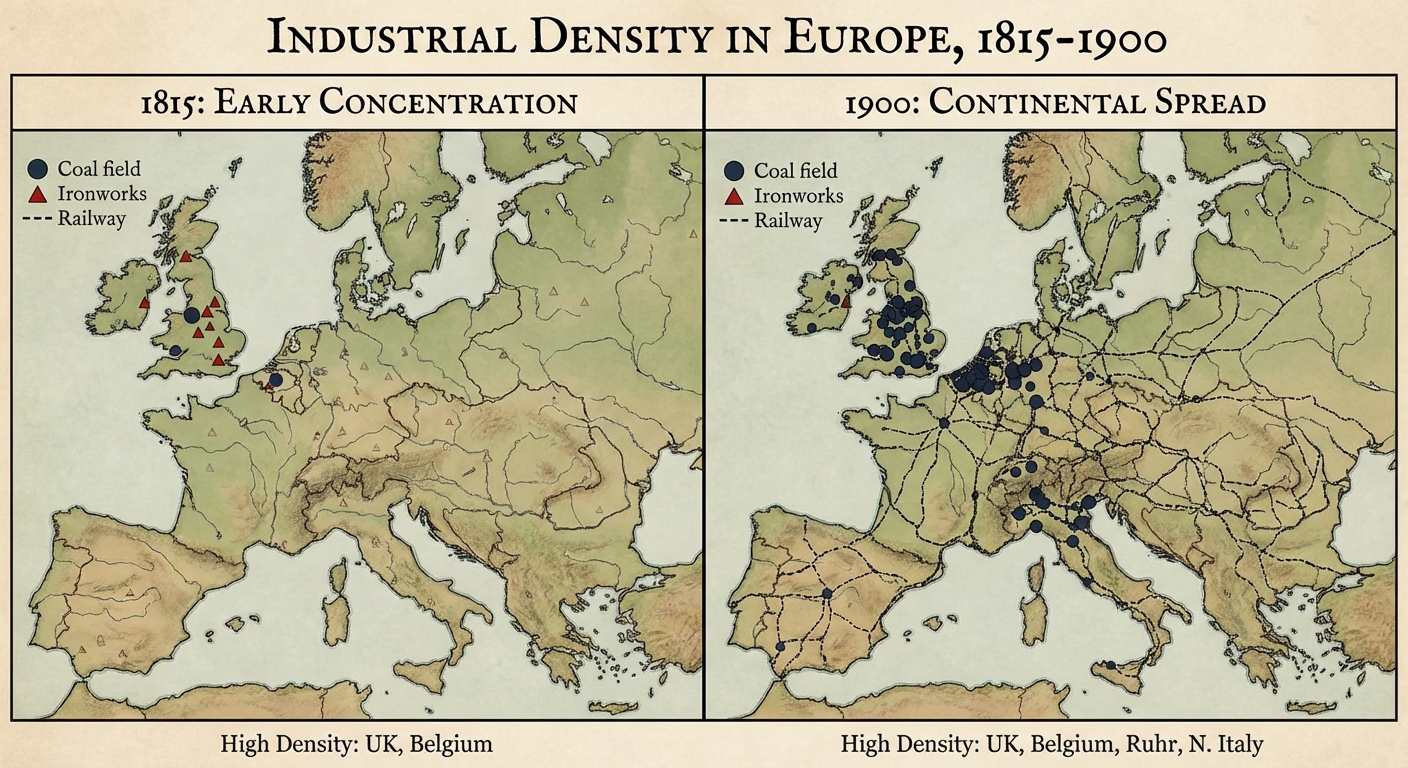
6.2 The Spread of Industry Throughout Europe
Britain's Leadership ("The Workshop of the World")
Britain maintained a significant lead in industrialization until the mid-19th century.
- The Crystal Palace (1851): The Great Exhibition in London showcased Britain's industrial, military, and economic superiority.
- Government Support: The British government protected innovation through patent laws and suppressed worker dissent (e.g., the Luddites).
The Luddite Reaction
Luddites were skilled textile artisans in the early 19th century who destroyed machinery they believed threatened their livelihood. This represents the friction between traditional labor and modern mechanization.
Continental Industrialization
The continent lagged behind Britain due to the Napoleonic Wars (political instability) and traditional guild restrictions. When it spread, it took different forms:
- State-Sponsored Industry: Unlike Britain's private enterprise, governments in France, Prussia, and Russia played a direct role in funding railways and factories.
- The Zollverein (1834): A German customs union that eliminated tolls between German states. It created a free-trade zone that laid the economic foundation for German unification and industrial growth.
Geographic Constraints
- France: Industrialized slower due to a lack of coal and a strong agrarian tradition.
- Eastern/Southern Europe: Remained largely agrarian with pockets of industrialization due to serfdom (in Russia until 1861) and lack of infrastructure.
6.3 Second-Wave Industrialization
First vs. Second Industrial Revolution
While the First Industrial Revolution (c. 1750–1830) centered on Textiles, Railroads, Iron, and Coal (TRIC), the Second Industrial Revolution (c. 1870–1914) focused on Steel, Chemicals, Electricity, and Petroleum (SCEP).
Key Innovations of the Second Wave
| Innovation | Figure | Impact |
|---|---|---|
| Bessemer Process | Henry Bessemer | Allowed for mass production of cheap, strong steel. Enabled skyscrapers and larger ships. |
| Electricity | Edison/Tesla | Powered factories (24/7 operations), streetlights (safer cities), and trams. |
| Internal Combustion | Daimler/Benz | Powered by petroleum; revolutionized transportation (automobiles, airplanes). |
| Synthetic Dyes & Chems | German Labs | Germany became the leader in chemical engineering (BASF, Bayer). |
| Communication | Bell/Marconi | Telephone and radio shrank global distances, facilitating imperialism and global markets. |
Rise of Mass Society
The Second Industrial Revolution fostered a consumer economy:
- Mass Production: The assembly line (perfected later by Henry Ford but rooted here) reduced costs.
- Department Stores: Venues like Le Bon Marché in Paris offered a wide array of goods to the middle class.
- Mass Leisure: With regulated work hours, people attended professional sports (soccer, rugby), music halls, and eventually aggressive nationalism spurred by print media.
6.4 Social Effects of Industrialization
Socioeconomic Class Structure
The feudal order of Aristocracy vs. Peasantry was replaced by a class system based on wealth:
- Upper Class (Bourgeoisie): Bankers, factory owners, and merchants. They gained political power in the 19th century (challenging the landed aristocracy).
- Middle Class (Petite Bourgeoisie): White-collar workers, teachers, shopkeepers. Valued hard work, education, and moral propriety.
- Working Class (Proletariat): Manual laborers. Often lived in slums with poor sanitation.
Family and Gender Roles
- Separate Spheres: The idea that men belong in the public sphere (work/politics) and women in the private sphere (home).
- Cult of Domesticity: An idealized view of women as moral guardians of the home, applicable mostly to the middle/upper classes. Working-class women still had to work in factories or domestic service to survive.
- The Nuclear Family: As economic production moved out of the home, the extended family declined, replaced by the nuclear family unit.
Living Conditions
Rapid urbanization led to overcrowding, lack of sewage systems, and disease (Cholera).
- Edwin Chadwick: A British reformer who linked unsanitary conditions to disease/poverty, leading to the Public Health Act of 1848.
Common Mistakes: Class vs. Caste
Student Pitfall: Do not confuse the "Middle Class" of the 19th century with the modern American "Middle Class." In the 19th century, the Middle Class (Bourgeoisie) were the wealthy capitalists, distinct from the aristocracy (nobles) and the workers.
6.5 The Concert of Europe and Conservatism
The Congress of Vienna (1815)
After defeating Napoleon, the major powers (Britain, Austria, Prussia, Russia) met to restore order.
- Leader: Klemens von Metternich (Austria).
- Guiding Principles:
- Legitimacy: Restoring ruling families deposed by Napoleon (Bourbons in France).
- Balance of Power: Ensuring no single nation could dominate Europe.
- Compensation: Rewarding victors with territory.
Conservatism
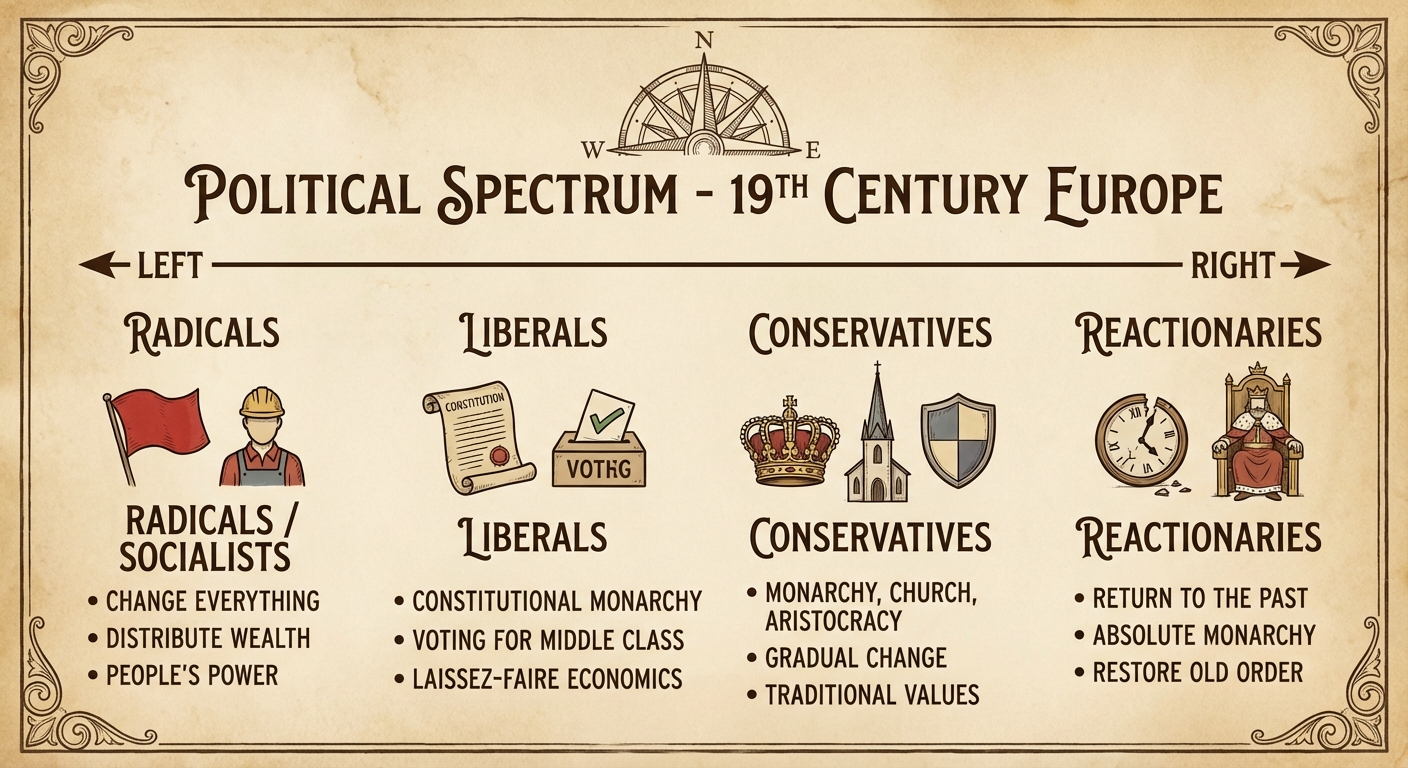
The dominant ideology of 1815–1848. It emphasized tradition, established religion, and aristocratic leadership. Conservatives viewed revolutions and liberal demands for constitutions as chaotic and dangerous.
- Edmund Burke: Introduction of "evolutionary" conservatism (change should be slow).
- The Concert of Europe: A system where Great Powers met to resolve international crises and intervene to suppress revolutions (The "Holy Alliance").
6.6 Revolutions (1815–1848)
Despite conservative repression, the ideas of the French Revolution (Liberalism/Nationalism) sparked waves of revolt.
1830 Revolutions
- France: The July Revolution overthrew reactionary King Charles X; established the "Bourgeois Monarchy" of Louis Philippe.
- Belgium: Successfully gained independence from the Netherlands (Catholic/Industrial Belgium vs. Protestant/Trading Dutch).
- Poland: Failed uprising against Russia.
1848: "The Springtime of Peoples"
Revolutions swept across Europe (France, Prussia, Austria, Italy).
- Causes: Potato famine (Hungry Forties), bad economy, desire for universal male suffrage, and nationalism.
- Results:
- France: Established the Second Republic (later Napoleon III's Empire).
- Elsewhere: Failed. Rulers utilized military force to crush rebellions. The middle class and working class failed to unite (middle class feared socialist radicalism).
Exceptions:
- Great Britain: Avoided revolution through gradual reform (Reform Act of 1832).
- Russia: Avoided revolution through strict repression.
6.7 Ideologies of Change
The 19th century is often called the "Age of Isms."
1. Liberalism
- Base: Middle Class (Bourgeoisie).
- Goals: Constitutions, natural rights, laissez-faire economics (Adam Smith), religious toleration.
- Key Figure: John Stuart Mill (On Liberty).
2. Nationalism
- Definition: Loyalty to a distinct culture/people (Volk) rather than a monarch.
- Impact:
- Unifying force: Germany and Italy.
- Destructive force: Austrian/Ottoman Empires (multi-ethnic states).
- Key Figures: Mazzini (Italy), Hegel (German philosophy).
3. Socialism
- Utopian Socialism: Believed in creating ideal communities (e.g., Robert Owen, Charles Fourier).
- Marxism (Scientific Socialism): Karl Marx and Friedrich Engels wrote the Communist Manifesto (1848).
- Theory: History is a class struggle. The Proletariat will eventually violently overthrow the Bourgeoisie and create a classless society.
4. Feminism
- Sought legal equality and suffrage.
- Flora Tristan: Combined socialism and feminism.
- Emmeline Pankhurst: Led the militant Suffragettes in Britain (WSPU), using violent tactics ("#DeedsNotWords") to gain the vote.
6.8 Social Reform and Mass Politics
British Reform (The Evolutionary Path)
Britain avoided revolution by expanding the franchise gradually.
- Reform Act of 1832: Gave the vote to the wealthy urban middle class; eliminated "rotten boroughs."
- Corn Laws Repeal (1846): Abolished tariffs on imported grain, favoring free trade and the industrial working class over aristocratic landowners.
- Chartist Movement: A working-class push for universal male suffrage and secret ballots. Failed in the short term, but all demands were eventually met.
Rise of Mass Political Parties
By the late 19th century, universal male suffrage was common, forcing parties to appeal to the masses.
Great Britain
- Conservatives (Tories): Led by Benjamin Disraeli. Passed the Reform Act of 1867 (giving vote to urban workers) to win their loyalty.
- Liberals (Whigs): Led by William Gladstone. Focused on education and Irish Home Rule.
- Labour Party: Formed around 1900 to represent unions and the working class (Keir Hardie).
Germany
- SPD (Social Democratic Party): The largest Marxist party in Europe.
- Bismarck's Response: Otto von Bismarck hated socialism but passed state social welfare programs (old age pensions, accident insurance) to win workers away from the SPD. This is an example of State Socialism.
6.9 Institutional Responses to Industrialization
Transforming the Urban Environment
Governments realized that filthy, narrow medieval streets were breeding grounds for disease and revolution.
- Georges Haussmann (Paris): Under Napoleon III, Haussmann rebuilt Paris with wide boulevards (harder to barricade), parks, and sewers.
- Public Transit: Electric streetcars and subways (London Underground) allowed workers to live further from factories, reducing density.
Policing and Order
- Professional Police: Sir Robert Peel established the "Bobbies" in London (1829). The goal was preventing crime and maintaining bourgeois order, distinct from the military.
- Prison Reform: Shift from public humiliation/punishment to rehabilitation and separation (Panopticons).
Compulsory Education
By the late 19th century, states implemented free, compulsory education.
- Goal: Create a literate workforce and instill nationalism (loyalty to the state/language).
6.10 Summary and Causation
Causation: The Industrial Revolution was the primary driver of 19th-century European history.
- Economic: Shifted the center of power from land (Aristocracy) to capital (Bourgeoisie).
- Social: Created a massive, urban proletariat that demanded rights, fueling Socialism.
- Political: The friction between the old order (Conservatism) and new powers (Liberalism/Nationalism) caused the Revolutions of 1848.
- Technological: Military advancements (machine guns, steamships) enabled the rapid colonization of Africa and Asia (Imperialism).
Mnemonics for Review
Factors for Industrialization (Britain): C.O.A.L.
- Capital (Banks)
- Overseas Markets (Empire)
- Agricultural Revolution
- Labor Supply
Effect on Women: Cult of Domesticity vs. Sweatshops (Class dependent).
1848 Revolutions: F.U.N.
- Failed (mostly)
- Urban workers vs Middle Class split
- No revolution in Britain or Russia