Comprehensive Review of Social Psychology, Personality, and Drives
4.1 Social Thinking and Perception
Social psychology begins with how we perceive ourselves and others. This section focuses on Attribution Theory—the mental process of inferring the causes of people's behavior.
Attribution Theory
Attribution is the process by which we explain our own behavior and the behavior of others.
- Situational Attribution: Explaining behavior based on external factors (e.g., "They yelled because they are stressed about a deadline").
- Dispositional Attribution: Explaining behavior based on internal personality traits (e.g., "They yelled because they are an aggressive person").
Key Errors and Biases
Humans are not objective observers; we are prone to specific cognitive errors.
- Fundamental Attribution Error (FAE): The tendency to overestimate dispositional factors (personality) and underestimate situational factors when evaluating others.
- Example: If a cashier is rude, you assume they are a mean person (dispositional), ignoring that they might have just been yelled at by a boss (situational).
- Note: We are less likely to make this error with ourselves or people we know well.
- Self-Serving Bias: The tendency to attribute our successes to internal factors and our failures to external factors to protect self-esteem.
- Success: "I aced the test because I'm smart."
- Failure: "I failed because the teacher made the test specific trick questions."
- Actor-Observer Bias: The tendency to attribute our own behavior to the situation (because we can see the environment) while attributing others' behavior to their personality.
- Just-World Phenomenon: The belief that the world is fair and people get what they deserve. This often leads to victim blaming (e.g., thinking a victim of crime must have done something to invite it).
Attitude Formation and Change
Attitudes are feelings, often influenced by our beliefs, that predispose us to respond in a particular way to objects, people, and events.
- Peripheral Route Persuasion: Occurs when people are influenced by incidental cues, such as a speaker's attractiveness or celebrity status (fast, emotional).
- Central Route Persuasion: Occurs when interested people focus on the arguments and respond with favorable thoughts (slow, logical).
Cognitive Dissonance Theory
Proposed by Leon Festinger, this is the mental discomfort (dissonance) we experience when two of our thoughts (cognitions) are inconsistent, or when our actions do not match our attitudes.
- Resolution: We cannot change the past action, so we usually change our attitude to reduce the discomfort.
- Example: A health-conscious person smokes a cigarette. To reduce dissonance, they might think, "One cigarette won't really hurt me."
4.2 Social Influence and Group Dynamics
This section covers how the presence of others affects individual behavior, heavily relying on classic experiments by Asch, Milgram, and Zimbardo.
Conformity and Obedience
1. Conformity (Solomon Asch)
Adjusting our behavior or thinking to coincide with a group standard.
- The Asch Line Study: Participants publicly agreed with an obviously wrong answer about line lengths because the rest of the group (actors) did so.
- Normative Social Influence: Conforming to gain approval or avoid rejection.
- Informational Social Influence: Conforming because we believe others have accurate information (e.g., following the crowd when escaping a building during an alarm).
2. Obedience (Stanley Milgram)
Complying with direct commands from an authority figure.
- The Milgram Shock Experiment: Demonstrated that a majority of ordinary people would administer potentially lethal electric shocks to a stranger if ordered to do so by a perceived authority figure. Obedience decreased if the authority was far away or the victim was close.
3. Roles and Deindividuation (Philip Zimbardo)
- Stanford Prison Experiment: Illustrated how social roles (expectations about a social position) can override individual personality. Guards became abusive; prisoners became passive.
- Deindividuation: The loss of self-awareness and self-restraint occurring in group situations that foster arousal and anonymity (e.g., mob mentality, internet trolling).
Group Behavior Effects
| Concept | Definition | Example |
|---|---|---|
| Social Facilitation | Improved performance on simple/well-learned tasks in the presence of others. | A pro athlete plays better with a cheering crowd. |
| Social Impairment | Worsened performance on difficult/new tasks in the presence of others. | Stumbling through a speech you didn't practice because of an audience. |
| Social Loafing | Tendency for people in a group to exert less effort when pooling their efforts toward a common goal. | One student doing no work in a group project. |
| Group Polarization | The enhancement of a group's prevailing inclinations through discussion within the group. | If a group is slightly racist, they become more racist after discussing it strictly among themselves. |
| Groupthink | The mode of thinking that occurs when the desire for harmony in a decision-making group overrides a realistic appraisal of alternatives. | The Challenger explosion decision; ignoring safety warnings to maintain group consensus. |
4.3 Prejudice, Aggression, and Altruism
Prejudice and Stereotypes
- Prejudice: An unjustifiable (and usually negative) attitude toward a group and its members.
- Stereotype: A generalized belief about a group of people.
- Discrimination: Unjustifiable negative behavior toward a group.
- In-group Bias: The tendency to favor our own group ("Us") over the "Out-group" ("Them").
- Scapegoat Theory: Prejudice offers an outlet for anger by providing someone to blame.
Aggression
Any physical or verbal behavior intended to hurt or destroy.
- Frustration-Aggression Principle: Frustration—the blocking of an attempt to achieve some goal—creates anger, which can generate aggression.
- Social Scripts: Culturally modeled guides for how to act in various situations (e.g., violent media providing scripts for resolving conflict).
Altruism and Attraction
Altruism is the unselfish regard for the welfare of others.
The Bystander Effect
The tendency for any given bystander to be less likely to give aid if other bystanders are present.
- Diffusion of Responsibility: We assume someone else will handle it.
- Darley and Latané research confirmed that the more people present, the slower the reaction to an emergency.
Theories of Helping
- Social Exchange Theory: Our social behavior is an exchange process, the aim of which is to maximize benefits and minimize costs.
- Reciprocity Norm: An expectation that people will help, not hurt, those who have helped them.
Factors of Attraction
- Proximity: Geographic nearness is the most powerful predictor of friendship.
- Mere Exposure Effect: Repeated exposure to novel stimuli increases liking of them.
- Physical Attractiveness: The first thing we notice; associated with the "halo effect."
- Similarity: Opposites rarely attract; we like those who share our attitudes and beliefs.
4.4 Theories of Personality
Personality is an individual's characteristic pattern of thinking, feeling, and acting.
1. Psychodynamic Perspective (Sigmund Freud)
Focuses on the unconscious mind and childhood experiences.
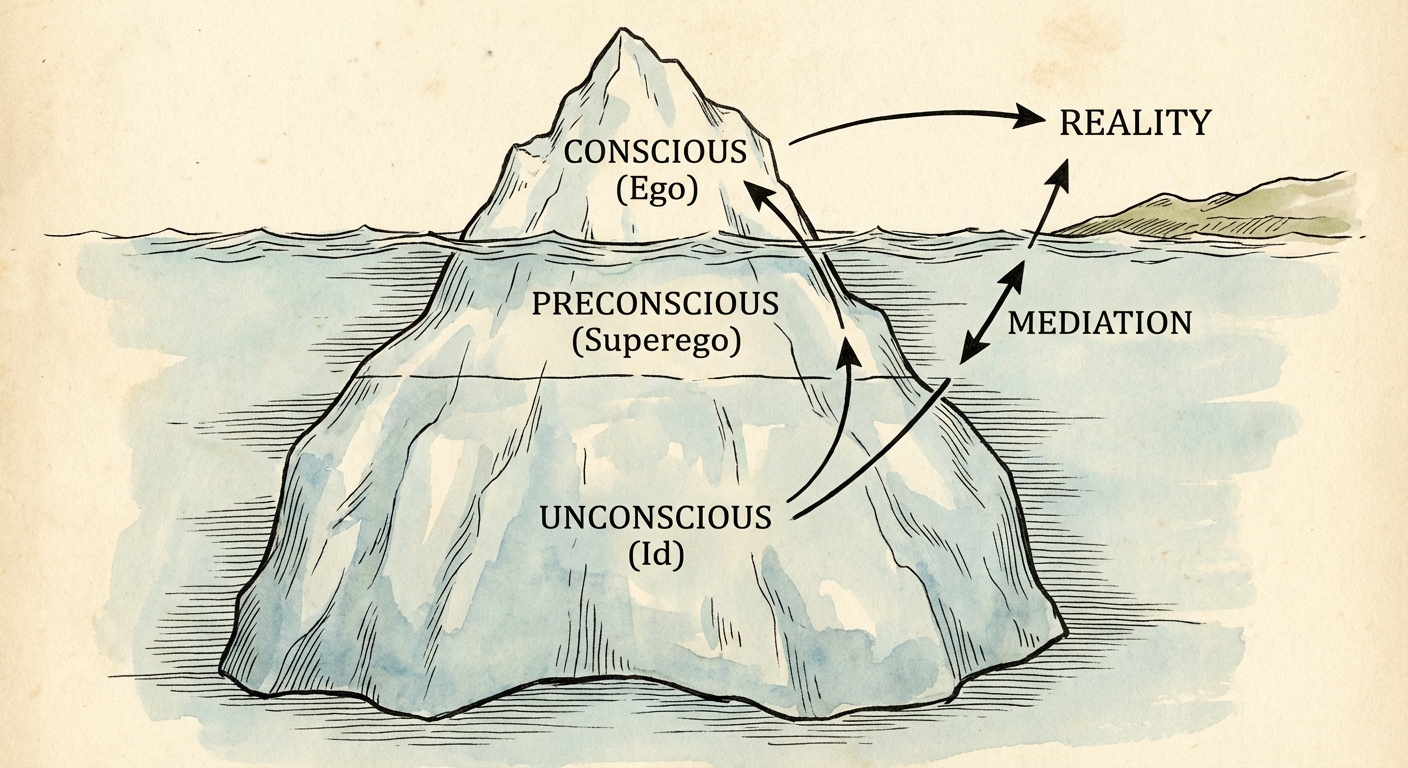
Structure of Personality
- Id: Unconscious psychic energy striving to satisfy basic sexual and aggressive drives. Operates on the Pleasure Principle (immediate gratification).
- Ego: The largely conscious "executive" part of personality. Operates on the Reality Principle, satisfying the id's desires in ways that will realistically bring pleasure rather than pain.
- Superego: Represents internalized ideals and provides standards for judgment (the conscience) and for future aspirations.
Defense Mechanisms
The ego's protective methods of reducing anxiety by unconsciously distorting reality.
- Repression: Banishing anxiety-arousing thoughts from consciousness (the foundation of all other defenses).
- Regression: Retreating to an earlier, more infantile stage of development.
- Reaction Formation: Switching unacceptable impulses into their opposites (e.g., being overly nice to someone you hate).
- Projection: Disguising one's own threatening impulses by attributing them to others.
- Rationalization: Offering self-justifying explanations in place of the real, more threatening unconscious reasons.
- Displacement: Shifting sexual or aggressive impulses toward a more acceptable or less threatening object or person (e.g., kicking the dog after a hard day at work).
- Sublimation: Channeling frustrated sexual/aggressive energy into productive activities (e.g., sports, art).
Projective Tests
Tools used by psychoanalysts to reveal the unconscious.
- Rorschach Inkblot Test: Seeks to identify people's inner feelings by analyzing their interpretations of inkblots.
- Thematic Apperception Test (TAT): People express their inner feelings through the stories they make up about ambiguous scenes.
2. Humanistic Perspective (Rogers & Maslow)
Emphasizes human potential, free will, and self-actualization.
- Abraham Maslow: Proposed the Hierarchy of Needs. We must satisfy physiological needs before moving to safety, love, esteem, and finally Self-Actualization (fulfilling one's potential).
- Carl Rogers: Believed people are basically good. Growth requires three conditions:
- Genuineness
- Acceptance (specifically Unconditional Positive Regard: an attitude of total acceptance toward another person).
- Empathy
- Self-Concept: All our thoughts and feelings about ourselves, in answer to the question, "Who am I?"
3. Trait Perspective
Focuses on describing personality traits rather than explaining their origins. Statistical method: Factor Analysis.
The "Big Five" Factors (Remember: CANOE or OCEAN)
- Conscientiousness (Organized vs. Disorganized)
- Agreeableness (Trusting vs. Suspicious)
- Neuroticism (Emotional stability vs. Instability)
- Openness (Imaginative vs. Practical)
- Extraversion (Sociable vs. Retiring)
4. Social-Cognitive Perspective (Albert Bandura)
Views behavior as influenced by the interaction between people's traits (including their thinking) and their social context.
- Reciprocal Determinism: The interacting influences of behavior, internal cognition, and environment.
- Self-Efficacy: One's sense of competence and effectiveness (different from self-esteem, which is one's sense of worth).
- Locus of Control:
- Internal: You control your own fate.
- External: Chance or outside forces determine your fate (linked to Learned Helplessness).
4.5 Motivation and Emotion
Theories of Motivation
- Drive-Reduction Theory: A physiological need (e.g., hunger) creates an aroused tension state (a drive) that motivates an organism to satisfy the need (eat) to return to Homeostasis (steady internal state).
- Incentive Theory: Behavior is pushed by internal drives and pulled by external incentives (rewards/punishments).
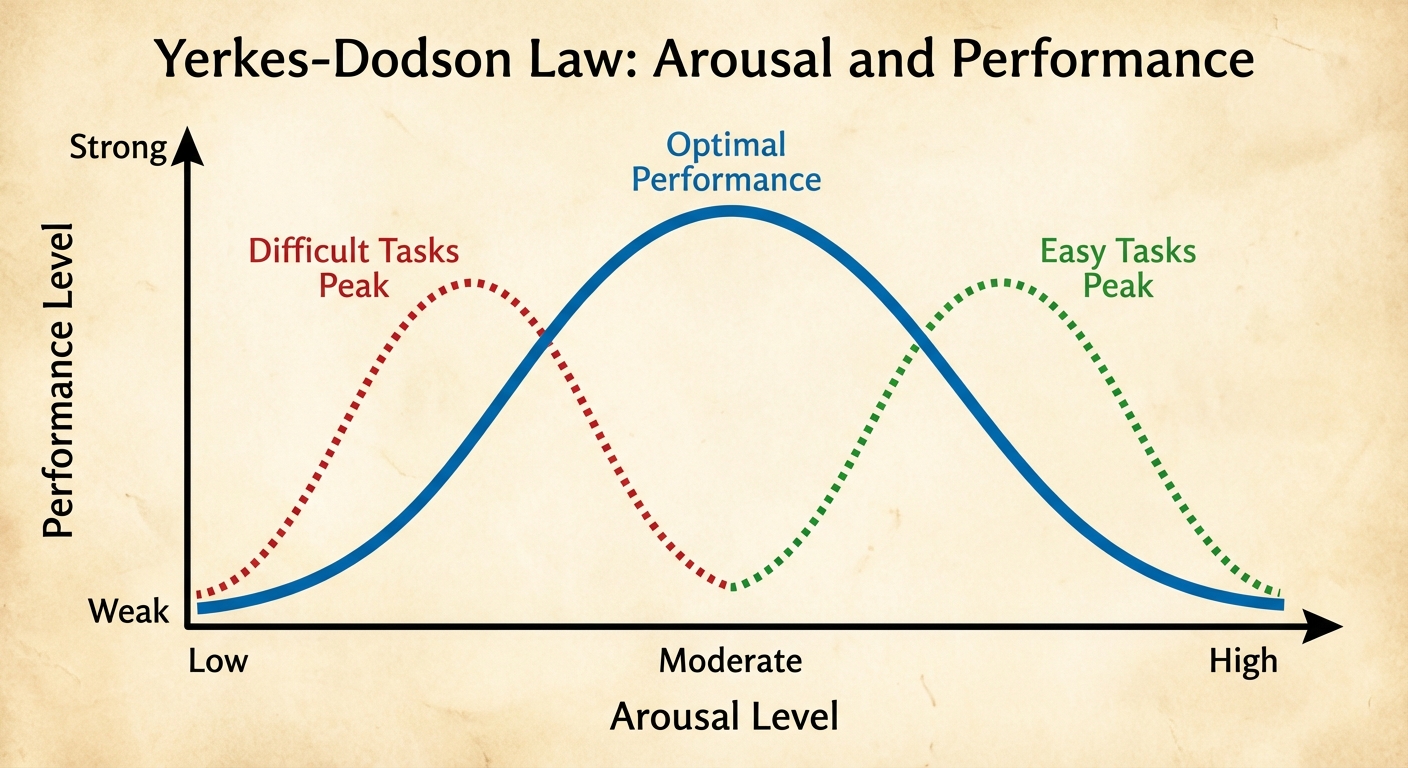
- Arousal Theory (Yerkes-Dodson Law): We seek an optimal level of arousal.
- Performance increases with arousal only up to a point, beyond which performance decreases.
- Difficult tasks require lower arousal; easy tasks require higher arousal.
Biology of Hunger
- Glucose: The form of sugar that circulates in the blood; low levels trigger hunger.
- Hypothalamus: The control center.
- Lateral Hypothalamus: The "Go" signal. Stimulation = Eat. Destruction = Starve.
- Ventromedial Hypothalamus: The "Stop" signal. Stimulation = Stop eating. Destruction = Obesity.
- Set Point: The point at which an individual's "weight thermostat" is supposedly set.
Theories of Emotion
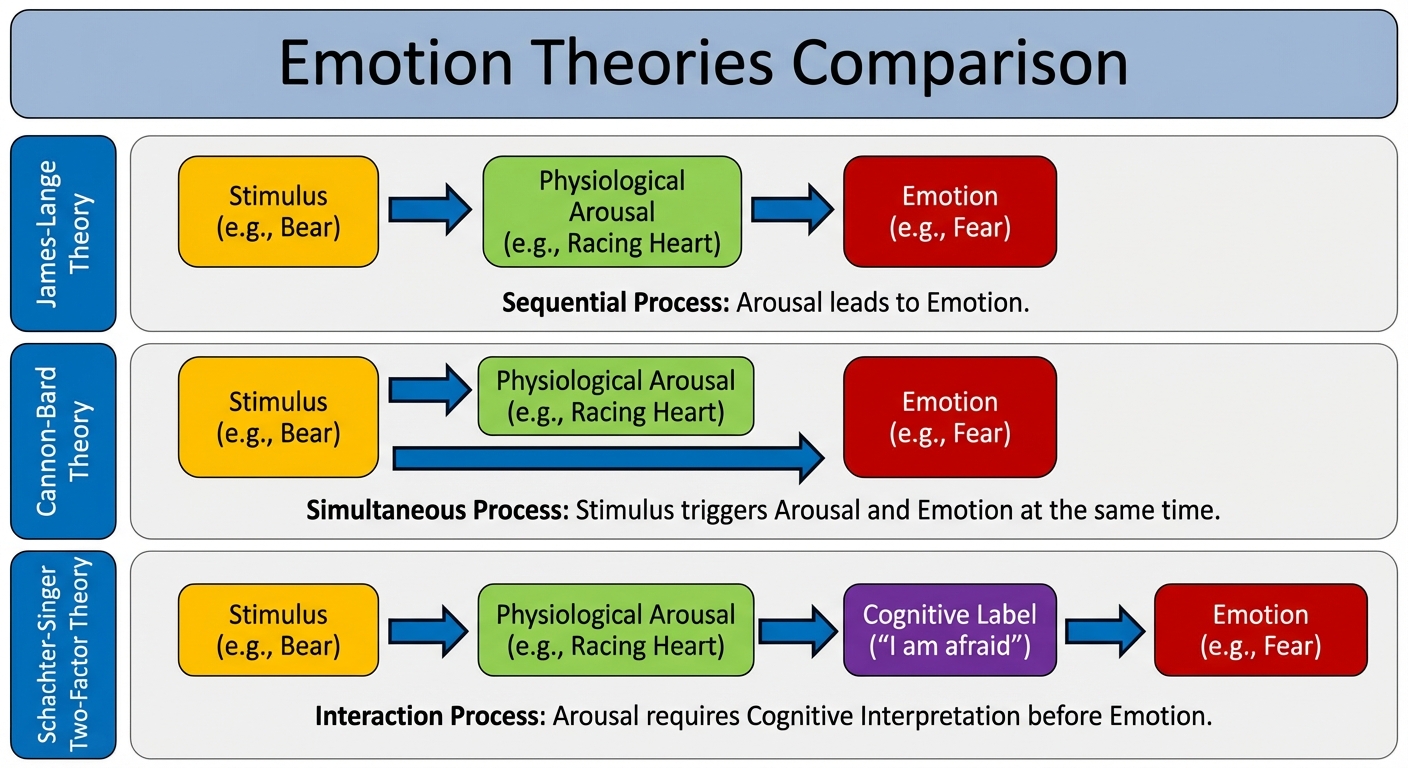
We generally agree emotion consists of (1) physiological arousal, (2) expressive behaviors, and (3) conscious experience. The order creates the theory.
| Theory | Mechanism (Order of Events) | Example |
|---|---|---|
| James-Lange | Arousal $\rightarrow$ Emotion | "I feel afraid because I am trembling." |
| Cannon-Bard | Arousal + Emotion (Simultaneously) | "The dog makes me tremble and feel afraid at the same time." |
| Schachter-Singer (Two-Factor) | Arousal + Cognitive Label $\rightarrow$ Emotion | "My heart is racing, and I see a bear, so I must be afraid." (Context matters). |
| Zajonc / LeDoux | Some responses happen instantly, without conscious appraisal (The "Low Road"). | Startling at a loud noise before knowing what it is. |
| Lazarus | Cognitive appraisal (" Is it dangerous?") defines emotion. | deciding a sound is just the wind reduces fear. |
Common Mistakes & Pitfalls
- Negative Reinforcement vs. Punishment: In motivation, students confuse these. Negative reinforcement increases behavior by removing a bad stimulus (taking aspirin for a headache). Punishment decreases behavior.
- Fundamental Attribution Error vs. Self-Serving Bias:
- FAE is about judging others.
- Self-Serving Bias is about judging yourself.
- Self-Efficacy vs. Self-Esteem:
- Efficacy = Belief in ability to do a specific task ("I can solve this math problem").
- Esteem = Overall feeling of self-worth ("I am a good person").
- Representativeness vs. Availability Heuristics:
- Availability: Judging probability based on how easily examples come to mind (e.g., fearing plane crashes because they are on the news).
- Representativeness: Judging based on how well something matches a prototype (stereotype).
- Groupthink vs. Group Polarization:
- Polarization: Opinions get more extreme.
- Groupthink: Opinions are suppressed to keep harmony.