Unit 4: Intellectual Shifts and Political Power (1543–1789)
4.1 The Scientific Revolution
Definitions & Concept
The Scientific Revolution refers to the dramatic shift in scientific thought and methodology that took place in Europe from the mid-16th to the late 17th century. It marked the transition from the medieval worldview—based on Aristotelian physics and Church doctrine—to a modern worldview based on empiricism, mathematical reasoning, and observation.
- Empiricism: The theory that all knowledge is derived from sense-experience and experimentation (promoted by Francis Bacon).
- Rationalism: The belief that reason and logic, rather than experience, are the primary sources of knowledge (promoted by René Descartes).
Cosmology and Astronomy
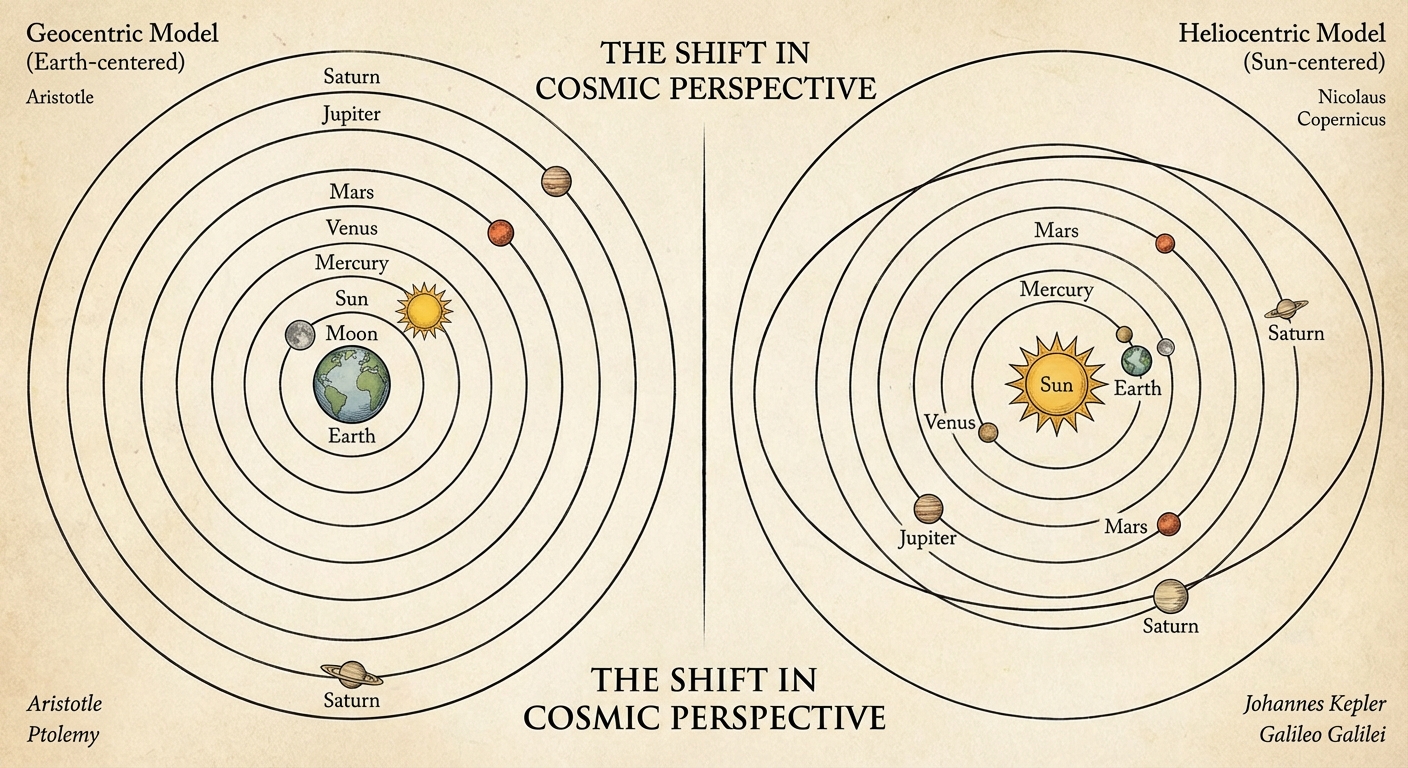
The revolution began by challenging the Geocentric Model (Ptolemaic system), which placed a stationary Earth at the center of the universe.
Nicolaus Copernicus (1473–1543):
- Published On the Revolutions of the Heavenly Spheres (1543).
- Proposed the Heliocentric Theory: The sun is the center of the universe, and the earth revolves around it.
- Note: He retained the flaw of circular orbits.
Johannes Kepler (1571–1630):
- Used data from Tycho Brahe to formulate the Three Laws of Planetary Motion.
- Key discovery: Planets move in elliptical orbits, not circles. This mathematically proved Copernicus right while correcting his geometry.
Galileo Galilei (1564–1642):
- Used the telescope to validate heliocentrism visually.
- Discoveries: Craters on the moon, moons of Jupiter (proving not everything orbits Earth), and sunspots.
- Conflict: Put on trial by the Roman Inquisition for heresy; forced to recant.
Isaac Newton (1642–1727):
- Synthesized the work of Copernicus, Kepler, and Galileo.
- Published Principia Mathematica (1687).
- Law of Universal Gravitation: Every object in the universe attracts every other object. The force is proportional to the product of their masses and inversely proportional to the square of the distance between them.
The Scientific Method
Two major thinkers established the methodology for modern science:
- Francis Bacon: Father of the Inductive Method (Empiricism). Argued that researchers should gather specific data and observe independent of prestige/tradition to draw general conclusions.
- René Descartes: Father of the Deductive Method (Rationalism). "Cogito, ergo sum" (I think, therefore I am). Argued for doubting everything until it could be proven through logic and mathematics.
Scientific Method Steps:
- Observation
- Hypothesis
- Experimentation
- Analysis
- Conclusion
Anatomy and Medicine
Medieval medicine was based on the ancient Greek physician Galen, who believed the body was governed by four "humors" (blood, phlegm, yellow bile, black bile).
- Andreas Vesalius: Broke with tradition by dissecting human cadavers. Published De humani corporis fabrica, correcting Galen’s anatomical errors.
- William Harvey: Discovered the circulation of blood. Proved the heart was a pump, not a "heater" as Galen thought.
4.2 The Enlightenment
Core Concepts
The Enlightenment (c. 1715–1789) was an intellectual movement that applied the methods of the Scientific Revolution (reason and natural laws) to human society, government, and economics.
- Reason: The absence of intolerance, bigotry, or superstition.
- Nature: Natural laws regulate both the universe and human society.
- Progress: Humanity can improve through education and the application of reason.
- Liberty: Intellectual and religious freedom.
The Philosophes and Political Theory
Philosophes were French intellectuals who popularized Enlightenment ideas. They discussed ideas in Salons (gatherings often hosted by wealthy women like Madame Geoffrin) and Coffeehouses.
| Thinker | Key Work | Major Idea | Impact |
|---|---|---|---|
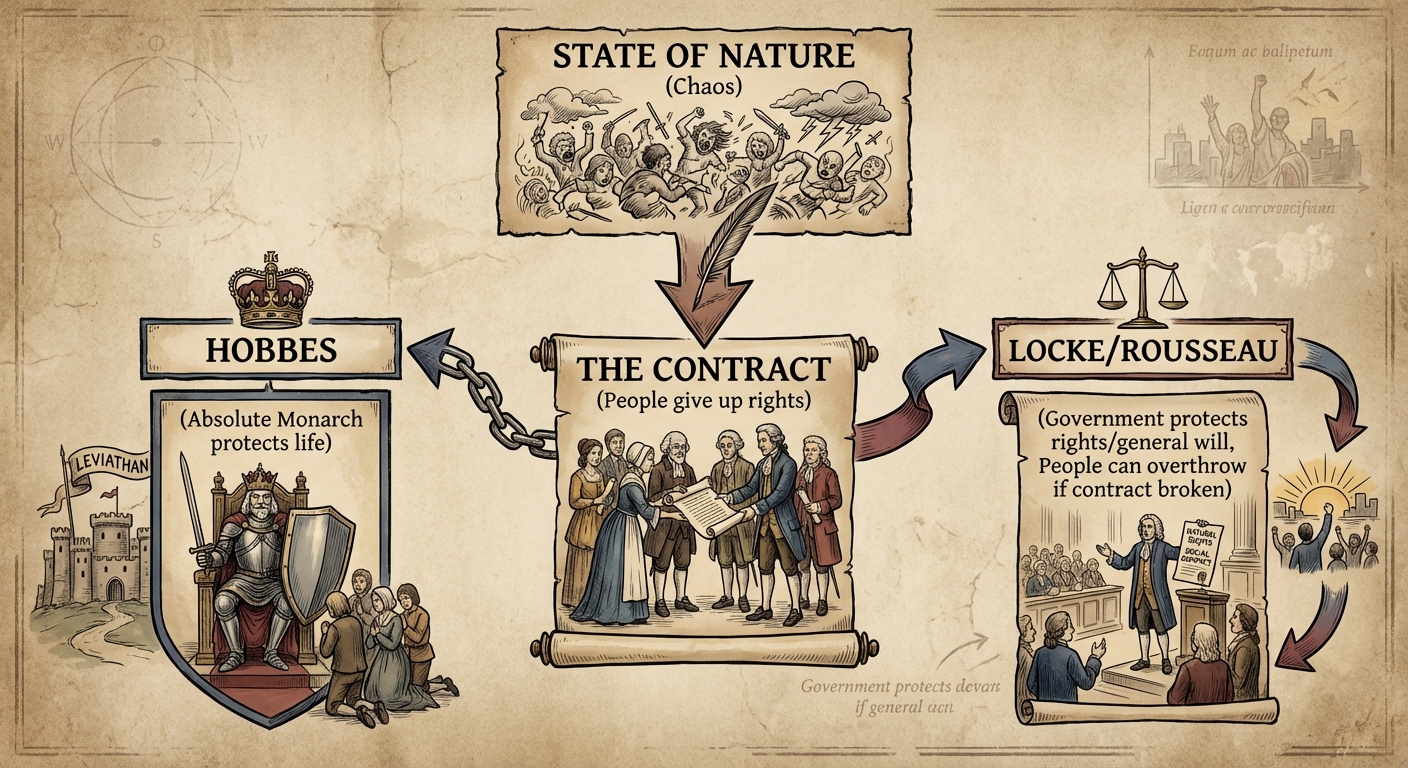
| Thomas Hobbes | Leviathan (1651) | Humans are naturally wicked; life is "nasty, brutish, and short." We need an Absolute Monarch to keep order. | Justification for Absolutism (Social Contract version). |
| John Locke | Two Treatises of Government (1689) | Tabula Rasa (blank slate). Humans have Natural Rights (Life, Liberty, Property). Gov exists to protect these; if not, revolt. | Influenced the American and French Revolutions. |
| Montesquieu | Spirit of the Laws (1748) | Separation of Powers and Checks and Balances. | Basis for the U.S. Constitution. |
| Voltaire | Candide | Freedom of speech and Religious Toleration. Critized the Catholic Church ("Écrasez l'infâme!" - Crush the loathsome thing). | First Amendment rights; Enlightened Absolutism. |
| Rousseau | The Social Contract (1762) | The General Will: What is best for the community should dictate the law, not individual interests. | Influenced the radical phase of the French Revolution. |
| Diderot | Encyclopedia | Compilation of all knowledge to "change the general way of thinking." | Spread Enlightenment ideas across Europe. |
Economic Theory: From Mercantilism to Capitalism
- Mercantilism (The Old Way): Government regulation, accumulation of gold/silver, finite wealth.
- Physiocrats: Early French economists (like Francois Quesnay) who criticized mercantilism. They believed land was the source of wealth.
- Adam Smith (The New Way):
- Published The Wealth of Nations (1776).
- Laissez-Faire ("Let it be"): The government should not interfere in the economy.
- Invisible Hand: Supply and demand will naturally regulate the economy if individuals pursue their own self-interest.
Religious Views
- Deism: The belief in a "Watchmaker God." God created the universe based on natural laws and then stepped back. He does not intervene (no miracles, no prayers answered). Popular among elites (Voltaire, Jefferson).
- Skepticism/Atheism: David Hume (skepticism regarding human certainty) and Baron d'Holbach (atheism), though full atheism was rare.
Women in the Enlightenment
Most philosophes argued for women's education only in the context of domestic duties. However, dissenters existed:
- Mary Wollstonecraft: Wrote A Vindication of the Rights of Woman (1792). Argued that women only appeared inferior due to lack of education.
- Olympe de Gouges: Wrote Declaration of the Rights of Woman (1791), asserting women should have equal political rights.
4.3 18th-Century Society and Demographics
The Agricultural Revolution
Before the Industrial Revolution, there was an Agricultural Revolution that increased food supply, allowing for population growth.
- Enclosure Movement: Wealthy landowners united small strips of land and "commons" into large, fenced farms.
- Result: Increased efficiency but forced poor peasants off the land (creating a labor force for factories later).
- New Techniques:
- Crop Rotation: Replaced the "three-field system" (leaving land fallow). Used nitrogen-restoring crops like turnips and clover (Townshend) to keep soil fertile.
- Seed Drill (Jethro Tull): Planted seeds in rows rather than scattering them.
- New Crops: The potato (from the Americas via Columbian Exchange) became a staple for the poor due to high calorie density.
Population Explosion
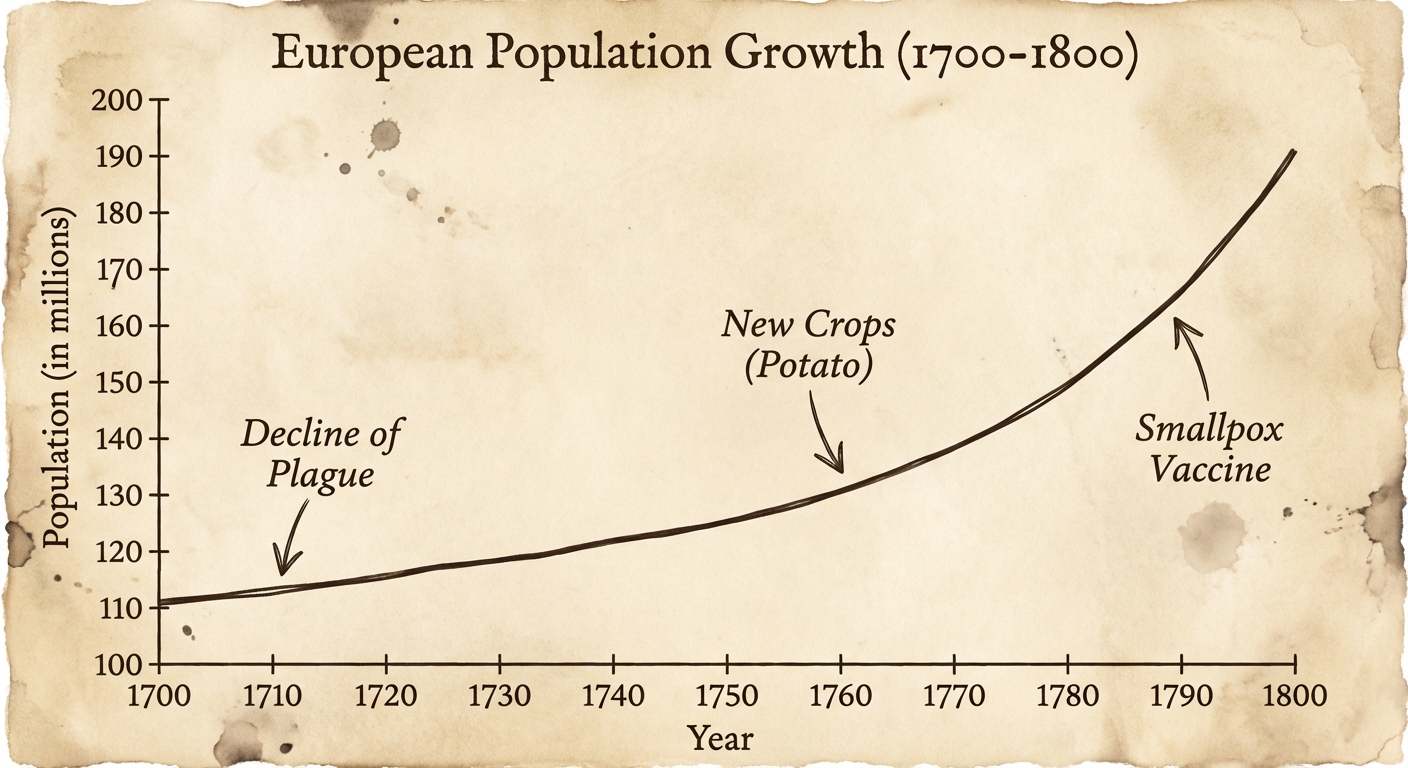
In the 18th Century, European population grew rapidly.
- More Food: See Agricultural Revolution above.
- Disappearance of the Plague: The Brown Rat replaced the Black Rat (plague carrier), and quarantine measures improved.
- Medicine:
- Inoculation: Lady Mary Wortley Montagu brought smallpox inoculation from the Ottoman Empire.
- Vaccination: Edward Jenner developed the cowpox vaccine for smallpox (1796), a massive public health victory.
Family and Private Life
- Child Rearing: Jean-Jacques Rousseau’s Emile encouraged loving children and dressing them comfortably, moving away from swaddling and harsh discipline.
- Illegitimacy Explosion: As urbanization increased and community controls broke down, premarital sex resulted in more illegitimate births (1750–1850).
- Cottage Industry (Putting-Out System): Rural families manufactured goods (textiles) in their homes for merchants. This was the precursor to the factory system.
4.4 18th-Century Culture and Arts
Art Movements
Rococo (c. 1720–1780):
- Characteristics: Soft pastels, ornate, sentimental, focused on the leisure of the aristocracy, playful, romantic.
- Artists: Antoine Watteau, Jean-Honoré Fragonard (The Swing).
- Association: Associated with the absolute monarchy and the frivolity of the Ancien Régime.
Neoclassicism (c. 1750–1820):
- Characteristics: Return to Greek/Roman themes, symmetry, moral seriousness, patriotism, sacrifice.
- Artists: Jacques-Louis David (Oath of the Horatii).
- Association: Associated with the Enlightenment and later, the French Revolution.
Consumer Revolution
Europeans began buying more goods not for survival, but for comfort and status.
- Privacy: Homes began having private rooms (boudoirs) rather than communal halls.
- Goods: Porcelain, mirrors, cotton linens, and colonial goods like coffee, tea, and sugar became accessible to the middle class.
The Public Sphere
Intellectual life moved out of the royal courts and into public spaces:
- Coffeehouses: Centers for political discussion.
- Lending Libraries: Allowed the middle class to read books without buying them.
- Freemasons: Secret societies that promoted Enlightenment ideals of fraternity and equality.
4.5 Enlightened Absolutism
Concept
Enlightened Absolutists (or Despots) were monarchs who adopted Enlightenment ideals (reason, toleration, reform) without giving up their absolute power.
Mnemonic: T.R.A.P.
- Toleration of religious minorities
- Reform of institutions (law codes, education)
- Absolutism (still kept hard power)
- Patronage of the philosophes
The Three Key Monarchs
| Monarch | Country | Reforms | Limitations | Success Rating |
|---|---|---|---|---|
| Frederick II (The Great) | Prussia | Called himself "First Servant of the State." Religious toleration (except Jews). Promoted education. Simplified laws. | Did not abolish serfdom (needed Junker support). Militaristic. | High (Strengthened state). |
| Catherine II (The Great) | Russia | Patronized Diderot/Voltaire. Drafted the Nakaz (enlightened law code). Restricted torture. | Pugachev's Rebellion (serf uprising) scared her into ending reforms. Expanded serfdom. | Mixed (Good PR, bad follow-through). |
| Joseph II | Austria | Most Radical. Abolished serfdom. Full religious toleration. Freedom of the press. Equality before the law. | Reforms were too fast. Nobles and church rebelled. Most reforms repealed after his death. | Low (Too radical to last). |
Comparison Note: Louis XV and XVI of France are generally not considered Enlightened Absolutists; they maintained the status quo until the Revolution.
Common Mistakes & Pitfalls
Confusing Bacon and Descartes:
- Mistake: Swapping their methods.
- Correction: Bacon = British = Beef (Empirical/Physical). Descartes = Deductive = Don't trust senses (Rationalism).
Misunderstanding "Enlightened Despots":
- Mistake: Thinking they were democrats or created constitutions.
- Correction: They were Absolutists first. They used Enlightenment ideas to make their governments more efficient and powerful, not to give power to the people.
Rococo vs. Baroque:
- Mistake: Thinking they are the same.
- Correction: Baroque (Unit 2/3) is heavy, dramatic, and religious (Catholic Reformation). Rococo (Unit 4) is light, airy, secular, and aristocratic.
Adam Smith vs. Capitalism Today:
- Mistake: Assuming Smith supported corporate greed.
- Correction: Smith hated monopolies and mercantilism. He believed competition was morally good because it protected consumers from high prices.
Napoleon's Placement:
- Mistake: Grouping Napoleon with Frederick the Great as an 18th-century Enlightened Despot.
- Correction: Napoleon comes after the French Revolution (Unit 5). While he had enlightened traits, he belongs to the 19th-century post-revolutionary era.