Unit 6 Review: Policy Impacts, Capital Flows, and Net Exports
Dynamics of the Foreign Exchange Market
In an open economy, the value of a currency is not static. It fluctuates based on supply and demand forces driven by international trade and investment. Understanding how government policies (Fiscal and Monetary) and economic conditions (Inflation and Income) shift these curves is critical for the AP Macroeconomics exam.
Determinants of Exchange Rates
The Foreign Exchange Market (Forex) works just like any other market. The "price" is the exchange rate, and the "quantity" is the amount of currency.
There are four primary "shifters" of currency demand and supply, often remembered by the mnemonic T.R.I.P.S (omitting Tastes/Preferences for the main economic drivers):
- Relative Real Interest Rates ($r$): The return on financial assets.
- Relative Inflation Rates ($PL$): The purchasing power of the currency.
- Relative Income Levels ($Y$): The ability to buy imports.
- Productivity/Tastes: Demand for a country's specific goods.
Here, we focus on how Policies (Fiscal/Monetary) alter these variables to move the market.
Real Interest Rates and International Capital Flows
Before analyzing specific policies, you must master the relationship between interest rates and the movement of money across borders.
The Search for Yield
Financial capital (money used for investment in bonds, stocks, and savings) seeks the highest possible Real Rate of Return.
- Capital Inflow: When domestic real interest rates are higher than foreign rates, foreign investors purchase domestic financial assets (like government bonds) to earn that higher return.
- Capital Outflow: When domestic real interest rates are lower than foreign rates, domestic investors send their money abroad to find better returns elsewhere.
The Transmission Mechanism
This flow of capital directly impacts the Forex market:
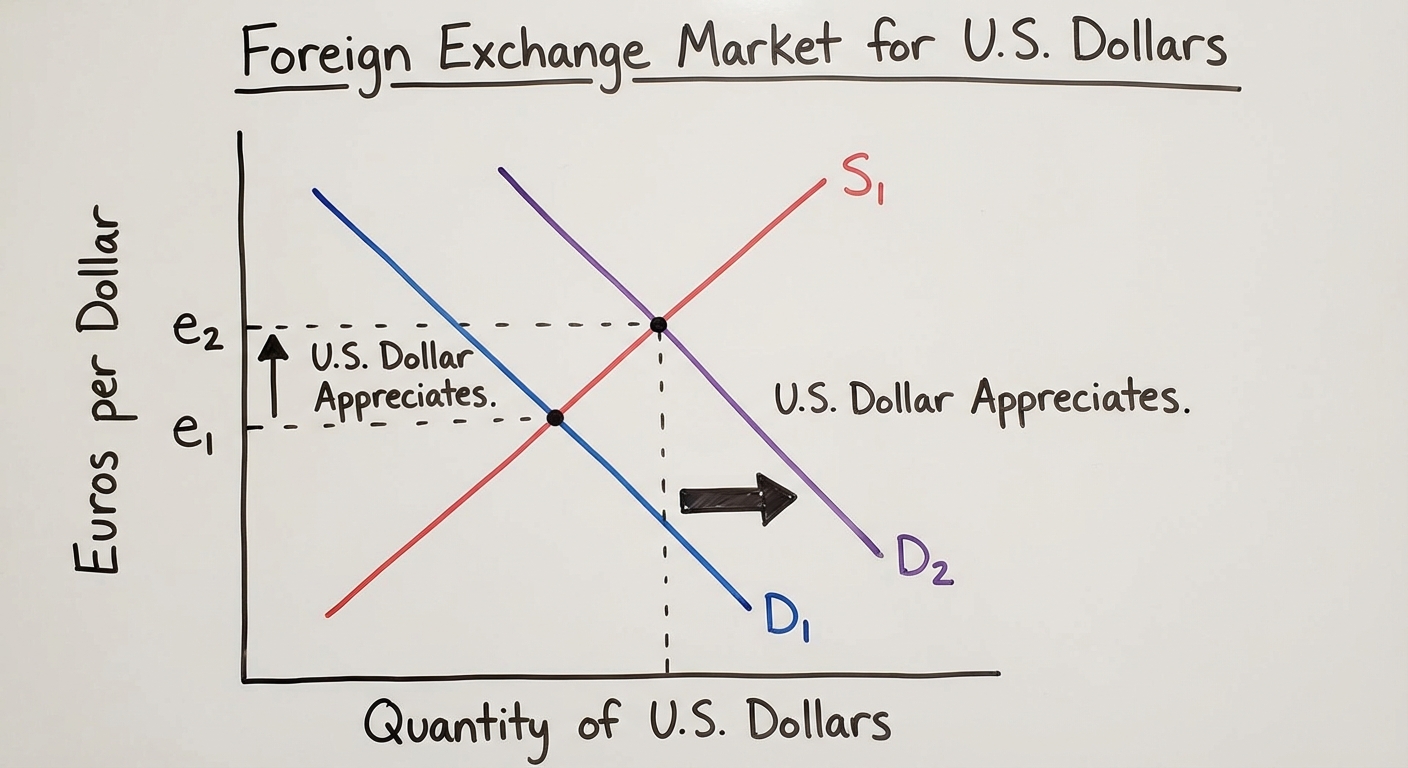
Higher Domestic $r$:
- Foreigners need your currency to buy your bonds.
- Demand for your currency $\uparrow$.
- Domestic investors keep money at home, so they supply less currency to the world.
- Supply of your currency $\downarrow$.
- Result: The currency Appreciates.
Lower Domestic $r$:
- Foreigners find your bonds unattractive.
- Demand for your currency $\downarrow$.
- Domestic investors exchange their money for foreign currency to invest abroad.
- Supply of your currency $\uparrow$.
- Result: The currency Depreciates.
Effect of Policies on the Foreign Exchange Market
Now we combine the Loanable Funds Market (which sets the interest rate) with the Forex Market.
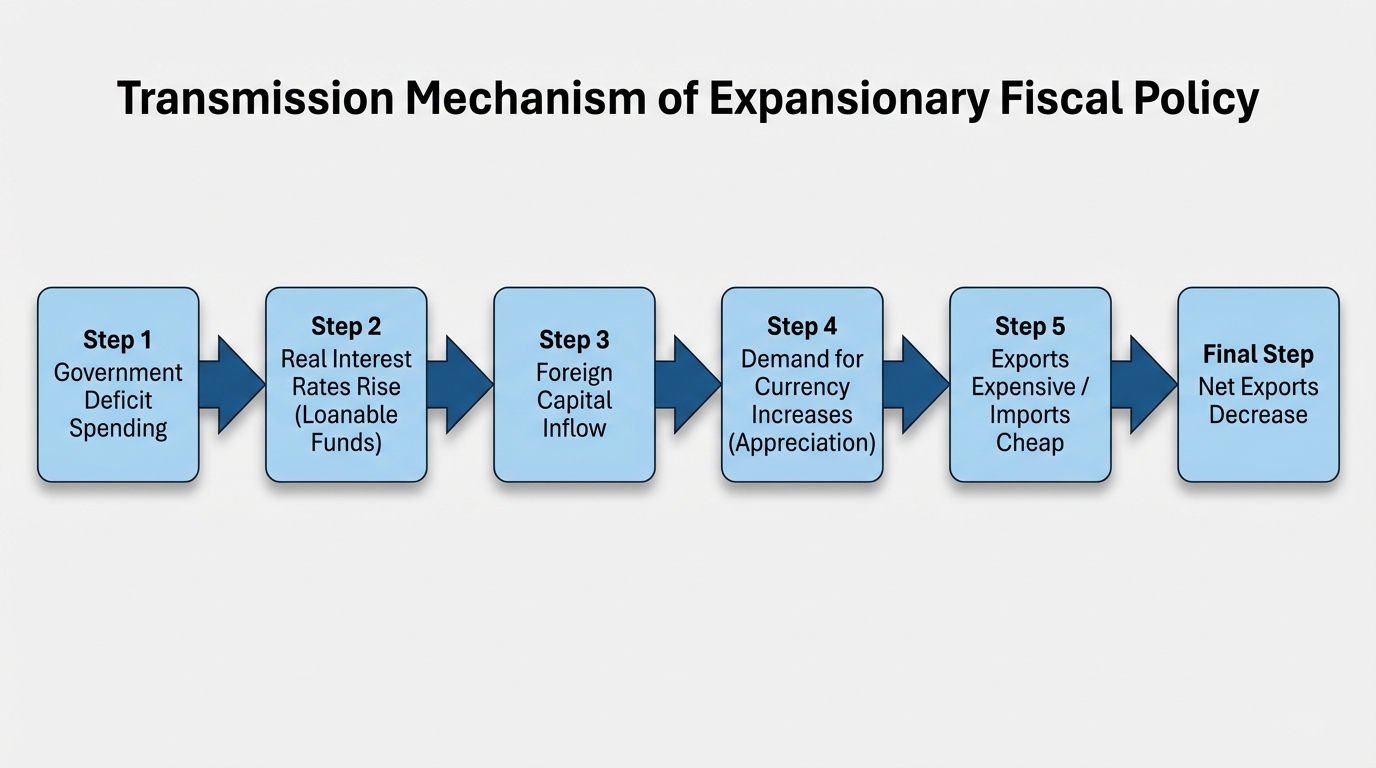
1. Expansionary Fiscal Policy
- Action: Government Spending ($G\uparrow$) or Taxes ($T\downarrow$).
- Loanable Funds Impact: The government usually borrows money to fund this deficit. This typically shifts the Demand for Loanable Funds to the right (or reduces National Savings), causing the Real Interest Rate ($r$) to rise.
- Forex Impact:
- High $r$ attracts foreign financial capital (Capital Inflow).
- Demand for Domestic Currency shifts Right.
- Result: Currency Appreciates.
2. Contractionary Fiscal Policy
- Action: $G\downarrow$ or $T\uparrow$.
- Loanable Funds Impact: Deficit shrinks (or surplus grows). Demand for Loanable Funds shifts left. Real Interest Rate ($r$) falls.
- Forex Impact:
- Low $r$ causes Capital Outflow.
- Supply of Domestic Currency shifts Right (to buy foreign currency).
- Result: Currency Depreciates.
3. Expansionary Monetary Policy
- Action: Central Bank buys bonds/lowers reserve requirement/lowers discount rate.
- Money Market Impact: Money Supply ($MS$) increases. Nominal (and Real) Interest Rate falls.
- Forex Impact:
- Low interest rates trigger Capital Outflow.
- Investors sell domestic currency to buy foreign currency.
- Result: Currency Depreciates.
4. Contractionary Monetary Policy
- Action: Central Bank sells bonds.
- Money Market Impact: Money Supply ($MS$) decreases. Interest Rate rises.
- Forex Impact:
- High interest rates trigger Capital Inflow.
- Result: Currency Appreciates.
Summary Table: Policy Connectors
| Policy Type | Interest Rate ($r$) | Capital Flow | Currency Value |
|---|---|---|---|
| Exp. Fiscal | $\uparrow$ | Inflow | Appreciates |
| Con. Fiscal | $\downarrow$ | Outflow | Depreciates |
| Exp. Monetary | $\downarrow$ | Outflow | Depreciates |
| Con. Monetary | $\uparrow$ | Inflow | Appreciates |
Changes in the Foreign Exchange Market and Net Exports
Once the currency value has changed (appreciated or appreciated), it exerts a secondary kickback effect on the domestic economy through Net Exports ($NX$).
The Link Between Value and Trade
Recall the aggregate demand formula:
Where $(X - M)$ is Net Exports ($NX$).
1. When Currency Appreciates ("Strong" Dollar)
- Buying Power: Your currency buys more foreign currency.
- Imports: Foreign goods become cheaper for domestic consumers. Imports ($M$) $\uparrow$.
- Exports: Domestic goods become more expensive for foreign buyers (they need more of their currency to buy yours). Exports ($X$) $\downarrow$.
- Result: Net Exports ($NX$) Decrease.
- Macro Effect: This creates a drag on Aggregate Demand, shifting $AD$ to the left.
2. When Currency Depreciates ("Weak" Dollar)
- Buying Power: Your currency buys less foreign currency.
- Imports: Foreign goods become more expensive. Imports ($M$) $\downarrow$.
- Exports: Domestic goods become cheaper for foreign buyers. Exports ($X$) $\uparrow$.
- Result: Net Exports ($NX$) Increase.
- Macro Effect: This boosts Aggregate Demand, shifting $AD$ to the right.
Economic Conditions: Inflation and Income
Aside from government policy, general economic health impacts $NX$ via the exchange rate.
- Relative Inflation: If Country A has higher inflation than Country B, Country A's goods are expensive. Foreigners don't want them (Demand for currency $\downarrow$), and locals buy foreign goods (Supply of currency $\uparrow$).
- Result: Currency Depreciates $\rightarrow$ Eventually, this depreciation makes exports cheap again (automatic stabilizer).
- Relative Income: If Country A's income rises, citizens buy more of everything, including imports.
- Result: Supply of currency $\uparrow$ (to buy imports) $\rightarrow$ Currency Depreciates $\rightarrow$ NX Decreases (initially due to high imports).
Common Mistakes & Pitfalls
Inflation vs. Interest Rates: This is the most common error.
- High Inflation causes a currency to Depreciate (purchasing power drops).
- High Interest Rates cause a currency to Appreciate (investment demand rises).
- Tip: Always ask if the question is about buying goods (Inflation/Purchasing Power Parity) or buying bonds (Interest Rates/Capital Flow).
"Crowding Out" Effects on Trade: Students often forget that Crowding Out (Government deficit spending $\rightarrow$ higher interest rates) has an Open Economy effect. The higher interest rate doesn't just lower Investment ($I$), it also lowers Net Exports ($NX$) because the currency appreciates.
Appreciation is not always "Good": While a "strong" dollar sounds positive, it hurts domestic manufacturers who rely on exports. Exam questions often ask who gets hurt by appreciation (exporters) and who benefits (importers/consumers).
Mixing up Inflow/Outflow:
- Money flows toward the higher real interest rate.
- Money flows away from the lower real interest rate.