Advanced Control Structures: Selection, Iteration, and Analysis
Implementing Selection and Iteration Algorithms
In AP Computer Science A, the ability to combine Selection (making decisions) and Iteration (repeating tasks) is fundamental to solving complex problems. An algorithm is a precise sequence of instructions implemented using programming languages (like Java) to solve a specific task.
Standard Algorithm Patterns
There are several standard algorithms you must memorize and understand conceptually. These often appear in Free Response Questions (FRQs) involving methods.
1. Divisibility and Modulo
To determine if a number is even, odd, or a multiple of another number, use the modulus operator (%). It returns the remainder of division.
- Even Check:
if (num % 2 == 0) - Odd Check:
if (num % 2 != 0) - Multiple Check:
if (num % k == 0)(Is $num$ a multiple of $k$?)
2. Determining Min/Max Values
To find the minimum or maximum value in a sequence of inputs (or elements), you need initialized variables and a loop structure.
- Initialization: Never initialize to
0if the data might be negative (for max) or large (for min).- Initialize
maxtoInteger.MIN_VALUEor the first value in the set. - Initialize
mintoInteger.MAX_VALUEor the first value in the set.
- Initialize
int currentMax = Integer.MIN_VALUE;
// Assume 'input' is a value received inside a loop
if (input > currentMax) {
    currentMax = input;
}
3. Digit Extraction
A classic algorithm involves analyzing integers digit-by-digit. This requires a while loop that continues as long as the number is greater than 0.
- Get the last digit:
int digit = number % 10; - Remove the last digit:
number = number / 10;

Accumulation Logic
Algorithms frequently require running totals (sums) or counts.
- Counter: A variable incremented by 1 (e.g.,
count++) when a condition is met. - Accumulator: A variable increased by a value from the dataset (e.g.,
total += currentValue).
Example: Sum of Even Digits
public int sumEvenDigits(int num) {
    int sum = 0;
    while (num > 0) {
        int digit = num % 10;
        if (digit % 2 == 0) {
            sum += digit;
        }
        num /= 10;
    }
    return sum;
}
Developing Algorithms Using Strings
Strings in Java are objects. Developing algorithms for strings usually involves iterating through the characters to analyze or construct new strings. Since strings are immutable, you cannot change them in place; you must build a new string using concatenation.
String Traversal
You iterate through a string using its index, which ranges from $0$ to $length() - 1$.
The Standard for Loop Structure
String str = "Computer";
for (int i = 0; i < str.length(); i++) {
    String letter = str.substring(i, i + 1);
    // Process 'letter'
}
Accessing Characters
While charAt(int index) exists, the AP exam frequently tests utilizing substring for single-character analysis.
- Syntax:
str.substring(index, index + 1)returns the single character atindexas aString. - Boundary: Be careful! Accessing
str.substring(n, n+1)wherenisstr.length()leads to aStringIndexOutOfBoundsException.
Common String Algorithms
- Counting Occurrences: finding how many times loop logic detects a specific character (e.g., vowels).
- Reversing a String: iterating backwards or prepending characters.
- Finding Nested Substrings: checking if a smaller string exists inside a larger one.
Example: Reversing a String
public String reverseString(String original) {
    String reversed = ""; // Initialize empty string
    for (int i = 0; i < original.length(); i++) {
        String singleChar = original.substring(i, i + 1);
        reversed = singleChar + reversed; // Prepend character
    }
    return reversed;
}
Informal Code Analysis
Informal code analysis (or "hand tracing") is the process of manually stepping through code to determine the output or the state of variables. This is a critical skill for attempting Multiple Choice Questions (MCQs).
Trace Tables
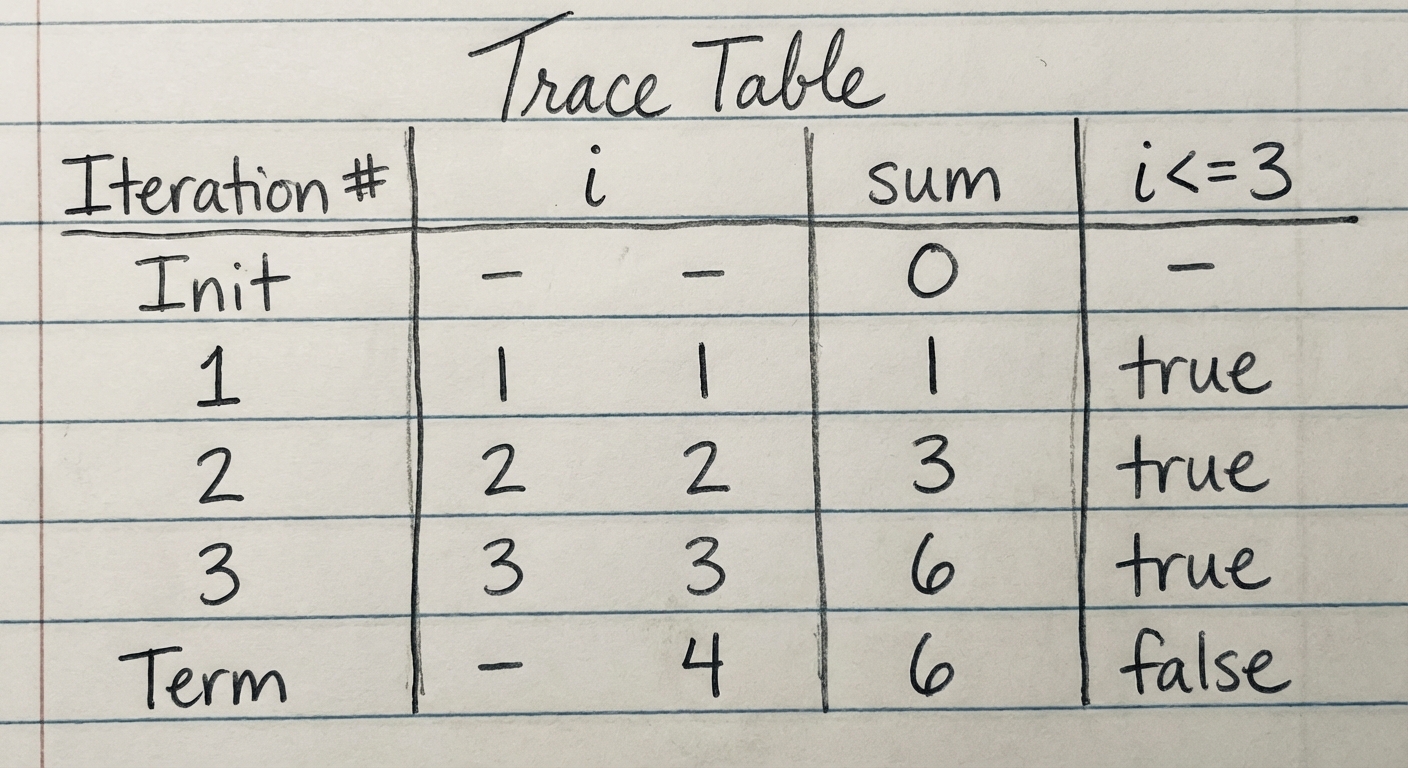
A Trace Table is a grid used to track the changing values of variables during iteration.
How to construct a Trace Table:
- Create columns for every variable (including the loop counter $i$).
- Create a column for the logical condition (True/False).
- Create a column for Output.
- Add a new row for every iteration of the loop.
Analyzing Nested Loops
When analyzing nested loops, remember that the inner loop completes a full cycle for every single iteration of the outer loop.
- If the outer loop runs $N$ times and the inner loop runs $M$ times, the body execution count is $N \times M$.
- Triangle Loops: Watch for inner loops dependent on the outer loop variable (e.g.,
for(int k=0; k < i; k++)). These usually print triangle patterns or process lower/upper portions of 2D data (covered later in arrays).
Predicting Output
When asked "What is printed?":
- Does the printing happen inside or outside the loop?
- Is it
System.out.print(same line) orSystem.out.println(new line)? - Watch for loop boundaries—does the loop stop at
< nor<= n? This determines if the last value is processed (a common "off-by-one" error source).
Common Mistakes & Pitfalls
- String Comparison Error: Never use
==to compare strings.==checks if two references point to the same memory object. Always usestr1.equals(str2)to check if the text content is the same. - Off-By-One Errors: Misinterpreting loop boundaries. Using
<=length on a specific index (like accessing an array or string) causes an Index Out of Bounds exception. The last valid index is always $length - 1$. - Integer Division: Remember that
int / intresults in anint(truncation).5 / 2equals2, not2.5. This often breaks average calculations if you don't cast todouble. - Infinite Loops: In
whileloops, failing to update the control variable inside the loop body results in an infinite loop which crashes the program. - Substring Blindness: For
substring(start, end), remember thestartindex is inclusive strings, but theendindex is exclusive (the character atendis NOT included).