Unit 4 Review: Magnetism and Electromagnetic Induction
Magnetic Fields and Forces
Magnetic Fields
The Nature of Magnetism
Magnetism is a fundamental force arising from the motion of electric charges. While electric fields are generated by static charges, Magnetic Fields (denoted by the symbol $B$) are generated by moving charges (currents) or intrinsic magnetic moments of elementary particles (spin).
Key fundamental properties include:
- Dipoles: Magnets always exist as dipoles with a North (N) and South (S) pole. Unlike electric charges, magnetic "monopoles" (isolated N or S poles) have never been observed.
- Interaction: Like poles repel (N-N, S-S); opposite poles attract (N-S).
Magnetic Field Lines
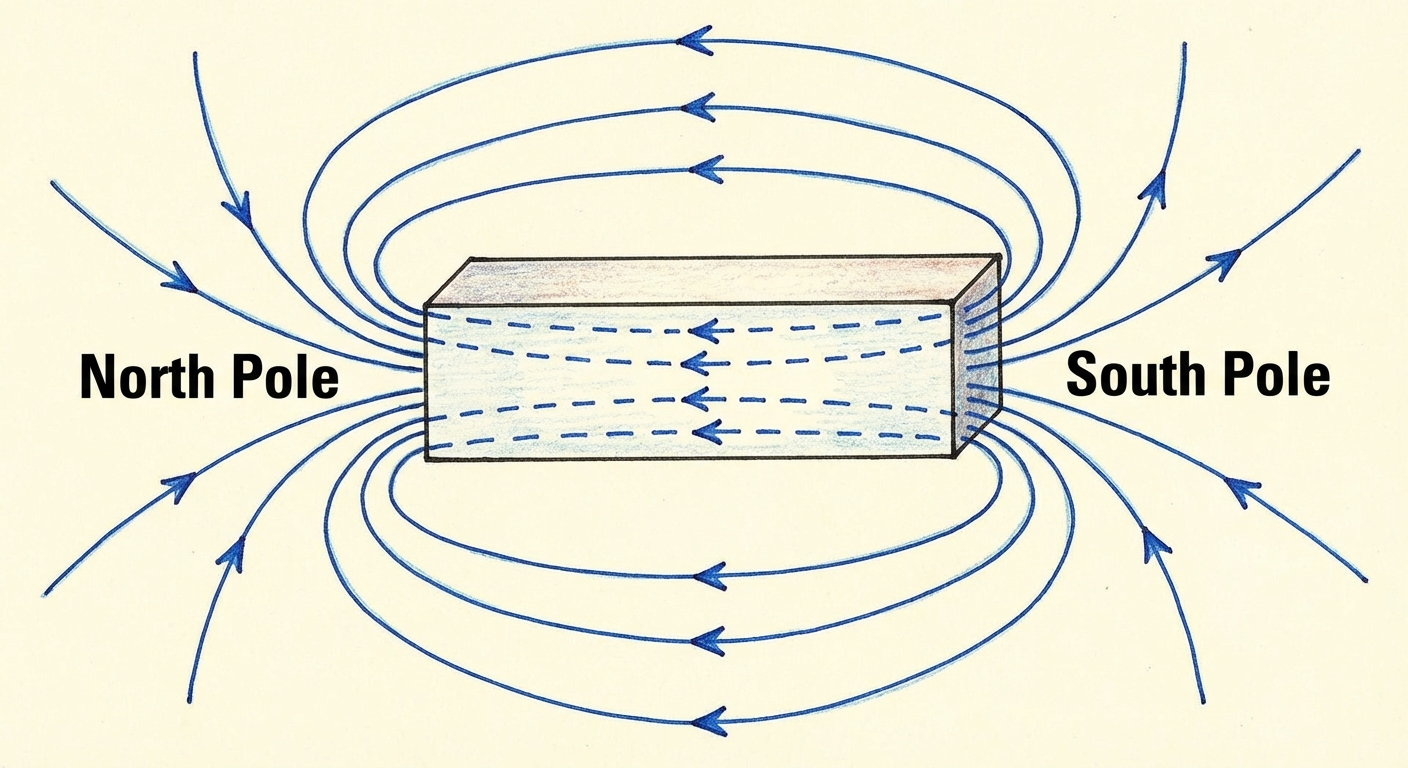
To visualize the magnetic field vector $\vec{B}$, we use magnetic field lines. The density of these lines indicates the strength of the field.
Rules for Drawing Field Lines:
- Outside the magnet: Lines extend from the North pole to the South pole.
- Inside the magnet: Lines continue from South to North, forming closed loops.
- No Crossing: Field lines never cross each other.
- Tangent: The direction of the magnetic field at any point is tangent to the field line.
Earth's Magnetic Field
The Earth acts like a giant bar magnet. However, there is a distinct naming convention confusion:
- The Geographic North Pole is effectively a Magnetic South Pole (because the north pole of a compass magnet is attracted to it).
- The Geographic South Pole is effectively a Magnetic North Pole.
Units
The SI unit for the magnetic field is the Tesla (T).
Another common (non-SI) unit is the Gauss (G), where $1 \text{ T} = 10,000 \text{ G}$.
Magnetic Force on Moving Charges
A static charge in a magnetic field feels no magnetic force. However, a charge $q$ moving with velocity $v$ through a magnetic field $B$ experiences a magnetic force $F_M$, provided the motion is not parallel to the field.
The Force Formula
The magnitude of the magnetic force is given by:
Where:
- $F_M$ is the magnetic force (Newtons).
- $q$ is the magnitude of the charge (Coulombs).
- $v$ is the speed of the charge (m/s).
- $B$ is the magnetic field strength (Tesla).
- $\theta$ is the angle between the velocity vector $\vec{v}$ and the magnetic field vector $\vec{B}$.
Critical Conditions:
- Maximum Force: Occurs when velocity is perpendicular to the field ($\theta = 90^\circ$).
- Zero Force: Occurs when velocity is parallel or anti-parallel to the field ($\theta = 0^\circ$ or $180^\circ$).
Direction: The Right-Hand Rule (RHR)
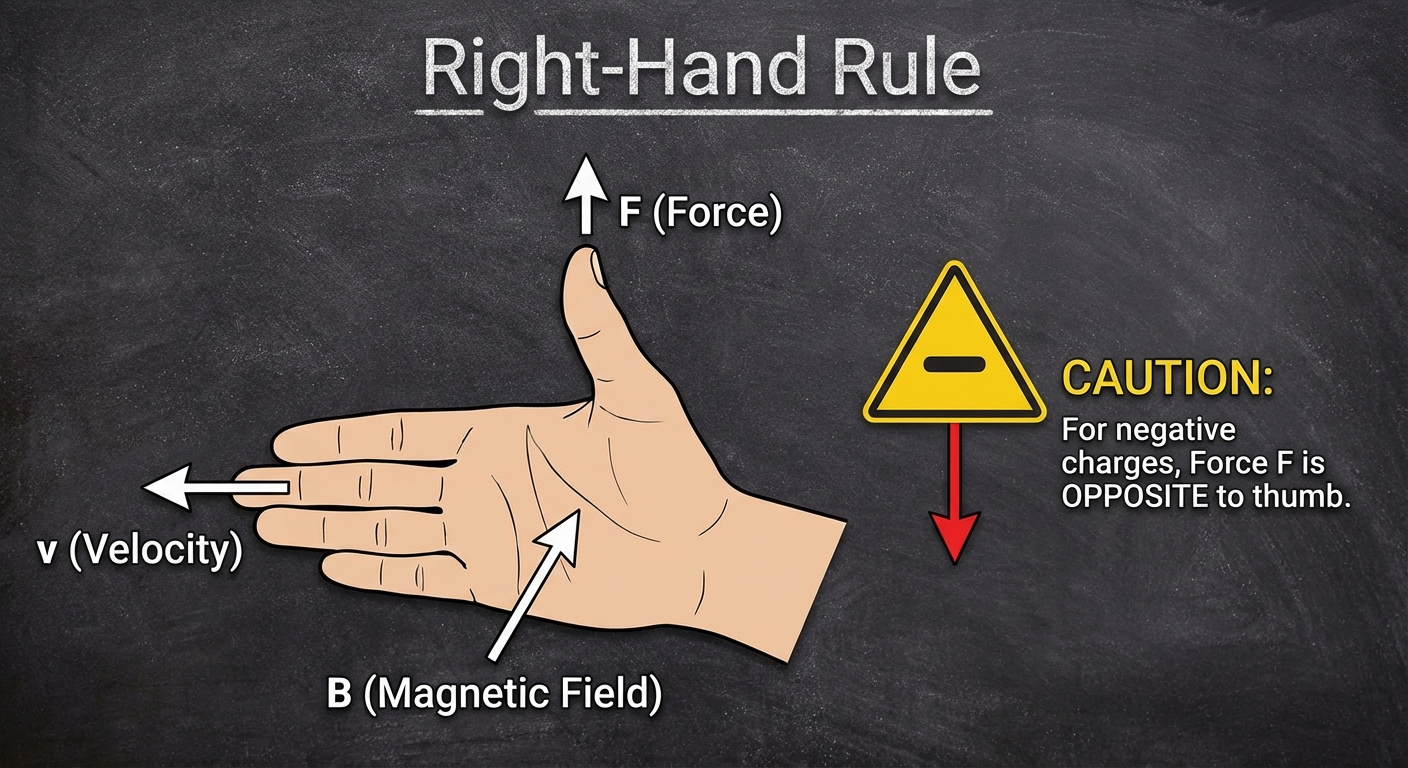
The magnetic force is always perpendicular to both the velocity vector and the magnetic field vector. To find the specific direction, use the Right-Hand Rule:
- Point fingers in the direction of velocity $\vec{v}$.
- Curl fingers towards the direction of the magnetic field $\vec{B}$ (palm faces $\vec{B}$).
- Thumb points in the direction of the Force $\vec{F}_M$ for a positive charge.
Note: For a negative charge (like an electron), the force points in the direction opposite to the thumb.
Motion in a Uniform Magnetic Field
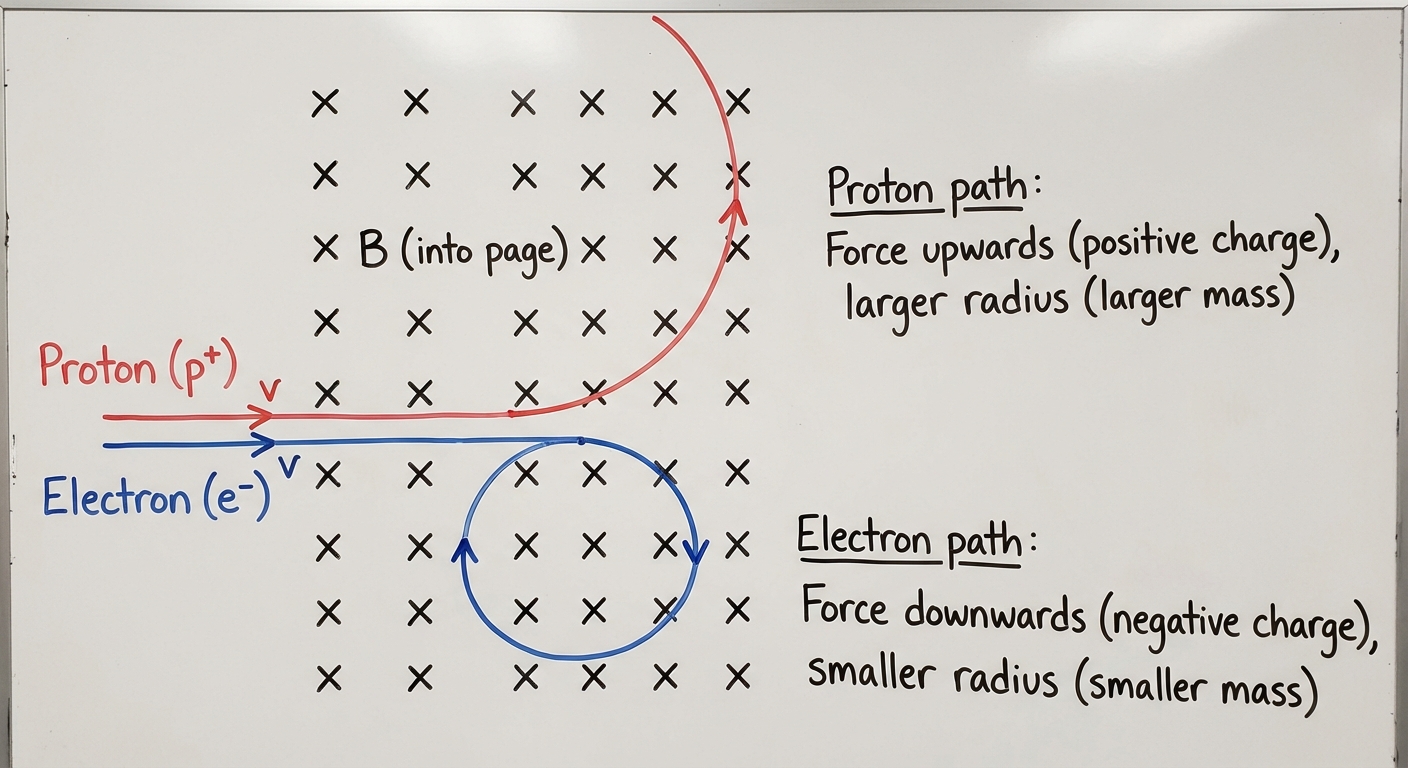
Since the magnetic force is always perpendicular to velocity, it acts as a centripetal force ($F_c$). It changes the direction of the particle but never does work on the particle; therefore, the speed (kinetic energy) remains constant.
If a charged particle enters a uniform magnetic field perpendicularly, it follows a circular path.
Setting Magnetic Force equal to Centripetal Force:
Solving for the radius $r$ of the path:
This relationship shows that:
- Heavier particles ($m$) have larger radii (harder to turn).
- Faster particles ($v$) have larger radii.
- Stronger fields ($B$) or larger charges ($q$) create tighter turns (smaller radii).
If the particle enters at an angle (not $90^\circ$), the parallel component of velocity remains constant while the perpendicular component creates circular motion, resulting in a helical (spiral) path.
Magnetic Force on Current-Carrying Wires
Since current is just a stream of moving charges, a wire carrying current $I$ in a magnetic field also experiences a force.
The Force Formula
The magnitude of the magnetic force on a straight wire is:
Where:
- $I$ is the current (Amps).
- $L$ is the length of the wire inside the magnetic field (meters).
- $B$ is the magnetic field strength (Tesla).
- $\theta$ is the angle between the current direction and the magnetic field.
Direction
The direction is found using a variation of the Right-Hand Rule:
- Point fingers in the direction of Current $I$.
- Let fingers curl or point palm toward Magnetic Field $B$.
- Thumb points toward Force $F_M$.
Forces Between Parallel Wires
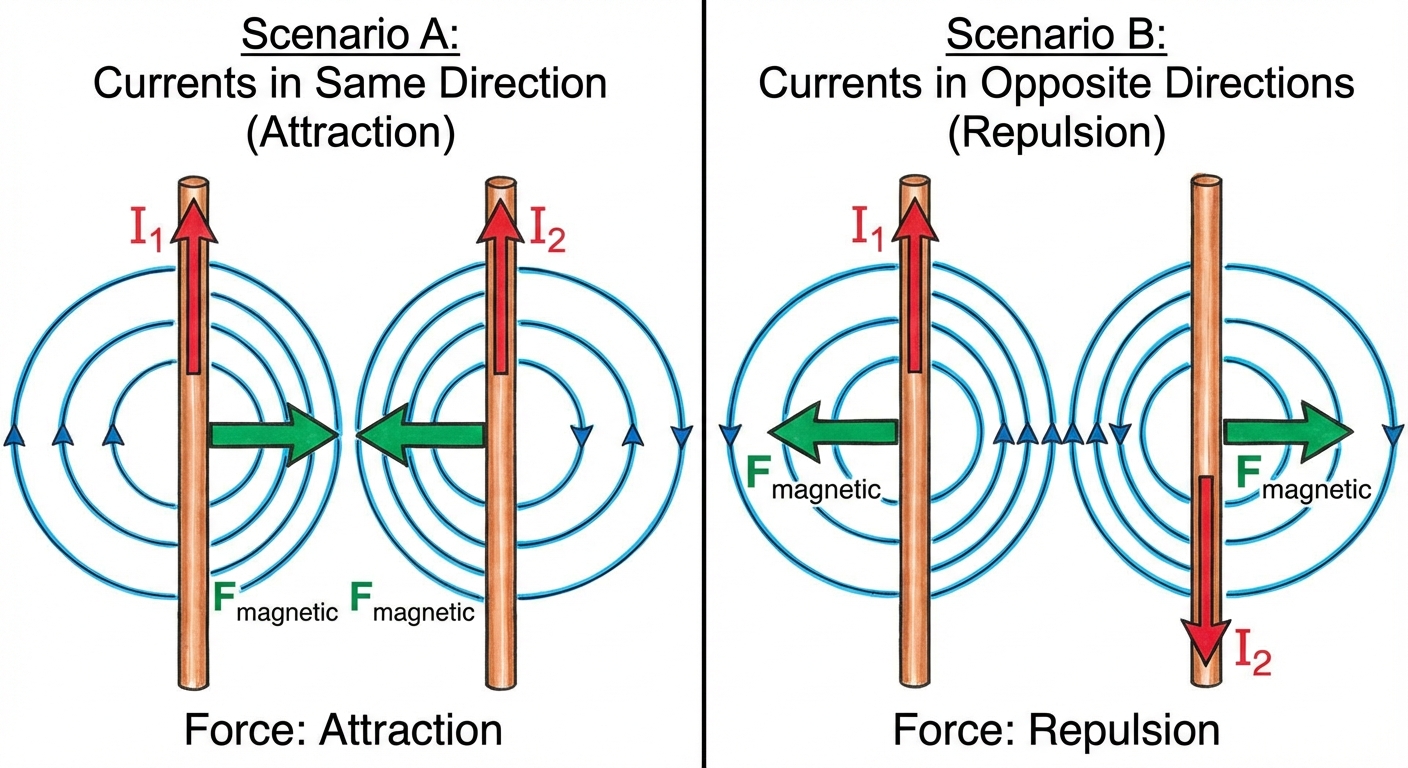
Two current-carrying wires exert magnetic forces on each other because each wire creates a magnetic field that affects the other.
- Currents in the SAME direction: The wires ATTRACT each other.
- Currents in OPPOSITE directions: The wires REPEL each other.
Memory Aid: "Likes attract" is FALSE for electrostatics, but "Like currents attract" is TRUE for magnetostatics.
notation for 3D Vectors
Since magnetic problems are inherently 3D, standard notation is used on exams to represent vectors entering or leaving the page:
| Symbol | Meaning | Mnemonic |
|---|---|---|
| $\times$ | Into the page | Viewing the tail feathers of an arrow flying away |
| $\bullet$ | Out of the page | Viewing the tip of an arrow flying toward you |
Common Mistakes & Pitfalls
Work Done by Magnetic Force
- Mistake: Thinking magnetic force increases the speed of a particle.
- Correction: $F_M$ is always perpendicular to displacement. Work = 0. Magnetic fields change direction, not speed.
Electric vs. Magnetic Field Direction
- Mistake: Assuming a moving charge follows the magnetic field lines like it follows electric field lines.
- Correction: Positive charges accelerate along E-field lines, but the force from a B-field is perpendicular to the B-field lines.
The Negative Charge Trap
- Mistake: Using the Right-Hand Rule for an electron and forgetting to flip the result.
- Correction: Always check the sign of the charge. If negative, flip the direction your thumb points (or use your Left Hand).
$\,\theta\,$ confusion
- Mistake: Assuming force is always $qvB$ or $ILB$.
- Correction: Always check the angle. If the charge moves parallel to the field, force is zero.
Newton's Third Law
- Mistake: Thinking the wire with more current exerts a stronger force on the wire with less current.
- Correction: Forces are an action-reaction pair. The force wire A exerts on B is equal in magnitude and opposite in direction to the force B exerts on A.