AP Psychology: Mechanisms of Learning and Behavior
Classical Conditioning: Associative Learning
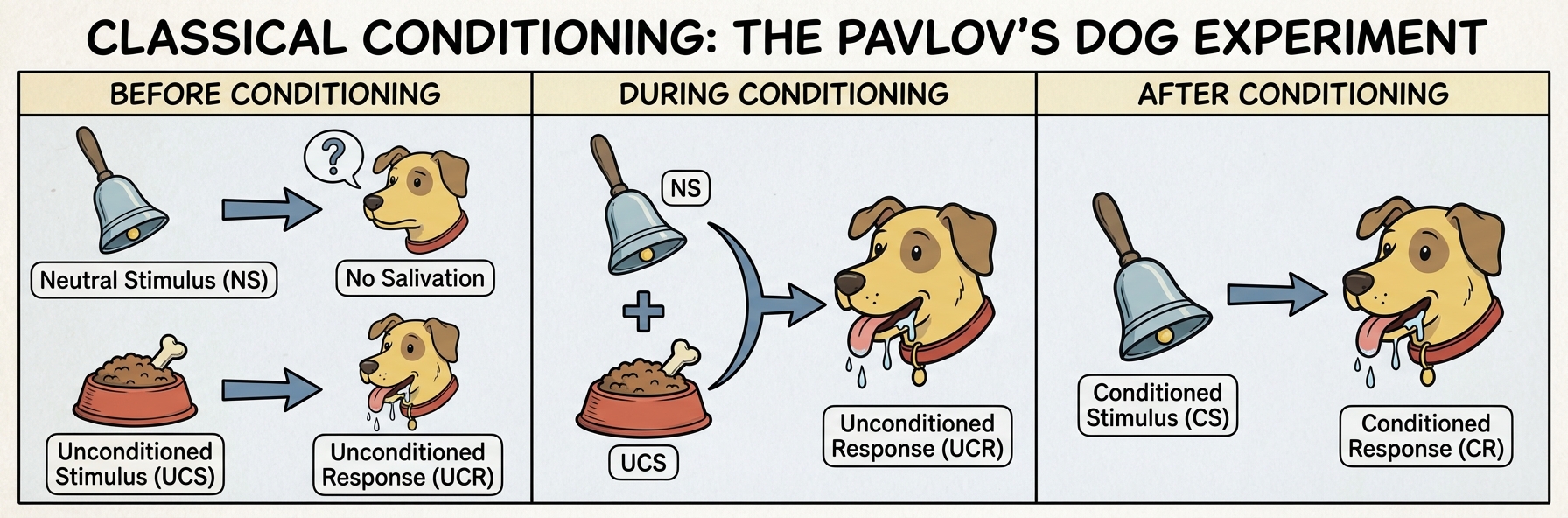
Classical conditioning is a type of associative learning where a subject learns to link two or more stimuli and anticipate events. It is a biological form of learning rooted in reflexes, pioneered by Ivan Pavlov.
The Components of Conditioning
To analyze a Classical Conditioning scenario on the AP exam, you must identify these five components:
- Neutral Stimulus (NS): A stimulus that elicits no response before conditioning (e.g., a bell).
- Unconditioned Stimulus (UCS/US): A stimulus that naturally and automatically triggers a response (e.g., food).
- Unconditioned Response (UCR/UR): The unlearned, naturally occurring response to the UCS (e.g., salivation).
- Conditioned Stimulus (CS): Originally the Neutral Stimulus that, after association with the UCS, comes to trigger a conditioned response.
- Conditioned Response (CR): The constructed response to the CS alone. Note: The CR and UCR are usually the same behavior (salivation), but the cause differs.
Key Processes
- Acquisition: The distinct phase when the NS and UCS are presented together. Timing is critical; the NS should precede the UCS by about half a second.
- Extinction: The diminishing of a CR. This happens if the CS (bell) is presented repeatedly without the UCS (food).
- Spontaneous Recovery: The reappearance of a weak CR after a pause (or rest period) following extinction.
- Generalization: The tendency to respond to stimuli similar to the CS (e.g., a dog drooling to a doorbell and a telephone ring).
- Discrimination: The learned ability to distinguish between a CS and other irrelevant stimuli.
The Little Albert Experiment
Conducted by John B. Watson, this controversial study applied classical conditioning to humans. A baby (Little Albert) was conditioned to fear a white rat (CS) by pairing it with a loud noise (UCS). Albert generalized this fear to other white, fluffy objects (fur coats, Santa beards).
Operant Conditioning: Consequences of Behavior
While classical conditioning forms associations between stimuli (automatic), Operant Conditioning involves associating actions with consequences (voluntary). This field is dominated by B.F. Skinner, though it builds on Edward Thorndike's Law of Effect (behaviors followed by favorable consequences become more likely).
Reinforcement vs. Punishment
Students often confuse "Negative" with "Bad." In psychology, treat these terms mathematically:
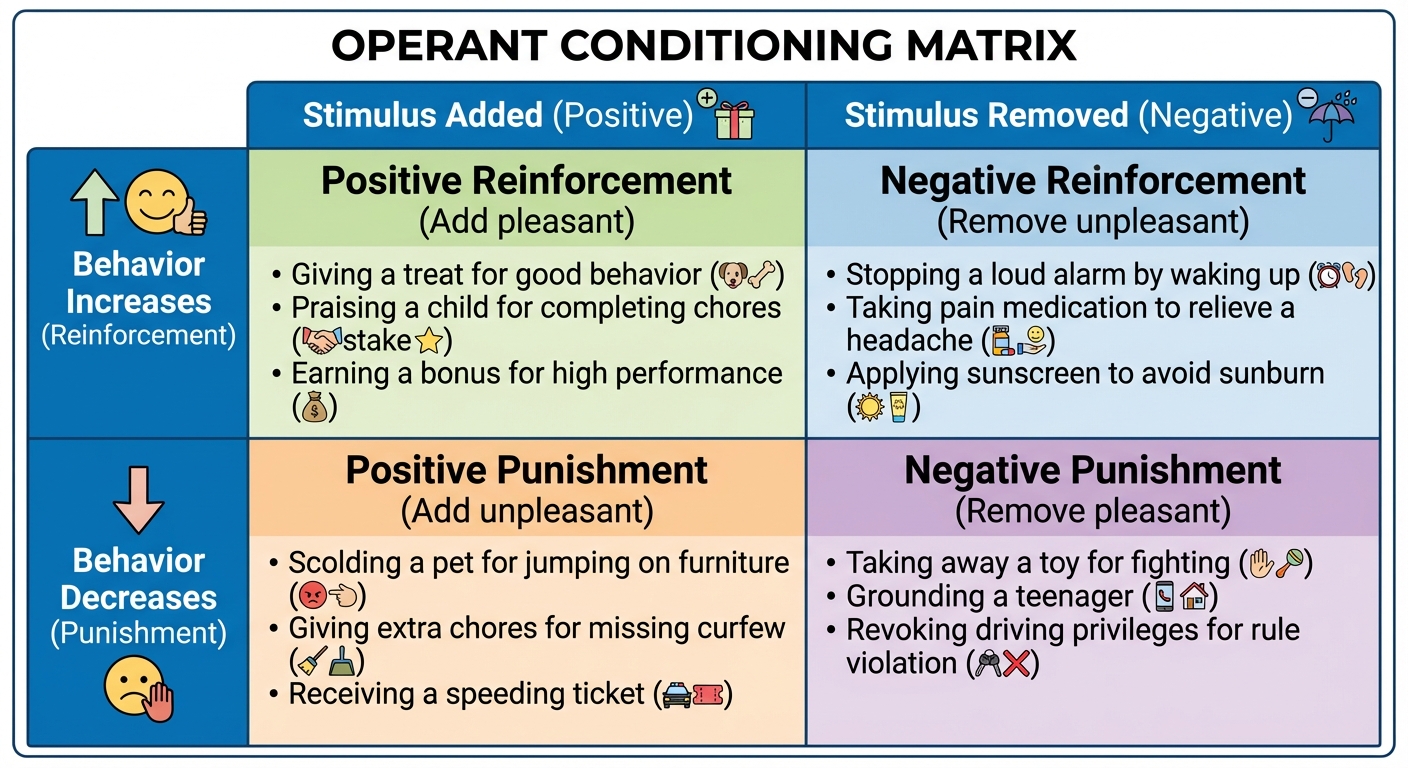
- Positive (+): Adding a stimulus.
- Negative (-): Removing a stimulus.
- Reinforcement: Increases behavior.
- Punishment: Decreases behavior.
| Type | Description | Example |
|---|---|---|
| Positive Reinforcement | Add pleasant stimulus to increase behavior. | Giving a dog a treat for sitting. |
| Negative Reinforcement | Remove unpleasant stimulus to increase behavior. | Taking Tylenol to remove a headache (increases drug-taking behavior). |
| Positive Punishment | Add unpleasant stimulus to decrease behavior. | Spanking a child; getting a speeding ticket. |
| Negative Punishment | Remove pleasant stimulus to decrease behavior. | Taking away a teenager's phone; "Time-out." |
Schedules of Reinforcement
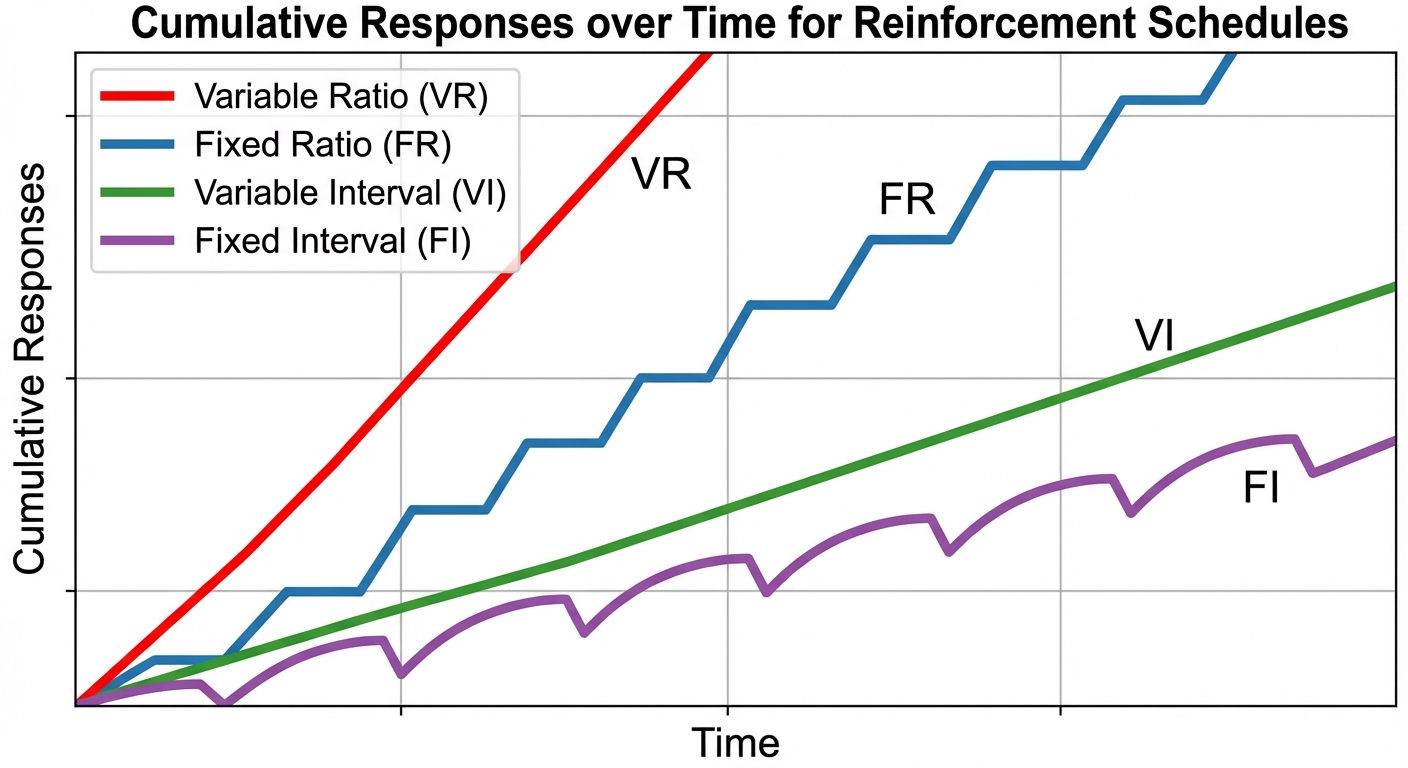
Skinner identified four schedules that dictate how often reinforcement occurs. These patterns affect how quickly a behavior is learned and how resistant it is to extinction.
- Fixed-Ratio (FR): Reinforcement after a set number of responses (e.g., "Buy 10 coffees, get 1 free"). High response rate, post-reinforcement pause.
- Variable-Ratio (VR): Reinforcement after an unpredictable number of responses (e.g., Slot machines, fishing). Highest response rate, most resistant to extinction.
- Fixed-Interval (FI): Reinforcement after a fixed time period (e.g., Checking mail right around delivery time). "Scalloped" response pattern.
- Variable-Interval (VI): Reinforcement after an unpredictable time period (e.g., Checking social media for likes). Steady, moderate response rate.
Observational and Cognitive Learning
Behaviorism (Pavlov/Skinner) originally ignored mental processes. Later researchers proved that cognition plays a major role.
Social Learning Theory
Albert Bandura demonstrated that we learn by watching others, known as Observational Learning or Modeling.
- Bobo Doll Experiment: Children watched adults beat up a doll. Those children mimicked the aggression and developed novel ways to attack the doll.
- Mirror Neurons: Frontal lobe neurons that fire when performing certain actions or when observing another doing so. They provide the neural basis for imitation and empathy.
Cognitive Learning Concepts
- Latent Learning (Tolman): Learning that occurs but is not apparent until there is an incentive to demonstrate it. Tolman's rats formed a cognitive map of a maze even without constant rewards.
- Insight Learning (Köhler): A sudden realization of a problem's solution (an "Aha!" moment). Köhler observed chimps stacking boxes to reach bananas without trial-and-error.
- Learned Helplessness (Seligman): When an animal/human is unable to avoid repeated aversive events, they eventually stop trying to avoid them, even when an escape becomes available. This is a model for depression.
Biological Constraints
John Garcia challenged the idea that all associations are learned equally. He discovered Taste Aversion (The Garcia Effect): rats (and humans) are biologically predisposed to associate nausea with taste rather than sights or sounds. This learning can occur after just one pairing and with a long delay between the CS and UCS.
Motivation and Emotion
Motivation directs and energizes behavior. It is often the "why" behind learning.
Intrinsic vs. Extrinsic Motivation
- Intrinsic Motivation: A desire to perform a behavior effectively for its own sake (e.g., reading a book because you enjoy the story).
- Extrinsic Motivation: A desire to perform a behavior to receive promised rewards or avoid threatened punishment (e.g., reading a book to pass a test).
- Overjustification Effect: The paradox where rewarding a person for a task they already enjoy (intrinsic) can inevitably decrease their interest in the task, as they start seeing it as "work" (extrinsic).
Theories of Motivation
- Drive-Reduction Theory: Physiological needs (water) create an aroused tension state (thirst) that drives organisms to reduce the need (drink). Goal: Homeostasis.
- Arousal Theory (Yerkes-Dodson Law): Performance increases with arousal only up to a point, beyond which performance decreases. Moderate arousal is best for average tasks.
- Maslow’s Hierarchy of Needs: We prioritize survival needs (hunger) before social needs (belonging) and self-actualization.
Theories of Emotion
While distinct from learning, AP exams often group these theories in the same unit block.
- James-Lange Theory: Arousal $\rightarrow$ Emotion ("I am sad because I am crying").
- Cannon-Bard Theory: Arousal + Emotion occur simultaneously and independently.
- Schachter-Singer Two-Factor Theory: Arousal + Cognitive Label $\rightarrow$ Emotion (You feel heart rate, label it as "fear," then feel fear).
Common Mistakes & Pitfalls
- Negative Reinforcement vs. Punishment: This is the #1 error. If the behavior increases, it is reinforcement. If the stimulus is removed, it is negative. Taking an aspirin is Negative Reinforcement (removes pain, increases pill-taking), NOT punishment.
- CS vs. UCS: Students mix these up. Ask: "What caused the response naturally?" That is the UCS.
- Interval vs. Ratio: If the reward depends on effort (number of times you do it), it's Ratio. If the reward depends on watching the clock (time passing), it's Interval.
- Resizing the CS: Remember, the Neutral Stimulus (NS) becomes the Conditioned Stimulus (CS). They are the same physical thing (e.g., the bell).