Power, Pragmatism, and Global Empire: Unit 7 Review
The Shift to Realpolitik and National Unification
By the second half of the 19th century, the idealistic/romantic revolutions of 1848 had largely failed. In their place emerged a new breed of conservative leaders who used the tools of nationalism and liberalism to strengthen the state. This approach is known as Realpolitik.
Defining Realpolitik
Realpolitik is a system of politics based on practical rather than moral or ideological considerations. It emphasizes:
- The pursuit of national interest above all else.
- The use of diplomacy and warfare as pragmatic tools.
- A manipulative approach to public opinion and ideology.
Italian Unification (Risorgimento)
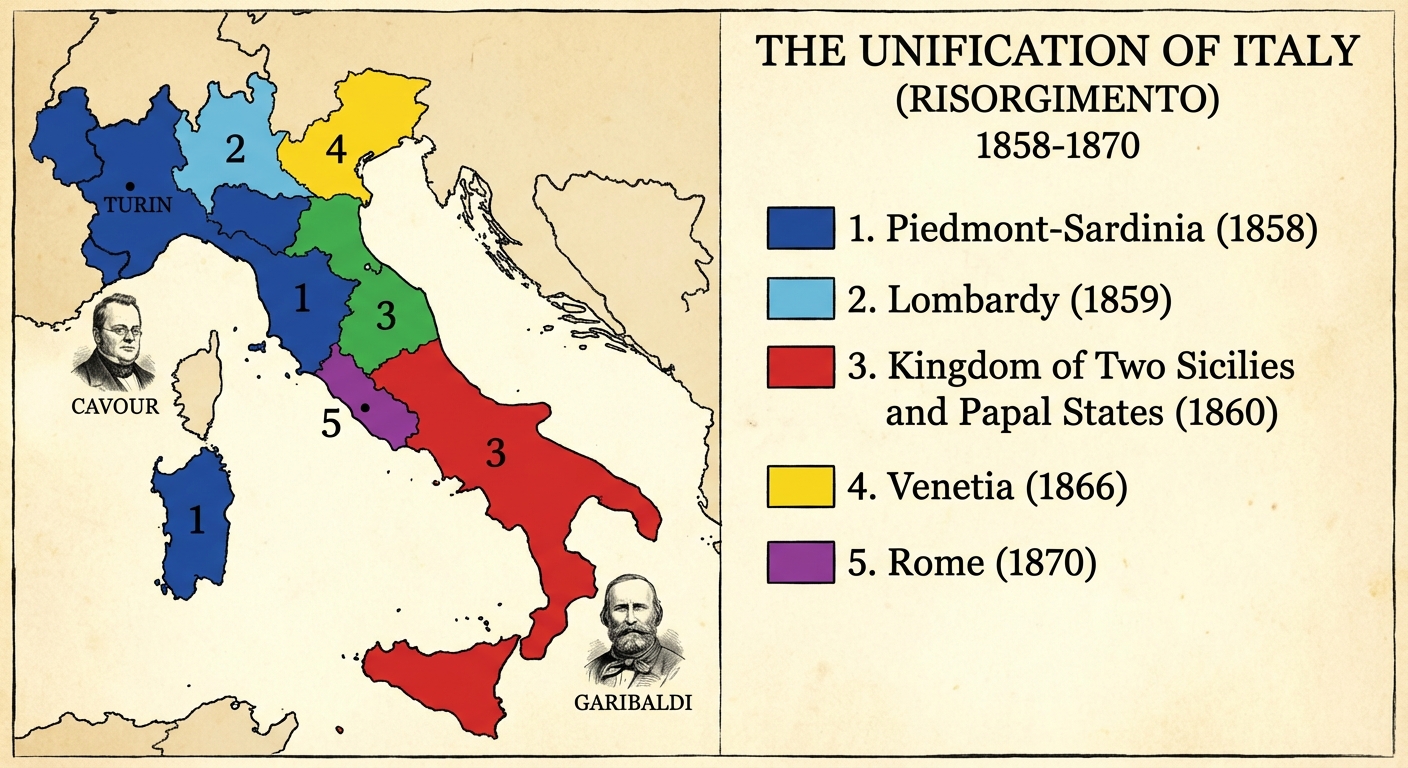
Italy was transformed from a "geographic expression" (as Metternich called it) into a unified constitutional monarchy.
The Three Key Figures:
- Count Camillo di Cavour (The Brain): Prime Minister of Piedmont-Sardinia. He was a practitioner of Realpolitik who sought to unify Northern Italy. He modernized Piedmont's economy and formed a secret alliance with Napoleon III of France to oust the Austrians.
- Giuseppe Garibaldi (The Sword): A romantic nationalist leader of the Red Shirts. He conquered the Kingdom of the Two Sicilies in the South. In a crucial moment of unity, he yielded his conquests to Piedmont rather than fighting a civil war.
- Giuseppe Mazzini (The Heart): The idealistic writer who fueled the desire for unification long before it was politically feasible.
Outcome: Victor Emmanuel II was declared King of Italy in 1861. However, the new state suffered from a severe economic divide between the industrial North and the agrarian South.
German Unification
The unification of Germany fundamentally altered the Balance of Power in Europe. It was driven by Prussia and its "Iron Chancellor," Otto von Bismarck.
Bismarck's Strategy: "Blood and Iron"
Bismarck believed that great questions of the day would be decided by military power, not speeches. He orchestrated three specific wars to isolate his enemies and rally German states behind Prussia:
- Danish War (1864): Prussia and Austria defeated Denmark. This set the stage for conflict with Austria over the spoils.
- Austro-Prussian War (1866): The "Seven Weeks' War." Prussia decisively defeated Austria but treated them leniently to ensure their neutrality later. This effectively expelled Austria from German affairs.
- Franco-Prussian War (1870-1871): Bismarck manipulated the Ems Dispatch (a telegram) to goad France into declaring war. The southern German states, fearing France, joined the Prussian-led North German Confederation.
The Result: The German Empire was proclaimed in the Hall of Mirrors at Versailles (a deliberate humiliation of France). This created a powerful, industrial, and military giant in the center of Europe.
New Imperialism: Motivations and Mechanisms
Between 1870 and 1914, European powers expanded their dominance over Africa and Asia. This was distinct from the "Old Imperialism" of the 16th/17th centuries.
Comparison: Old vs. New Imperialism
| Feature | Old Imperialism (1450-1750) | New Imperialism (1870-1914) |
|---|---|---|
| Primary Focus | Americas, Coastal Africa, Trading Posts in Asia | Interior Africa, Full control of Asia |
| Economic Goal | Gold, Spices, Slaves (Mercantilism) | Raw Materials (Rubber, Oil), Markets for manufactured goods |
| Political Goal | Prestige, religious conversion | Global strategic dominance, national rivalry |
| Management | Trading Companies (EIC) | Direct government control or Protectorates |
Motivations for New Imperialism
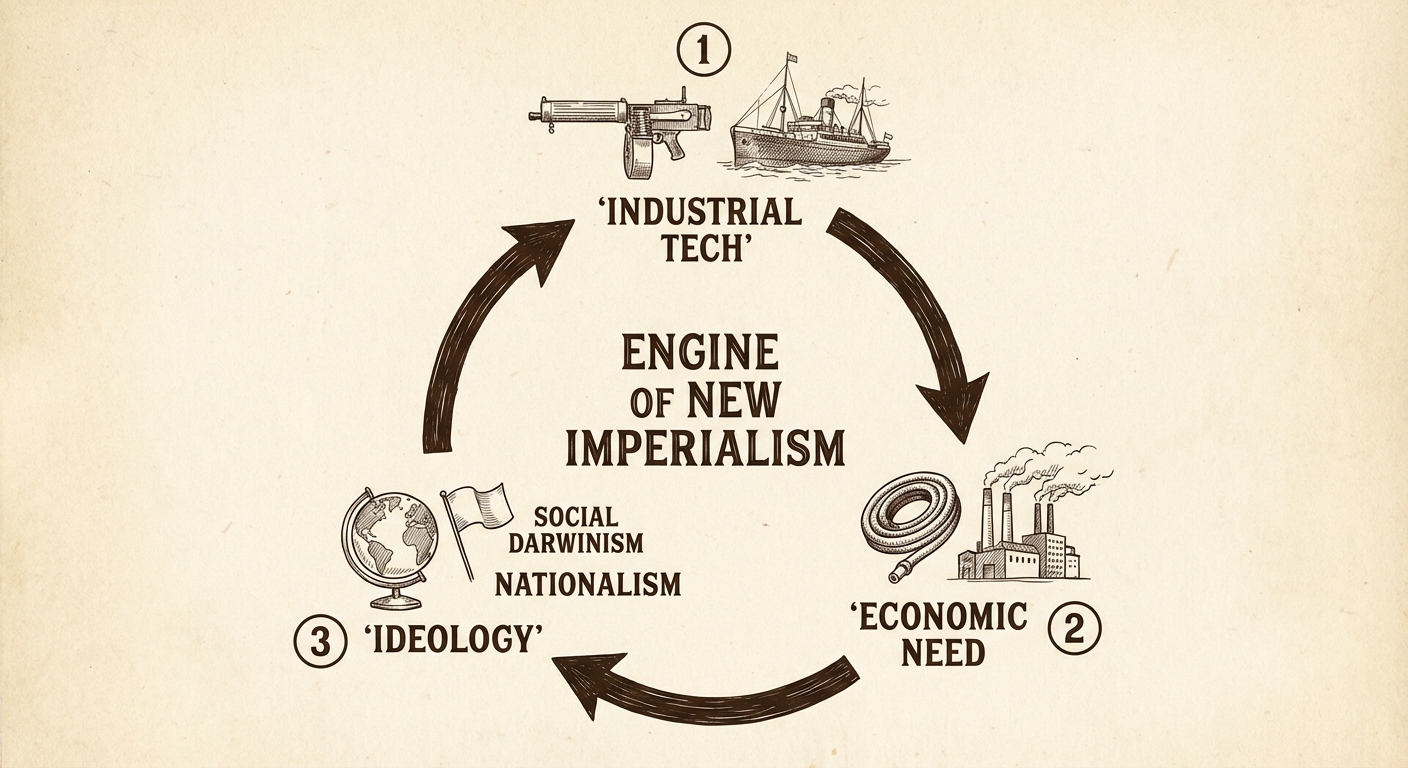
- Economic (Second Industrial Revolution): Empires needed raw materials like rubber, petroleum, and copper that were not native to Europe. They also needed captive markets to sell their surplus manufactured goods.
- Nationalism/Political Rivalry: Colonies became status symbols. Nations felt they had to acquire territory to keep up with rivals (e.g., "If Britain takes Egypt, France must take Morocco").
- Cultural and Ideological Justifications:
- Social Darwinism: The misapplication of Darwin's "survival of the fittest" to human societies. It claimed distinct "races" were in a struggle for survival, justifying the conquest of "weaker" peoples.
- The White Man's Burden: Based on Rudyard Kipling’s poem, this was the paternalistic belief that Europeans had a moral duty to "civilize" non-Europeans by bringing Christianity, commerce, and Western education.
The Technological Gap
Expansion was made possible by specific advancements:
- Machine Guns: The Maxim gun gave small European forces overwhelming firepower.
- Medicine: Quinine allowed Europeans to survive malaria, opening the African interior.
- Transportation/Communication: Steamships and telegraphs allowed for effective administration of distant colonies.
Imperial Expansion in Africa and Asia
The Scramble for Africa
Prior to 1880, Europeans controlled less than 10% of Africa. By 1914, they controlled over 90%.
- The Spark: Belgian King Leopold II established a private colony in the Congo. His brutal exploitation of rubber resources (cutting off hands of workers who missed quotas) alarmed other powers and set off a rush for territory.
- The Berlin Conference (1884-1885): Organized by Bismarck to prevent war between European powers. They established the rule of Effective Occupation: a nation could only claim territory if they effectively controlled it militarily and administratively. Note: No Africans were invited to this conference.
Imperialism in Asia
India:
- Following the Sepoy Mutiny (1857)—a rebellion sparked by cultural insensitivity regarding animal fats in rifle cartridges—Britain dissolved the East India Company and took direct control.
- Establishing the British Raj, India became the "Jewel in the Crown" of the British Empire, essential for its cotton, opium, and market size.
China:
- China was not directly colonized but carved into Spheres of Influence where European powers had exclusive trading rights.
- Boxer Rebellion (1900): An anti-foreign, anti-Christian uprising. A multi-national coalition (Europeans, US, Japan) crushed the rebellion, further weakening the Qing Dynasty.
Japan:
- Unlike China, Japan rapidly modernized during the Meiji Restoration. They adopted Western industrial and military techniques to avoid colonization, eventually becoming an imperial power themselves (defeating Russia in 1905).
Writing Aid: Analyzing Imperialism (HIPP)
When you see a document about Imperialism (like a Kipling poem or a political cartoon) on the exam, use HIPP to analyze it:
- H - Historical Context: Is this during the Scramble for Africa? Is it after the Berlin Conference?
- I - Intended Audience: Is the author convincing the British public to support a war? Is it an internal memo?
- P - Purpose: Is the document justifying violence (Social Darwinism)? Is it criticizing brutality (like Morel's critique of the Congo)?
- P - Point of View: Is the author a conqueror, a missionary, or a native resistor?
Example Sentence for an LEQ:
"While economic factors like the demand for rubber drove the 'Scramble for Africa,' these actions were publicly justified through the ideology of Social Darwinism, which framed exploitation as a civilizing mission."
Common Mistakes & Pitfalls
- Confusing Nationalist Movements: Students often mix up the revolutions of 1848 (which largely failed due to idealism/disorganization) with the unifications of 1871 (which succeeded due to Realpolitik/military might).
- Misunderstanding Bismarck: Bismarck was a conservative monarchist, not a German nationalist in the modern sense. He used nationalism as a tool to strengthen Prussia, not because he believed in the "spirit of the people."
- Old vs. New Imperialism: Do not use "God, Gold, and Glory" for late 19th-century Imperialism. That applies to Columbus and Cortez. For the 19th century, think "Markets, Materials, and Racial Ideology."
- The Berlin Conference: A common error is thinking the Berlin Conference divided Africa. It set the rules for the division; the actual conquest happened on the ground over the following years.