AP Psychology: Cognitive Processes and Perception
Unit 2: Cognition
Cognition refers to the mental activities associated with thinking, knowing, remembering, and communicating. This unit encompasses how we process information (perception), how we store it (memory), how we use it to solve problems (thinking), and how language shapes our understanding.
2.1 Perception
Perception is the process of organizing and interpreting sensory information, enabling us to recognize meaningful objects and events. While sensation is the bottom-up detection of stimuli, perception is the top-down interpretation of that stimuli.
2.1.A Processing Mechanisms
- Bottom-Up Processing: Analysis that begins with the sensory receptors and works up to the brain's integration of sensory information.
- Example: You look at a random shape, detect lines and angles, and eventually realize it is a letter "A."
- Top-Down Processing: Information processing guided by higher-level mental processes, as when we construct perceptions drawing on our experience and expectations.
- Example: Because you expect to see a letter, you instantly recognize the shape as an "A" even if it is handwritten messily.
2.1.B Influencing Factors (Perceptual Set)
A Perceptual Set is a mental predisposition to perceive one thing and not another. It is a prime example of top-down processing.
Internal Factors
- Motivation: High motivation to perceive a specific stimulus can lower the threshold for perceiving it. (e.g., A hungry person is more likely to interpret ambiguous shapes as food).
- Emotion: Distinct emotions shape how we view reality. (e.g., Listening to sad music can make a hill look steeper or a task seem harder).
- Expectation/Context: We perceive based on what we expect. (e.g., "The cat is in the hat" vs. "The cat is in the hat" - context determines word recognition).
External Factors & Culture
- Culture: Cultural background influences perception of architecture, depth cues, and social signals.
- Muller-Lyer Illusion: People from "carpentered cultures" (mostly right angles and buildings) fall for this optical illusion more than people from cultures living in round huts.
2.1.C Gestalt Principles of Organization
Gestalt psychologists emphasize that the whole is greater than the sum of its parts. We tend to organize visual clusters into groups.
- Proximity: We group nearby figures together.
- Similarity: We group figures that are similar.
- Continuity: We perceive smooth, continuous patterns rather than discontinuous ones.
- Closure: We fill in gaps to create a complete, whole object.
2.2 Memory Models and Systems
Memory is the persistence of learning over time through the encoding, storage, and retrieval of information.
2.2.A Information Processing Model (Atkinson-Shiffrin)
This model likens the human memory system to computer processing. It involves three distinct stages:
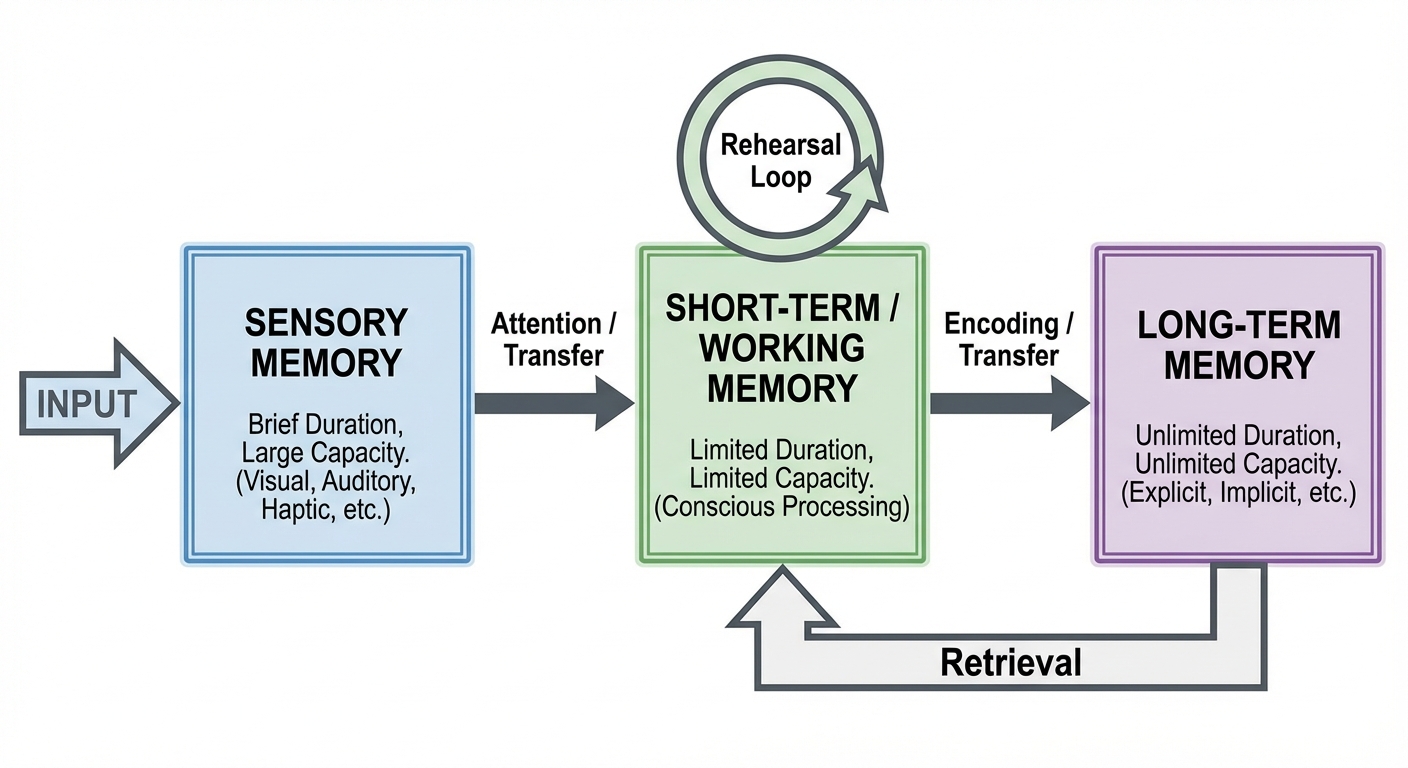
- Sensory Memory: The immediate, very brief recording of sensory information.
- Iconic Memory: A momentary sensory memory of visual stimuli (lasts $\approx 0.5$ seconds).
- Echoic Memory: A momentary sensory memory of auditory stimuli (lasts 3–4 seconds).
- Short-Term Memory (STM): Activated memory that holds a few items briefly before the information is stored or forgotten.
- Capacity: famously described by George Miller as items.
- Long-Term Memory (LTM): The relatively permanent and limitless storehouse of the memory system.
2.2.B Working Memory (Baddeley's Model)
Modern psychology updates the STM concept to Working Memory, a newer understanding of short-term memory that focuses on conscious, active processing of incoming auditory and visual-spatial information.
- Central Executive: The "boss" of working memory; directs attention and processes information.
- Phonological Loop: Handles auditory information (repeating a phone number in your head).
- Visuospatial Sketchpad: Handles visual and spatial information (picturing how to rearrange furniture).
2.3 Encoding: Getting Information In
Encoding is the processing of information into the memory system.
2.3.A Types of Processing
- Automatic Processing: Unconscious encoding of incidental information (space, time, frequency) and well-learned information (word meanings).
- Effortful Processing: Encoding that requires attention and conscious effort. This produces durable and accessible memories.
2.3.B Encoding Strategies & Mnemonics
To improve encoding (and beat the limit of 7 items), we use specific strategies:
- Chunking: Organizing items into familiar, manageable units (e.g., grouping
1-9-8-4as the year "1984"). - Mnemonics: Memory aids, especially those using vivid imagery and organizational devices.
- Peg-Word System: Associating numbers with items (1 is a bun, 2 is a shoe…).
- Hierarchies: Dividing broad concepts into narrower concepts and facts.
- Spacing Effect: Distributed study yields better long-term retention than massed study (cramming).
- Testing Effect: Enhanced memory after retrieving, rather than simply rereading, information.
2.3.C Levels of Processing
- Shallow Processing: Encoding on a basic level based on the structure or appearance of words (e.g., is the word capitalized?).
- Deep Processing: Encoding semantically, based on the meaning of the words. This yields the best retention.
2.4 Biological Bases of Memory
Memory is not stored in a single spot in the brain; it is distributed across neural networks.
2.4.A Synaptic Changes
- Long-Term Potentiation (LTP): An increase in a synapse's firing potential after brief, rapid stimulation. This is believed to be a neural basis for learning and memory.
2.4.B Brain Structures
| Brain Structure | Function in Memory |
|---|---|
| Hippocampus | Explicit (declarative) memories (names, images, events). Acts as a "loading dock" before moving memories to the cortex. |
| Frontal Lobes | Processing and organizing explicit memories. |
| Cerebellum | Implicit (non-declarative) memories created by classical conditioning (reflexes). |
| Basal Ganglia | Procedural memories for skills (e.g., riding a bike). |
| Amygdala | Emotion-related memory formation (Flashbulb Memories). |
Flashbulb Memory: A clear memory of an emotionally significant moment or event (e.g., 9/11 or a graduation). Hormones released during stress signal the brain to "pay attention."
2.5 Retrieval and Forgetting
2.5.A Retrieval: Getting Information Out
- Recall: Retrieving information not currently in conscious awareness (e.g., Fill-in-the-blank test).
- Recognition: Identifying items previously learned (e.g., Multiple-choice test).
- Priming: The activation, often unconsciously, of particular associations in memory.
Context and State Dependence
- Context-Dependent Memory: Recall is better when you are in the same environment where you learned the material (e.g., taking a test in the same seat where you studied).
- State-Dependent Memory: Recall is better when you are in the same physiological state (e.g., caffeinated vs. tired) as when encoding happened.
- Serial Position Effect: Our tendency to recall best the last (Recency Effect) and first items (Primacy Effect) in a list.
2.5.B Forgetting
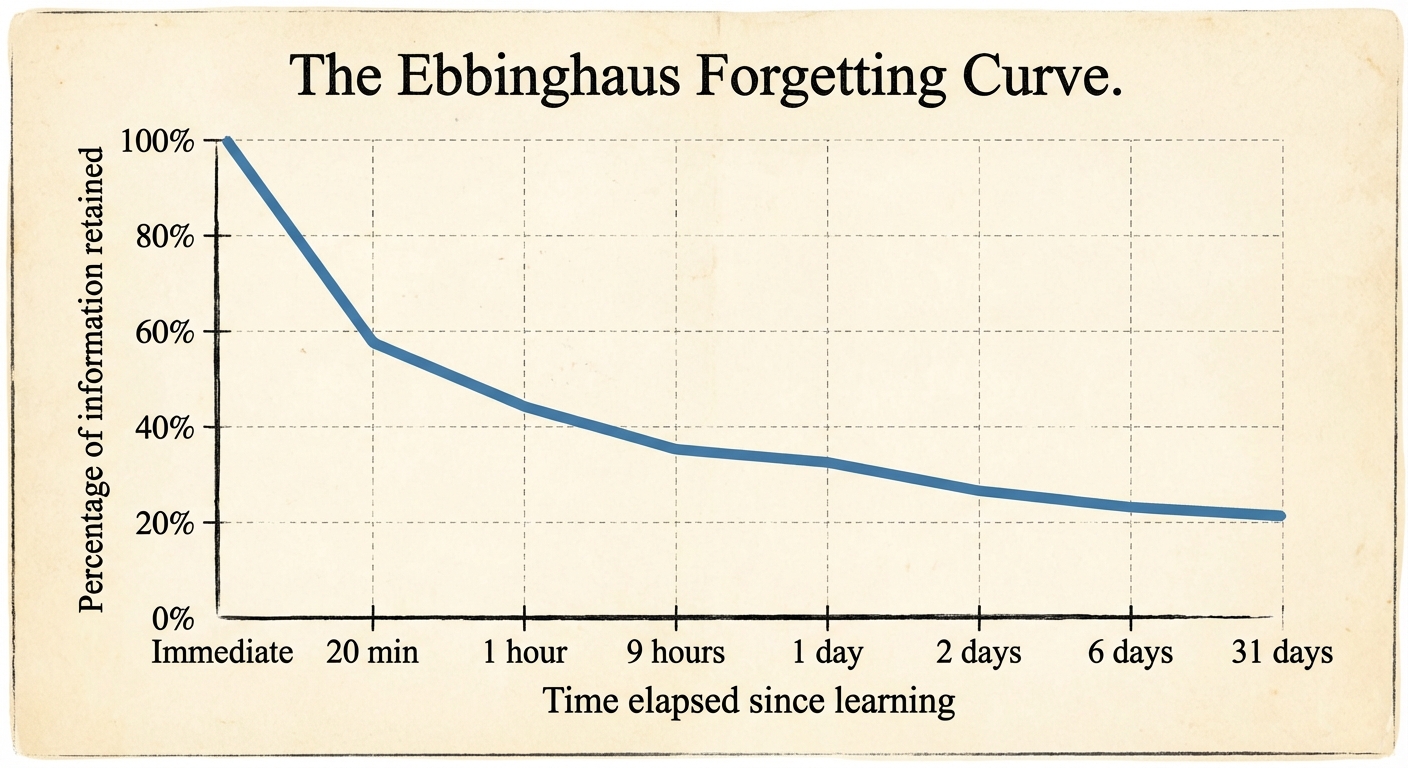
Forgetting is not just a failure; it is an adaptive process. The Ebbinghaus Forgetting Curve shows that the course of forgetting is initially rapid, then levels off with time.
Types of Interference
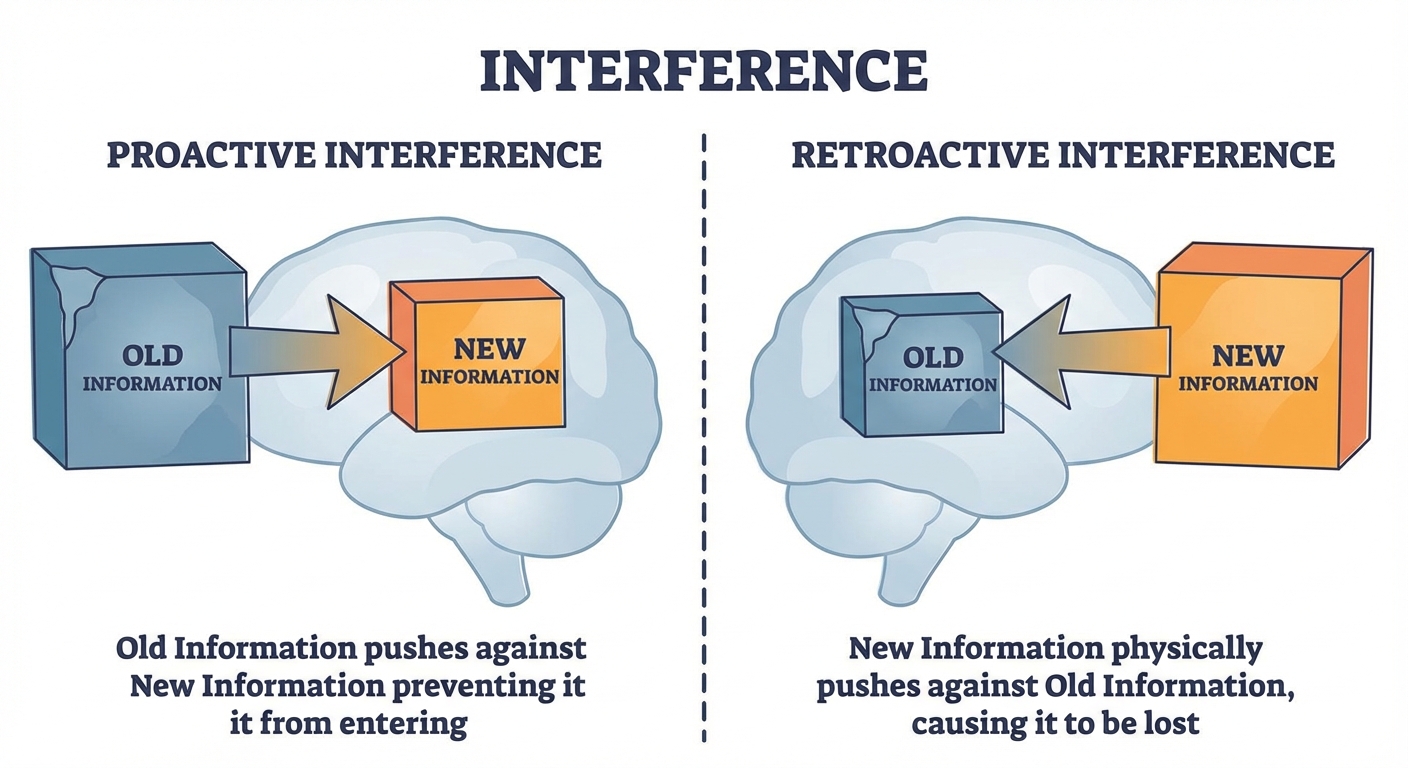
Interference occurs when learning limits the retrieval of other information. Use the mnemonic P.O.R.N.:
- Proactive Old: Proactive Interference occurs when Old memory blocks new information.
- Example: You keep writing the previous year's date on checks in January.
- Retroactive New: Retroactive Interference occurs when New memory blocks old information.
- Example: You learn a new password and can no longer remember the old one.
Amnesia Types
- Anterograde Amnesia: An inability to form new memories (damage often to the hippocampus).
- Retrograde Amnesia: An inability to retrieve information from one’s past.
2.6 Thinking and Problem Solving
Cognition involves the mental activities associated with thinking, knowing, remembering, and communicating.
2.6.A Elements of Thought
- Concepts: Mental groupings of similar objects, events, ideas, or people.
- Prototypes: A mental image or best example of a category. (e.g., A robin is a "prototypical" bird; a penguin is not).
2.6.B Problem Solving Strategies
- Algorithm: A methodical, logical rule or procedure that guarantees solving a particular problem. (Accurate but Slow).
- Heuristic: A simple thinking strategy (mental shortcut) that allows us to make judgments and solve problems efficiently. (Fast but Error-prone).
- Insight: A sudden realization of a problem's solution (the "Aha!" moment).
2.6.C Creativity
- Convergent Thinking: Narrowing the available problem solutions to determine the single best solution (standardized tests).
- Divergent Thinking: Expanding the number of possible problem solutions (creative brainstorming).
2.7 Cognitive Biases and Errors
Humans are not strictly rational; we are prone to predictable errors.
2.7.A Common Biases
| Bias | Definition | Example |
|---|---|---|
| Confirmation Bias | Tendency to search for information that supports our preconceptions and ignore contradictory evidence. | Watching only news channels that agree with your political views. |
| Fixation / Mental Set | A tendency to approach a problem in one particular way, often a way that has worked in the past. | Trying to restart a frozen phone the same way you restarted an old computer, even if it doesn't work. |
| Functional Fixedness | The tendency to think of things only in terms of their usual functions. | Failing to see that a coin can be used as a screwdriver. |
| Overconfidence | The tendency to be more confident than correct. | Student estimating they can finish a paper in 1 hour when it takes 4. |
| Framing Effect | The way an issue is posed triggers different decisions. | "90% survival rate" sounds better than "10% death rate," though they are identical. |
2.7.B The Heuristic Traps
- Availability Heuristic: Estimating the likelihood of events based on their availability in memory. If instances come readily to mind (because of vividness), we presume such events are common.
- Example: Fearing plane crashes more than car crashes because plane crashes are on the news (even though cars are statistically more dangerous).
- Representativeness Heuristic: Judging the likelihood of things in terms of how well they seem to represent, or match, particular prototypes.
- Example: Assuming a quiet, spectacled man is a librarian rather than a farmer, ignoring the statistical fact that there are many more farmers than librarians.
Mnemonic for Heuristics:
- Availability = Amount of info / Accessibility (What's on the news?)
- Representativeness = Stereotype (Does it look like what I expect?)
2.8 Language (Brief Overview)
Language consists of spoken, written, or signed words and the ways we combine them to communicate meaning.
Structure
- Phoneme: The smallest distinctive sound unit (e.g., "ch", "a", "t").
- Morpheme: The smallest unit that carries meaning (e.g., "pre-", "ed", "bat").
- Grammar: A system of rules (semantics + syntax) that enables us to communicate.
Language Development Theories
- B.F. Skinner (Behaviorist): We learn language through association, imitation, and reinforcement (Operant Conditioning).
- Noam Chomsky (Nativist): Humans have an inborn Language Acquisition Device (LAD). We are pre-wired to learn grammar rules.
Linguistic Determinism (Whorf’s Hypothesis)
Benjamin Whorf's hypothesis acts as the extreme view of language's power: Language determines the way we think.
- Example: If a language has no past-tense verbs, its speakers might struggle to think about the past.
- Current view: Language influences thought, but does not strictly determine it.
Common Mistakes & Pitfalls
- Negative Reinforcement vs. Punishment: (From previous unit, but often appears in Cognition questions regarding learning language). Remember: Reinforcement increases behavior; Punishment decreases it.
- Proactive vs. Retroactive Interference: Students often swap these. Use the PORN acronym: Proactive absorbs Old (blocks new); Retroactive absorbs New (blocks old).
- Availability vs. Representativeness:
- If the question is about how easily you can remember examples, it is Availability.
- If the question is about comparing someone to a stereotype/prototype, it is Representativeness.
- Sensation vs. Perception: Sensation is the hardware (eyes seeing light); Perception is the software (brain seeing a face).
- Implicit vs. Explicit Memory:
- Implicit = Impossible to explain (how to ride a bike).
- Explicit = Explainable (what you had for dinner).