History
0.0(0)
Studied by 3 people Call Kai
 Learn
Learn Practice Test
 Spaced Repetition
 Match
Match Flashcards
 Knowt Play
Card Sorting
1/71

Earn XP
Description and Tags
Last updated 9:47 AM on 10/24/22
Name | Mastery | Learn | Test | Matching | Spaced | Call with Kai | Chat |
|---|
No analytics yet
Send a link to your students to track their progress
72 Terms
1
New cards
civilizations
The U.S. often looks to the Greek and Roman _________ as early democracies. = a society that is well organized and developed
2
New cards
agricultural
The southern U.S. states were largely ________ in the 1700s and 1800s. = relating to farming or farmers
3
New cards
ruins
We visited some ancient Native American _________ in New Mexico. = the parts of buildings that are left after the rest has been destroyed
4
New cards
evidence
Historians look at many primary sources such as maps, letters, and legal documents as __________ of what really happened. = facts or materials that show clearly that something existed or was true
5
New cards
monarchy
The British _______ was very powerful in the 18th and 19th centuries. = the system in which a country is ruled by a king or queen
6
New cards
ruled
King George _________ England during the time of the Revolutionary War. = to be in power and control a country or area
7
New cards
peasant
There were many _______ in the village. = a poor farmer who owns or rents a small amount of land, either in past times or in poor countries
8
New cards
nobility
The _______ owned most of the land. = people in a high social class who have titles such as 'duke' or 'dutchess'
9
New cards
feudal
There were many ______ societies in Europe in the 1400s and 1500s. = a system where poor peasants worked for and were controlled by a lord when
10
New cards
industrialization
There was a lot of ________ in the late 1800s in the U.S. = changing society so that people things with large factories and machines
11
New cards
invaded
Germany ________ France and Poland during WWII. = when a military force enters a country, town, or area in order to take control of it
12
New cards
border
To cross the ________, you need a passport. = the official line that separates two countries, states, or areas, or the area close to this line
13
New cards
military
German _______ power was strictly controlled after WWII. = relating to the army, navy, or air force
14
New cards
navy
The British _______ was very powerful in the 1700s and 1800s. = the part of a country's military forces that fights at sea
15
New cards
army
The Union ______ stayed in the South for 10 years after the Civil War. = a large organized group of people trained to fight on land in a war
16
New cards
dictator
Hitler was a brutal _________. = a ruler who has complete power over a country, especially one whose power has been gained by force
17
New cards
spread
The news about the Boston Massacre ________ all over the colonies. = when something like information moves all over an area and affects many people
18
New cards
immigrated
Many people __________ to the U.S. in the late 1800s and early 1900s. = come to a new country to live
19
New cards
revolution
The American __________ started in 1776. = a time when people change a ruler or political system by using force or violence
20
New cards
rebels
The ________ fought for their freedom from Britain. = people who fight against the government because they want to change it.
21
New cards
attack
The _______ on Pearl Harbor during WWII happened on Dec. 7th, 1941. = the act of using weapons against an enemy in a war
22
New cards
conflict
There was a _______ between the northern and southern states over slavery. = when two or more people, groups, countries etc disagree about something; can also be a kind of fight
23
New cards
treaties
The U.S. government signed many ________ with Native American tribes but then later broke them. = a formal written agreement between two or more countries or groups of people
24
New cards
invention
The ______ of the cotton gin in 1793 made it easier to process cotton and increased the demand for slaves = something new that is made, designed, or created.
25
New cards
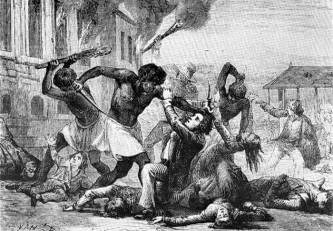
revolts
There were many slave _______ in the U.S. = when people fight against the government or system; rebellions
26
New cards
refugees
There were many ________ escaping Nazi Germany in the 1930's. = people who are forced to leave their country, especially during a war, or for political or religious reasons
27
New cards
battle
There was a big _________ between the North and South at Gettysburg during the Civil War. = a fight between two armies, ships, etc, especially one that is part of a larger war
28
New cards
empire
The British ________ was very powerful in the 1700s. = a group of countries that are all controlled by one ruler or government
29
New cards
century
The computer revolution started in the 20th ________. = one of the 100-year periods measured from before or after the year of Christ's birth
30
New cards
millenium
People have been living in that area for over a ___________. = a period of 1,000 years
31
New cards
decade
The 1960s were a very turbulent ________. = a period of 10 years (Note: turbulent = a situation or period of time is one in which there are a lot of sudden changes)
32
New cards
alliance
France and the U.S. formed an __________ during the Revolutionary War against England. = when two or more countries, groups etc agree to work together to try to change or achieve something
33
New cards
defend
Native Americans tried to _________ themselves, but the Europeans had superior weapons and also brought new diseases. = to do something to protect someone or something from being attacked
34
New cards
timeline
The teacher drew a ________ on the board. = a line showing the order in which events happened
35
New cards
defeated
The British army was _______ at Yorktown in the Revolutionary War in 1781. = to lose a battle or fight
36
New cards
destroyed
The San Francisco earthquake in 1906 _______ much of the city. = to damage something so badly that it no longer exists or cannot be used
37
New cards
conquered
The Spanish ________ the Aztecs and Mayans in the 1500s. = the act of getting control of a country by fighting and killing people

38
New cards
trade
There was a lot of _______ between Europe, Africa, and the U.S. in the 1700s and 1800s = the activity of buying, selling, or exchanging goods within a country or between countries
39
New cards
merchants
There were many ________ in big cities like New York. = an old word that means people who buy and sell goods in large quantities
40
New cards
protests
There were many ________ against the Vietnam War in the 1960s. = when people have large public meetings to show that they think something is wrong or unfair.

41
New cards
overthrow
They were trying to ________ the government. = to remove a leader or government from power, especially by force
42
New cards
depression
There was a big economic ________ in the 1930's. = a long period during which there is very little business activity and a lot of people do not have jobs
43
New cards
expanded
The U.S. ________ toward the west in the 1800s. = to become larger in size, number, or amount
44
New cards
assassinated
President Lincoln was _________ in 1865 by John Wilkes Booth. = when an important person is murdered.
45
New cards
routes
There were many trade __________ between Europe and the New World. = a way from one place to another
46
New cards
fascist
The Nazi government in WWII was ________. = a right-wing political system in which people's lives are completely controlled by the state and no political opposition is allowed
47
New cards
democracy
The U.S. is a _________. = a system of government in which every citizen in the country can vote to elect its government officials
48
New cards
regime
The Khmer Rouge was a brutal ________ in Cambodia that killed millions of people in the 1970s. = a government, especially one that was not elected fairly and treats its citizens in a bad way.
49
New cards
declared
The U.S. __________ independence from England in 1776. = to officially and publicly say something exists or is true
50
New cards
slaves
Millions of African people were brought to the New World as ________ between 1525 and 1866. = people who are owned by others, have no rights, and are forced to work for no money
51
New cards
indentured
Many early Americans came over as ________ workers. = someone who must work for an employer for a long period of time, under a contract, usually for very low wages
52
New cards
fled
Many Jewish people ________ Europe when the Nazis took power. = to leave somewhere very quickly, in order to escape from danger
53
New cards
Holocaust
Many of his relatives died in the ________. = the killing of millions of Jews and other people by the Nazis during the Second World War
54
New cards
territory
Puerto Rico is not a state. It is a U.S. _______. = land that is owned or controlled by a country but is not officially part of the that country.
55
New cards
abolished
Slavery in the U.S. was _________ in 1865 by the 13th amendment. = to officially end a law or system.
56
New cards
period
The _______ between 1920 and 1933 is known as Prohibition and alcohol was illegal. = a length of time
57
New cards
explorer
Columbus was an _________ who was looking for a route to Asia. = someone who travels through an unknown area to find out about it

58
New cards
settlers
The first ________ in North America landed in Jamestown, Virginia in 1607. = someone who goes to live in a country or area where not many people like them have lived before; similar to immigrant

59
New cards
colonies
Before the U.S. became independent in 1776, it was 13 British _________. = a country or area that is under the political control of a more powerful country, usually one that is far away
60
New cards
migrated
The first Americans _________ from Asia about 30,000 years ago. = when large numbers of people go to live in another area
61
New cards
factors
There were several _______ that led to the increase in immigration in the 1800s in the U.S. = things that influence or cause a situation
62
New cards
famine
There was a big potato _________ in Ireland in the mid-1800s. = when many people have little or no food for a long time and many people die
63
New cards
struggled
Recent immigrants _________ to get enough money to survive. = to try extremely hard to achieve something, even though it is very difficult
64
New cards
right
Women got the ________ to vote in the U.S. in 1920. = something that you are morally, legally, or officially allowed to do or have
65
New cards
segregation
_____________ was legal in the U.S. until the 1960s. = when people of different races, sexes, or religions are kept apart so that they live, work, or study separately
66
New cards
secede
The South tried to _______ from the U.S. in the 1860s. = when part of a country tries to officially stops being part of it and becomes independent
67
New cards
Puritans
The ________ came to the New World in the 1600s to find religious freedom. = a type of Protestant Christian that wanted to simplify the English churches.
68
New cards
reservations
The American government created _________ for Native Americans. = land that was put aside for Native American to live; usually the land was quite poor
69
New cards
labor unions
___________ formed in the late 1800s to fight for workers' rights and better pay. (2 words) = an organization that represents workers especially in meetings with employers
70
New cards
socialist
Some European countries have ________ governments. = an economic and political system in which large industries are owned by the government, and taxes are used to take some wealth away from richer citizens and give it to poorer citizens
71
New cards
communist
The Soviet Union was a ________ country, but collapsed in 1991. = a political system in which the government controls the production of all food and goods, and there is no privately owned property
72
New cards
capitalist
The U.S. is a _________ country. = an economic and political system in which businesses belong mostly to private owners, not to the government