Mechanics of Magnetic Interactions Review
Magnetic Force on Moving Charges
Unlike gravitational and electric forces, which act effectively on stationary objects, the magnetic force is unique: particles must be in motion to feel it. The Magnetic Force (often represented as $\vec{F}B$ or $\vec{F}M$) is the force exerted on a charged particle moving through a magnetic field.
The Lorentz Force Law
Mathematically, the magnetic force on a single point charge is defined by the cross product of the velocity vector and the magnetic field vector. This relationship is a fundamental component of the Lorentz Force Law.
Where:
- $q$ is the magnitude of the charge (Coulombs, C)
- $\vec{v}$ is the velocity vector of the particle (m/s)
- $\vec{B}$ is the magnetic field vector (Tesla, T)
Because this is a cross product, the magnitude of the force can be calculated using the scalar formula:
Where $\theta$ is the angle between the velocity vector $\vec{v}$ and the magnetic field vector $\vec{B}$.
Key Properties of Magnetic Force
- Perpendicularity: The magnetic force is always perpendicular to both the velocity vector $\vec{v}$ and the magnetic field $\vec{B}$.
- Zero Force Conditions: No magnetic force is exerted if:
- The particle is stationary ($v = 0$).
- The particle moves parallel or anti-parallel to the field ($\theta = 0^\circ$ or $180^\circ$, so $\sin(\theta) = 0$).
- No Work Done: Because the magnetic force is always perpendicular to the displacement ($d\vec{s} = \vec{v}dt$), the work done by a steady magnetic field on a charged particle is always zero.
Consequence: Magnetic fields can change the direction of a particle, but they cannot change its speed (kinetic energy).
The Right-Hand Rule (RHR)
To determine the direction of the force on a positive charge, use the Right-Hand Rule for cross products.
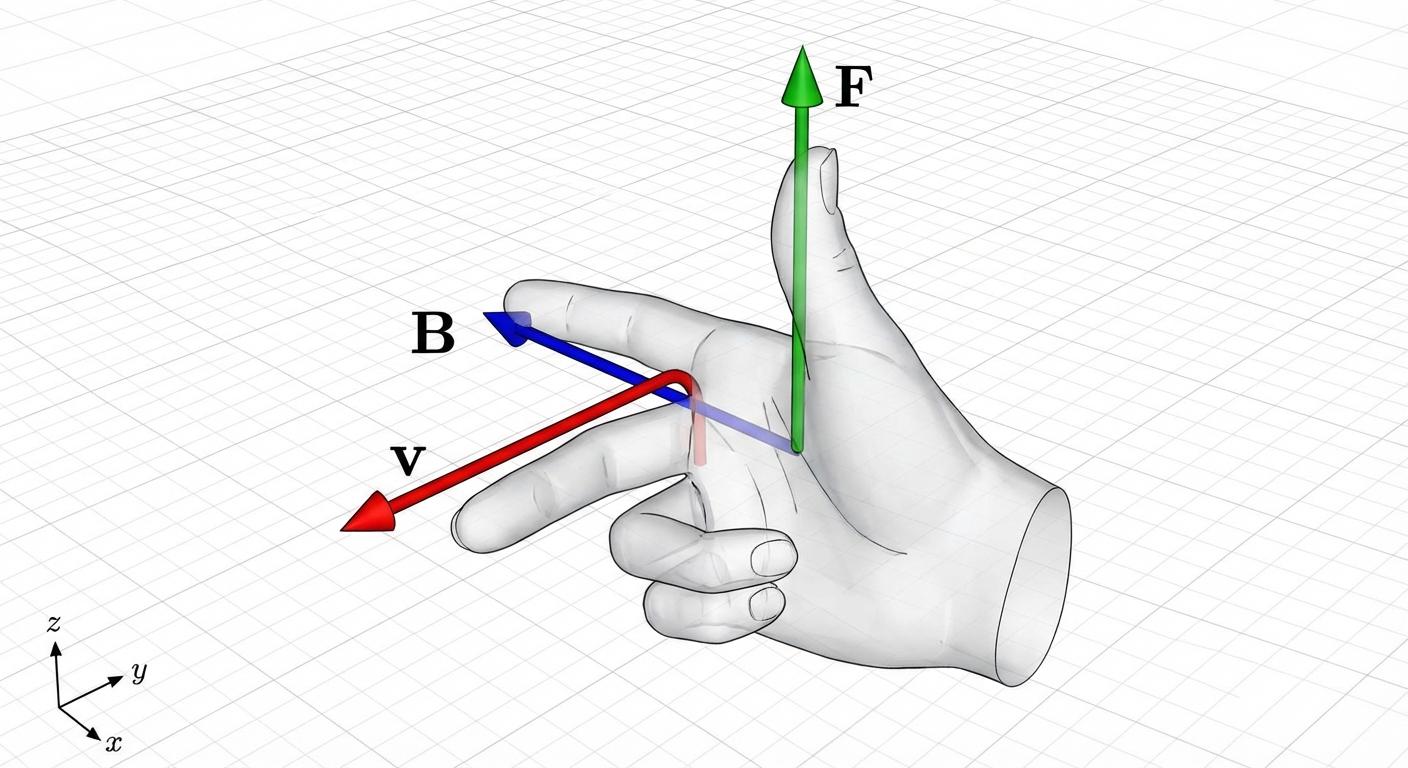
- Point your fingers in the direction of velocity $\vec{v}$.
- Curl your fingers toward the magnetic field $\vec{B}$.
- Your thumb points in the direction of the force $\vec{F}_B$.
Note: If the charge $q$ is negative (like an electron), the force points in the opposite direction of the thumb. Many students prefer using their Left Hand for negative charges to avoid confusion.
Magnetic Force on Current-Carrying Wires
Since electric current is simply a stream of moving charges, a current-carrying wire placed in a magnetic field experiences a macroscopic force. This force is the vector sum of the individual forces acting on the charge carriers within the wire.
General Formula (Calculus Approach)
For a wire of arbitrary shape or a non-uniform magnetic field, we integrate along the length of the wire:
Where:
- $I$ is the current (Amperes, A)
- $d\vec{l}$ is a differential length vector pointing in the direction of the conventional current.
Straight Wire in a Uniform Field
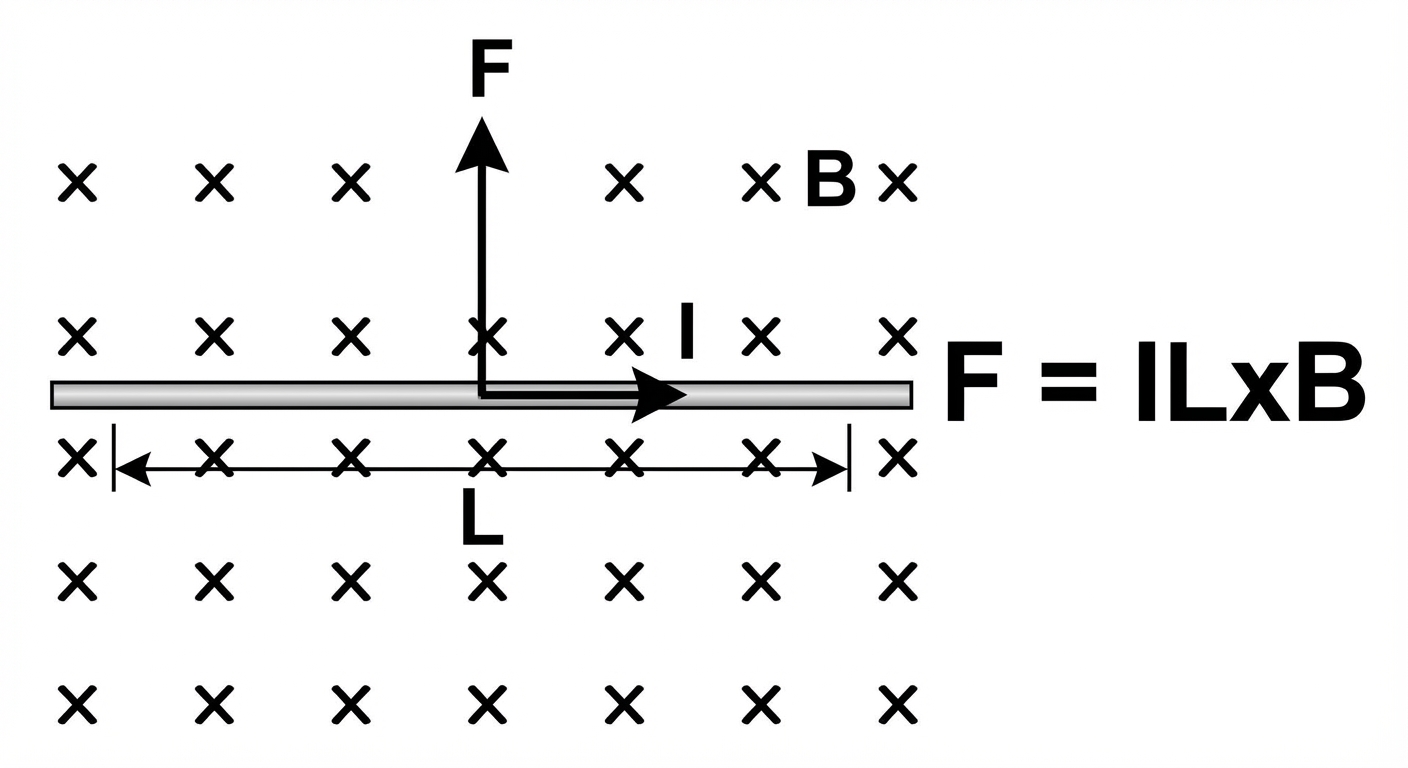
If the wire is straight and the magnetic field is uniform (constant in magnitude and direction), the integral simplifies to:
Magnitude:
Here, $\vec{L}$ is the length vector of the wire segment within the field, pointing in the direction of the current.
Applications
This concept is the operating principle behind electric motors, galvanometers, and loudspeakers. The interaction between the external magnetic field and the current creates a torque or linear force driving mechanical motion.
Motion of Charged Particles in Magnetic Fields
Analyzing the trajectory of a charged particle in a B-field is a standard exam problem in AP Physics C.
Uniform Circular Motion ($v \perp B$)
When a charged particle enters a uniform magnetic field with a velocity exactly perpendicular to the field ($\theta = 90^\circ$), the magnetic force provides a centripetal force. Since the force is always perpendicular to velocity, the particle undergoes Uniform Circular Motion.
Using Newton’s Second Law ($ \Sigma F = ma $):
From this equality, we derive two critical variables:
1. Cyclotron Radius ($r$):
This shows that a heavier or faster particle orbits in a wider circle, while a stronger field tightens the circle.
2. Period ($T$) and Frequency ($f$):
Crucial Insight: The period $T$ depends only on the mass, charge, and magnetic field. It is independent of velocity. This principle allows cyclotrons (particle accelerators) to operate at a fixed frequency.
Helical Motion
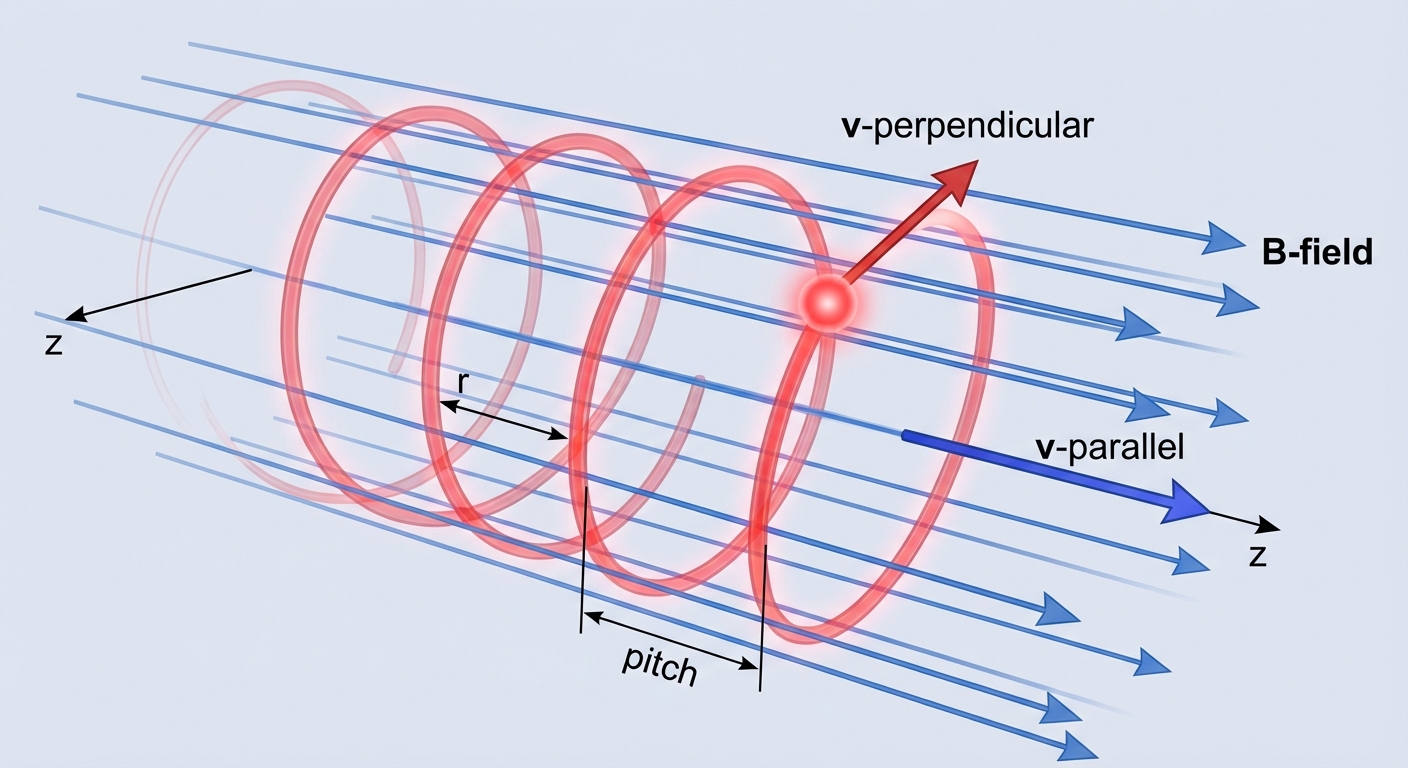
If the particle enters the field at an angle (not $90^\circ$ or $0^\circ$), the velocity vector can be resolved into two components:
- $v_{\perp} = v\sin\theta$: perpendicular to $\vec{B}$. Creates circular motion.
- $v_{\parallel} = v\cos\theta$: parallel to $\vec{B}$. Experiences zero force ($F=0$) and continues at constant velocity.
The resulting path is a helix (spiral). The "pitch" of the helix (distance between loops) is determined by $v_{\parallel} \cdot T$.
Application: Velocity Selector & Mass Spectrometer
Velocity Selector:
If we cross a magnetic field $\vec{B}$ with an electric field $\vec{E}$ so that the magnetic force opposes the electric force, we can filter particles by speed.
- Electric Force: $F_E = qE$
- Magnetic Force: $F_B = qvB$
For the particle to move in a straight line (net force = 0):
Only particles with this specific speed pass through undeflected.
Mass Spectrometer:
After passing through a velocity selector, particles enter a region with only a magnetic field. They curve into a semicircle of radius $r$. Measuring $r$ allows calculation of the charge-to-mass ratio ($q/m$) or isotope identification.
Worked Example: Particle in a Field
Problem: A proton ($m_p = 1.67 \times 10^{-27}$ kg, $q = 1.6 \times 10^{-19}$ C) moves with a speed of $3.0 \times 10^5$ m/s horizontally to the East. It enters a uniform magnetic field of $0.5$ T directed vertically Upward.
- Calculate the magnitude of the magnetic force.
- Determine the direction of the force.
- Calculate the radius of the circular path.
Solution:
Magnitude: Since East ($v$) is perpendicular to Up ($B$), $\theta = 90^\circ$.
Direction: Using the Right-Hand Rule:
- Fingers point East (Velocity).
- Curl fingers Up (Magnetic Field).
- Thumb points North (out of the page/plane defined by East and Up).
Radius:
Common Mistakes to Avoid
- Cross Product Order: Remember that $\vec{v} \times \vec{B} = -(\vec{B} \times \vec{v})$. If you curl from field to velocity, you get the wrong direction. Always start with velocity (or length vector for wires).
- The Negative Sign Trap: The Right-Hand Rule applies to positive charges. If the problem involves an electron, you must find the direction using the RHR and then flip it 180 degrees (or use your left hand).
- Work Done Misconception: Students often assume a strong magnetic force increases the kinetic energy of a particle. Remember: Magnetic force is always centripetal (perpendicular to motion) and does zero work.
- Units: Magnetic field is measured in Tesla (T). Sometimes problems use Gauss (G). Remember: $1 \text{ T} = 10,000 \text{ G}$.
- Direction of $\vec{L}$: For wire problems, the vector $\vec{L}$ points in the direction of the conventional current (positive to negative), not electron flow.