Unit 6 Study Guide: Navigating Global Challenges in Chinese Context
Environmental Issues (Huánjìng Wèntí)
In the context of AP Chinese, discussing environmental issues requires not just vocabulary acquisition, but the ability to articulate the tension between rapid economic development and ecological preservation. You must be able to describe problems, propose solutions, and connect them to traditional Chinese philosophies.
Key Concepts and Vocabulary
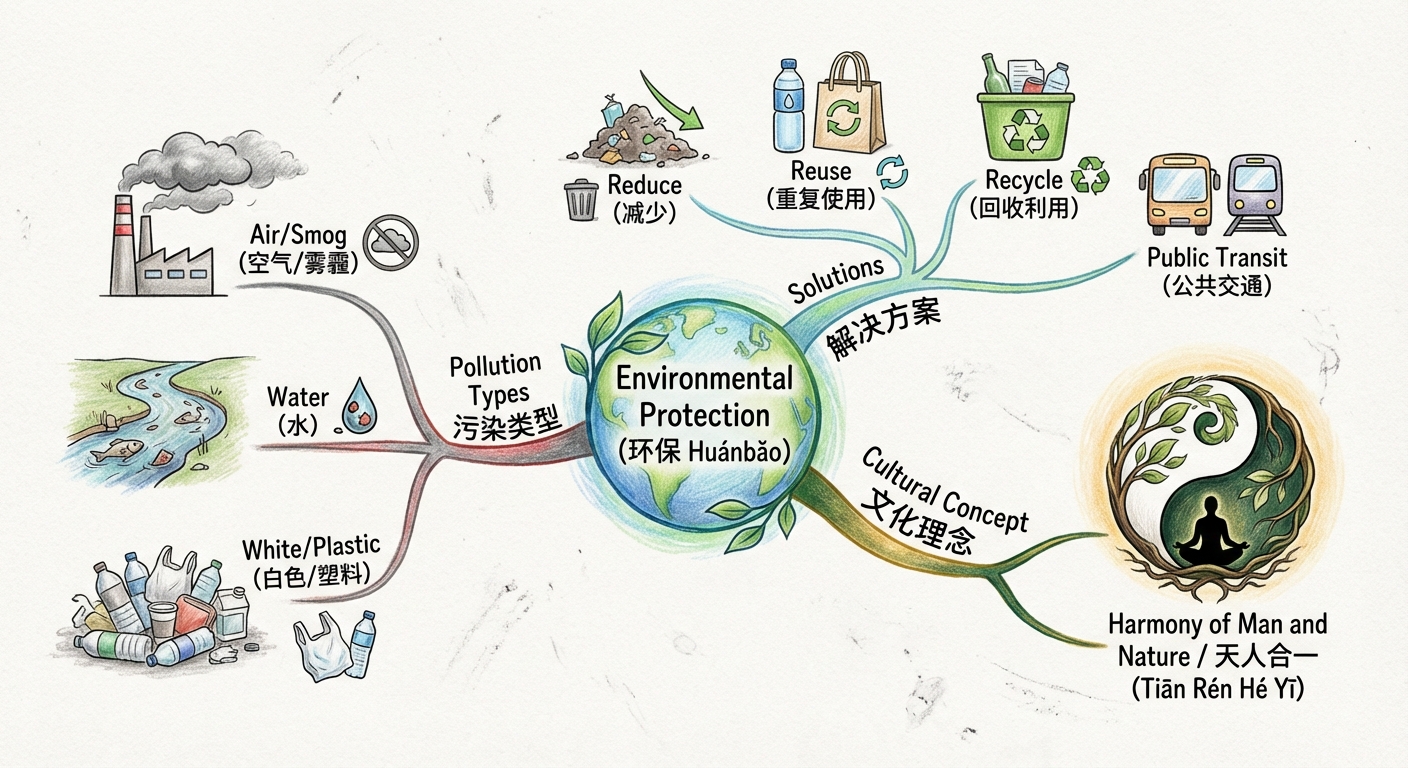
- Environmental Protection (Huánjìng Bǎohù / 环保 - Huánbǎo): The umbrella term for this section. Always use the abbreviation Huánbǎo in compound words.
- Pollution (Wūrǎn / 污染):
- Air Pollution (Kōngqì Wūrǎn): Often associated with Smog (Wùmái / 雾霾).
- Water Pollution (Shuǐ Wūrǎn): Issues with industrial waste.
- White Pollution (Báisè Wūrǎn): Refers specifically to plastic waste (bags, styrofoam).
- Global Warming (Quánqiú Biànnuǎn): often discussed with the Greenhouse Effect (Wēnshì Xiàoyìng).
Cultural Perspective: Harmony between Nature and Humans
A critical cultural connection for the Presentation Speaking task is the concept of Tiān Rén Hé Yī (天人合一) — the unity of heaven (nature) and humanity. Traditional Chinese philosophy (Taoism and Confucianism) emphasizes that humans are an integral part of nature, not masters over it.
- Exam Tip: If asked about modern environmental solutions, you can mention that China is "returning to its roots" by embracing Tiān Rén Hé Yī to combat industrial pollution.
Practical Solutions (Green Lifestyle)
For the Interpersonal Speaking or Email Writing sections, you are often asked how students can help. Use these phrases:
- Reduce (Jiǎnshǎo): Jiǎnshǎo làngfèi (Reduce waste).
- Reuse (Chóngfù Shǐyòng): Chóngfù shǐyòng sùliào dài (Reuse plastic bags).
- Recycle (Huíshōu): Huíshōu fèizhǐ (Recycle waste paper).
- Low-carbon Life (Dītàn Shēnghuó): Riding bikes ( Qí zìxíngchē ) or taking public transit ( Zuò gōnggòng jiāotōng ) instead of driving.
Political and Social Structures
This section focuses on demographics, the movement of people, and the societal shifts caused by China's unique political policies over the last 50 years.
The Aging Population (Rénkǒu Lǎolínghuà)
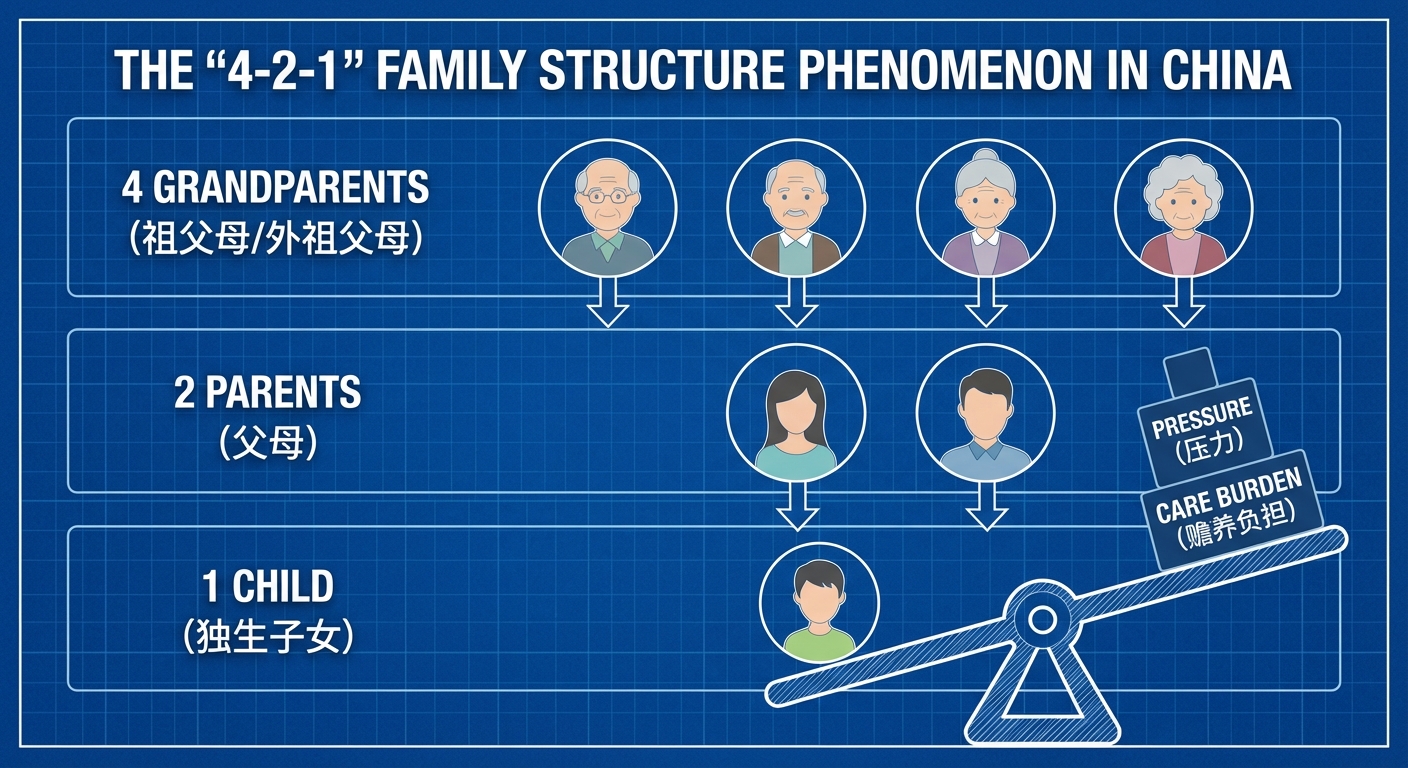
Due to the previous "One Child Policy" (now distinctively changed to the Two-child and Three-child policies) and increased life expectancy, China faces significant aging challenges.
- The "4-2-1" Family Structure: This is a crucial concept. It refers to 4 Grandparents, 2 Parents, and 1 Child.
- The Challenge: The single child faces the heavy burden of supporting six elders ( Yǎng lǎo ) alone.
- Empty Nest Elderly (Kōngcháo Lǎorén): Old people whose children have moved away for work, leaving them lonely.
Urbanization and Migration (Chéngzhènhuà)
China has experienced the largest human migration in history from rural areas ( Nóngcūn ) to cities ( Chéngshì ).
- Migrant Workers (Nóngmín Gōng): Laborers who move from villages to cities to build infrastructure. They contribute to economic growth but often lack local social benefits.
- Left-behind Children (Liúshǒu Értóng): Children who stay in rural villages with grandparents while their parents work in cities.
The Wealth Gap (Pínfù Chājù)
While the standard of living ( Shēnghuó Shuǐpíng ) has risen generally, the gap between the wealthy and the poor has widened.
- Coast vs. Inland: The eastern coastal cities are generally wealthier than the western inland regions.
- Vocabulary:
- Fādá (Developed)
- Luòhòu (Backward/Underdeveloped)
- Jīngjì Fāzhǎn (Economic Development)
Social Conscience and Civic Responsibility
This topic covers how individuals contribute to society, a frequent topic for the "Email Response" section of the exam.
Volunteering (Zuò Yìgōng / Zhiyuanzhe)
Being a specific type of "Global Citizen" usually involves volunteering.
- Key Phrases:
- Wǒ cānjiā le yìgōng huódòng. (I participated in volunteer activities.)
- Zhījiào (Volunteer teaching in poor areas).
- Císhàn Jīgòu (Charity organizations).
Gender Equality (Nánnǚ Píngděng)
China has a famous saying by Mao Zedong: "Women hold up half the sky" (Fùnǚ néng dǐng bànbiāntiān). While legally equal, traditional views still impact society. In AP responses, you can discuss:
- Women in the workforce.
- The balance between career and family ( Shìyè hé jiātíng ).
Internet and Social Responsibility
The internet ( Hùliánwǎng ) plays a massive role in Chinese civic life.
- Netizens (Wǎngmín) often expose corruption or bad behavior.
- Human Flesh Search Engine (Rénròu Sōusuǒ): A phenomenon where internet users track down the real-world identity of someone to shame them publicly (shows the double-edged sword of technology).
Essential Sentence Structures for Argumentation
When writing or speaking about these challenges, you need transition words to sound sophisticated:
- Suīrán… dànshì… (虽然…但是…): Although [problem exists], [solution is happening].
- Example: "Although air pollution is serious, the government is developing green energy."
- Yī fāngmiàn… lìng yī fāngmiàn… (一方面…另一方面…): On one hand… on the other hand…
- Example: "Migration helps the economy, but on the other hand, it creates 'left-behind children'."
- Wèile… (为了…): In order to…
- Example: "In order to protect the environment, we should drive less."
Common Mistakes & Pitfalls
Confusing "Protect" vs. "Save":
- Use Bǎohù (保护) for protecting the environment or animals.
- Use Jiù (救) for saving a life physically.
- Mistake: Wǒ yào jiù huánjìng. (I want to save the environment.)
- Correct: Wǒ yào bǎohù huánjìng.
Grammar: "Because" and "So":
- In English, you don't say "Because… so…" in one sentence. In Chinese, Yīnwèi (因为)… Suǒyǐ (所以)… is the correct standard structure. Do NOT omit the Suǒyǐ if the sentence is complex.
Cultural Sensitivity:
- Avoid purely criticizing China's pollution. The AP exam values balanced perspectives. Acknowledge the problem, but focus on the measures (Cuòshī) being taken to fix it (e.g., high-speed trains, electric vehicles).