Unit 4: The Scientific Revolution and the Birth of Modern Thought
The Shift in Worldview: Medieval vs. Modern
The Scientific Revolution refers to the sweeping change in the scientific view of the universe that occurred in the West approximately between 1543 (publication of Copernicus's On the Revolutions) and 1687 (Newton's Principia). This period marked a fundamental shift from reliance on ancient authorities and religious dogma to reliance on observation, experimentation, and mathematics.
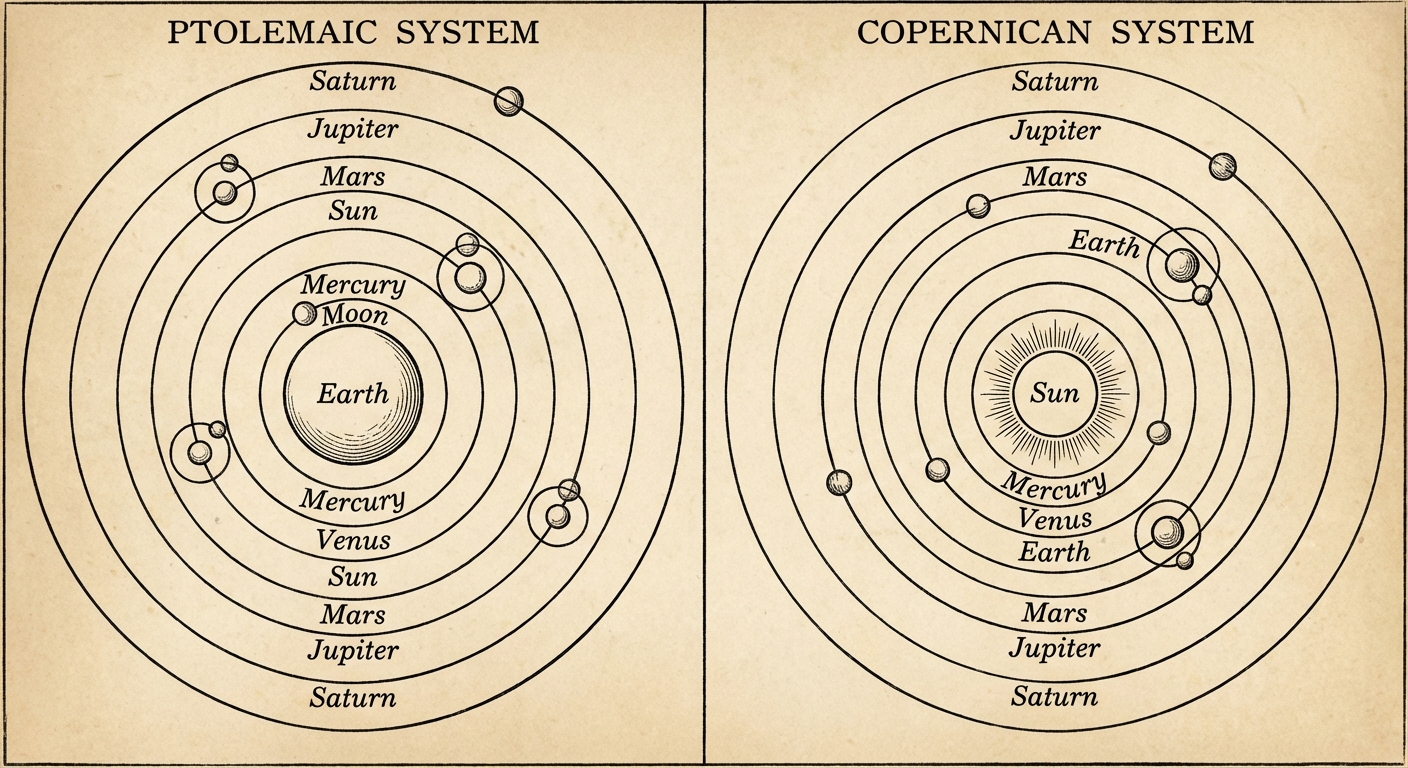
The Old Paradigm: Geocentrism
Before the 16th century, the European worldview was dominated by Natural Philosophy, heavily influenced by:
- Aristotle: Believed the earth was stationary and the universe was composed of crystal spheres using different physics than earth.
- Ptolemy: Created the mathematical model for the Geocentric Theory—the idea that the Earth is at the center of the universe. To make the math work for planetary movement, he invented complex "epicycles."
- The Church: Biblical interpretations supported the idea that God placed humanity at the center of creation.
The Titans of Astronomy & Physics
This revolution began in astronomy but quickly dismantled the entire Aristotelian physics system.
Nicolaus Copernicus (1473–1543)
A Polish priest and astronomer who challenged the Ptolemaic system. In his seminal work, On the Revolutions of the Heavenly Spheres (published posthumously to avoid persecution), he proposed the Heliocentric Theory.
- Concept: The sun, not the earth, is the center of the universe.
- Impact: It destroyed the main premise of Aristotelian physics (crystal spheres) but still used perfect circles for orbits, so his math wasn't significantly better than Ptolemy's initially. It was known as the "Copernican Hypothesis."
Tycho Brahe (1546–1601)
While he rejected full heliocentrism (he believed planets orbited the sun, but the sun orbited the earth), Brahe is crucial for being the great data collector of the era. He built the most sophisticated observatory of his time and compiled decades of precise naked-eye observations of planetary movements.
Johannes Kepler (1571–1630)
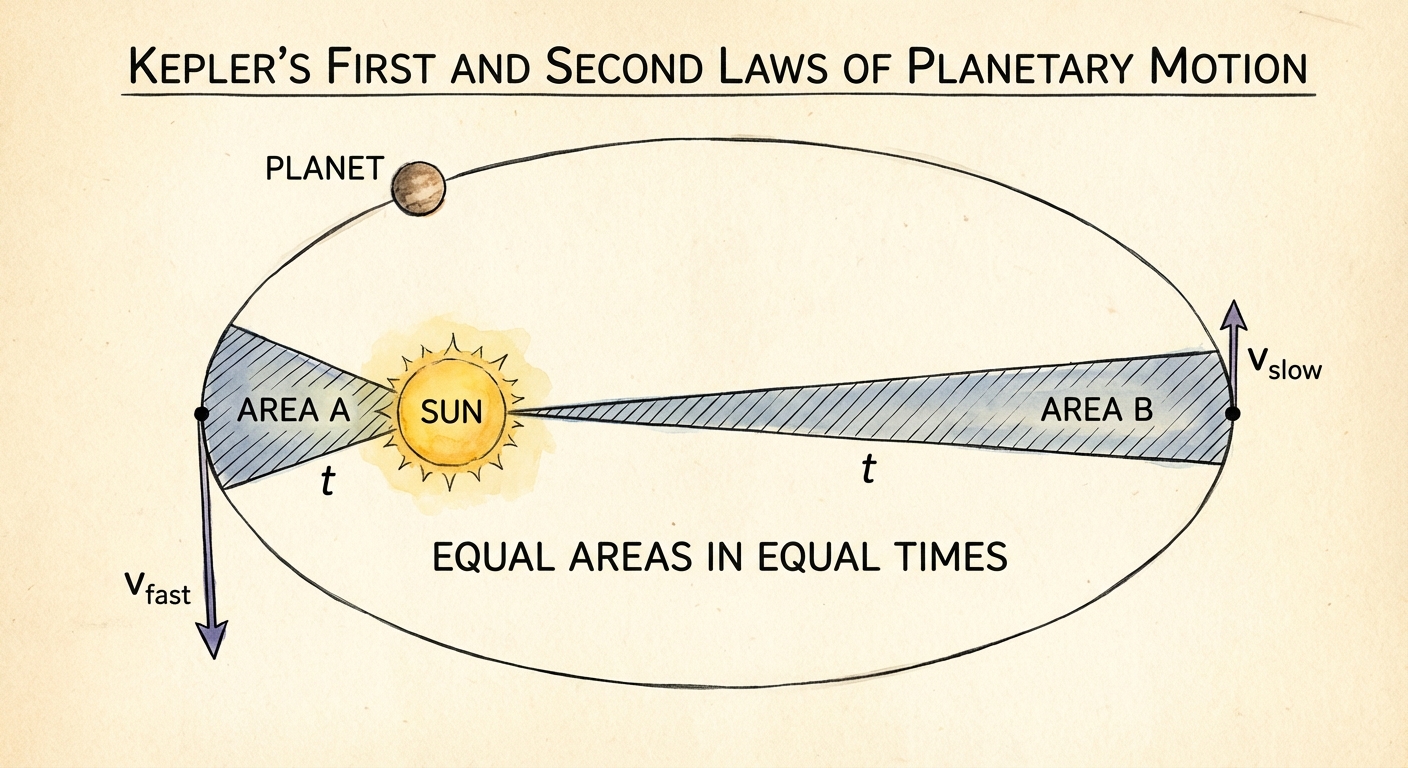
Brahe's assistant, a brilliant mathematician, used Brahe's massive data set to prove Copernicus right—but with a twist. He formulated the Three Laws of Planetary Motion:
- Orbits are elliptical, not circular (this fixed the math problems in Copernicus's theory).
- Planets do not move at a uniform speed (they speed up closer to the sun).
- Orbit time is related to distance from the sun.
Galileo Galilei (1564–1642)
While Kepler provided the math, Galileo provided the empirical evidence. He applied the experimental method to physics and astronomy.
- The Telescope: He did not invent it, but he improved it significantly.
- Discoveries:
- Craters on the moon (proving celestial bodies were not perfect/smooth spheres).
- Moons of Jupiter (proving not everything orbits the earth).
- Laws of Motion: Formulated the Law of Inertia—an object in motion stays in motion unless stopped by an external force (shattering Aristotle's view that objects naturally stop).
The Trial of Galileo (1633): After publishing Dialogue on the Two Chief World Systems, which mocked the geocentric view (and by proxy, the Pope), Galileo was tried by the Inquisition for heresy. He was forced to recant and spent the rest of his life under house arrest. This event symbolizes the conflict between religious authority and scientific observation.
Isaac Newton (1642–1727)
The great synthesizer. Newton combined the astronomy of Copernicus and Kepler with the physics of Galileo into a single, explanatory system.
- Key Work: Philosophiæ Naturalis Principia Mathematica (1687).
- Law of Universal Gravitation: Every body in the universe attracts every other body in a precise mathematical relationship:
- Significance: This created the view of the universe as a giant machine—a "Clockwork Universe"—governed by natural laws that humans could discover and understand. God became viewed by many as the "clockmaker" who set the universe in motion (leading to Deism in the Enlightenment).
The New Methodologies: How to Think
The revolution wasn't just about what we know, but how we know it. Two competing philosophical methods emerged.
Francis Bacon: Empiricism
An English politician and writer who attacked the medieval way of thinking (scholasticism).
- Empiricism (Inductive Reasoning): Knowledge comes from observation and experimentation. You gather specific data points and then form a general conclusion.
- Memory Aid: Bacon = Bottom-up (Start with data at the bottom, move up to theory).
René Descartes: Rationalism
A French philosopher and mathematician (invented analytic geometry).
- Rationalism (Deductive Reasoning): Used logic and reason to deduce truths from self-evident principles. He doubted everything that could be doubted until he reached the one thing he couldn't doubt: his own existence.
- "Cogito, ergo sum" ("I think, therefore I am").
- Cartesian Dualism: The separation of mind (spiritual) and matter (physical).
The Modern Scientific Method
The modern method is a synthesis of Bacon's empiricism (experimentation) and Descartes's rationalism (logic/math).
| Feature | Bacon (Empiricism) | Descartes (Rationalism) |
|---|---|---|
| Starting Point | Observation / Experiment | Doubt / Logic |
| Direction | Specific $\rightarrow$ General | General $\rightarrow$ Specific |
| Focus | Practical application | Theoretical certainty |
Medicine and Anatomy
While astronomers looked up, others looked inside the human body, challenging the ancient Greek authority Galen (who believed the body was balanced by four humors: blood, phlegm, black bile, yellow bile).
- Andreas Vesalius: Published On the Structure of the Human Body. He dissected cadavers (previously taboo) and produced precise anatomical drawings, correcting Galen's errors.
- William Harvey: Discovered the circulation of blood. He proved the heart was a pump and that blood circulated through veins and arteries (mechanistic view of the body).
Common Mistakes & Pitfalls
Misconception: The Scientific Revolution was anti-religious.
- Reality: Almost all the great scientists (Newton, Kepler, Copernicus) were deeply religious Christians. They saw science as a way to understand God's creation. They opposed the Church's authority in science, not God himself.
Misconception: It happened quickly.
- Reality: It was a slow process spanning 150 years. It was a "revolution" in impact, not speed. Most of the population remained illiterate and believed in superstition/witchcraft well into the 18th century.
Misconception: Galileo proved heliocentrism entirely.
- Reality: Galileo provided strong evidence, but Newton provided the proof (gravity) that explained why the planets stayed in orbit rather than flying off into space.
Misconception: Deductive and Inductive reasoning are the same.
- Reality: Remember: Inductive moves Into the theory (data $\to$ theory). Deductive moves Down from the theory (theory $\to$ specific conclusion).