Comprehensive Guide to Geometric Optics for AP Physics 2
Light Propagation and Reflection
Geometric optics treats light as a collection of rays that travel in straight lines until they interact with a boundary. This simplified model helps us analyze how light interacts with mirrors and lenses to form images.
The Ray Model of Light
In the Ray Model, we assume:
- Light travels in straight lines in a uniform medium.
- Light rays change direction only when they encounter a boundary (reflection or refraction).
- Light rays are reversible.
Reflection
Reflection occurs when a light ray bounces off a surface. There are two types:
- Specular Reflection: Reflection off a smooth, shiny surface (like a mirror). Rays remain parallel.
- Diffuse Reflection: Reflection off a rough surface (like paper). Rays scatter in many directions.
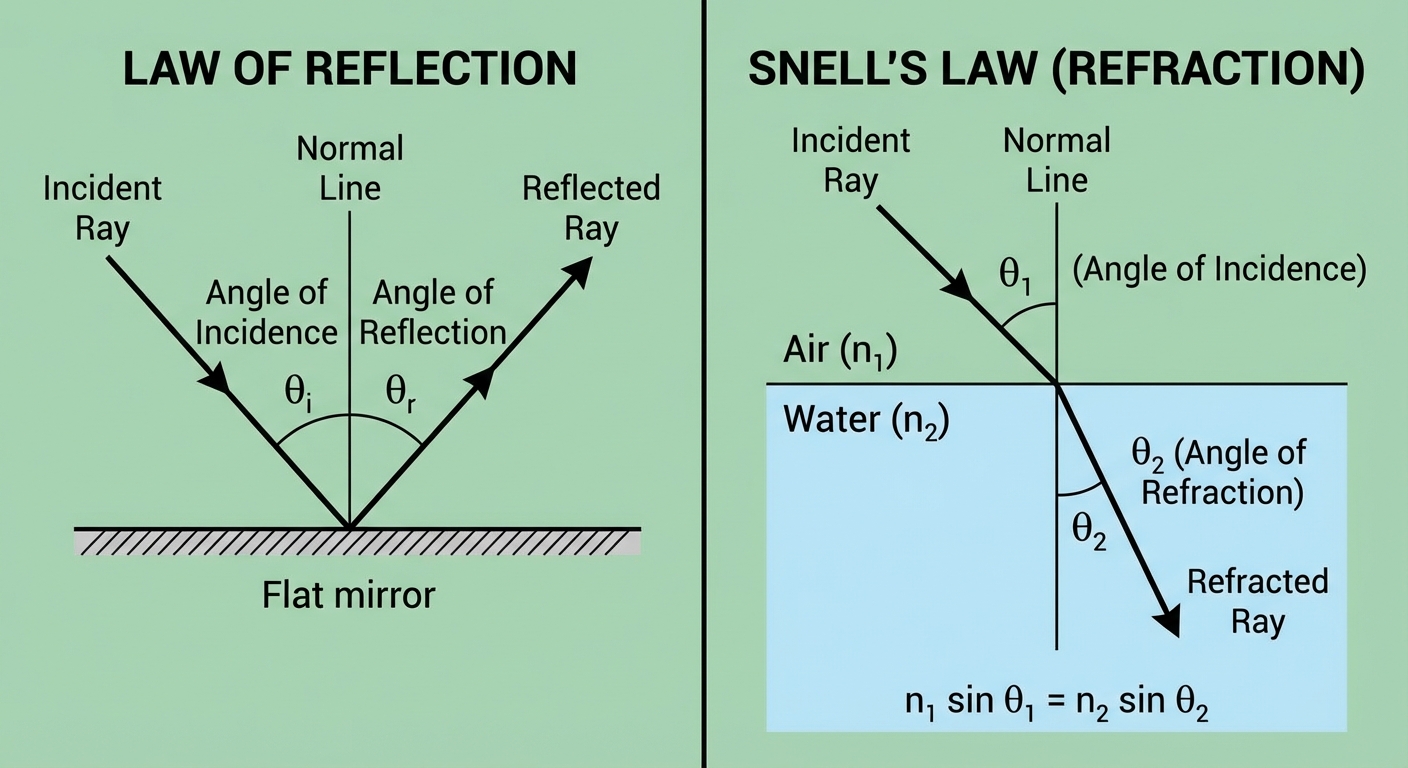
The Law of Reflection
The fundamental rule governing reflection is simple:
Crucial Note: The angle of incidence ($\thetai$) and the angle of reflection ($\thetar$) are always measured relative to the Normal line (a perpendicular conceptual line sticking out of the surface), NOT the surface itself.
Plane Mirrors
Plane (flat) mirrors create the simplest images.
- Image Type: Virtual (light rays do not physically meet behind the mirror; they only appear to).
- Orientation: Upright.
- Magnification: 1 (Image size = Object size).
- Distance: $di = -do$ (The image is as far behind the mirror as the object is in front).
Refraction and Snell's Law
Refraction is the bending of light as it passes from one transparent medium into another. This bending occurs because light travels at different speeds in different materials.
Index of Refraction ($n$)
The index of refraction is a dimensionless number describing how much light slows down in a medium.
- $c$: Speed of light in a vacuum ($3.00 \times 10^8 \text{ m/s}$)
- $v$: Speed of light in the medium
- $n_{vacuum} = 1$ (by definition)
- $n_{air} \approx 1.0003$ (usually treated as 1.0 in problems)
Snell's Law
Snell's Law quantifies the amount of bending based on the indices of refraction and the angles relative to the normal.
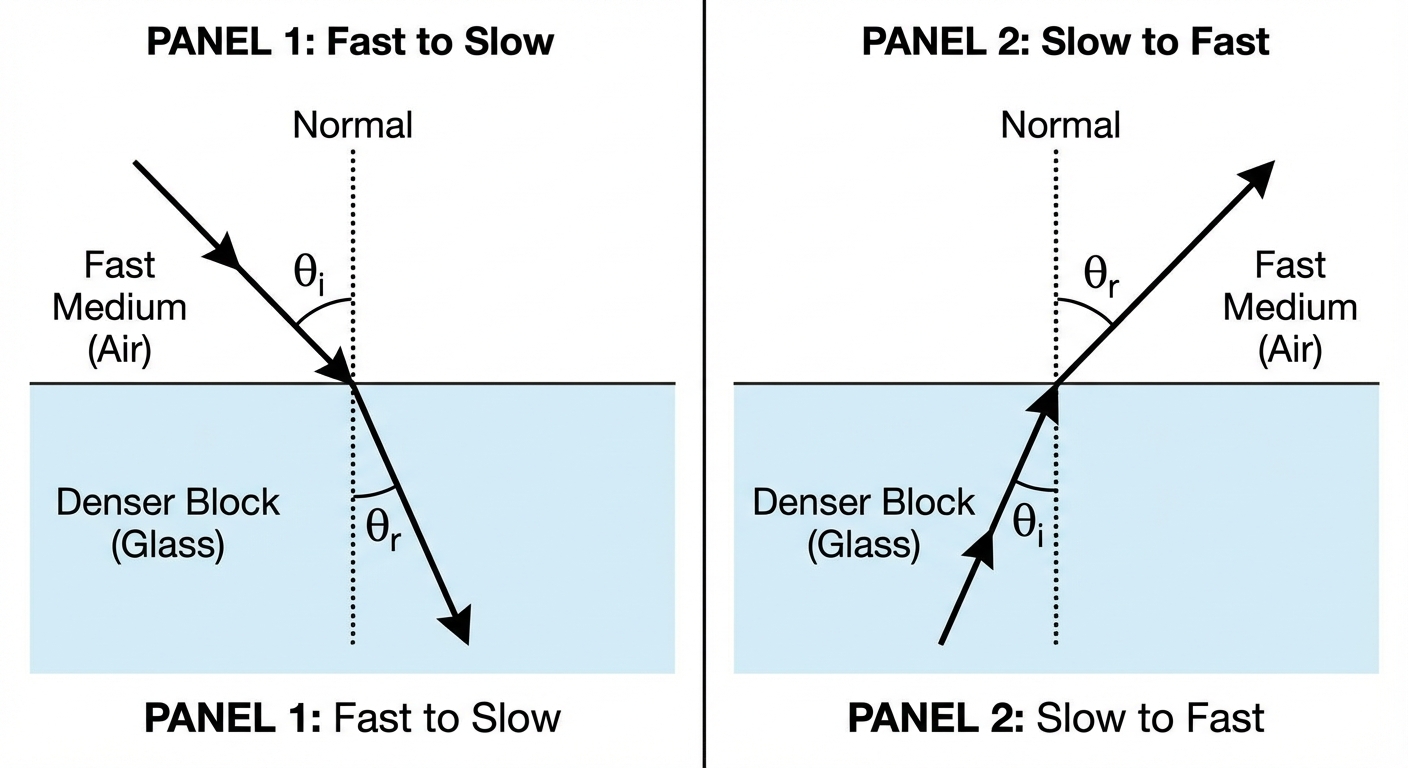
Qualitative Rules:
- Fast to Slow ($n1 < n2$): Light bends towards the normal.
- Slow to Fast ($n1 > n2$): Light bends away from the normal.
Total Internal Reflection (TIR)
When light travels from a high index medium to a low index medium ($n1 > n2$), the light bends away from the normal. If the incident angle increases enough, the refracted angle reaches $90^\circ$. Beyond this point, light cannot escape standardly; it is trapped inside the first medium.
This specific angle is the Critical Angle ($ \theta_c $):
- TIR only happens when traveling from Higher $n$ $\rightarrow$ Lower $n$.
- Used in fiber optics and diamonds.
Image Formation: Mirrors and Lenses
Understanding how spherical boundaries form images is the core of this unit. We classify optical devices as either Converging or Diverging.
Definitions of Image Types
- Real Image: Light rays physically converge at a location (can be projected onto a screen).
- Virtual Image: Light rays diverge, but our brain traces them back to an apparent origin point (cannot be projected).
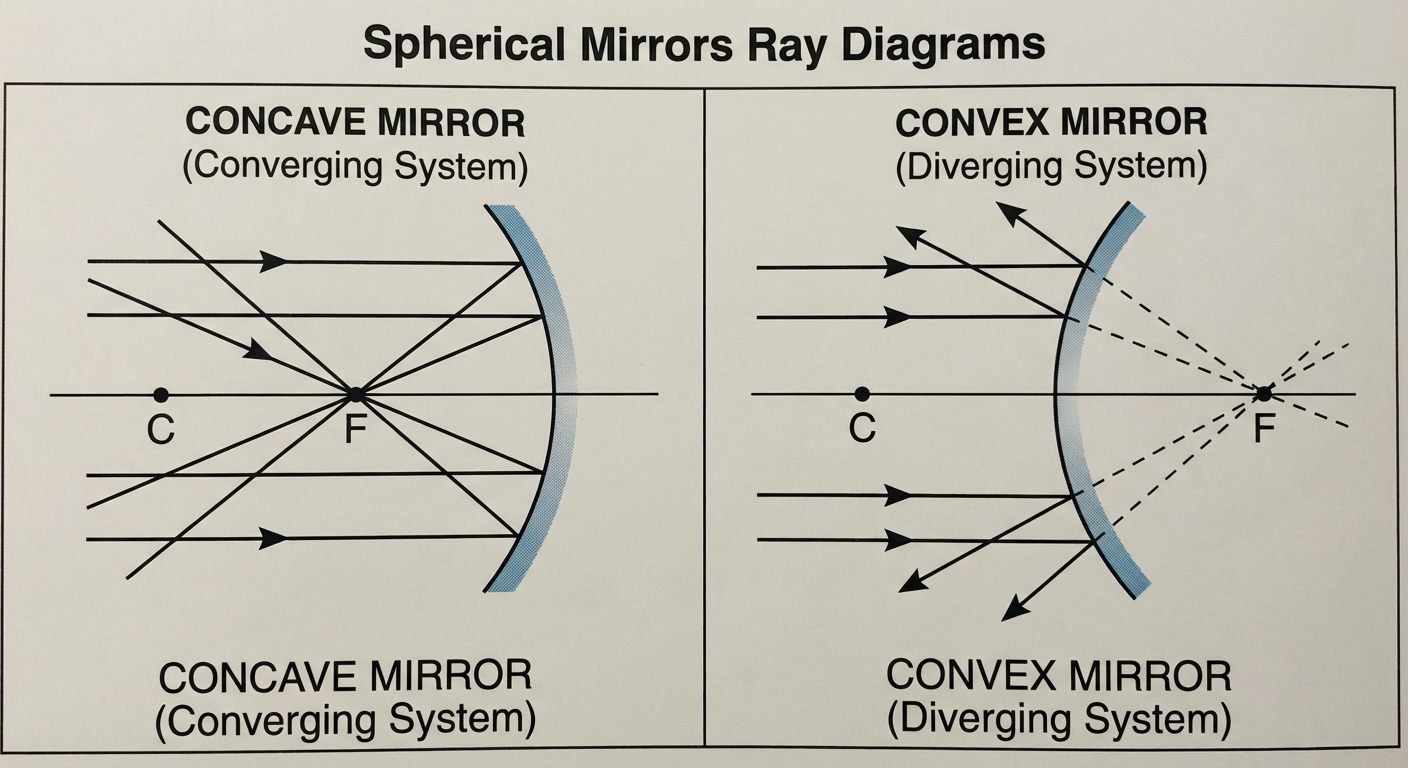
Spherical Mirrors
Mirrors reflect light. The "Real" side is in front of the mirror.
| Mirror Type | Shape | Focal Point ($f$) | Behavior |
|---|---|---|---|
| Concave | Caves inward | Positive ($+f$) | Converging: Can form Real or Virtual images depending on object distance. |
| Convex | Bulges outward | Negative ($-f$) | Diverging: ALWAYS forms Virtual, Upright, Reduced images. |
Thin Lenses
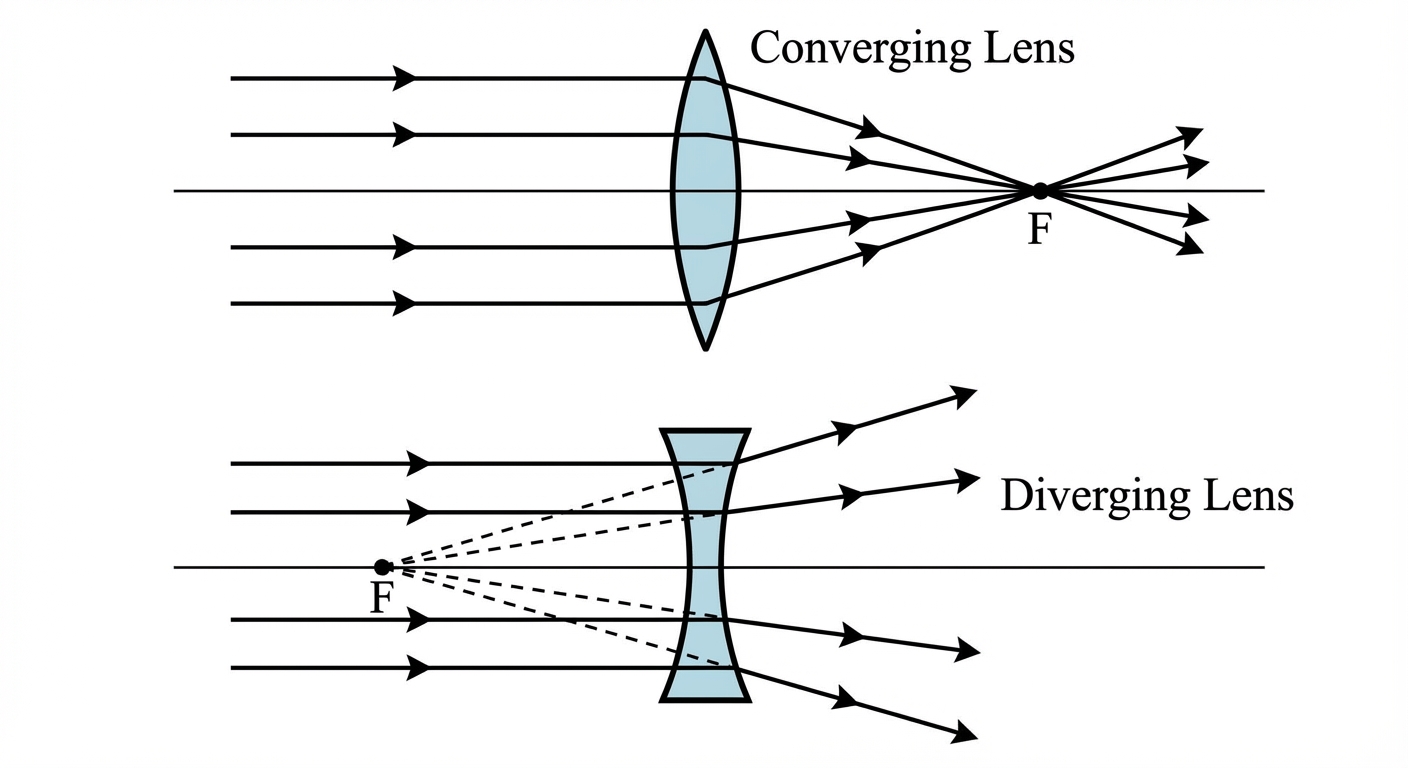
Lenses refract light. The "Real" side is behind the lens (where light passes through).
| Lens Type | Shape | Focal Point ($f$) | Behavior |
|---|---|---|---|
| Convex (Converging) | Thicker at center | Positive ($+f$) | Converging: Behaves like a Concave Mirror. Can form Real or Virtual images. |
| Concave (Diverging) | Thinner at center | Negative ($-f$) | Diverging: Behaves like a Convex Mirror. ALWAYS forms Virtual, Upright, Reduced images. |
Ray Tracing Rules
To find an image geometrically, draw 2 of these 3 rays from the top of the object:
- Parallel Ray: Travels parallel to the principal axis, then reflects/refracts through the focal point ($f$).
- Focal Ray: Travels through the focal point, then reflects/refracts parallel to the principal axis.
- Center Ray: mirrors: hits the center of the mirror and reflects at the same angle; lenses: passes straight through the geometric center unbent.
Quantitative Optics: The Equations
For the AP exam, you must master the sign conventions for the Thin Lens/Mirror Equation and Magnification.
The Fundamental Equations
1. The Thin Lens/Mirror Equation:
Relates focal length ($f$), object distance ($do$), and image distance ($di$).
2. Magnification Equation ($M$):
Relates image height ($hi$) to object height ($ho$) and distances.
The Master Sign Convention Table
Memorize this. Incorrect signs are the #1 cause of lost points.
| Variable | Positive ($+$) | Negative ($-$) |
|---|---|---|
| Object Dist ($d_o$) | Real object (standard) | Virtual object (multiple lens systems only) |
| Image Dist ($d_i$) | Real Image (Mirror: front, Lens: back) | Virtual Image (Mirror: back, Lens: front) |
| Focal Length ($f$) | Converging (Concave Mirror, Convex Lens) | Diverging (Convex Mirror, Concave Lens) |
| Magnification ($M$) | Upright Image | Inverted Image |
| Image Height ($h_i$) | Upright | Inverted |
Summary of Outcomes (The "Rule of Thumb")
For Converging Systems (Concave Mirror / Convex Lens):
- If Object is outside $f$ ($d_o > f$): Real, Inverted Image.
- If Object is inside $f$ ($d_o < f$): Virtual, Upright, Magnified Image.
- If Object is at $f$: No image formed (rays are parallel).
For Diverging Systems (Convex Mirror / Concave Lens):
- ALWAYS: Virtual, Upright, Reduced (Smaller) Image.
Common Mistakes & Exam Pitfalls
- Normal Line Contusion: Students often use the angle between the ray and the surface. Always use the angle between the ray and the normal ($90^\circ$ to surface).
- Sign Convention Errors: Forgetting that virtual images have a negative $di$. If the math yields a negative $di$, the image is virtual. If it yields a negative magnification, the image is inverted.
- Real vs. Virtual Geometry: In lenses, a real image is on the opposite side of the object. In mirrors, a real image is on the same side. Real = Light is actually there.
- Refraction Frequency: When light changes medium, Frequency ($f$) remains constant. Speed ($v$) and Wavelength ($\lambda$) change. Since $v = f\lambda$, if speed decreases, wavelength decreases.
- Snell's Law Calculation: Make sure your calculator is in Degrees mode, not Radians, unless the problem specifies otherwise.
- TIR Conditions: Remembering that TIR only happens when going from High Index -> Low Index. You cannot get TIR going from Air to Water.