Constructing Advanced Arguments: AP Seminar Big Idea 4
In AP Seminar, Big Idea 4 is where your research transforms into a unique academic contribution. It focuses on the ability to Synthesize Ideas—not merely summarizing what you have read, but weaving different perspectives together to support your own specific claim. This section covers the critical transition from information gathering to argumentative writing.
Formulating a Well-Reasoned Argument
An argument in AP Seminar is not a disagreement or a fight; it is a logical progression of ideas leading to a conclusion. The backbone of your essay (Individual Research Report or Individual Written Argument) is your Line of Reasoning (LOR).
The Anatomy of an Argument
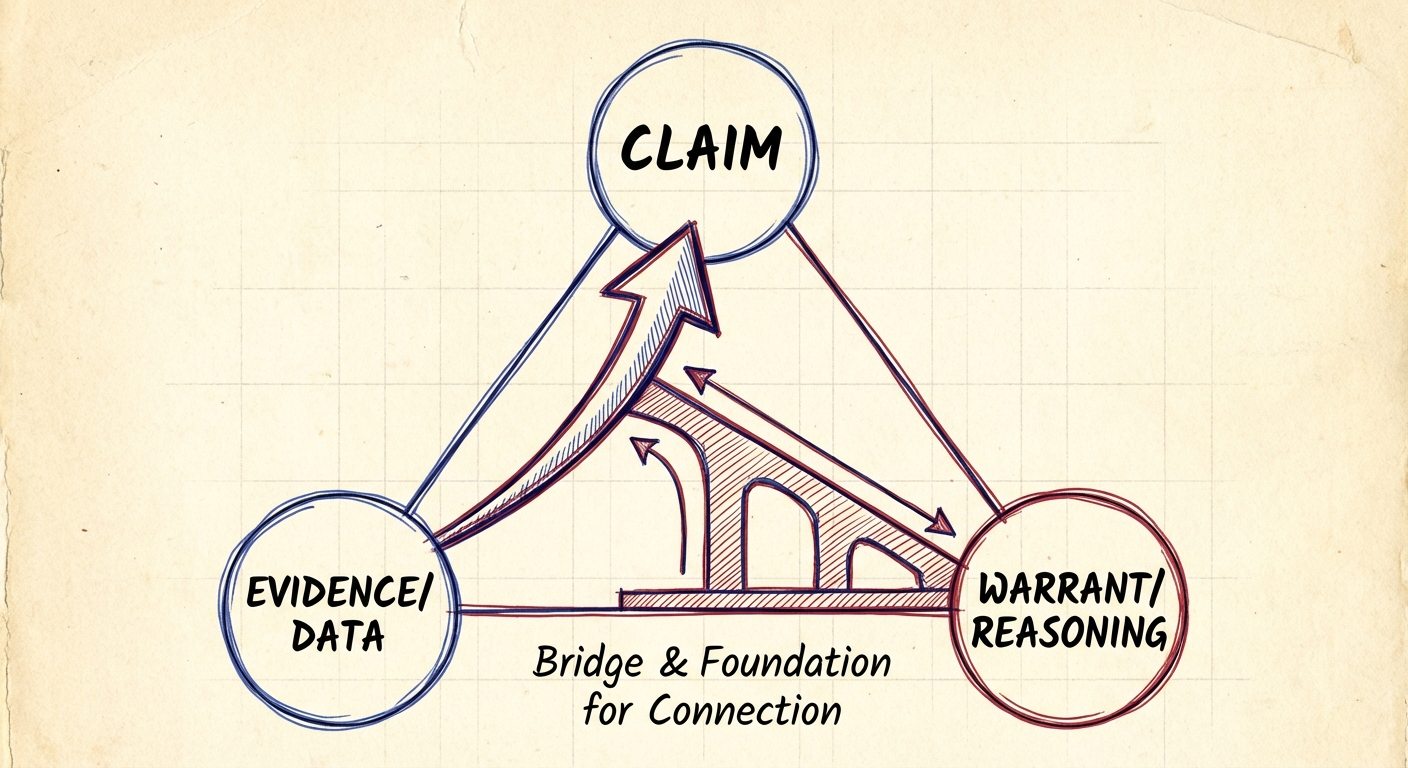
A strong argument requires three structural components working in unison:
- Claim: An assertion that you want the audience to accept. This can be your main thesis or the sub-claims of individual paragraphs.
- Evidence: Data, quotes, or findings from your research that support the claim.
- Warrant (Reasoning/Commentary): This is often the most neglected part. The warrant explains how the evidence supports the claim and why it matters. It is the logical glue.
Establishing a Line of Reasoning
The Line of Reasoning is the logical arrangement of claims and evidence that leads to a conclusion. It is the path you want your reader to walk down.
- Sequential Logic: Ensure that Paragraph A creates a premise necessary to understand Paragraph B.
- Alignment: All sub-claims must explicitly connect back to your main thesis.
Types of Reasoning
Understanding how you are arguing can help strengthen your case:
- Inductive Reasoning: Moving from specific observations (evidence) to a broad generalization (thesis). Common in scientific synthesis.
- Deductive Reasoning: Moving from a general premise to a specific conclusion.
Incorporating and Attributing Sources
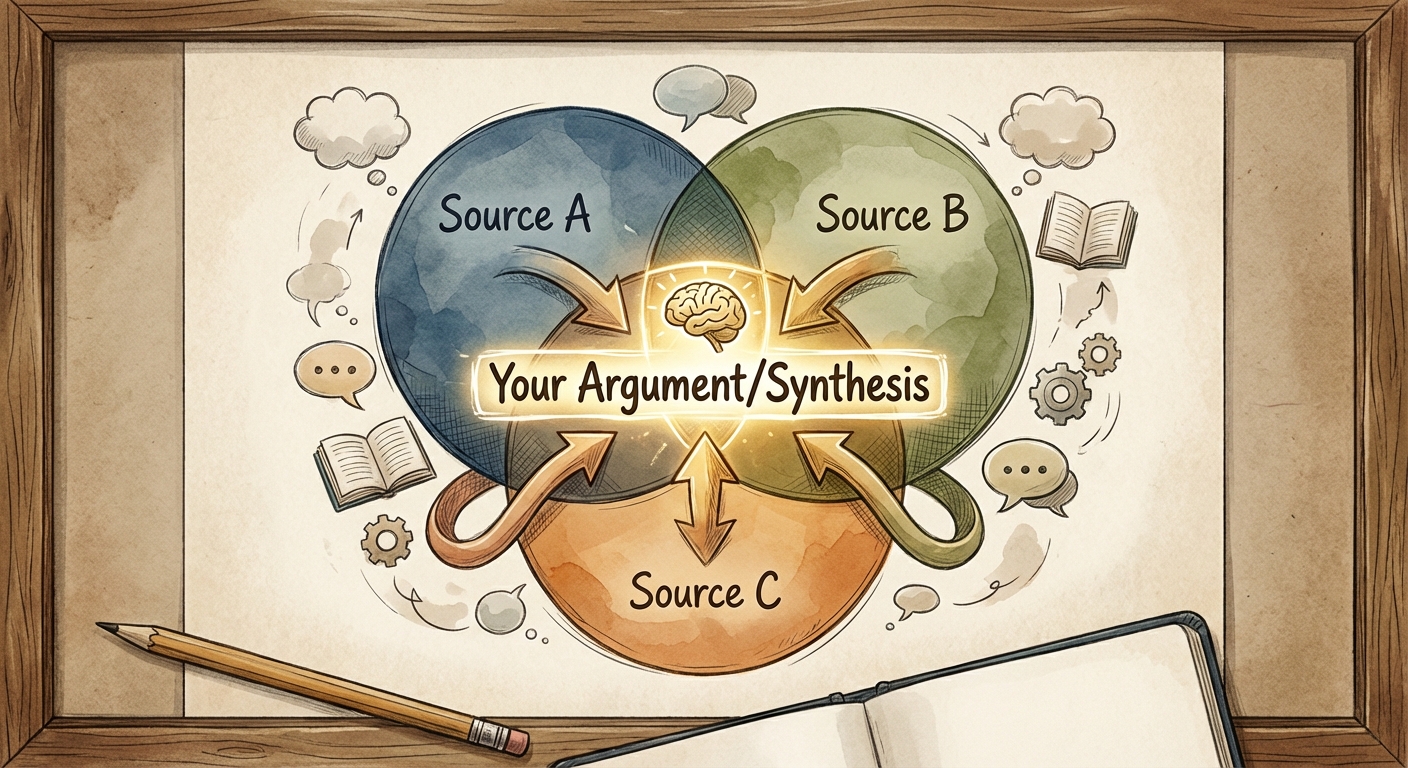
Once you have a framework, you must populate it with research. The main objective here is to avoid the "shopping list" approach (Source A says this, then Source B says that…). Instead, you must facilitate a conversation between sources.
The "Burkean Parlor" Concept
Imagine your essay is a room (a parlor) where experts are already discussing your topic. You enter, listen, and then introduce one expert to another.
- Corroboration: Show how Source A backs up Source B.
- Example: "While Smith (2019) identifies economic instability as a primary cause, Jones (2020) reinforces this by providing statistical evidence regarding inflation rates."
- Contradiction/Nuance: Show how Source A complicates Source B.
- Example: "Although Miller supports the ban on single-use plastics, Garcia contends that such bans disproportionately affect low-income communities."
Attribution and Signal Phrases
You must distinguish your voice from the voices of your sources. This is done through signal phrases—verbs that indicate the source's stance.
| Neutral/Objective | Argumentative/Strong | Counter-Argument |
|---|---|---|
| States | Argues | Contends |
| Observes | Claims | Disputes |
| Mentions | Asserts | Refutes |
| Suggests | Emphasizes | Counters |
Key Rule: Never leave a quote "floating" or "dropped." Every piece of evidence must be anchored by an attribution to its author or origin.
Developing a Coherent and Persuasive Synthesis
True synthesis occurs when you prioritize your own argument over the sources. The sources are the tools; you are the architect.
The Role of Commentary
Commentary is your analysis. In a high-scoring AP Seminar essay, the commentary connects the evidence to the specific claim of the paragraph and then connects that paragraph to the broader thesis.
The "So What?" Test: After presenting evidence, ask yourself "So what?" Your answer to that question is your commentary.
Dealing with Complexity (Qualifiers)
A sophisticated argument acknowledges that solutions are rarely perfect. To demonstrate complex thinking, use qualifiers—words that limit the scope of your claim to make it more defensible.
- Absolute (Weak): "Social media causes depression in teenagers."
- Qualified (Strong): "Excessive social media use can be a contributing factor to depression in teenagers, specifically those predisposed to anxiety."
Transitions as Logical Bridges
Do not use transitions just to start a new paragraph (e.g., "First," "Next"). Use transitions to show the logical relationship between ideas.
- To extend: "Building on this concept…"
- To pivot: "Conversely, ethical considerations suggest…"
- To conclude: "Consequently, these factors converge to demonstrate…"
Mnemonics for Synthesis: THE BRIDGE
When reviewing your synthesis, think of THE BRIDGE:
- Thess (Is it clear?)
- How (does it connect?)
- Evidence (Is it attributed?)
- Balance (Are perspectives varied?)
- Reasoning (Is the logic sound?)
- Integration (Are quotes woven in?)
- Defense (Is the claim defensible?)
- Gaps (Are limitations acknowledged?)
- Ending (Does the conclusion follow?)
Common Mistakes & Pitfalls
- Summary vs. Synthesis: The most common error is summarizing one source after another without connecting them. If you can shuffle the order of your body paragraphs and the essay still makes sense, you likely have a summary, not a Line of Reasoning.
- The "Dropped Quote": Placing a quotation in a sentence without an introduction or explanation.
- Wrong: "The sky is blue. 'The refraction of light causes color.' This shows…"
- Right: "As Newton explained, 'the refraction of light causes color,' which implies that…"
- Ignoring the Counter-Perspective: Students often cherry-pick only sources that agree with them. You gain credibility by presenting a counter-argument and then respectfully refuting it or acknowledging its validity.
- Weak Verbs: Overusing "says" or "talks about." Use the strong verbs listed in the Attribution section to show how the author is presenting the information.