Unit 2: Population and Migration Patterns and Processes
Population Dynamics: Measurement and Change
Understanding how populations grow, shrink, or stabilize is the foundation of human geography. We measure these changes using specific demographic rates excluding migration at first, focusing solely on biological natural increase.
Key Formulas and Definitions
To determine population health and growth, demographers rely on these three core metrics:
- Crude Birth Rate (CBR): The total number of live births in a year for every 1,000 people alive in the society.
- Crude Death Rate (CDR): The total number of deaths in a year for every 1,000 people alive.
- Natural Increase Rate (NIR): The percentage by which a population grows in a year. It excludes migration.
Note: Because CBR and CDR are based on 1,000 and NIR is a percent (out of 100), you must divide by 10.
Example Calculation:
If Country A has a CBR of 20 and a CDR of 5:
The population is growing at 1.5% per year.
Doubling Time
Doubling time is the number of years needed to double a population, assuming a constant rate of natural increase. We use the Rule of 70 to approximate this.
Using the previous example ($NIR = 1.5$):
$70 / 1.5 = 46.6$ years. Country A's population will double in roughly 47 years.
The Demographic Transition Model (DTM)
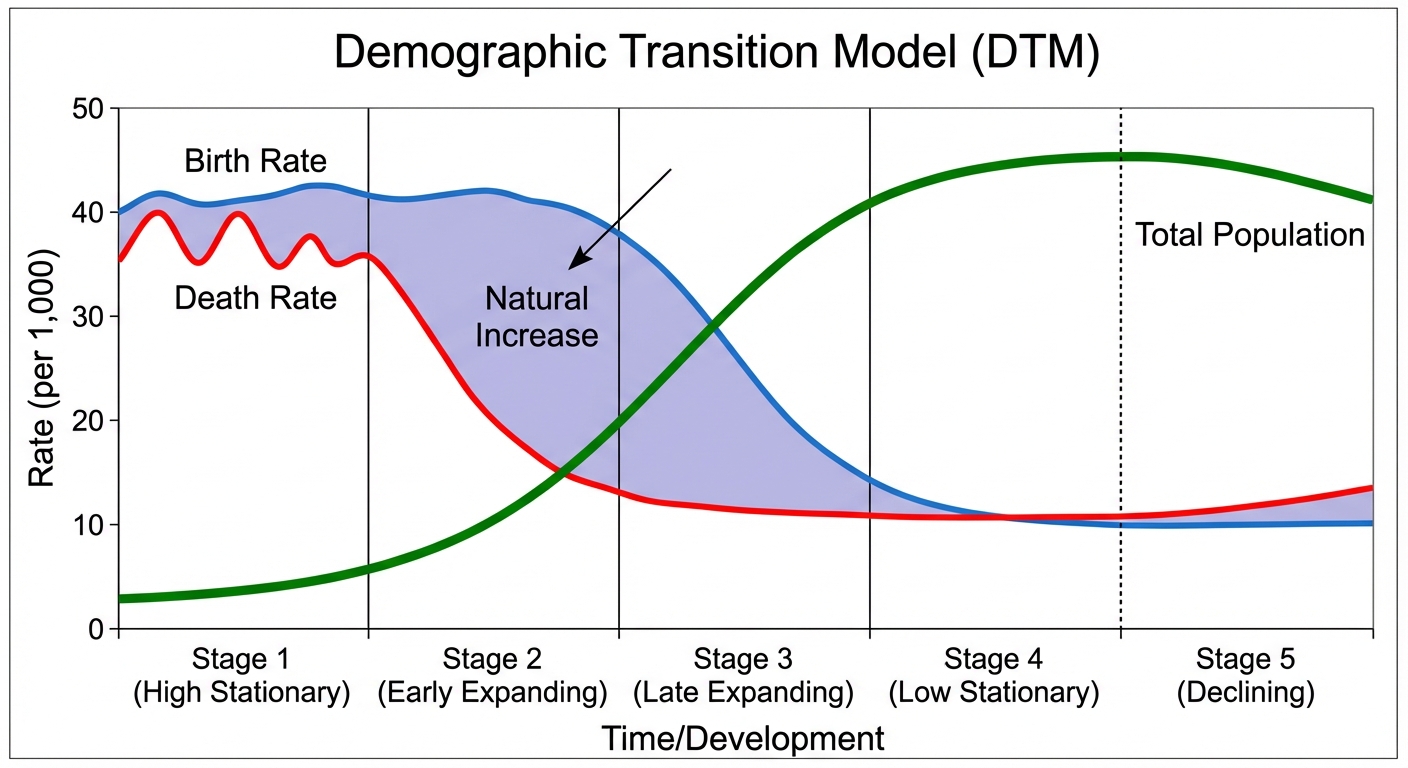
The DTM creates a framework for understanding how countries shift from high birth/death rates to low birth/death rates as they develop economically and culturally.
Stage 1: Low Growth
- CBR: Very High
- CDR: Very High (and fluctuating due to disease/famine)
- NIR: Low or Zero
- Drivers: Lack of clean water, medical care, or stable food supply. High births needed to offset high infant mortality.
- Example: No entire country is in Stage 1 today. Only isolated indigenous tribes.
Stage 2: High Growth
- CBR: High (remains stable)
- CDR: Rapidly declining
- NIR: Very High (Population Explosion)
- Drivers: The Industrial Revolution (mechanization) or the Medical Revolution (vaccines/antibiotics) reaches the society. People live longer, but cultural norms for large families persist.
- Example: Many countries in Sub-Saharan Africa (e.g., Niger, Mali).
Stage 3: Moderate Growth
- CBR: Rapidly declining
- CDR: Moderately declining
- NIR: Moderate
- Drivers: Urbanization (kids become an economic liability rather than an asset on a farm), increased female literacy, and access to family planning.
- Example: Mexico, India, Turkey (Newly Industrialized Countries).
Stage 4: Low Growth
- CBR: Low
- CDR: Low
- NIR: Zero or Low (Zero Population Growth - ZPG)
- Drivers: Women entering the workforce, delayed marriage, high cost of living.
- Example: United States, China, Denmark.
Stage 5: Declining (Theoretical/Emerging)
- CBR: Very Low (drops below CDR)
- CDR: Increasing (due to an aging population)
- NIR: Negative
- Drivers: Aging population places strain on the workforce; cultural shift toward having 0 or 1 child.
- Example: Japan, Germany, Russia.
Malthusian Theory and Critics
In 1798, Thomas Malthus published An Essay on the Principle of Population, sparking a debate that continues today.
The Core Theory
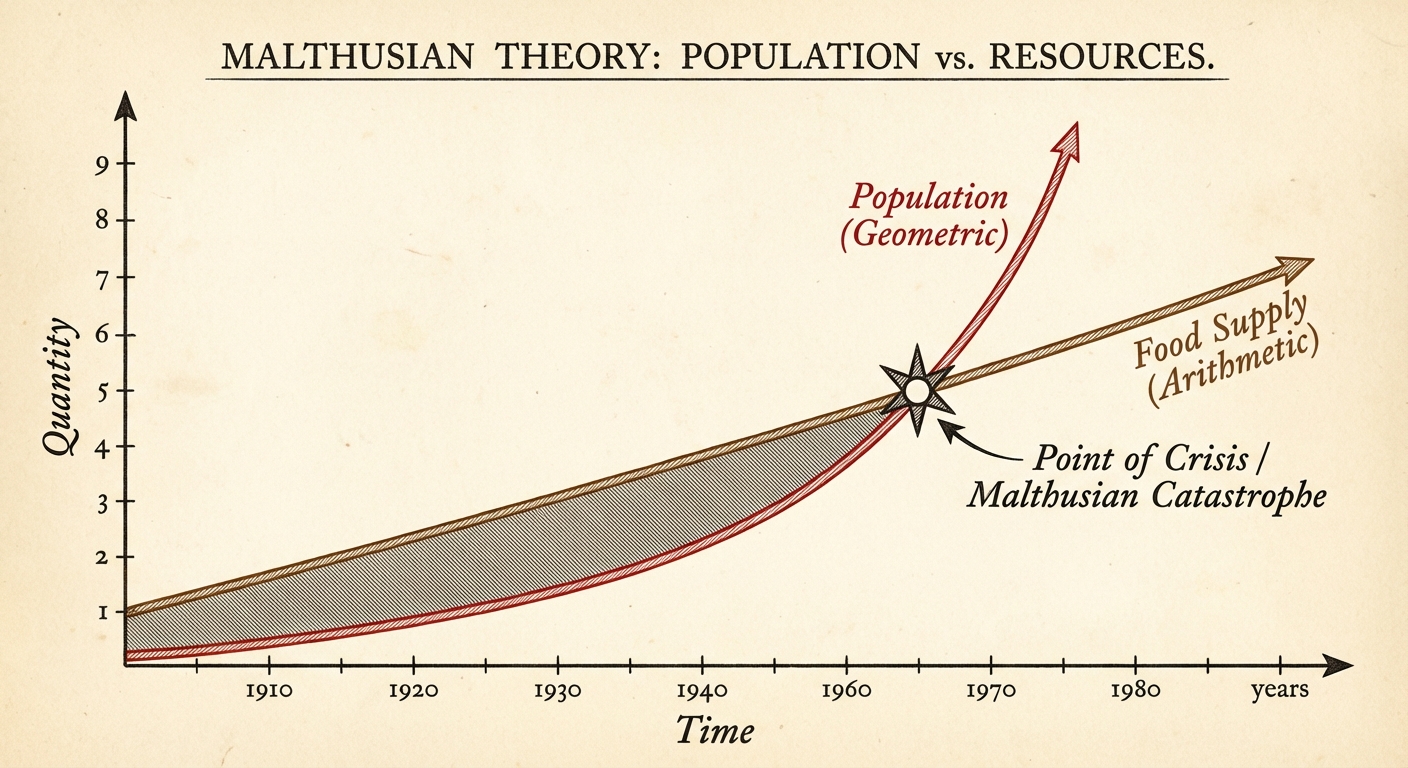
Malthus predicted that population growth would outpace food supply, leading to inevitable catastrophe.
- Population grows Geometrically (Exponentially): 1, 2, 4, 8, 16…
- Food supply grows Arithmetically (Linearly): 1, 2, 3, 4, 5…
Malthus identified "Checks" on population:
- Positive Checks: Events that increase deaths (War, Famine, Disease).
- Preventive Checks: Actions to lower birth rates (Moral restraint, delaying marriage).
Neo-Malthusians vs. Critics
| Perspective | Argument |
|---|---|
| Neo-Malthusians | Support Malthus but expand the concern beyond food. They argue that population growth in LDCs (Stage 2) is stripping resources like energy, clean water, and arable land, leading to conflict. |
| Critics (Boserup) | Ester Boserup argued that "necessity is the mother of invention." As population increases, humans develop new technologies (GMOs, fertilizers) to increase food production (intensification). |
Causes of Migration
Migration is a permanent move to a new location. People migrate due to a combination of Push Factors (reasons to leave) and Pull Factors (reasons to go).
Categories of Push/Pull Factors
- Economic (Most Common):
- Push: High unemployment, poverty.
- Pull: Job opportunities, higher wages.
- Cultural/Political:
- Push: Persecution, slavery, political instability, war.
- Pull: Democracy, freedom of religion, stable government.
- Environmental:
- Push: Natural disasters (hurricanes), desertification, flooding.
- Pull: Warm climates (e.g., the Sun Belt in the US), seaside/mountains.
Intervening Obstacles and Opportunities
Migrants rarely go from Point A to Point B without interruption.
- Intervening Obstacle: An environmental or political feature that hinders migration (e.g., a mountain range, a border wall, a visa requirement).
- Intervening Opportunity: A positive factor encountered en route that stops the migrant from reaching their original destination (e.g., finding a good job in a city halfway to the final goal).
Forced vs. Voluntary Migration
Classifying migration requires analyzing the element of choice. This is a critical distinction in AP Human Geography.
Voluntary Migration
The migrant has chosen to move, usually for economic reasons.
- Transnational Migration: Movement across international borders (e.g., Moving from Mexico to Canada).
- Internal Migration: Movement within a country.
- Interregional: Moving from one region to another (e.g., Rural China to Urban China).
- Intraregional: Moving within one region (e.g., City center to suburbs).
- Transhumance: The seasonal migration of livestock between mountains and lowland pasture areas.
Forced Migration
The migrant has been compelled to move by cultural or political factors. Three specific legal definitions are vital:
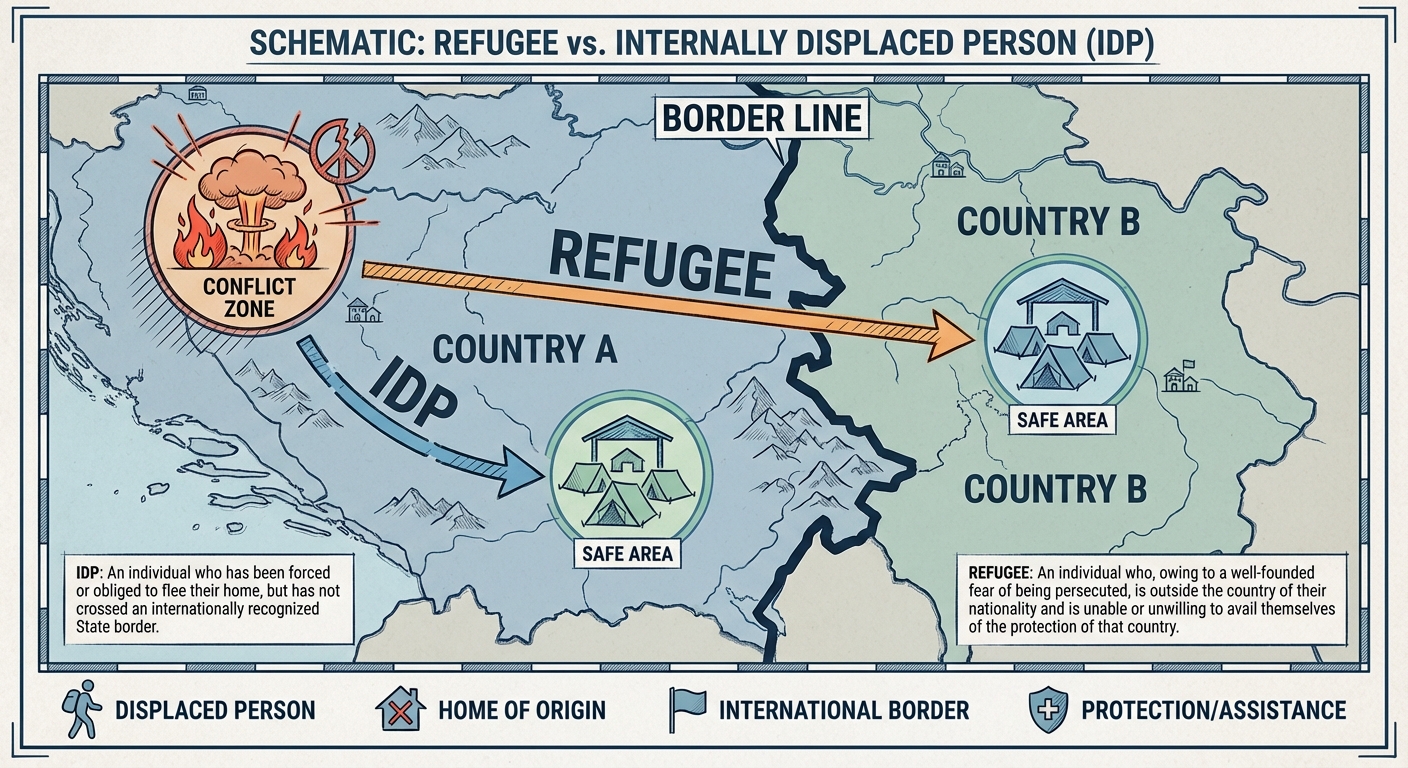
- Refugee: Someone forced to migrate to another country to avoid the effects of armed conflict, generalized violence, or violations of human rights.
- Internally Displaced Person (IDP): Someone who has been forced to migrate for similar political reasons as a refugee but has not crossed an international border.
- Asylum Seeker: Someone who has migrated to another country in the hope of being recognized as a refugee.
Patterns of Migration
- Step Migration: Migration occurs in stages (e.g., Farm → Village → Small Town → Major City).
- Chain Migration: Migration of people to a specific location because relatives or members of the same nationality previously migrated there.
Effects of Migration
On the Source Country
- Brain Drain: The loss of highly educated and skilled workers (doctors, engineers) to other countries.
- Remittances: Money sent back home by migrants. In some LDCs, remittances account for a significant portion of the GDP.
On the Destination Country
- Cultural Diffusion: Introduction of new foods, languages, and religions.
- Labor: Immigrants often fill labor shortages, particularly in low-wage sectors (agriculture, construction) or high-skill sectors (tech).
- Conflict: Rapid migration can lead to xenophobia or political tension regarding resource allocation.
Common Mistakes & Pitfalls
- Refugee vs. IDP: Students often conflate these. The only difference is the border crossing. An IDP stays in their home country; a refugee leaves it.
- NIR and Migration: Remember that the Natural Increase Rate ONLY includes births and deaths. It does not maintain the "Total Population Growth Rate," which includes migration.
- "Stage 1 Countries": Stop! Do not list any modern country as Stage 1 DTM. War-torn countries are not Stage 1; they are usually Stage 2 countries experiencing a temporary spike in CDR.
- Malthus and Food: Malthus was wrong about food production because he did not predict agricultural technology (Green Revolution). He was right that population can grow faster than resources, but technology shifted the curve.
- Chain vs. Step Migration: Chain involves who you are following (family/kin). Step involves how you get there (gradual geographic stops).