AP Euro Unit 2: The Age of Religious Wars (1560–1648)
Religious Wars and Social Upheaval
Overview
Transitioning from the initial theological debates of Luther and Calvin, the late 16th and early 17th centuries saw religion become the primary catalyst for devastating warfare. This period marks the shift from religious unity to religious pluralism and the rise of the sovereign state. The chaos of these wars also fundamentally altered European society, family structure, and culture.
The French Wars of Religion (1562–1598)
Origins and Factions
Civil war in France was driven by a power vacuum following the death of King Henry II and the rise of Calvinism. By 1560, roughly 10% of the French population were hugeunots (French Calvinists), but this included nearly 40-50% of the nobility, making them a significant political threat to the Catholic monarchy.
Three main families vied for influence:
- The Valois Family: The ruling Catholic dynasty (moderates), led effectively by the Queen Mother, Catherine de' Medici, who sought stability.
- The Guise Family: Ultra-Catholics backed by the Papacy and Jesuits; strongest in Paris and northern France.
- The Bourbon Family: Leaders of the Huguenots; strongest in the south and west.
The St. Bartholomew’s Day Massacre (1572)
This event is the hallmark of the conflict's savagery. A marriage was arranged between the King's sister (Margaret of Valois) and the Huguenot leader Henry of Navarre (Bourbon) to reconcile the factions. Instead, fueled by panic and Guise manipulation, Catholics massacred thousands of Huguenots gathered in Paris for the wedding. The violence spread to the provinces, killing approximately 20,000 Protestants.
The War of the Three Henrys & The Rise of the Politiques
The conflict culminated in the War of the Three Henrys (Henry III of Valois, Henry of Guise, and Henry of Navarre). Following the assassinations of the Catholic leaders, Henry of Navarre was the last man standing.
- Henri IV (Henry of Navarre): Becoming the first Bourbon king of France, he recognized that a Protestant king could not govern a staunchly Catholic Paris. He famously converted to Catholicism, allegedly stating, "Paris is well worth a mass."
- The Politiques: Henry IV embodied the concept of the politique—a ruler who places political stability and national unity above religious conformity.
The Edict of Nantes (1598)
Henry IV ended the wars by issuing the Edict of Nantes. This was a landmark document for religious toleration, though it was not about modern religious freedom. It granted Huguenots:
- The right to worship publicly in specific towns.
- The right to maintain fortified towns for defense.
- Civil rights and access to education.
The Thirty Years' War (1618–1648)
Causes and Context
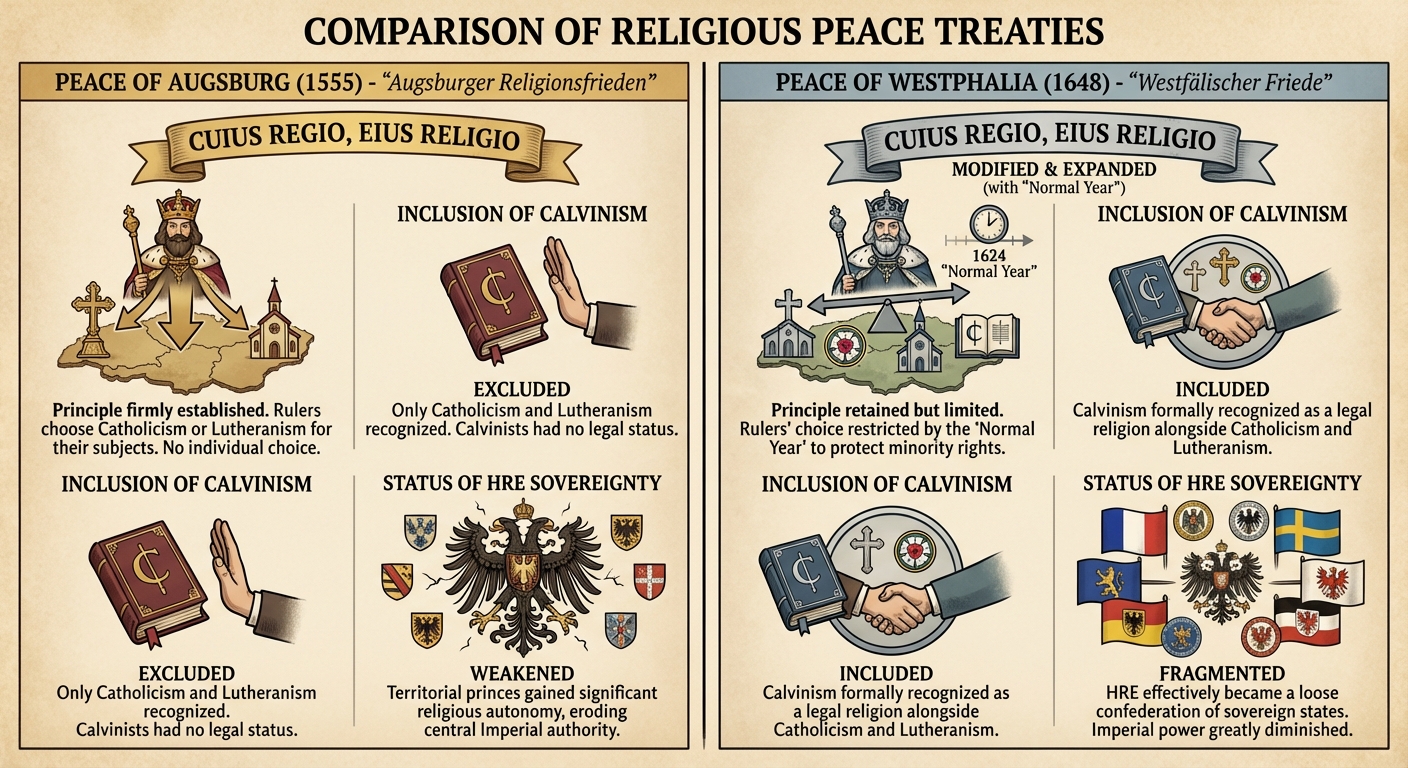
The Peace of Augsburg (1555) had recognized Lutheranism but explicitly excluded Calvinism. As the Holy Roman Empire (HRE) fragmented into hundreds of semi-autonomous states, religious tension coupled with the political ambition of the Habsburg dynasty (who wanted to consolidate imperial power) created a powder keg.
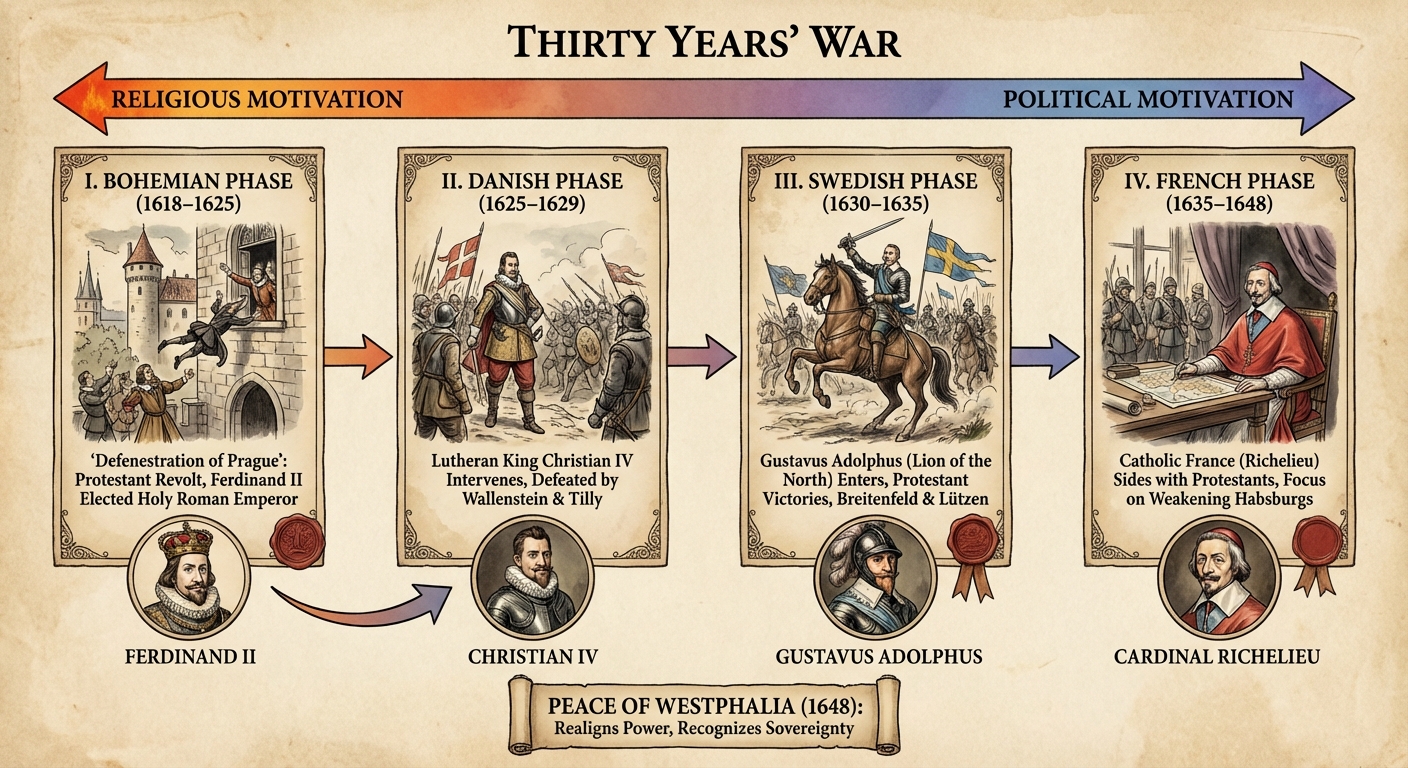
The Four Phases of War
The war is typically divided into four phases, marking a transition from a local religious conflict to a continent-wide political war.
1. The Bohemian Phase (1618–1625) - Local & Religious
- trigger: The Defenestration of Prague (Protestant nobles threw Catholic officials out of a castle window).
- Conflict: Catholic forces (Emperor Ferdinand II) defeated the Protestant forces at the Battle of White Mountain.
- Outcome: Bohemia was forcibly recatholicized.
2. The Danish Phase (1625–1629) - Local & Religious
- Lutheran Intervention: King Christian IV of Denmark intervened to support Protestants but was crushed by the imperial general Albrecht von Wallenstein.
- Edict of Restitution (1629): The Emperor declared all church territories secularized since 1552 must be returned to the Catholic Church. This terrified Protestant princes.
3. The Swedish Phase (1630–1635) - Continental & Political
- Gustavus Adolphus: The Lutheran King of Sweden, a military genius and father of modern warfare, led the Protestant forces. He was supported financially by Catholic France (Cardinal Richelieu).
- Significance: Richelieu's support proved that state interests (checking Habsburg power) now outweighed religious allegiance. Adolphus died in battle, but he stopped the Habsburg advance.
4. The French Phase (1635–1648) - Continental & Political
- Direct Conflict: France entered the war directly to destroy the Habsburgs. It was now a war of France (Catholic) vs. Spain/HRE (Catholic).
- Devastation: German lands were decimated; roughly one-third of the German population died due to famine, disease, and combat.
The Peace of Westphalia (1648)
This treaty is a major turning point in European history.
- Religious Outcome: Reinstated the Peace of Augsburg but added Calvinism as a legally permissible creed.
- Political Outcome: Recognized the sovereignty of the 300+ German princes, effectively nullifying the Holy Roman Emperor's political power. The HRE remained a loose confederation.
- Diplomatic Outcome: Established the modern system of international relations based on independent sovereign states and balance of power.
Effects of the Reformation on Society and Culture
Social Changes and Family Life
- Marriage and Women: Protestantism rejected celibacy, praising marriage as a divinely ordained state. The pastor's wife became a model of virtue. However, the closing of convents removed the only independent career path for Catholic women. Women were encouraged to be educated (literacy) primarily to read the Bible and instruct children.
- Education: The Reformation spurred an explosion in literacy due to the emphasis on Sola Scriptura (scripture alone). Schools were established to ensure believers could read the Bible.
The Witchcraft Craze (c. 1580–1650)
Religious uncertainty and social upheaval contributed to the "Great Witch Hunt."
- Victims: Approx. 80-90% were women, often older, single, or widowed (those without patriarchal protection).
- Causes: Religious reformers' emphasis on the devil's power, communal tensions in changing economic times, and lingering misogyny.
- Decline: The craze subsided as the Scientific Revolution introduced a more empirical worldview and religious wars ceased.
Art and Mannerism/Baroque
Art reflected the religious tensions of the era.
- Mannerism (e.g., El Greco): Featured distorted figures and confusing perspectives, reflecting the anxiety and chaos of the Reformation era.
- Baroque (e.g., Bernini, Rubens): Embraced by the Catholic Counter-Reformation (and absolute monarchs). It utilized dramatic lighting, intense emotion, and movement to inspire awe and religious devotion among the illiterate masses.
Common Mistakes & Pitfalls
- Confusing the Edicts: Students often confuse the Edict of Nantes (1598, granted toleration) with the Revocation of the Edict of Nantes (1685, Louis XIV took it away). Always check the date.
- 30 Years' War Motivations: A common error is thinking the Thirty Years' War was purely religious. By the 3rd and 4th phases (Swedish/French), it was primarily a political struggle between the Bourbons (France) and Habsburgs (HRE/Spain).
- Protestant Tolerance: Do not assume Protestants were inherently more tolerant than Catholics. Luther and Calvin both advocated for the suppression of "heresy" (e.g., Anabaptists) and did not believe in modern freedom of religion.
- Westphalia vs. Augsburg: Remember: Augsburg (1555) = rigid, local, excluded Calvinism. Westphalia (1648) = international, sovereignty-focused, included Calvinism.