Democracy, Sovereignty, and the Market Revolution
4.1 The Rise of Political Parties & Jeffersonian Democracy (1800–1816)
The Revolution of 1800
Definition: The election of 1800 is termed the "Revolution of 1800" not because of violence, but because it marked the first peaceful transfer of power from one political party (Federalists) to another (Democratic-Republicans) in modern history.
- The Election: Thomas Jefferson and Aaron Burr (both Democratic-Republicans) tied in the Electoral College. The Federalist-controlled House of Representatives had to break the tie.
- Hamilton’s Influence: Alexander Hamilton, though he despised Jefferson, lobbied for him over Burr, calling Burr “a most unfit and dangerous man.” Jefferson won on the 35th ballot.
- 12th Amendment (1804): To prevent future ties between running mates, this amendment was ratified to allow electors to vote specifically for a President and a Vice President.
Jefferson’s Presidency (1801–1809)
Jefferson championed a strict interpretation of the Constitution, limited federal government, and an agrarian society. However, his actions as president often contradicted his philosophy.
The Judiciary & Marbury v. Madison (1803)
Before leaving office, Federalist John Adams appointed "Midnight Judges" to maintain Federalist control of the judiciary.
- The Conflict: One appointee, William Marbury, sued Secretary of State James Madison for his commission.
- The Ruling: Chief Justice John Marshall (a Federalist) ruled that while Marbury deserved the commission, the law allowing the Court to force its delivery (Judiciary Act of 1789) was unconstitutional.
- Significance: This established Judicial Review—the Supreme Court's power to declare laws unconstitutional. This exerted federal power over states and other branches.
The Louisiana Purchase (1803)
- The Dilemma: Napoleon offered the Louisiana Territory for $15 million. Jefferson’s strict constructionist views clashed with the fact that the Constitution did not explicitly grant the president power to buy land.
- The Justification: Jefferson pragmatically used his treaty-making power to authorize the deal.
- Impact: Doubled the size of the U.S., secured control of the Mississippi River (New Orleans), and fueled the agrarian vision.
- Lewis and Clark Expedition: Commissioned to map the territory, establish relations with Native Americans, and check British influence.
The War of 1812
Often called the "Second War for Independence," fought between the U.S. and Great Britain.
- Causes:
- Impressment: British seizing American sailors and forcing them into the Royal Navy.
- Frontier Conflict: British supply of arms to Native American coalitions (led by Tecumseh).
- War Hawks: Young Congressmen like Henry Clay and John C. Calhoun eager for territory (Canada) and national honor.
- Key Events:
- Burning of Washington D.C.
- Battle of New Orleans: Andrew Jackson won a decisive victory after the peace treaty was signed, propelling him to national fame.
- Hartford Convention (1814): Federalists met to voice grievances and discuss secession. The timing (just as the war ended) made them look treasonous, leading to the death of the Federalist Party.
- Outcomes: Deepened American Nationalism and signaled the start of the "Era of Good Feelings."
4.2 The Era of Good Feelings & Rising Sectionalism (1816–1824)
The "Era of Good Feelings"
A period dominated by one political party (Democratic-Republicans) effectively ruling without opposition after the collapse of the Federalists. However, the name is a misnomer due to rising economic and sectional tensions.
The Marshall Court: Expanding Federal Power
Chief Justice John Marshall continued to issue rulings that prioritized federal supremacy over states' rights.
| Case | Ruling & Significance |
|---|---|
| McCulloch v. Maryland (1819) | Ruled that states cannot tax federal agencies (Bank of U.S.). Established Implied Powers via the "Necessary and Proper" clause. |
| Gibbons v. Ogden (1824) | Ruled that only the federal government can regulate interstate commerce, striking down a NY steamboat monopoly. |
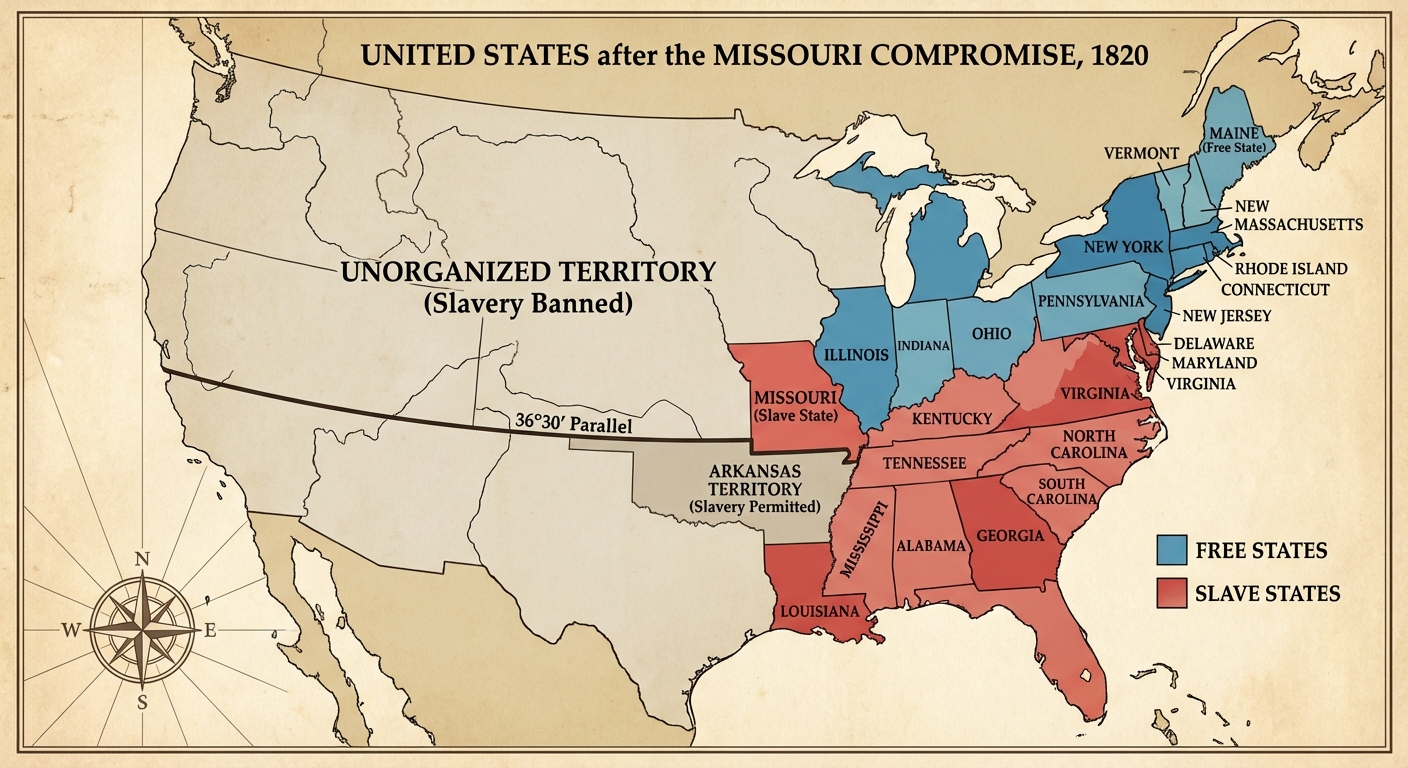
The Missouri Compromise (1820)
The first major legislative crisis regarding the expansion of slavery.
- The Issue: Missouri applied for statehood as a slave state, threatening the balance of power in the Senate (11 free states vs. 11 slave states).
- The Solution (Henry Clay):
- Missouri enters as a slave state.
- Maine enters as a free state.
- 36°30' Line: Slavery prohibited in the Louisiana Territory north of this latitude (except Missouri).
The Monroe Doctrine (1823)
Authored largely by John Quincy Adams, this foreign policy statement asserted:
- The Western Hemisphere is closed to further European colonization.
- The U.S. will not interfere in European affairs.
- Any attempt by Europe to control independent nations in the Americas would be viewed as a threat to U.S. security.
4.3 The Age of Jackson (1824–1840)
The Rise of Mass Democracy
Between 1824 and 1840, property requirements for voting were eliminated in most states, leading to Universal White Male Suffrage. Voter turnout exploded.
The Election of 1824 & The "Corrupt Bargain"
- Andrew Jackson won the popular vote but lacked an electoral majority.
- The House of Representatives decided the winner. Speaker Henry Clay threw support to John Quincy Adams.
- Adams made Clay Secretary of State. Jackson denounced this as a "Corrupt Bargain."
Jacksonian Democracy
Winning in 1828, Jackson presented himself as the champion of the "Common Man."
- Spoils System: Replacing government officials with political supporters. Jackson argued this "rotation in office" prevented corruption.
- Veto Power: Used the veto more than all previous presidents combined, strengthening the executive branch.
Key Crises of the Jackson Era
1. The Nullification Crisis (1828–1832)
- Tariff of Abominations (1828): High tariffs protected Northern industry but hurt the Southern economy.
- Nullification Theory: John C. Calhoun argued states could void unconstitutional federal laws.
- Outcome: S.C. threatened secession. Jackson threatened military force (Force Bill). Henry Clay negotiated a compromise tariff lowering rates gradually.
2. The Bank War (1832)
- Jackson distrusted the Second Bank of the United States (BUS), viewing it as a tool for the elite.
- He vetoed the bank's recharter and withdrew federal funds, placing them in state "Pet Banks."
- Consequence: This destabilized the economy and contributed to the Panic of 1837.
3. Indian Removal Act (1830)
- Aimed to open land in the South for cotton production (white settlement).
- Worcester v. Georgia (1832): The Supreme Court ruled that the Cherokee Nation was sovereign and Georgia laws did not apply to them. Jackson reportedly defied the ruling: "John Marshall has made his decision; now let him enforce it."
- Trail of Tears: The forced removal of Cherokees to Oklahoma territory; thousands died from disease and starvation.
The Second Party System
By the mid-1830s, a two-party system re-emerged:
- Democrats (Jackson): Limited federal power, lower tariffs, rights of the "common man," supported by South/West.
- Whigs (Clay/Webster): Strong federal government, American System, moral reform, supported by New England/wealthy merchants.
4.4 The Market Revolution
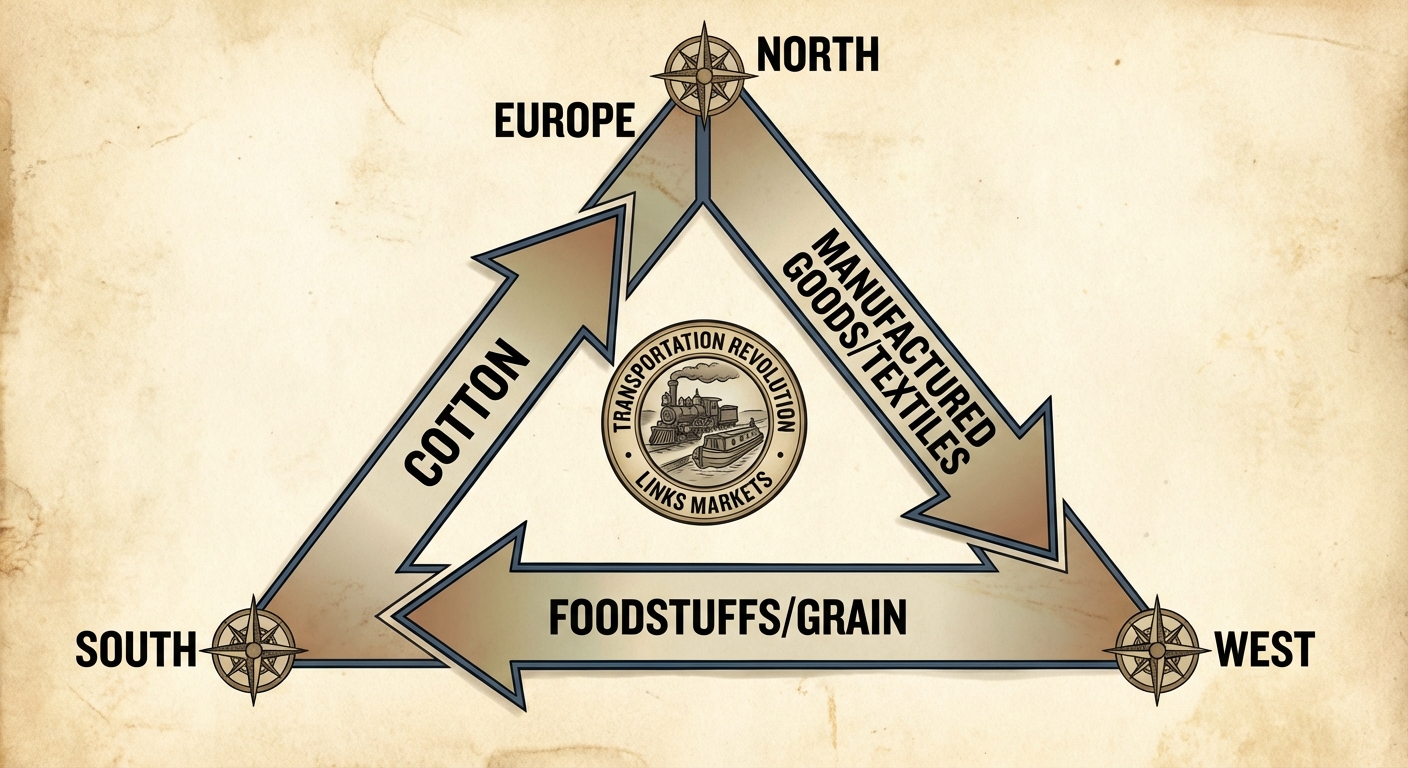
Definition: A drastic transformation of the economy characterized by a shift from subsistence farming to a national network of industry and commerce.
1. The Transportation Revolution
New technology lowered shipping costs and linked regional economies.
- Roads: The Cumberland (National) Road linked Maryland to Illinois.
- Canals: The Erie Canal (1825) connected the Great Lakes to NYC, cutting shipping costs by 90% and making NYC the economic capital.
- Steamboats: Allowed upstream travel on rivers (Robert Fulton).
- Railroads: By the 1840s, trains began to replace canals as the dominant transport method.
2. Industrialization & Tech
- Cotton Gin (Eli Whitney): Made cotton processing 50x more efficient. Consequence: Revitalized slavery in the South.
- Interchangeable Parts (Eli Whitney):Allowed for mass production and easier repair of goods.
- Textile Mills (Lowell System): Concentrated in New England. Initially employed "Lowell Girls" (farmers' daughters) under strict supervision. By the 1840s, they were replaced by Irish immigrants willing to work for lower wages.
- McCormick Reaper & Steel Plow: Mechanized agriculture in the West.
3. Henry Clay’s American System
A Whig economic plan to unify the nation:
- Protective Tariffs: To shield US industry.
- National Bank: To stabilize credit.
- Internal Improvements: Federally funded roads/canals (mostly blocked by Democrats like Madison and Monroe who questioned constitutionality).
4.5 Society, Culture, and Reform (1820–1860)
The Second Great Awakening
A massive religious revival emphasizing spiritual rebirth and perfectionism. Preachers like Charles Grandison Finney argued that individuals could save themselves and society through good works.
- Impact: Fueled the Reform Movements (Temperance, Abolition, Women's Rights).
- Mormonism: Founded by Joseph Smith. Fled persecution to Utah under Brigham Young.
Reform Movements
- Temperance: The most popular movement; aimed to reduce alcohol consumption (American Temperance Society).
- Penitentiary & Asylum Reform: Dorothea Dix exposed abuse of the mentally ill, leading to the creation of professional asylums.
- Education: Horace Mann advocated for public tax-supported schools, longer school years, and teacher training.
The Abolitionist Movement
shifted from "gradualism" to "immediatism."
- William Lloyd Garrison: Published The Liberator, demanding immediate, uncompensated emancipation.
- Frederick Douglass: Escaped slave, orator, and writer (The North Star).
- Nat Turner’s Rebellion (1831): Violent slave uprising in Virginia. Resulted in harsher Slave Codes and ended Southern debate on emancipation.
Women’s Rights
Women were active in abolition but barred from leadership, alerting them to their own lack of rights.
- Cult of Domesticity: The prevailing view that a woman’s sphere was the home (private sphere) and her role was to civilize the husband and family.
- Seneca Falls Convention (1848): Organized by Elizabeth Cady Stanton and Lucretia Mott.
- Declaration of Sentiments: Modeled on the Declaration of Independence; stated "all men and women are created equal."
Transcendentalism
A philosophical movement prioritizing intuition, nature, and self-reliance over established institutions.
- Ralph Waldo Emerson: Urged Americans to create a unique culture (