AP United States History Unit 2: Migration and Settlement
2.1 European Colonization Patterns (1607–1754)
Comparison of European Imperial Goals
Different European powers pursued distinct strategies in North America, influenced by their economic goals and religious motivations.
- Spanish (Southwest/Florida):
- Goal: Extraction of wealth (gold/silver) and religious conversion.
- Relations: rigid class system (Casta system); subjugation of Natives through the Encomienda system; Catholic evangelism (missions).
- Key Event: Pueblo Revolt (1680) — The Pueblo people, led by Popé, successfully drove the Spanish out of New Mexico for 12 years due to forced religious conversion and harsh treatment. It remains the most successful Native uprising in North American history.
- French & Dutch (Northeast/Canada/New Amsterdam):
- Goal: Trade alliances, specifically for furs (beaver pelts).
- Relations: collaborative; more intermarriage (Métis in French culture); fewer permanent settlers compared to the British.
- Dutch: Established New Netherland (1614) as a commercial hub. It was diverse and tolerant but small. Taken by the British in 1664 and renamed New York.
- British (Atlantic Coast):
- Goal: Agricultural settlement, land acquisition, and social mobility.
- Relations: Exclusionary. Unlike the Spanish (who subjugated) or French (who allied), the British sought to remove Natives from the land to make room for families and farms.
British Corporate Structures
- Joint-Stock Companies: Investors pooled money to fund colonization, sharing risk and profit (e.g., Virginia Company).
- Proprietorships: Land granted by the King to an individual (e.g., William Penn’s Pennsylvania, Lord Baltimore’s Maryland).
- Royal Colonies: Controlled directly by the Crown (e.g., Virginia after 1624).
2.2 The British Colonial Regions
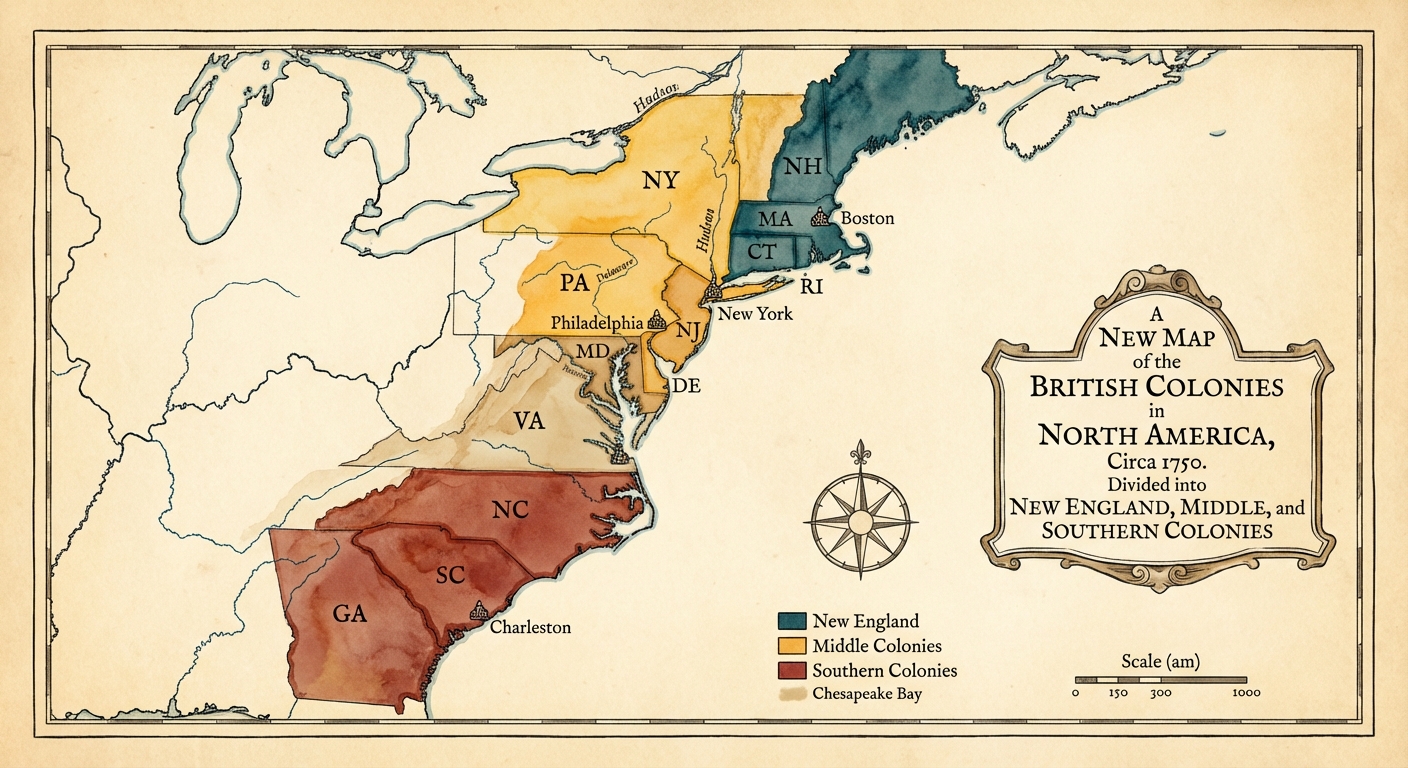
The British colonies developed into four distinct regions based on geography, climate, and resources.
1. The Chesapeake (Virginia & Maryland)
- Environment: Fertile land, long growing season, unhealthy swampy areas (malaria/dysentery).
- Economy: Defined by Tobacco. This labor-intensive cash crop required a large workforce.
- Labor Systems:
- Initially relied on Indentured Servants (Headright System: 50 acres of land for every immigrant sponsored).
- Shifted to Chattel Slavery (lifelong, inheritable property) after Bacon's Rebellion (1676).
- Religion: Anglican dominate; Maryland founded as a Catholic haven (Act of Toleration 1649—granted freedom to all Christians but death to non-Christians).
2. New England (MA, CT, RI, NH)
- Environment: Rocky soil, short growing season, natural harbors.
- Economy: Mixed economy (subsistence farming, shipbuilding, fishing, lumber).
- Society: Founded by Puritans seeking religious freedom (for themselves).
- Settled by family units (higher birth rates, longer life expectancy).
- Town-hall meetings (direct democracy).
- "City upon a Hill": John Winthrop’s sermon expressing the desire to be a model Christian society.
- Dissenters:
- Roger Williams: Banished, founded Rhode Island on separation of church and state.
- Anne Hutchinson: Banished for challenging clerical authority (Antinomianism).
3. The Middle Colonies (NY, NJ, PA, DE)
- Environment: Fertile soil, moderate climate.
- Economy: The "Breadbasket" (wheat/grain export), trade hubs (Philadelphia, NYC).
- Society: Most diverse region ethnically (Scots-Irish, German) and religiously.
- Pennsylvania: Founded by William Penn (Quaker). Pacifist, friendly relations with Natives initially, religious tolerance, opposed slavery (early abolitionism).
4. The Southern Colonies (NC, SC, GA, British West Indies)
- Environment: Long growing seasons.
- Economy: Plantation agriculture exporting staple crops.
- South Carolina: Rice and Indigo.
- West Indies: Sugar (the most profitable and deadly crop).
- Labor: Heavy reliance on enslaved Africans. In SC and the West Indies, enslaved people often outnumbered whites.
Comparison Table: Regional Characteristics
| Feature | New England | Middle Colonies | Chesapeake/South |
|---|---|---|---|
| Life Expectancy | High (70 years) | Moderate | Low (40s often) |
| Economy | Commerce, Shipbuilding | Grains, Trade | Tobacco, Rice, Indigo |
| Family Structure | Tight-knit families | Mixed | scattered, single males |
| Religion | Puritan (Congregational) | Quaker, Diverse | Anglican/Catholic |
2.3 Transatlantic Trade and Mercantilism
Economic Theory: Mercantilism
Mercantilism is the economic theory that a nation's power is determined by its wealth (gold/silver) and a favorable balance of trade (export > import).
- Role of Colonies: Provide raw materials to the Mother Country and purchase manufactured goods from the Mother Country.
The Navigation Acts (1651–1673)
Laws passed by Britain to enforce mercantilism:
- Trade to/from colonies must be on British/colonial ships.
- "Enumerated goods" (tobacco, sugar) could only be exported to England.
- Goods from other countries bound for colonies had to pass through English ports (for battering/taxation).
- Impact: Boosted New England shipbuilding but limited colonial manufacturing (e.g., Wool Act 1699, Molasses Act 1733).
- Salutary Neglect: From roughly 1713 to 1763, Britain rarely enforced these rules rigorously, allowing colonies to develop self-government and autonomy. This "benign neglect" ended after the French and Indian War, causing friction.
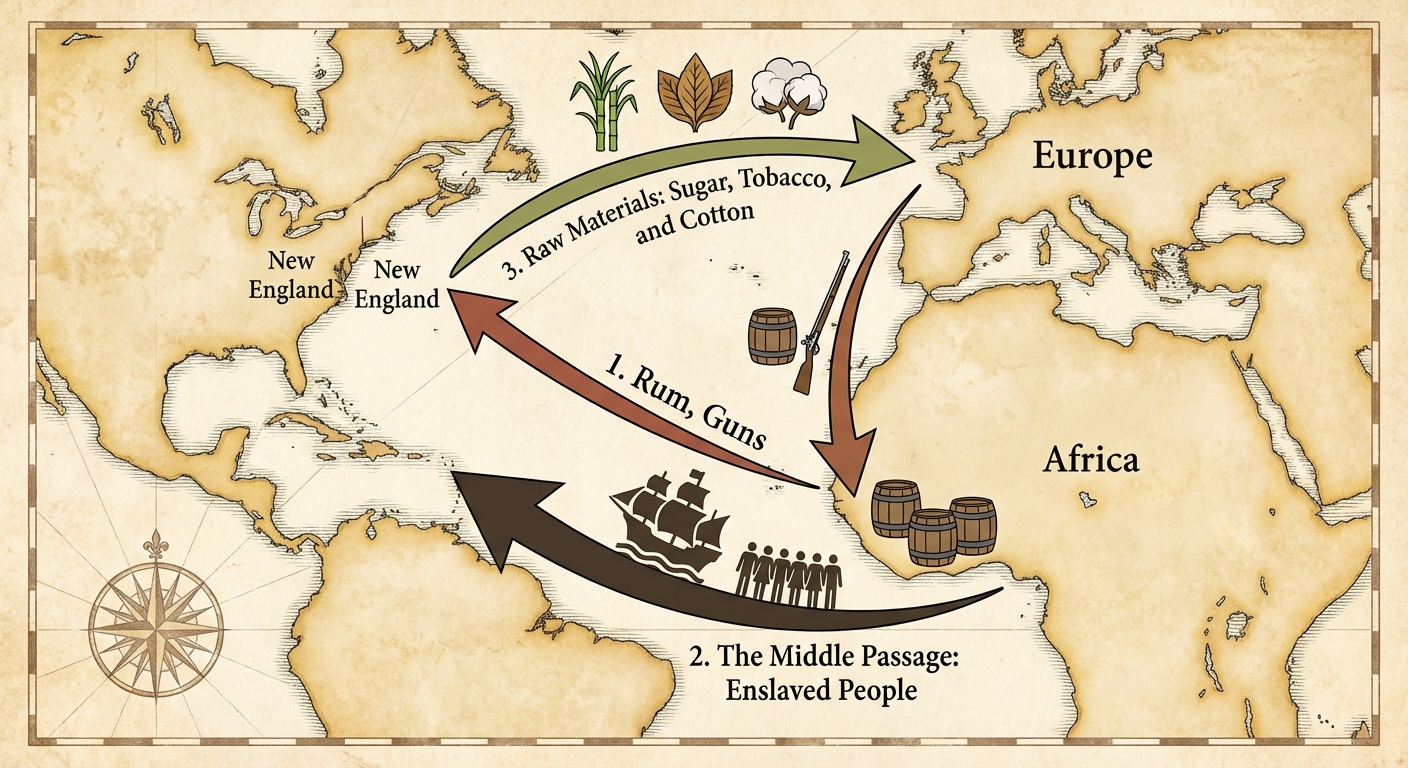
The Triangular Trade
A complex trading network connecting Europe, Africa, and the Americas.
- New England/Europe to Africa: Rum, guns, manufactured goods.
- Africa to Americas (The Middle Passage): Enslaved Africans.
- Americas to Europe: Raw materials (sugar, tobacco, cotton).
2.4 Interactions Between Natives and Europeans
Conflict and Displacement
As British colonists expanded westward, conflict was inevitable.
- Powhatan Wars (1610–1646, VA): Early conflict in the Chesapeake ending in the segregation of Native and Colonial lands.
- King Philip’s War (Metacom's War, 1675–1676, New England):
- Cause: Encroachment on Wampanoag land.
- Event: Metacom united tribes to attack settlements; initially successful, destroying 12 towns.
- Outcome: Metacom killed; Native resistance in New England effectively ended.
Bacon's Rebellion (1676)
A pivotal turning point in colonial history occurring in Virginia.
- Players: Nathaniel Bacon (backcountry farmers/former indentured servants) vs. Governor William Berkeley (coastal elite).
- Causes:
- Class tension: Poor farmers felt unprotected from Native attacks on the frontier.
- Political power: Resentment of the Governor's "inner circle."
- Events: Bacon burned Jamestown.
- Significance: The elite realized indentured servants were a volatile population. This accelerated the shift toward chattel slavery, which was viewed as a more controllable labor source based on race.
Accommodation
- Praying Towns (New England): Settlements established by Puritans to convert Natives to Christianity and English culture.
- Covenant Chain: Alliance between the Iroquois Confederacy and the colony of New York.
2.5 Slavery in the British Colonies
Evolution of Slavery
Slavery existed in all 13 colonies, but the systems differed.
- Definition: Chattel Slavery defined enslaved people legally as property, not humans. Status was inherited from the mother.
- Northern Slavery: Slaves worked as dockworkers, farmhands, or servants. Smaller population.
- Southern Slavery: Plantation-based gang labor systems. Deep integration into the economy.
- Slave Codes: Laws passed to control rights.
- Barbados Slave Code (1661): Influential code that denied fundamental rights and gave masters complete control; adopted by South Carolina.
Resistance to Slavery
Enslaved people resisted their dehumanization through both overt and covert means.
- Covert (Hidden) Resistance: Breaking tools, working slowly (slow-downs), feigning illness, maintaining African cultural traditions (names, food, music).
- Overt (Open) Resistance:
- Stono Rebellion (1739, SC): The largest slave uprising in the British mainland colonies. 20 slaves stole guns near the Stono River, marching toward Spanish Florida (where they were promised freedom). They killed storekeepers and burned plantations before being stopped by militia.
- Result: South Carolina passed the Negro Act of 1740, severely restricting slave assembly, education, and movement.
2.6 Colonial Society and Culture
Anglicization
The process by which colonial elites began to adopt English customs, architecture, fashion, and print culture. Despite growing distinct, colonists saw themselves as British subjects entitled to British rights.
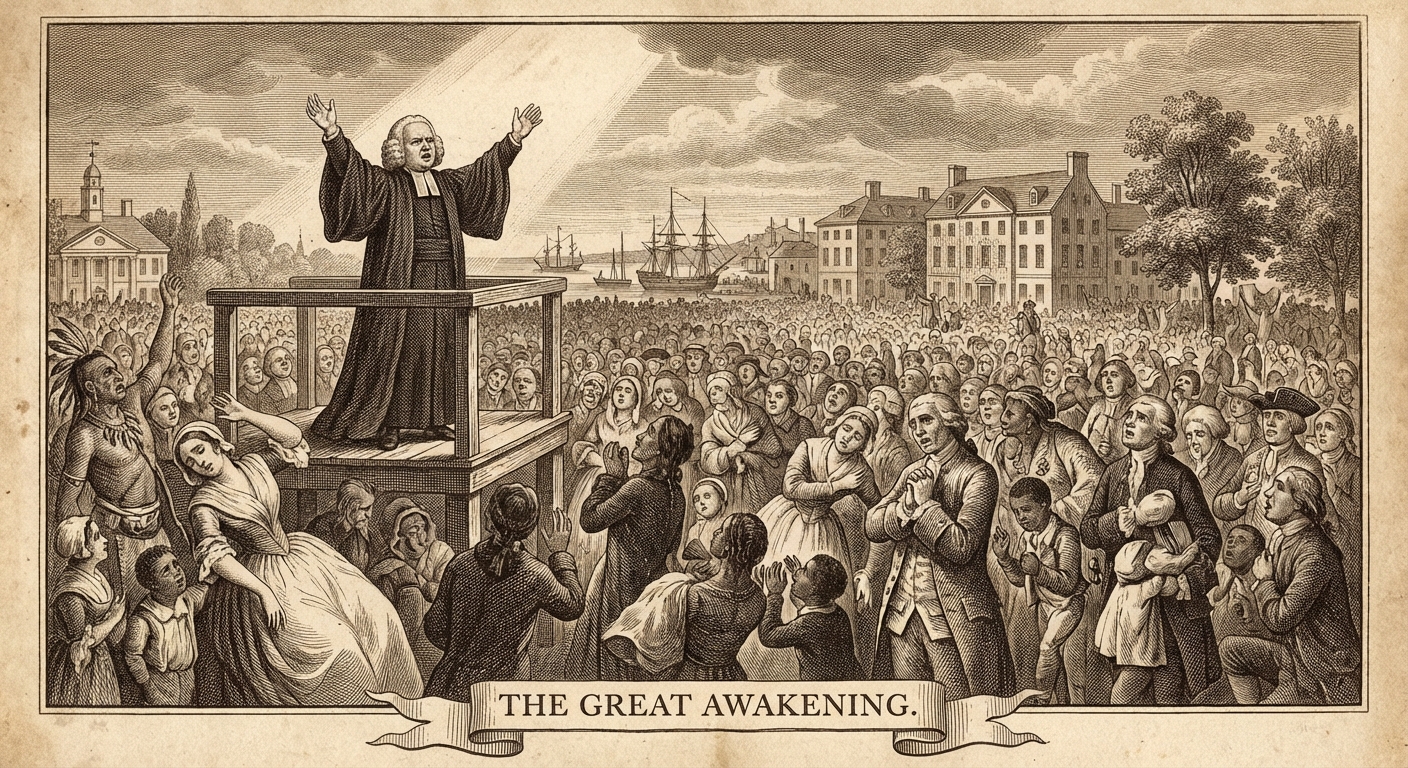
The First Great Awakening (1730s–1740s)
A massive religious revival that swept through all colonies.
- Key Figures:
- Jonathan Edwards: "Sinners in the Hands of an Angry God." Preached Calvinist predestination and emotional repentance.
- George Whitefield: Itinerant (traveling) preacher who drew massive crowds (Ben Franklin was impressed by his projection). Stressed personal salvation over clerical authority.
- Impact:
- Split churches into "Old Lights" (traditional, rational) and "New Lights" (emotional, revivalist).
- First shared, mass movement in American history.
- Democratization of Religion: By challenging church authority, it inadvertently taught colonists to challenge political authority later.
The Enlightenment
An intellectual movement emphasizing reason, science, and individual rights.
- John Locke: Two Treatises of Government. Argued for Natural Rights (Life, Liberty, Property) and the right to rebel if government fails to protect them.
- Benjamin Franklin: The embodiment of the American Enlightenment (science, invention, civic organizations).
Freedom of the Press
- Zenger Trial (1735): John Peter Zenger imprisoned for criticizing the Governor of New York.
- Defense: His lawyer argued that truth is a defense against libel.
- Verdict: Acquitted. Established the precedent that citizens could criticize government if the criticisms were true.
Gender Roles
- Society was patriarchal. Women lost property rights upon marriage (coverture).
- Salem Witch Trials (1692): Mass hysteria in MA where 19 people were executed. Causes included religious extremism, class tensions (poor farmers accusers vs. wealthy merchants accused), and misogyny.
2.7 Common Mistakes & Pitfalls
- Mistake: Confusing the Chesapeake (VA/MD) with the Deep South (SC/GA).
- Correction: Chesapeake grew tobacco; the Deep South grew rice/indigo and had a much higher density of enslaved people.
- Mistake: Assuming Puritans believed in "Religious Freedom."
- Correction: Puritans wanted freedom from the Anglican church for themselves, but they were intolerant of others (Quakers, Catholics, Baptists).
- Mistake: Thinking resistance to slavery only meant rebellion.
- Correction: Violent rebellion was rare and suicide. Most resistance was "silent"—cultural preservation, work slowdowns, and running away.
- Mistake: Overlooking Native American Agency.
- Correction: Natives weren't just victims; they used alliances (like the Covenant Chain) and European rivalries (French vs. British) to their advantage when possible.