Period 2 Review: The Growth of British North America (1607–1754)
Comparisons of Regional Colonial Development
In AP United States History, Period 2 is defined by the establishment of permanent colonies and the development of distinct regional identities. While all British colonies were part of the Atlantic world, geography, motivation for settlement, and labor systems created three distinct colonial regions: New England, the Middle Colonies, and the Southern Colonies (including the Chesapeake).
New England Colonies
Location: Massachusetts, Rhode Island, Connecticut, New Hampshire.
- Motivation: Primarily religious freedom. Settled by Puritans seeking to purify the Anglican Church. John Winthrop famously declared they would build a "City upon a Hill" (a model Christian community).
- Economy: The rocky soil and long winters made large-scale plantations impossible. Instead, the economy was mixed: subsistence farming, shipbuilding, fishing, and lumber.
- Society: Close-knit, homogeneous communities centered around the church and the school. They had high life expectancies and migrated as families.
- Politics: Town Hall Meetings allowed adult male church members to vote directly on local issues, an early form of direct democracy.
The Middle Colonies
Location: New York, Pennsylvania, New Jersey, Delaware.
- Motivation: Economic opportunity and religious tolerance. Pennsylvania was founded by William Penn as a refuge for Quakers, who believed in non-violence and equality.
- Economy: Known as the "Breadbasket Colonies" because of their massive export of cereal crops (wheat, barley, oats). They also utilized distinct rivers for fur trade and shipping.
- Society: The most diverse region ethnically and religiously. It included Dutch, Germans, Scots-Irish, and English dissenters. Generally more tolerant than New England.
The Southern and Chesapeake Colonies
Location:
Chesapeake: Virginia, Maryland.
Deep South: North Carolina, South Carolina, Georgia.
Motivation: Primarily economic profit. The Jamestown colony (1607) was established by a joint-stock company looking for gold/commodities.
Economy: Dominated by the Plantation System exporting cash crops.
- Chesapeake: Tobacco (labor-intensive, exhausted the soil).
- Deep South: Rice and Indigo.
Society: Rigid hierarchy. Wealthy planters held power; poor whites and landless tenants were the majority of free people; enslaved Africans eventually became the majority of the population in places like South Carolina.
Politics: dominated by the planter elite (e.g., the House of Burgesses in Virginia).
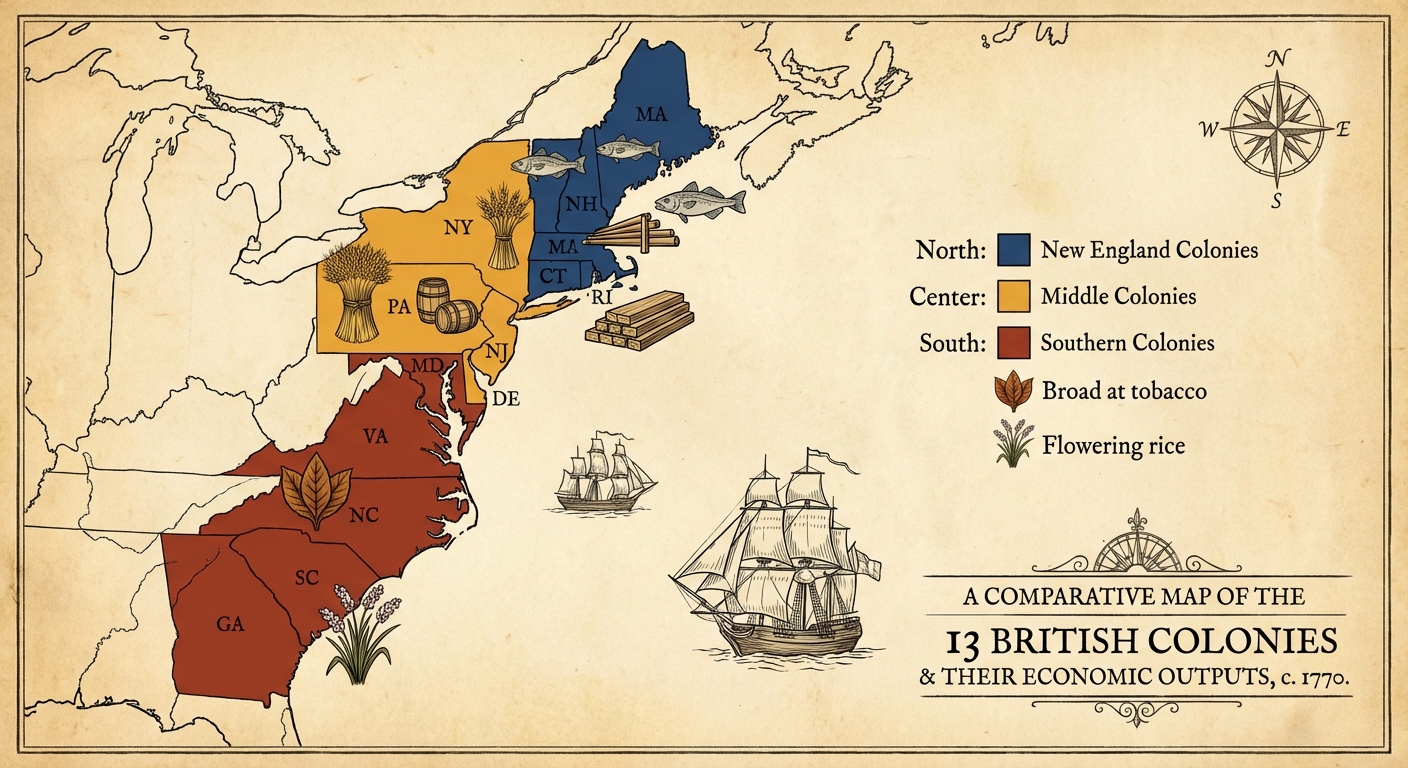
Regional Comparison Table
| Feature | New England | Middle Colonies | Southern/Chesapeake |
|---|---|---|---|
| Primary Crops | None (Subsistence) | Wheat, Oats, Barley | Tobacco, Rice, Indigo |
| Labor System | Family Labor | Indentured Servants/wage labor | Indentured Servants $\rightarrow$ Enslaved Africans |
| Demographics | Homogeneous (English Puritan) | Diverse (German, Dutch, Scots-Irish) | Bi-racial (White/Black), low density |
| Governance | Town Meetings (Direct Democracy) | Representative Assemblies | Elite-dominated Assemblies |
The Evolution of Slavery in the British Colonies
Slavery existed in all British colonies, but the systems differed significantly by region. The transition from a society with slaves to a full slave society was most pronounced in the South.
From Indentured Servitude to Chattel Slavery
Initially, the Chesapeake relied on Indentured Servants—poor Europeans who signed contracts to work for 5–7 years in exchange for passage to America.
Why the shift occurred:
- Economic Recovery: Wages rose in England, reducing the supply of willing servants.
- Bacon's Rebellion (1676): A rebellion of landless, frustrated former indentured servants in Virginia led wealthy planters to fear poor whites. They sought a more controllable, permanent labor source.
- Chattel Slavery: Laws were passed establishing that enslaved people were property (chattel) for life, and this status was hereditary.
The Atlantic Slave Trade
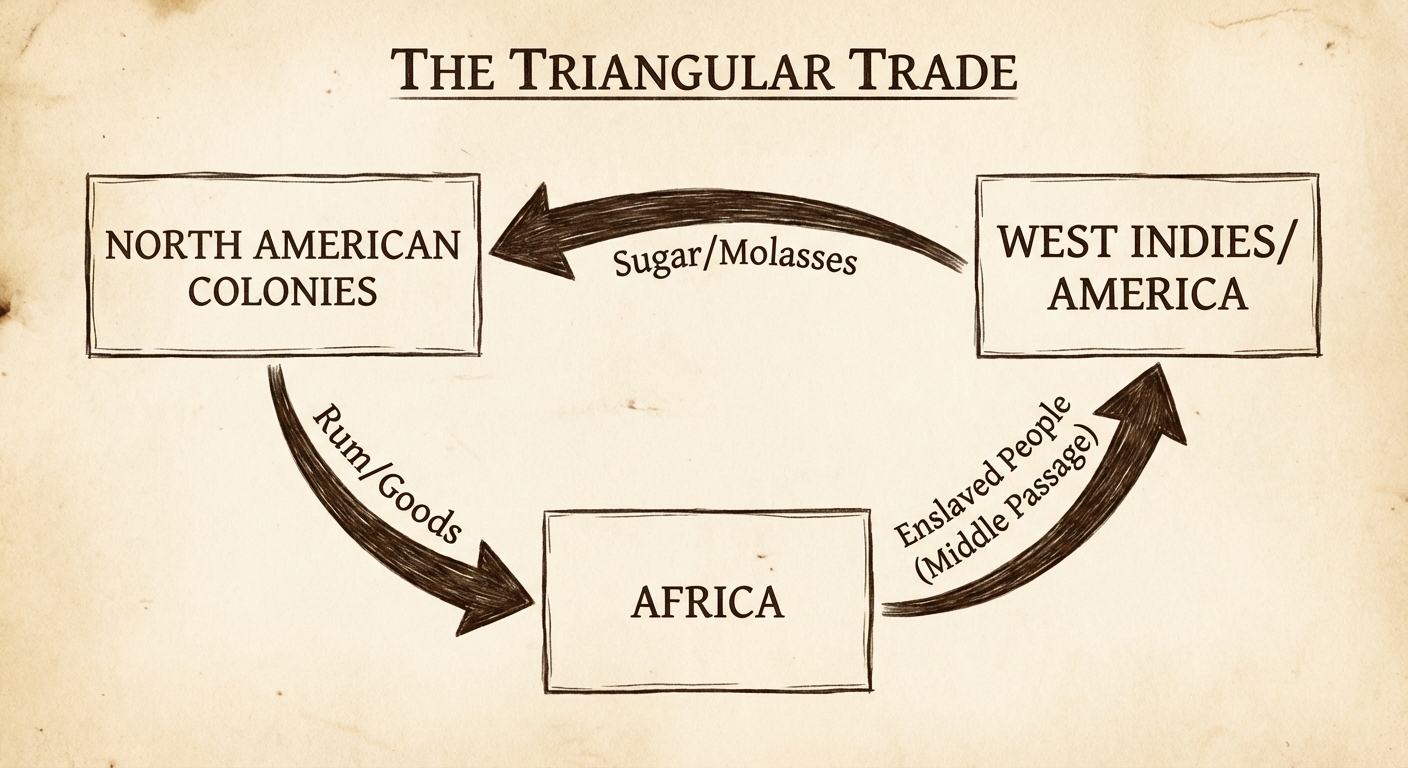
The colonies were integrated into the Triangular Trade network.
- New England: Exported rum to Africa.
- Africa: Exported enslaved people to the Americas via the Middle Passage (a horrific journey with high mortality rates).
- West Indies/South: Exported sugar and molasses to New England.
Resistance to Slavery
Enslaved people resisted the dehumanizing nature of chattel slavery through both overt and covert means.
- Covert (Hidden): Working slowly, breaking tools, maintaining African cultural traditions (naming patterns, music, religion), and running away.
- Overt (Violent):
- Stono Rebellion (1739): One of the largest slave uprisings in the British colonies (South Carolina). Enslaved men seized weapons and tried to march to Spanish Florida (where they were promised freedom). It resulted in stricter slave codes.
Interactions Between American Indians and Europeans
Relationships generally followed a pattern of initial cooperation (trade) followed by conflict over land and resources.
Conflicting Worldviews
- Land Use: Europeans viewed land as a commodity to be privately owned and fenced. Native Americans generally viewed land as a communal resource to be utilized but not "owned."
- Gender Roles: Many Native societies (like the Iroquois) were matrilineal (power passed through women), whereas European societies were strictly patriarchal.
Cycles of Conflict
As English colonists expanded westward, conflicts erupted. Unlike the French (who focused on fur trade and intermarriage), the English sought to remove Native populations to take their land.
- The Beaver Wars (mid-1600s): The Iroquois Confederacy, armed by Dutch and English allies, fought the French-backed Algonquian tribes to control the fur trade.
- King Philip's War (Metacom's War, 1675–1676):
- Context: New England colonists encroached on Wampanoag land.
- Event: Metacom (King Philip) built a pan-Indian alliance to destroy English settlements.
- Outcome: The war was devastating for both sides, but it effectively ended Native American resistance in New England.
- Pueblo Revolt (1680):
- Context: While this occurred in the Spanish Southwest, it is a vital comparison. The Spanish suppressed Native religion.
- Event: Pope led a successful revolt that drove the Spanish out of New Mexico for 12 years.
- Outcome: When the Spanish returned, they were forced to be more accommodating of Pueblo culture.
Economic Theories
The relationship between the colonies and Britain was defined by Mercantilism.
The goal of mercantilism is to maximize national wealth by ensuring exports exceed imports:
\text{Exports} > \text{Imports} = \text{Favorable Balance of Trade}
To enforce this, Britain passed the Navigation Acts, requiring colonies to trade primarily with England. While this guaranteed a market for colonial goods, it often caused resentment, leading to widespread smuggling.
Common Mistakes & Pitfalls
- Confusing the Pilgrims and Puritans: While both were in New England, the Pilgrims (separatists, Plymouth, 1620) were a small initially distinct group. The Puritans (non-separatists, Mass. Bay, 1630) were much larger and established the dominant culture of the region.
- "Slavery was only in the South": Slavery existed in all 13 distinct colonies. New York City had a significant enslaved population. The distinction is that the North was a society with slaves, while the South became a slave society (dependent on it economically).
- Homogenizing the South: Students often lump the Chesapeake (Virginia/Maryland) with the Deep South. Remember: Chesapeake = Tobacco; Deep South = Rice/Indigo. Factors regarding life expectancy and family formation differed significantly between these sub-regions in the 17th century.
- Bacon's Rebellion vs. Shays' Rebellion: Bacon's Rebellion (1676) is about the shift to slavery and class conflict in Virginia. Shays' Rebellion (1786) occurs much later (Period 3) regarding the Articles of Confederation.