Unit 5 Guide: Modern Agricultural Practices and Land-Use Models
Modern Agriculture and Land Use
This guide covers the critical transition from traditional farming to industrial agribusiness, the spatial organization of agriculture (Von Thünen), and the environmental and social consequences of these systems. This material aligns with Unit 5 of the AP Human Geography curriculum.
The Green Revolution (Third Agricultural Revolution)
Definition and Origins
The Green Revolution refers to the rapid diffusion of new agricultural technology, especially new high-yield seeds and fertilizers, from the 1960s to the present. It is often considered the Third Agricultural Revolution.
- Key Figure: Norman Borlaug (won the Nobel Peace Prize for his work in wheat research).
- Goal: To alleviate world hunger, specifically in LDCs (Less Developed Countries) like India, Mexico, and the Philippines.
Key Technologies
- High-Yield Varieties (HYVs): Scientists genetically modified seeds (specifically wheat, rice, and corn) to be shorter, stiffer, and more responsive to fertilizers. This creates more grain per stalk.
- Chemical Inputs: The massive use of synthetic nitrogen fertilizers, herbicides, and pesticides.
- Mechanization: Increased use of tractors, seeders, and irrigation systems.
Impacts of the Green Revolution
The impacts are spatially uneven and multifaceted. You must know both the successes and the failures for the AP exam.
| Positive Impacts | Negative Impacts |
|---|---|
| Increased Food Production: Prevented massive famines in Asia and Latin America. | Environmental Damage: Excessive runoff leads to algal blooms; soil salinization from over-irrigation; loss of biodiversity. |
| Lower Food Prices: Higher supply drove down global grain prices. | Social Inequality: Small family farmers could not afford the expensive seeds/machinery and were displaced by wealthy landowners. |
| Self-Sufficiency: Countries like India became net exporters of grain. | Gender Inequality: Mechanization often displaced women from field labor, reducing their economic status in rural societies. |
Agricultural Production Regions
Modern agriculture is characterized by Agribusiness—the set of economic and political relationships that organize food production for commercial purposes. It essentially treats farming as a large-scale industry.
Subsistence vs. Commercial Agriculture
While this distinction was stark in the past, the lines are blurring due to globalization.
- Subsistence Agriculture: Production of food primarily for consumption by the farmer's family (common in LDCs).
- Commercial Agriculture: Production of food primarily for sale off the farm (common in MDCs).
Global Supply Chains
Agriculture is now part of a global commodity chain. Commodity Chains are the linked processes of gathering resources, manufacturing, and distributing goods.
- Example: Coffee beans grown in Brazil are roasted in Germany and sold in the United States.
- Dependency: Low-latitude (tropical) countries often produce luxury crops (coffee, tea, bananas, cacao) specifically for export to high-latitude developed countries.
Monocropping and Economies of Scale
Large-scale agribusiness relies on Monocropping (growing a single crop year after year on the same land) to maximize efficiency and utilize specialized machinery. This creates Economies of Scale, where the cost per unit of production decreases as the volume of production increases.
The Von Thünen Model
Created by Johann Heinrich von Thünen in 1826, this is the most critical spatial model for Unit 5. It explains the relationship between the cost of land and the cost of transporting crops to market.
Core Concept: Bid-Rent Theory
The model is driven by Bid-Rent Theory, which states that the price and demand for real estate change as the distance from the Central Business District (CBD) increases.
The Profit Formula:
Where:
- $P$ = Profit
- $V$ = Value of the commodity (market price)
- $E$ = Production costs (Expense)
- $T$ = Transportation costs (Distance $\times$ Cost per mile)
Because transport costs increase with distance, farmers will bid more for land closer to the market if their product has high transport costs (bulky or perishable).
The Four Concentric Rings
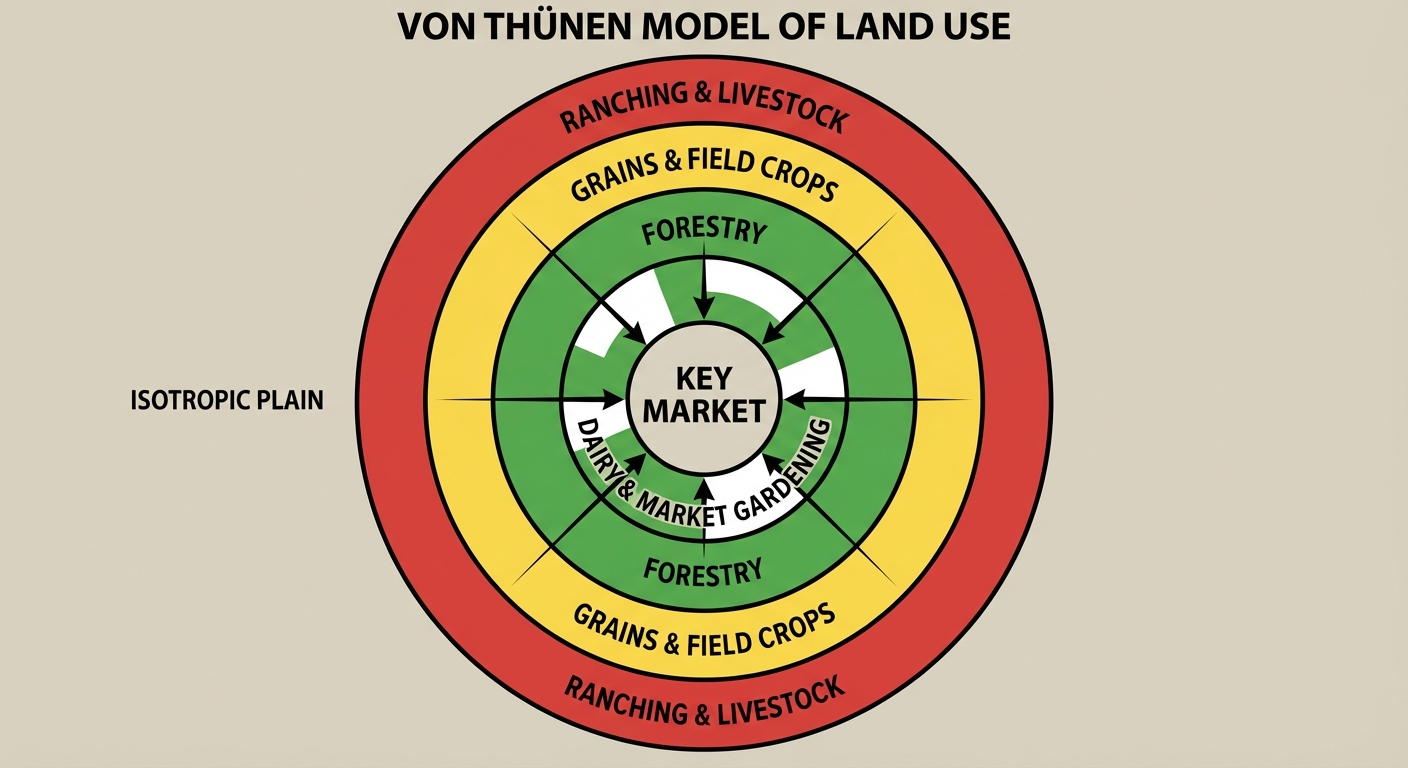
Ring 1: Market Gardening and Dairying
- Why? Products are perishable (milk, strawberries) and used to require immediate transport. Also, land here is most expensive, necessitating intensive agriculture.
- Modern Context: Refrigeration has expanded this ring, but it generally holds true (e.g., "milksheds").
Ring 2: Forestry (Timber/Firewood)
- Why? Wood is extremely heavy and bulky. In 1826, high transport costs necessitated proximity to the city (for heating/cooking).
- Modern Context: This ring is effectively obsolete in developed nations due to modern shipping and electricity.
Ring 3: Grains and Field Crops
- Why? Grains (wheat, corn) are light, non-perishable, and easy to store. Farmers need vast acreage (extensive agriculture), so they seek cheaper land further away.
Ring 4: Ranching and Livestock
- Why? Animals are self-transporting (they can walk to market, historically). Land is cheapest here, suitable for extensive grazing.
Assumptions vs. Reality
The model assumes:
- An Isotropic Plain (flat, featureless land).
- Consistent soil quality and climate.
- A single market center.
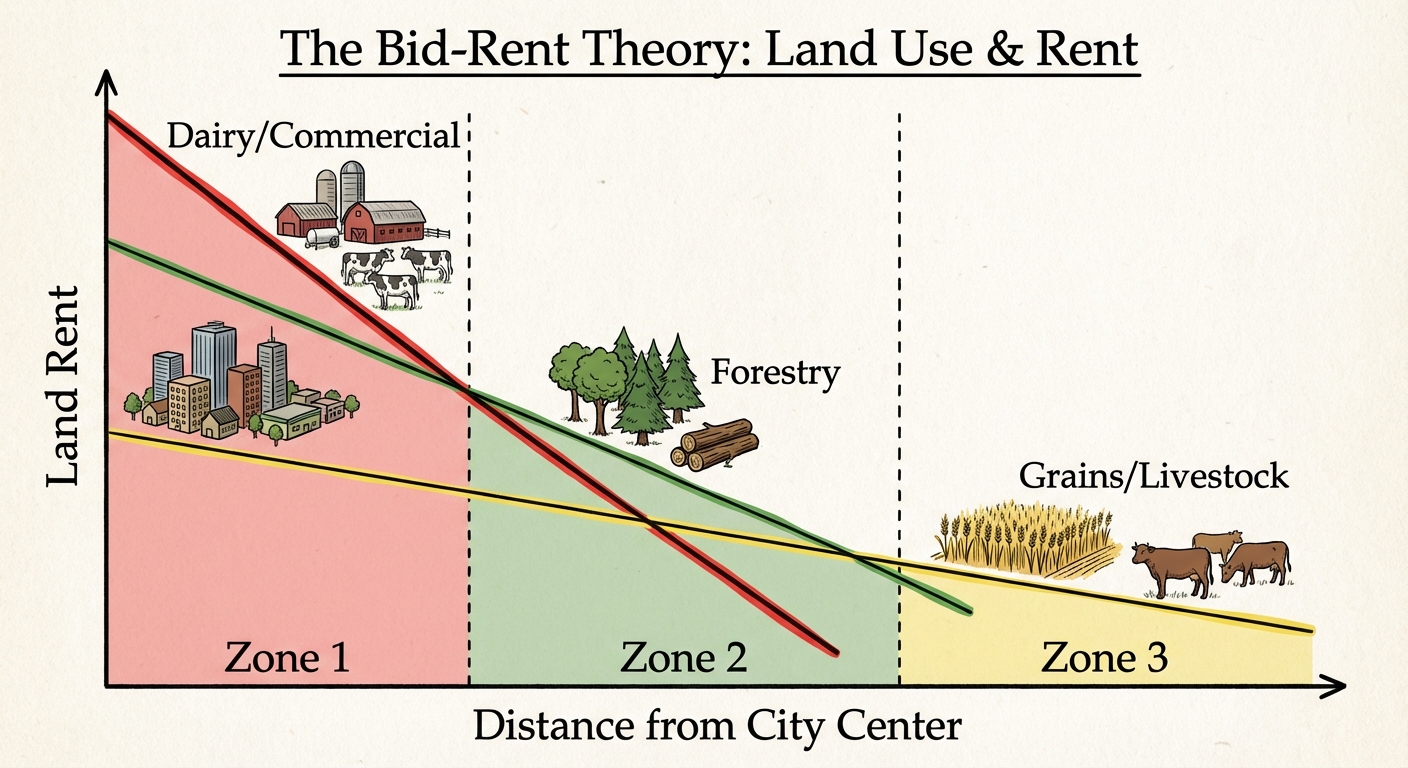
Key Takeaway: If a river runs through the plain, the rings stretch along the river because water transport is cheaper than road transport.
Challenges of Contemporary Agriculture
1. Environmental Issues
Modern farming places immense stress on the biosphere.
- Desertification: The degradation of semi-arid land into desert, often caused by overgrazing (common in the Sahel region of Africa).
- Soil Salinization: In arid regions, irrigation water evaporates, leaving salt behind. Eventually, the soil becomes toxic to plants.
- Pollution: Runoff containing nitrates and phosphates creates "dead zones" in oceans/lakes.
2. Genetic Modification (GMOs)
Genetically Modified Organisms involve splicing DNA from one organism into another.
- Pros: Drought resistance, pest resistance (Roundup Ready), higher nutrition (Golden Rice).
- Cons: Potential unknown health risks, impact on pollinators (butterflies), and corporate control over patented seeds (farmers cannot save seeds).
3. Sustainability Movements
In response to industrial agriculture, several counter-trends have emerged:
- Organic Farming: Farming without synthetic chemicals. It requires more land for the same yield but commands higher prices.
- Fair Trade: Ensures producers in developing countries (e.g., coffee farmers in Guatemala) receive fair wages and work in safe conditions.
- Eat Local / Farm-to-Table: Reduces the carbon footprint of food transport (food miles).
- Urban Farming: Utilizing rooftops and vacant lots in cities to grow food, combating Food Deserts (areas with limited access to affordable, nutritious food).
4. The Role of Women
Women compromise roughly 43% of the agricultural labor force globally, rising to 70% in parts of Africa and Asia. However, legal and cultural barriers often prevent women from owning land or accessing credit/loans to buy machinery. Improving female access to agricultural resources is a primary strategy for reducing global hunger.
Common Mistakes & Pitfalls
- Confusing Green Revolution with "Going Green": Students often think the Green Revolution implies environmentally friendly practices. It is the opposite. It involves heavy chemical use. "Green" refers to the growth of plants, not sustainability.
- Applying Von Thünen Literally: Do not expect to see perfect circles in the real world. You must explain why the model varies (topography, multiple markets, refrigeration).
- Mixing up Intensive and Extensive:
- Intensive: High capital/labor per unit of land (Market Gardening, Rice paddies).
- Extensive: Low capital/labor per unit of land (Ranching, Wheat farming).
- GMOs vs. HYVs: HYVs (Green Revolution) were developed through cross-breeding. GMOs (Biotech Revolution) involve lab-based DNA manipulation. They are distinct phases.