Christendom Fractured: A Deep Dive into the Age of Reformation
Martin Luther and the German Reformation
The Protestant Reformation did not happen in a vacuum. It was sparked by a combination of clerical corruption and the rise of Christian Humanism (Erasmus), which emphasized going back to original biblical texts. However, it was Martin Luther who successfully shattered the unity of the Catholic Church.
The Catalyst: Indulgences and Corruption
By the early 16th century, the Catholic Church faced criticism for:
- Simony: The selling of church offices.
- Nepotism: Appointing family members to powerful positions.
- Pluralism: Holding multiple church offices simultaneously.
- Indulgences: The selling of forgiveness to reduce time in Purgatory. Johann Tetzel famously hawked these to fund St. Peter's Basilica, claiming, "As soon as the coin in the coffer rings, the soul from purgatory springs."
Luther’s Theology: The Three "Solas"
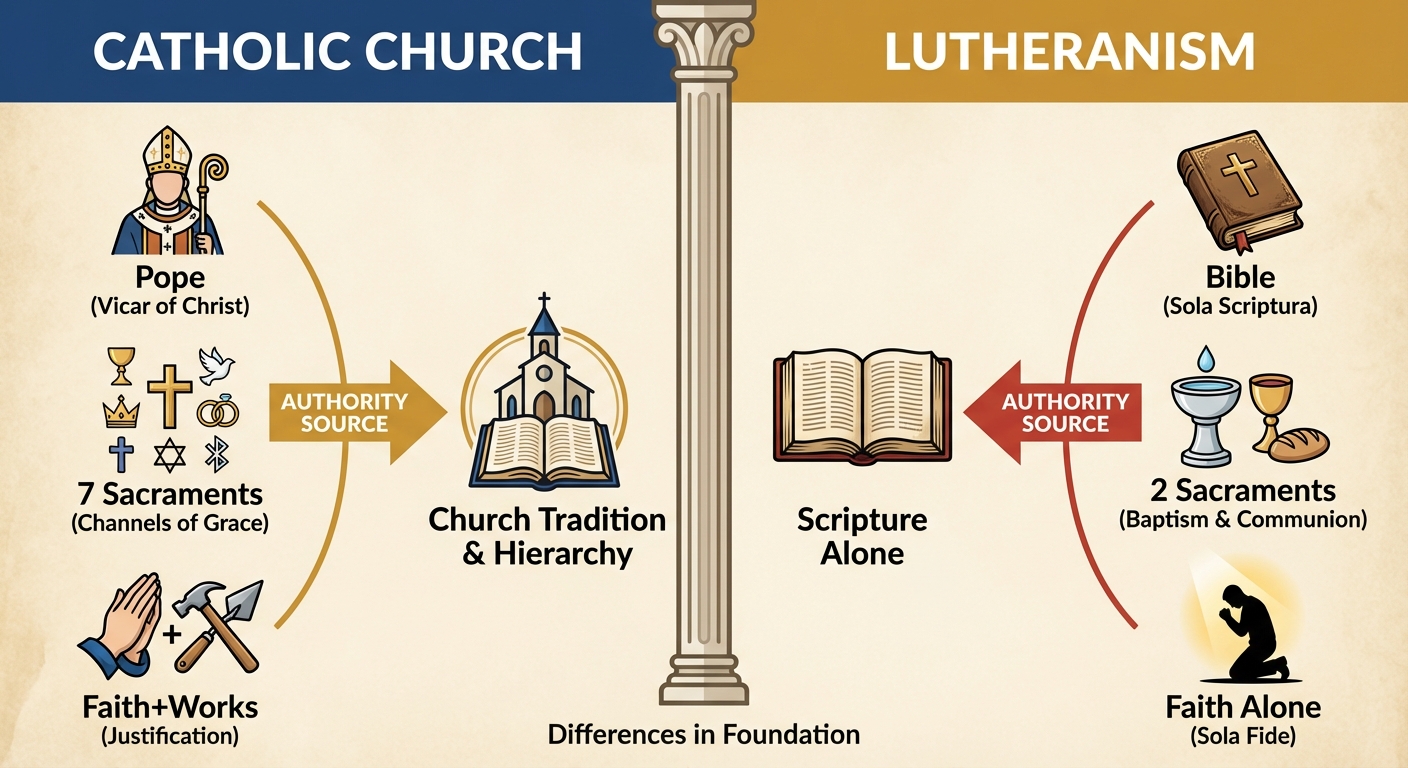
In 1517, Luther posted the 95 Theses, focusing primarily on the theology of salvation. His core beliefs created a schism with Rome:
- Sola Fide (Faith Alone): Salvation comes only through faith in God, not through good works or sacraments.
- Sola Scriptura (Scripture Alone): The Bible is the only source of authority. Traditional church teachings (decrees of Popes/Councils) are invalid if they contradict the Bible.
- Priesthood of All Believers: All Christians are equal before God; there is no spiritual hierarchy that makes a priest holier than a layperson.
Political Consequences in the Holy Roman Empire (HRE)
The Reformation was not just religious; it was intensely political.
- The Diet of Worms (1521): Luther refused to recant ("Here I stand, I can do no other"). Emperor Charles V declared him an outlaw.
- German Princes: Many princes (like Frederick of Saxony) protected Luther, not just for piety, but to gain independence from the Emperor and stop sending tax money to Rome.
- German Peasants' War (1525): Peasants interpreted "Christian Freedom" socially and revolted against feudal lords. Luther condemned the peasants, urging the princes to crush the revolt. Note: Luther was a theological radical but a social conservative.
The Peace of Augsburg (1555)
After decades of war, Charles V admitted he could not force Catholicism back on Germany. This treaty established the legal principle: Cuius regio, eius religio ("Whose realm, his religion").
- Princes could choose between Catholicism or Lutheranism.
- Crucial Exclusion: Calvinism became popular but remained illegal under this treaty.
Protestantism Spreads: Varieties of Belief
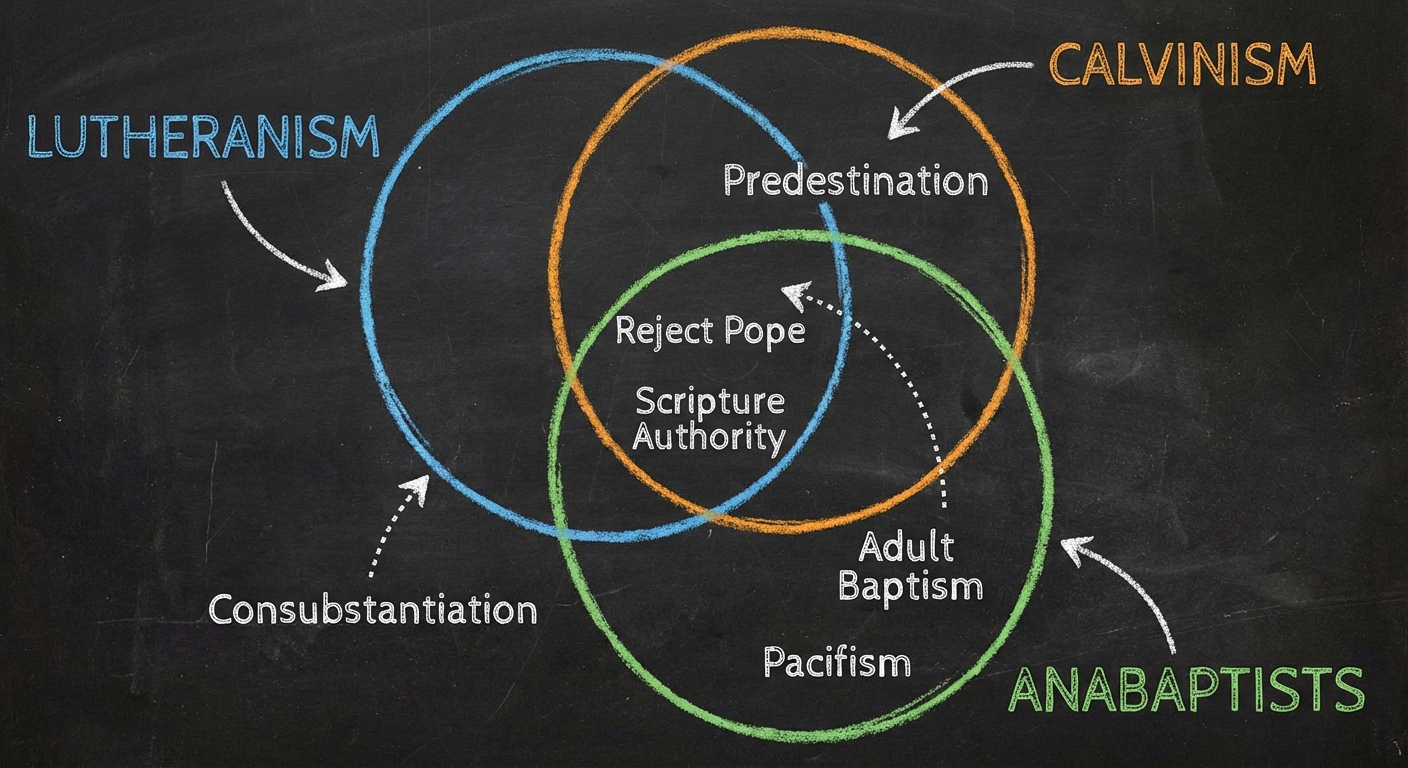
The reformation fragmented rapidly. Different leaders interpreted Scripture differently, leading to new denominations.
Zwingli and the Eucharist Debate
Ulrich Zwingli led the reformation in Zurich. While he agreed with Luther on many points, they split over the Eucharist (Communion).
| View | Definition | Proponent |
|---|---|---|
| Transubstantiation | Bread/Wine physically transform into body/blood of Christ. | Catholic Church |
| Consubstantiation | Christ is spiritually present in the bread/wine, but no physical change occurs. | Martin Luther |
| Memorialism | The Eucharist is entirely symbolic; a remembrance only. | Ulrich Zwingli |
John Calvin and Calvinism
John Calvin arguably became the most influential Protestant systematizer. In his Institutes of the Christian Religion, he outlined:
- Predestination: God has known since the beginning of time who will be saved (the Elect) and who will be damned. Human actions cannot change this fate.
- The Geneva Consistory: Calvin established a theocracy in Geneva, Switzerland, regulating moral behavior (no dancing, drinking, or gambling).
Mnemonic: TULIP (Five points of Calvinism)
- Total Depravity (Humans are inherently sinful)
- Unconditional Election (God chooses the Elect without conditions)
- Limited Atonement
- Irresistible Grace
- Perseverance of the Saints
Impact: Calvinism spread rapidly to Scotland (John Knox/Presbyterians), France (Huguenots), and England (Puritans).
The Radical Reformation: Anabaptists
The Anabaptists were despised by Catholics, Lutherans, and Calvinists alike. Their beliefs were considered dangerous to the social order:
- Adult Baptism: Baptizing infants is invalid because they cannot consciously choose faith.
- Separation of Church and State: Governments should have no authority over religion.
- Pacifism: Refusal to hold office or serve in the military.
The English Reformation: Politics over Doctrine
Unlike the continental trend, the English Reformation began as an act of state power, not theological dispute.
Henry VIII and the Act of Supremacy
Henry VIII was originally a critic of luther ("Defender of the Faith"), but he needed a male heir. When the Pope refused to annul his marriage to Catherine of Aragon (aunt of Charles V), Henry broke away.
- Act of Supremacy (1534): Declared the King the supreme head of the Church of England (Anglican Church).
- Dissolution of the Monasteries: Henry seized church lands and wealth, selling them to nobles to secure their loyalty.
- Theology: Henry remained conservative; he kept most Catholic doctrines (celibacy, transubstantiation) but removed the Pope's authority.
The Tudor Pendulum
- Edward VI (r. 1547–1553): Henry's son. Advisors moved England toward true Protestantism (Book of Common Prayer).
- Mary I (r. 1553–1558): "Bloody Mary." Attempted to restore Catholicism; executed hundreds of Protestants.
- Elizabeth I (r. 1558–1603): Established the Elizabethan Settlement. This was a via media (middle way). She required outward conformity to the Anglican Church but did not inquire into private beliefs. The theology was Protestant, but the ritual remained traditional.
The Catholic Reformation (Counter-Reformation)
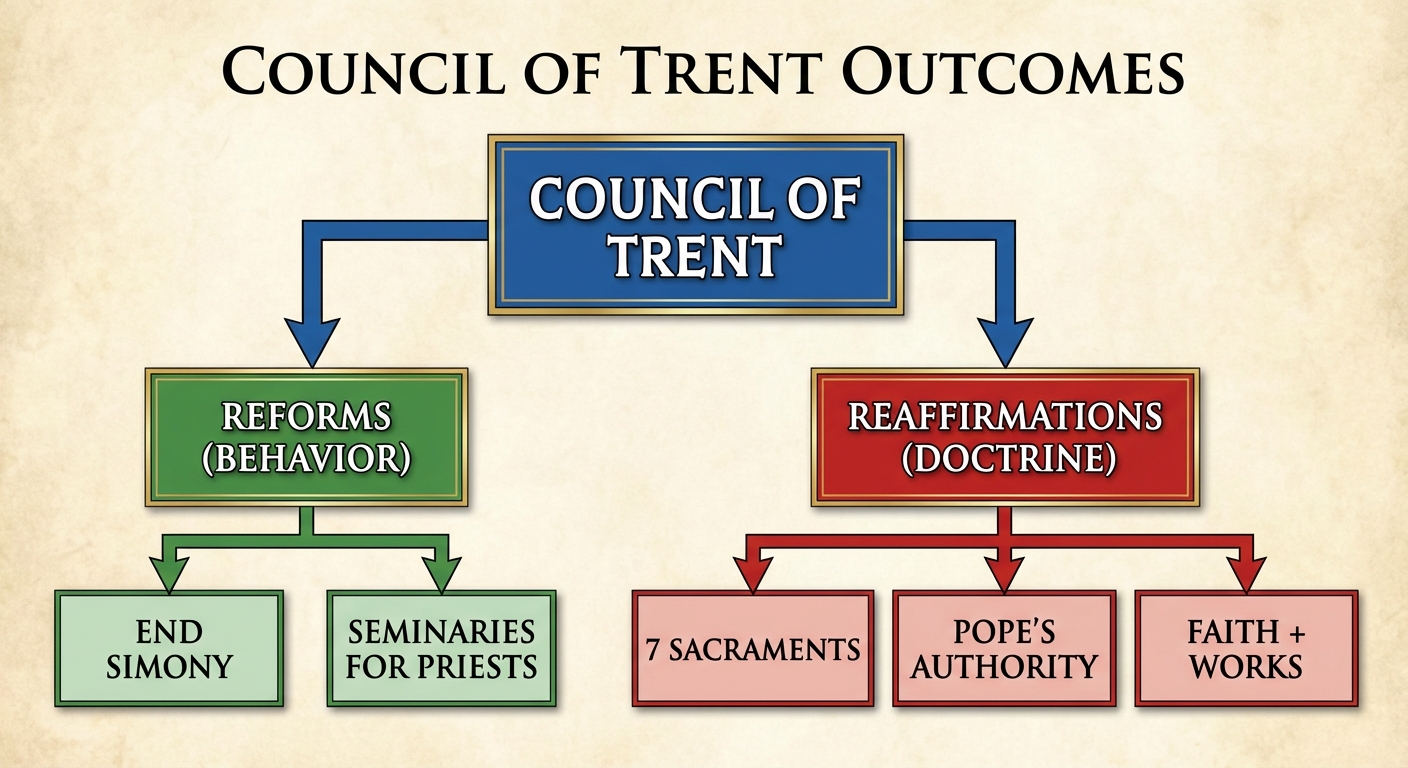
The Catholic Church responded with a two-pronged strategy: reforming internal corruption and reaffirmed dogma to stop the Protestant spread.
The Council of Trent (1545–1563)
This was the centerpiece of the Catholic response.
- Reformed: It stopped the sale of indulgences, improved education for priests, and banned pluralism.
- Reaffirmed: It refused to compromise on theology. It upheld the 7 sacraments, the authority of the Pope + Scripture, and transubstantiation.
New Religious Orders
- The Jesuits (Society of Jesus): Founded by Ignatius of Loyola. They operated like spiritual soldiers focused on three goals:
- Education (founding schools).
- Missionary work (Americas/Asia).
- Fighting Protestantism (reverting Poland and parts of Germany to Catholicism).
- Ursuline Nuns: Focused on the education of women.
Enforcement and Art
- The Roman Inquisition: A committee of cardinals capable of arresting and trying heretics.
- Index of Prohibited Books: A list of banned texts (including Erasmus and Luther) that Catholics were forbidden to read.
- Baroque Art: The Church commissioned grandiose, dramatic, and emotional art (Bernini, Rubens) to overwhelm the viewer and emphasize the glory of God, contrasting with the stark simplicity of Calvinist churches.
Common Mistakes & Pitfalls
Confusing "Reform" with "Change of Doctrine":
- Mistake: Thinking the Catholic Reformation changed Catholic beliefs to match Luther.
- Reality: The Council of Trent cleaned up behavior but doubled down on traditional Catholic dogma. They didn't agree with Luther on anything theological.
The "King" vs. The "Theologian":
- Mistake: Thinking Henry VIII was a Protestant reformer like Luther.
- Reality: Henry VIII hated Luther. Henry's reformation was political/legal. The theological shift in England happened under his children (Edward VI and Elizabeth I).
Peace of Augsburg Scope:
- Mistake: Thinking the Peace of Augsburg allowed religious freedom for everyone.
- Reality: It only allowed Princes to choose, and only between Catholicism and Lutheranism. Calvinists were still illegal.
Predestination Misunderstanding:
- Mistake: Thinking Calvinists believed they could "earn" salvation by working hard.
- Reality: Calvinists believed their hard work/wealth was a sign they were already saved (Elect), not the cause of their salvation.