Comprehensive Study Guide: Unit 4 Magnetism and Induction
Magnetic Systems and Fields
Properties of Magnetic Fields
To understand magnetism, we must first understand the field concept. Similar to how mass creates a gravitational field and charge creates an electric field, magnetic interactions are mediated by the Magnetic Field (denoted as $\vec{B}$).
- Source: Moving electric charges (currents) or intrinsic spin of electrons.
- Direction: Defined as the direction the North pole of a compass would point. Field lines exit the North pole and enter the South pole outside the magnet.
- Loops: Unlike electric field lines, which start on positive and end on negative charges, magnetic field lines always form closed loops. This implies that there are no magnetic monopoles; you cannot isolate a North pole without a South pole.
- SI Unit: Tesla ($T$).
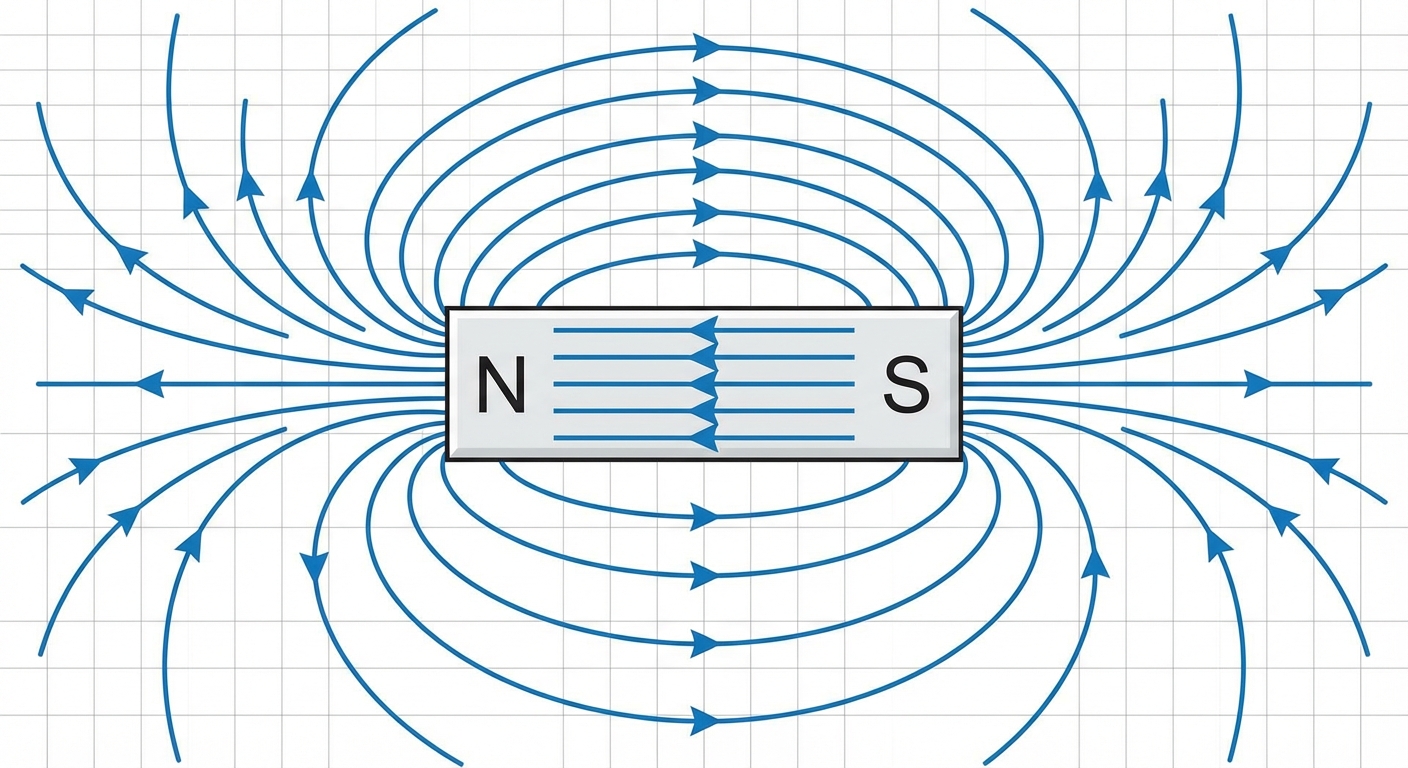
Magnetic Dipoles
The fundamental unit of magnetism is the dipole. Even a single atom acts as a dipole due to electron spin. When a material has domains where these atomic dipoles align, the material becomes a permanent magnet (ferromagnetism).
Magnetic Forces on Moving Charges
A stationary charge in a magnetic field feels no magnetic force. However, once a charge moves through a magnetic field, it experiences a force relative to its velocity and the field orientation.
The Force Equation
The magnitude of the magnetic force ($F_M$) on a point charge $q$ is given by:
Where:
- $q$ is the magnitude of the charge (Coulombs, $C$).
- $v$ is the speed of the charge ($m/s$).
- $B$ is the magnetic field strength ($T$).
- $\theta$ is the angle between the velocity vector $\vec{v}$ and the magnetic field vector $\vec{B}$.
Key Consequences:
- Maximum Force: Occurs when velocity is perpendicular to the field ($\theta = 90^\circ$).
- Zero Force: Occurs when velocity is parallel or anti-parallel to the field ($\theta = 0^\circ$ or $180^\circ$).
- Work: The magnetic force is always perpendicular to the velocity. Therefore, magnetic fields do no work on particles and cannot change their kinetic energy (speed remains constant; only direction changes).
Circular Motion of Charged Particles
Since the force is always perpendicular to velocity (centripetal force), a charged particle entering a uniform B-field perpendicularly will undergo Uniform Circular Motion.
Rearranging for radius ($r$):
Right-Hand Rule #1 (The Flat Hand Rule)
To find the direction of the magnetic force:
- Point your Thumb in the direction of the velocity vector $\vec{v}$.
- Point your Fingers in the direction of the magnetic field $\vec{B}$.
- For a positive charge (+), the Force dominates out of your Palm.
- For a negative charge (-), the Force comes out of the Back of your Hand.
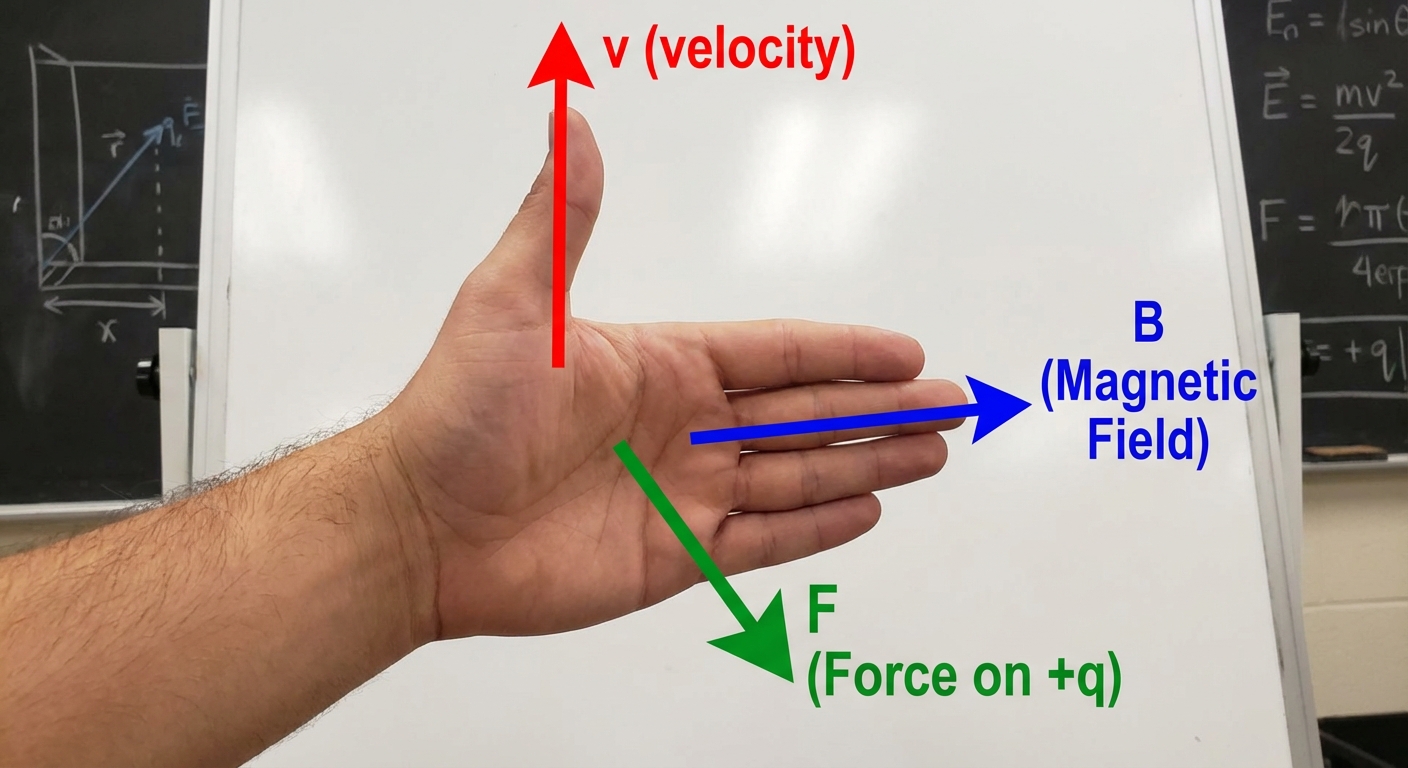
Magnetic Forces on Current-Carrying Wires
Since current is simply a collection of moving charges, a wire carrying current in an external magnetic field also experiences a force.
Force on a Wire
Where:
- $I$ is the current ($A$).
- $\ell$ is the length of the wire inside the magnetic field ($m$).
- $\theta$ is the angle between the direction of current $I$ and the field vector $\vec{B}$.
Direction: Use the same Right-Hand Rule as above, but point your Thumb in the direction of conventional current ($I$).
Magnetic Fields Generated by Currents
Moving away from forces exerted by fields, we now look at fields created by currents. In AP Physics 2, we focus primarily on long, straight wires.
The Long Straight Wire
The magnetic field created by a long, straight current-carrying wire forms concentric circles around the wire. The magnitude is given by:
Where:
- $\mu0$ is the vacuum permeability constant ($\mu0 \approx 4\pi \times 10^{-7} \ T\cdot m/A$).
- $r$ is the radial distance from the wire ($m$).
Right-Hand Rule #2 (The Curl Rule)
To find the direction of limits field lines generated by a wire:
- Point your Thumb in the direction of the conventional current.
- Curl your fingers.
- Your fingers curl in the direction of the circular magnetic field lines.
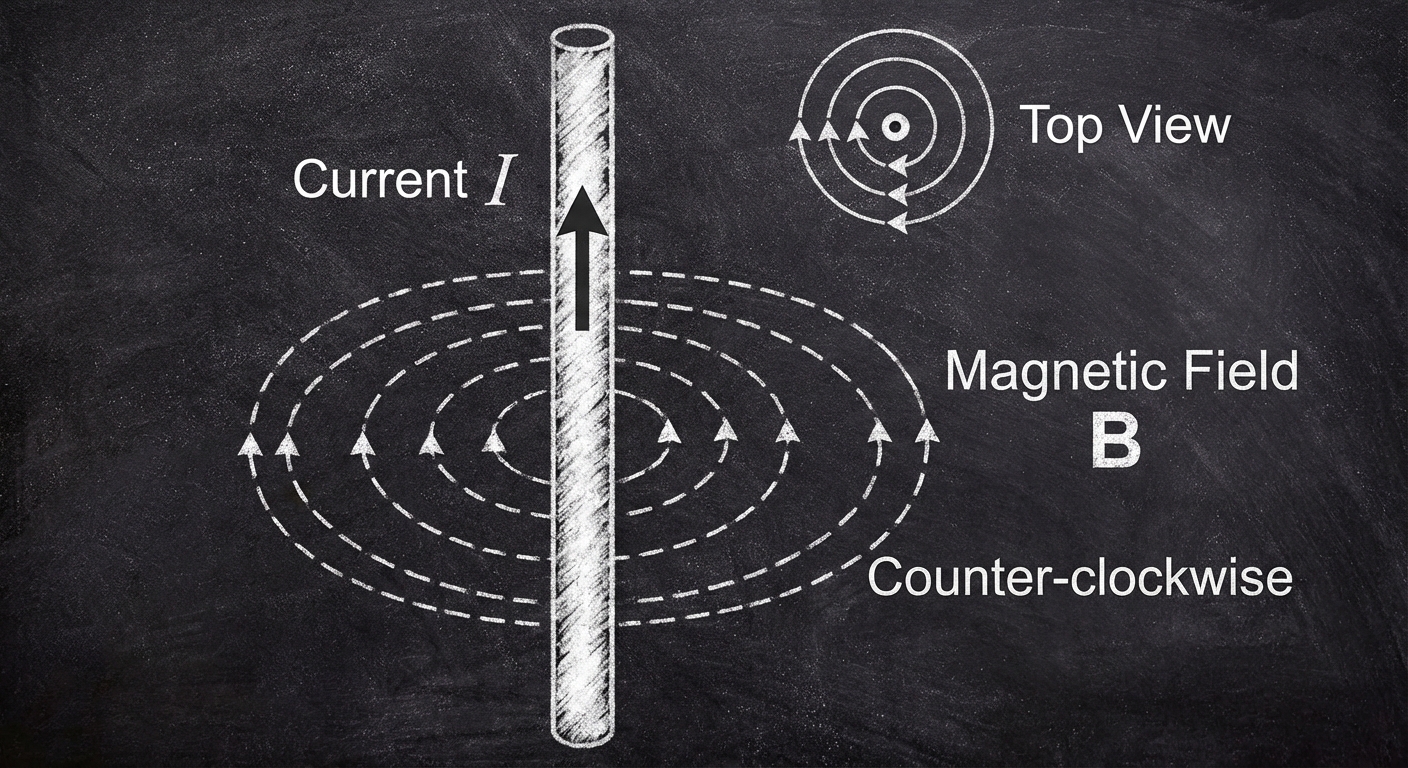
Forces Between Two Parallel Wires
If two wires carry current, Wire 1 creates a field that exerts a force on Wire 2, and vice versa.
- Parallel Currents (Same Direction): The wires Attract.
- Anti-Parallel Currents (Opposite Direction): The wires Repel.
Mnemonic: "Likes repel" applies to charges, but for currents, "Likes (same direction) attract."
Electromagnetic Induction
Electromagnetic induction describes how a changing magnetic environment can create (induce) a current. This is the principle behind generators and transformers.
Magnetic Flux ($\Phi_B$)
Flux is a measure of the amount of magnetic field passing through a specific area. Think of it as the number of field lines piercing a surface.
Where:
- $\Phi_B$ is Magnetic Flux (Webers, $Wb$).
- $A$ is the area of the loop ($m^2$).
- $\theta$ is the angle between the Magnetic Field vector and the Area Normal vector (a line perpendicular to the surface).
Crucial Detail: Flux is maximum when the field is perpendicular to the surface (which means it is parallel to the normal vector, $\theta = 0^\circ$). Flux is zero when the field runs parallel to the surface.
Faraday's Law of Induction
Faraday's Law states that an Electromotive Force (EMF, or Voltage) is induced only when there is a change in magnetic flux over time.
Where:
- $\mathcal{E}$ is the induced EMF ($V$).
- $N$ is the number of loops or turns in the coil.
- The negative sign represents Lenz's Law.
Ways to Induce EMF:
Since $\Phi_B = BA\cos(\theta)$, you can induce EMF by:
- Changing magnitude of $B$ (moving a magnet closer/farther).
- Changing the Area $A$ (expanding/shrinking a loop).
- Changing orientation $\theta$ (rotating a loop in a field).
Lenz's Law
Lenz's Law explains the direction of the induced current. It states that nature abhors a change in flux.
The Rule: The induced current creates a magnetic field that opposes the change in the original magnetic flux.
Step-by-Step Analysis:
- Identify the direction of the original external field ($B_{ext}$).
- Determine if the Flux is increasing or decreasing.
- Choose the direction of the Induced Field ($B_{ind}$):
- If Flux is increasing, $B{ind}$ must point opposite to $B{ext}$ to cancel the gain.
- If Flux is decreasing, $B{ind}$ must point in the same direction as $B{ext}$ to prop it up.
- Use RHR #2 (Curl Rule) to find the current direction that creates that $B_{ind}$.
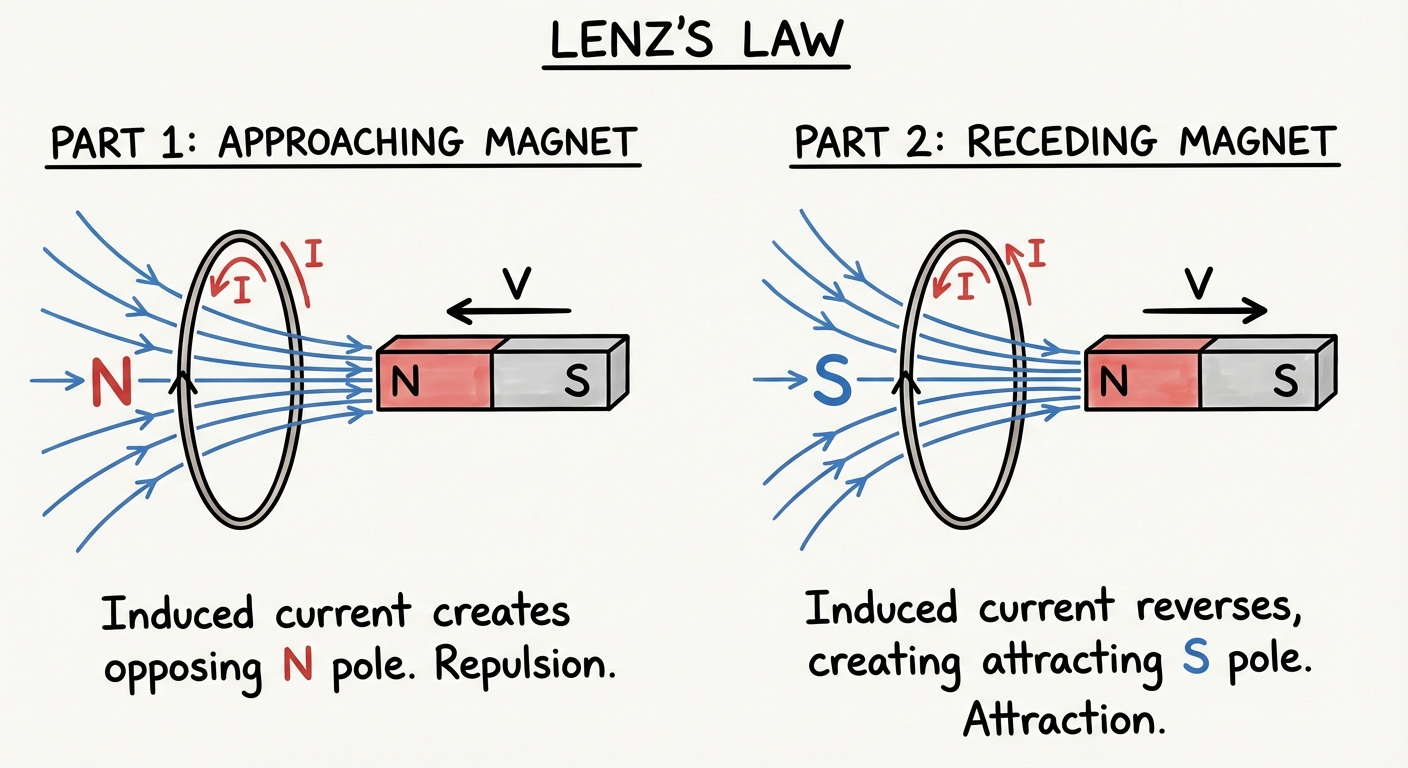
Motional EMF
A specific case of induction occurs when a conducting bar of length $\ell$ moves at velocity $v$ perpendicularly through a magnetic field.
Assume the bar is part of a complete circuit. The moving charges in the bar feel a magnetic force (separated charges), which acts as a voltage source (battery).
Comparison: Electric vs. Magnetic Fields
| Feature | Electric Fields ($\vec{E}$) | Magnetic Fields ($\vec{B}$) |
|---|---|---|
| Source | Static or moving charges | Moving charges (currents) only |
| Force Action | Acts on any charge | Acts only on moving charges |
| Work | Can do work (change KE) | Cannot do work (Force $\perp$ v) |
| Field Lines | Start on (+), end on (-) | Form closed loops (North to South) |
| Force Direction | Parallel to Field | Perpendicular to Field |
Common Mistakes & Pitfalls
- The "Normal" Vector Confusion: In the flux equation $\theta$ is measured relative to the normal (perpendicular) to the area, not the surface itself. If a problem says "The field makes a $30^\circ$ angle with the plane of the coil," the angle for the formula is $90^\circ - 30^\circ = 60^\circ$.
- Forgetting Flux vs. Change in Flux: Students often think a large flux creates a large EMF. This is false. A huge, constant flux induces zero EMF. Only the rate of change matters.
- Right-Hand Rule with the Left Hand: Always use your right hand. If you are left-handed, put your pencil down before applying the rule!
- Charge Signs: Remember that for negative charges (electrons), the force points opposite to the palm direction (back of hand).
- Velocity Components: Only the component of velocity perpendicular to the field creates force. If $v$ is parallel to $B$, force is zero.
- Lenz's Law Logic: Students often think the induced field always opposes the external field. It opposes the change. If the external field is effectively dying out (decreasing), the induced field tries to save it (points the same way).