Unit 3 Study Guide: Dynamics of Longer Narratives
Character Development and Perspective
Unlike short fiction, novels and plays allow for gradual, complex character development over time. In Unit 3, the focus shifts to how interactions, epiphanies, and varying perspectives shape our understanding of characters in longer works.
Character Types and Functions
When analyzing a long narrative, categorize characters not just by their role in the plot, but by their function in developing the theme.
- Protagonist: The central character driving the action. While often the "hero," they can be flawed (anti-hero). The narrative arc usually follows their psychological journey.
- Antagonist: The character or force opposing the protagonist. This does not strictly mean "villain"; the antagonist creates the necessary conflict that spurs the protagonist’s growth.
- Foil Characters: A character whose traits contrast sharply with another character (usually the protagonist) to highlight particular qualities of the other character.
- Example: In Hamlet, Laertes's impulsive action acts as a foil to Hamlet's indecisiveness.
Dynamic vs. Static Characters
Understanding character change is essential for analyzing the "Bildungsroman" (coming-of-age story) or tragic falls common in Unit 3.
Dynamic Characters
Dynamic characters undergo significant internal change over the narrative. This change is often the primary vehicle for the author's theme.
- Catalysts for Change: Change is rarely random. It is driven by:
- Epiphany: A sudden realization that changes a character's understanding of themselves or the world.
- Crisis: A moment of high tension requiring a difficult choice.
- Interaction: Conflicts with society or other characters.
| Type of Change | Surface Level Example | AP Analysis Level |
|---|---|---|
| Perspective | Changing an opinion on a topic. | Shifting away from a childhood bias to an adult worldview (loss of innocence). |
| Status/Wealth | Getting rich or poor. | Analyzing how class mobility corrupts or liberates the character's morality. |
| Skills/States | Learning to fight or getting sick. | Physical deterioration symbolizing spiritual decay (or vice versa). |
Static Characters
Static characters remain largely the same throughout the text.
- Common Misconception: Being "static" is not a flaw in writing. Static characters serve vital structural roles:
- The Flat Static Character: Often distinct, caricatured figures (like the comedic relief or the wicked stepmother) who move the plot but don’t need to grow.
- The Symbolic Static Character: They represent an abstract idea or societal norm that the dynamic protagonist must struggle against.
Perspective and Bias
Character perspective is the distinct lens through which a character views the world. It is shaped by:
- Background: Race, class, gender, and nationality.
- Values: Religious or ethical codes.
- Relationships: Past trauma or alliances.
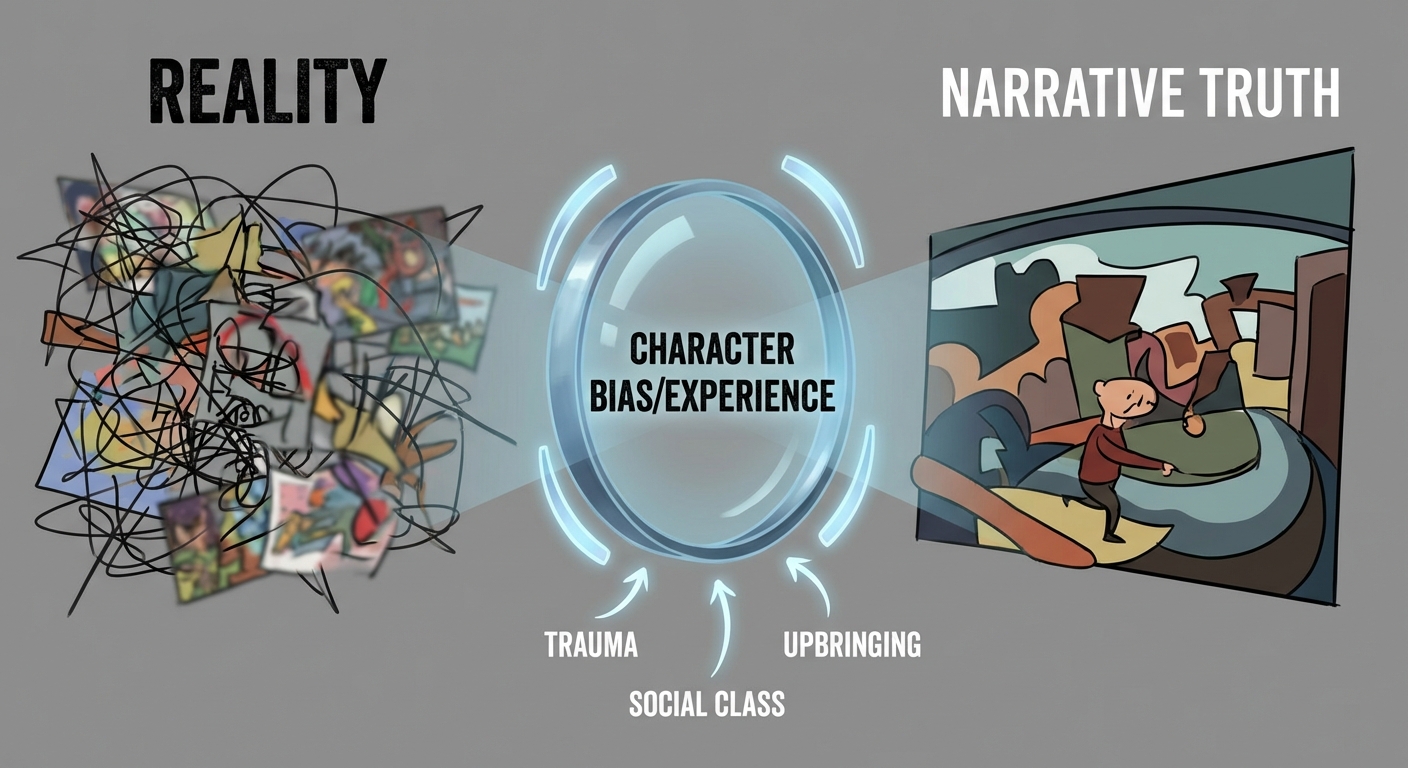
When a novel switches the point-of-view (POV) character or offers a biased narrator, ask: What is this character refusing to see? How does their limitation affect the reader's understanding of the truth?
Setting as more than Background
In longer fiction, setting encompasses the physical location, time period, and the social/cultural environment. It is rarely just a backdrop; it functions as an active force.
The Functions of Setting
- Setting as Mood: The atmosphere created by the setting reflects or contrasts with the internal state of the characters (e.g., a stormy heath reflecting a character's madness).
- Setting as Antagonist: In Person vs. Nature or Person vs. Society conflicts, the environment itself impedes the protagonist.
- Setting as Symbol: Specific places often represent specific values.
- Example: The "West Egg" vs. "East Egg" in The Great Gatsby represent different types of wealth and morality.
Plot Structure and Conflict
Plot is the arrangement of events in a narrative. In longer works, authors manipulate structure to control pacing and suspense.
Structural Elements
- Linear Structure: Chronological order. Best for showing clear cause-and-effect.
- Non-Linear Structure: Uses flashbacks, in media res (starting in the middle), or framing devices. This often mimics the chaotic nature of memory or trauma.
The Dramatic Arc (Freytag's Pyramid)
Most longer fiction follows a variation of this structure:

- Exposition: Introduces characters, setting, and the "status quo."
- Inciting Incident: The specific event that disrupts the status quo and launches the conflict.
- Rising Action: A series of complications. In a novel, this is the longest section.
- Climax: The moment of highest tension; the turning point where the protagonist's fate is sealed.
- Falling Action: The immediate consequences of the climax.
- Resolution (Dénouement): The new status quo is established.
Categories of Conflict
Use these categories to identify the conflict, but focus your essay on what the conflict reveals about the human condition.
- Internal Conflict (Person vs. Self): A psychological struggle (guilt, duty vs. desire, hubris). This creates complexity and makes characters relatable.
- Person vs. Person: Highlights opposing values. (e.g., Tradition vs. Progress guided by two different characters).
- Person vs. Society: The protagonist clashes with cultural norms, government, or oppression. Common in satire and dystopian fiction.
- Person vs. Nature: Stresses human vulnerability and the indifference of the universe.
Symbolism and Archetypes
Symbolism
Attributes meanings to objects, actions, or characters beyond their literal existence.
- Conventional Symbols: Universally recognized (e.g., a dove = peace).
- Contextual Symbols: Meaning is specific only to that text (e.g., the green light in Gatsby).
- Tip: If an object appears repeatedly or is described with intense detail, it is likely a symbol.
Archetypes
Recurring patterns, images, or character types found across cultures and literature. Recognizing these helps predict plot points or understand the author's subversion of tradition.
- The Hero's Journey
- The Scapegoat
- The Mentor
Literary Argumentation (The FRQ 3 Essay)
Unit 3 reinforces the skills needed for the "Literary Argument" essay (Question 3 on the AP exam), where you analyze a specific theme in a novel or play of your choice.
The Thesis Statement
A defensible claim that establishes a line of reasoning. It must be more than a summary.
Formula for a Strong Thesis:
- Weak: Shakespeare uses Hamlet's madness to show he is sad.
- Strong: Shakespeare utilizes Hamlet's feigned madness and subsequent existential spiral to critique the corrupt nature of the distinct separation between appearance and reality in the Danish court.
Evidence and Commentary
- Evidence: Specific details from the text. In FRQ 3, you cannot quote (because you won't have the book), so you must rely on specific textual references (summaries of specific scenes, symbols, or interactions).
- Commentary: The "so what?" This connects the evidence back to your thesis. It explains why the author included this detail and how it proves your thematic point.
Sophistication (Rule of 3)
To earn the Sophistication point (Row C), students must demonstrate complex understanding. Strategies include:
- Nuance: Exploring tensions (e.g., "While the protagonist appears heroic, his actions ultimately reinforce the oppressive system…").
- Broader Context: Situating the text within a historical, cultural, or social trend.
- Alternative Interpretations: Acknowledging a counter-argument and then refuting it with stronger textual support.
Common Mistakes and Pitfalls
Plot Summary vs. Analysis:
- Mistake: Spending 2 paragraphs retelling what happened in the book.
- Fix: Assume the reader knows the plot. Focus on how and why the author constructed the plot to convey meaning.
Confusing Theme with Topic:
- Mistake: "The theme is love."
- Fix: A theme is a full sentence expressing an opinion. "The theme is that obsessive love eventually leads to self-destruction."
Ignoring the Ending:
- Mistake: Analyzing a character but ignoring their final fate.
- Fix: The ending is where the author cements their message. If the hero dies, the author might be warning against their behavior. If they succeed, the author validates their choices.
Moralizing:
- Mistake: Criticizing a character's choices based on modern standards (e.g., "Romeo was stupid").
- Fix: Analyze narrative function. Romeo's impulsiveness is a device to explore the intensity of youth, not a behavior to be judged by the student.