Unit 6: Reactions to the Industrial Revolution and the Age of Isms
The Changing Social Fabric: Urbanization and Class
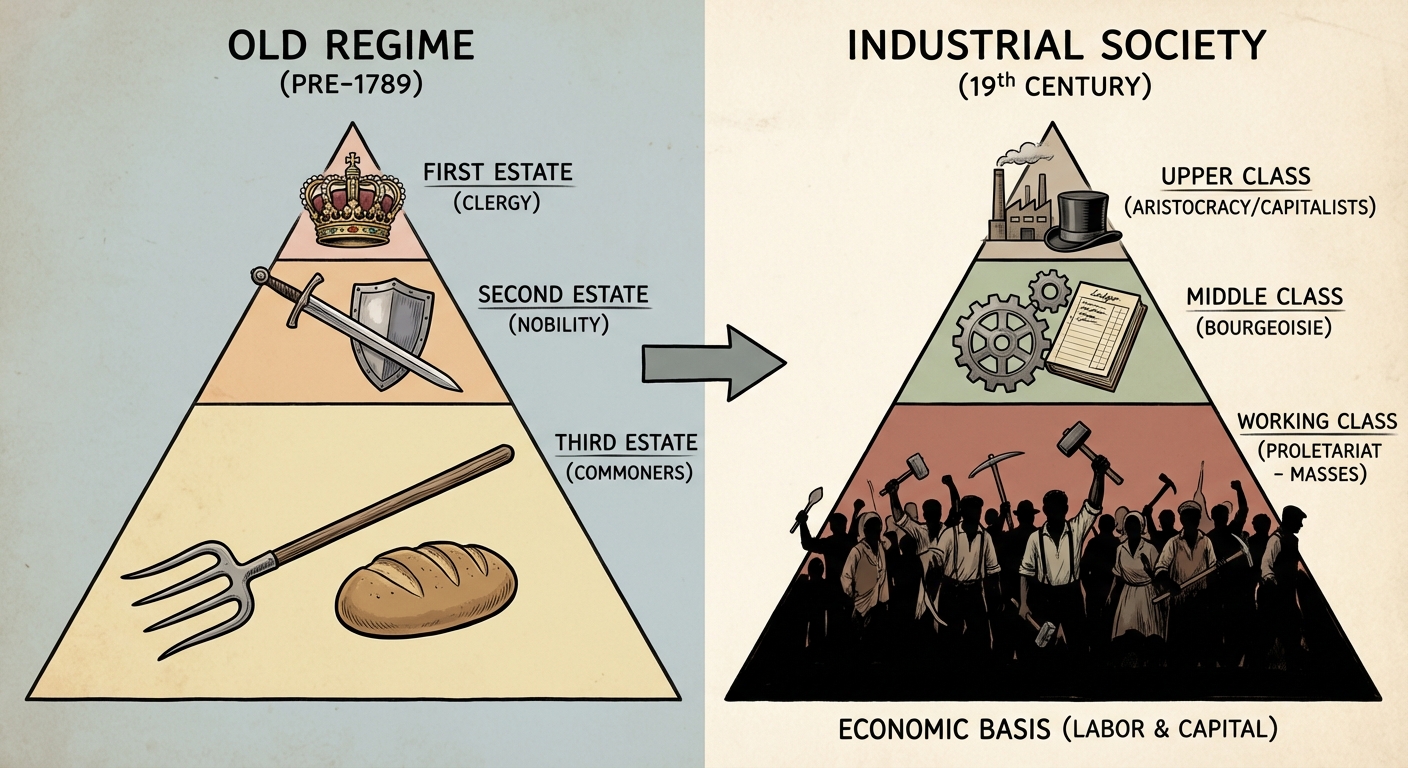
The Industrial Revolution did not just change how goods were produced; it fundamentally altered how humans lived, related to one another, and perceived their place in society. This transition moved Europe from a society based on legal estates (nobility, clergy, commoners) to one based on economic social classes.
Urbanization and Conditions of Living
The shift to factories required a massive labor force concentrated in specific locations. This led to rapid urbanization, often outpacing infrastructure.
- The Great Stink: Cities like Manchester and London grew exponentially without proper sanitation. Human waste, industrial runoff, and coal smog created toxic environments.
- Cholera & Disease: Without knowledge of germ theory (until Pasteur/Lister later in the century), waterborne diseases ravaged the working class.
- Edwin Chadwick: A utiltarian reformer in Britain who linked disease to filth. His report led to Britain's first Public Health Act (1848), which established modern sanitary systems.
New Social Classes
The Industrial Revolution crystallized two distinct and opposing classes:
- The Bourgeoisie (Middle Class):
- Owners of capital, factories, and means of production.
- Valued hard work, discipline, and material success.
- Classical Liberalism was often their political ideology.
- The Proletariat (Working Class):
- Wage laborers who owned nothing but their ability to work.
- Faced long hours (12–16 hours), low wages, and dangerous conditions.
- Class Consciousness: A term popularized by Marx, referring to the awareness of one’s economic rank and the solidarity felt among the working class against the owners.
Changing Family Structure: Separate Spheres
Prior to industrialization, families often worked together in cottage industries or on farms. Industrialization separated the workplace from the home.
- Separate Spheres Ideology: The distinct division of labor where:
- Men: Belonged in the public sphere (work, politics, economy) as the breadwinners.
- Women: Belonged in the private sphere (home, children) as the moral guardians of the family.
- Cult of Domesticity: Idealized the middle-class woman as an "angel in the house." Note that working-class women had to work (in textile mills or as domestic servants) to survive, so this ideal was a luxury of the middle/upper classes.
Ideological Responses: The "Isms"
As society fractured, intellectuals developed competing theories to explain or fix the new world order.
Classical Liberalism
Primary associated with the rising middle class. It emphasized individual freedom, private property, and limited government interference.
- Laissez-Faire Economics: Based on Adam Smith’s Wealth of Nations (1776). The "invisible hand" of the market should dictate prices and wages, not the government.
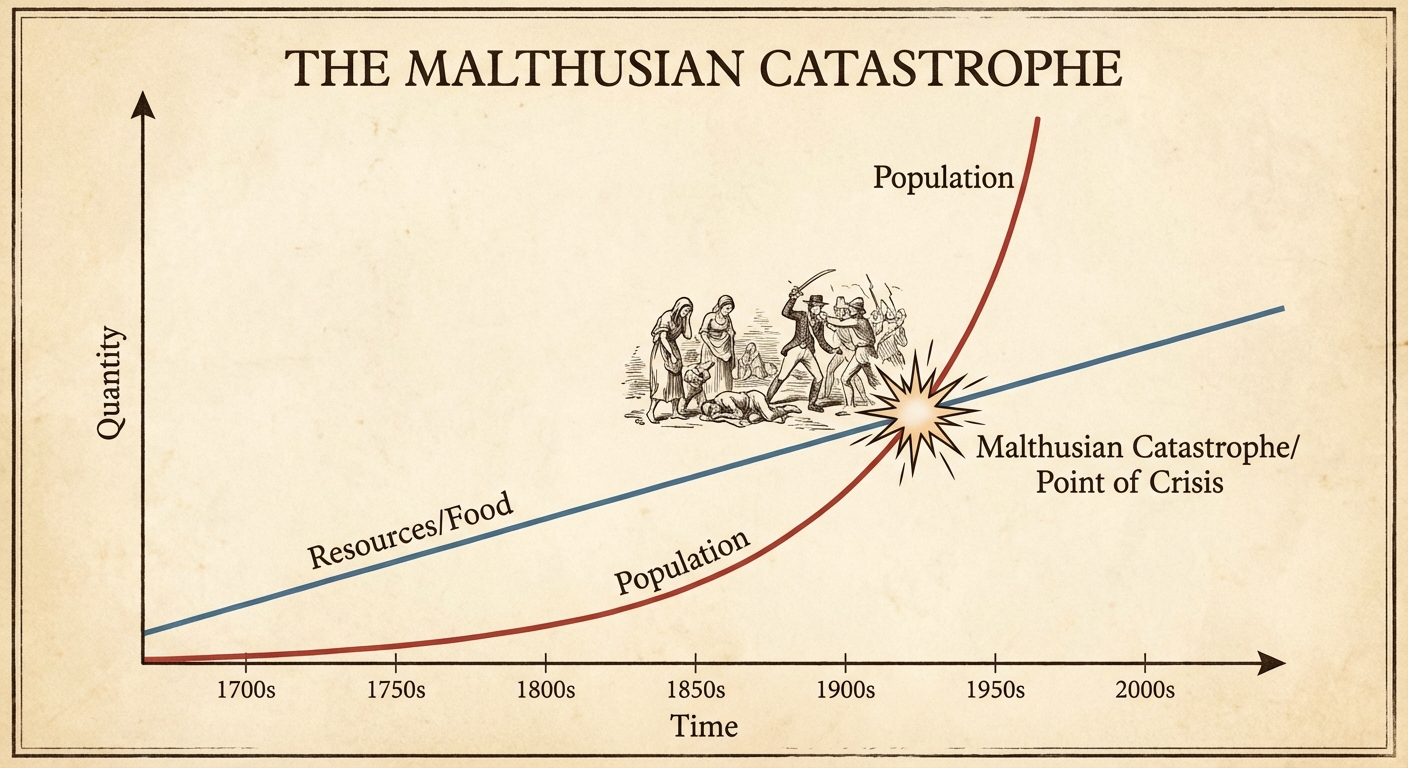
- Thomas Malthus: Wrote Essay on the Principle of Population. He argued that different growth rates would lead to inevitable suffering.
- Population grows geometrically:
- Food supply grows arithmetically:
- Conclusion: Famine, disease, and war are natural checks on population; government aid to the poor only encourages them to have more children they cannot feed.
- David Ricardo: Proposed the Iron Law of Wages.
- If wages go up $\rightarrow$ workers have more kids $\rightarrow$ labor supply increases $\rightarrow$ wages fall back to subsistence level.
Utopian Socialism
Early socialists believed that the competitive capitalist system was fracturing society. They sought to create ideal communities based on cooperation rather than competition. They were termed "Utopian" by later Marxists who viewed them as naive.
- Henri de Saint-Simon: Believed "parasites" (court, aristocracy, lawyers) should give way to the "doers" (scientists, engineers, industrialists) who would plan the economy for the poor.
- Charles Fourier: Envisioned self-sufficient communities called Phalansteries where work was rotated to prevent boredom.
- Robert Owen: A successful British cotton manufacturer who created a distinct industrial community at New Lanark, Scotland. He proved that treating workers well (schools, housing, fair hours) actually increased productivity.
Marxism (Scientific Socialism)
In 1848, Karl Marx and Friedrich Engels published The Communist Manifesto, changing the course of history.
- Dialectical Materialism: Marx adapted this from the philosopher Hegel. He believed history is a constant struggle between opposing forces based on material (economic) reality.
- Thesis (Status Quo) vs. Antithesis (Opposing Force) $\rightarrow$ Synthesis (New System).
- The Theory:
- History is the history of Class Struggle.
- The current struggle is Bourgeoisie (Thesis) vs. Proletariat (Antithesis).
- Competition will drive wages down until the Proletariat violently revolts.
- A temporary "Dictatorship of the Proletariat" will seize means of production.
- Final Stage: Communism—a classless, stateless society without private property.
| Feature | Classical Liberalism | Marxism |
|---|---|---|
| Key Figures | Smith, Ricardo, Malthus | Marx, Engels |
| Goal | Individual Liberty, Property | Economic Equality, No Class |
| Economic Role | Laissez-Faire (Free Market) | State/Collective Ownership |
| View of State | Protects property/contracts | Tool of the oppressor (bourgeoisie) |
The Labor Movement and Political Reform
While ideologies were debated in books, workers took action in the streets.
Early Resistance
- The Luddites: Handicraft workers (weavers) in northern England who physically attacked and smashed the new machines that were putting them out of business.
- Significance: Represents the intense fear of mechanization, though they failed to stop it.
The Chartist Movement
A massive working-class movement in Britain (1830s-40s) that demanded political power. They drafted the People's Charter with six demands. The most famous were:
- Universal Male Suffrage (the right to vote).
- Secret ballots.
- Salaries for Parliament members (so poor people could serve).
Outcome: Parliament rejected the petitions three times, but eventually, most demands were enacted later in the century.
Legislative Reform
Governments, fearful of revolution and appalled by reports like the Sadler Committee (which exposed child labor abuse), began to abandon strict laissez-faire policies.
- Factory Act of 1833: Limited the factory workday for children; children under 9 were banned from employment. This unintentionally helped solidify the "separate spheres" by pushing women/children out and men into the provider role.
- Mines Act of 1842: Prohibited underground work for all women and girls, as well as boys under 10.
- Ten Hours Act of 1847: Limited the workday for women and young people in factories to 10 hours.
Common Mistakes & Pitfalls
- Confusing "Liberalism" with Modern US Liberalism:
- Correction: In the 19th century, Classical Liberalism meant small government, free markets, and property rights (closer to modern Libertarianism or Conservatism). It did not mean the welfare state.
- Mixing up Socialists:
- Correction: Do not lump Robert Owen with Karl Marx. Owen (Utopian) wanted to build model communities peacefully. Marx (Scientific) believed violent revolution was inevitable and necessary.
- The Timeline of Voting Rights:
- Correction: Students often assume the Chartists succeeded immediately. They failed in the 1840s. Universal male suffrage in Britain didn't happen until massive reform bills passed decades later (1867, 1884).
- Standard of Living Debate:
- Correction: Don't claim life immediately got better. The early industrial period (1790–1840) generally saw a decline or stagnation in the quality of life for the poor; improvements in wages and consumption came in the second half of the 19th century.