AP Physics C: Unit 5 Study Guide - Electromagnetic Induction
Magnetic Flux: The Precursor
Before understanding how electricity is created from magnetism, we must understand the concept of Magnetic Flux. Think of magnetic flux as a measure of the "amount" of magnetic field passing through a specific surface area.
Definition and Calculus Formulation
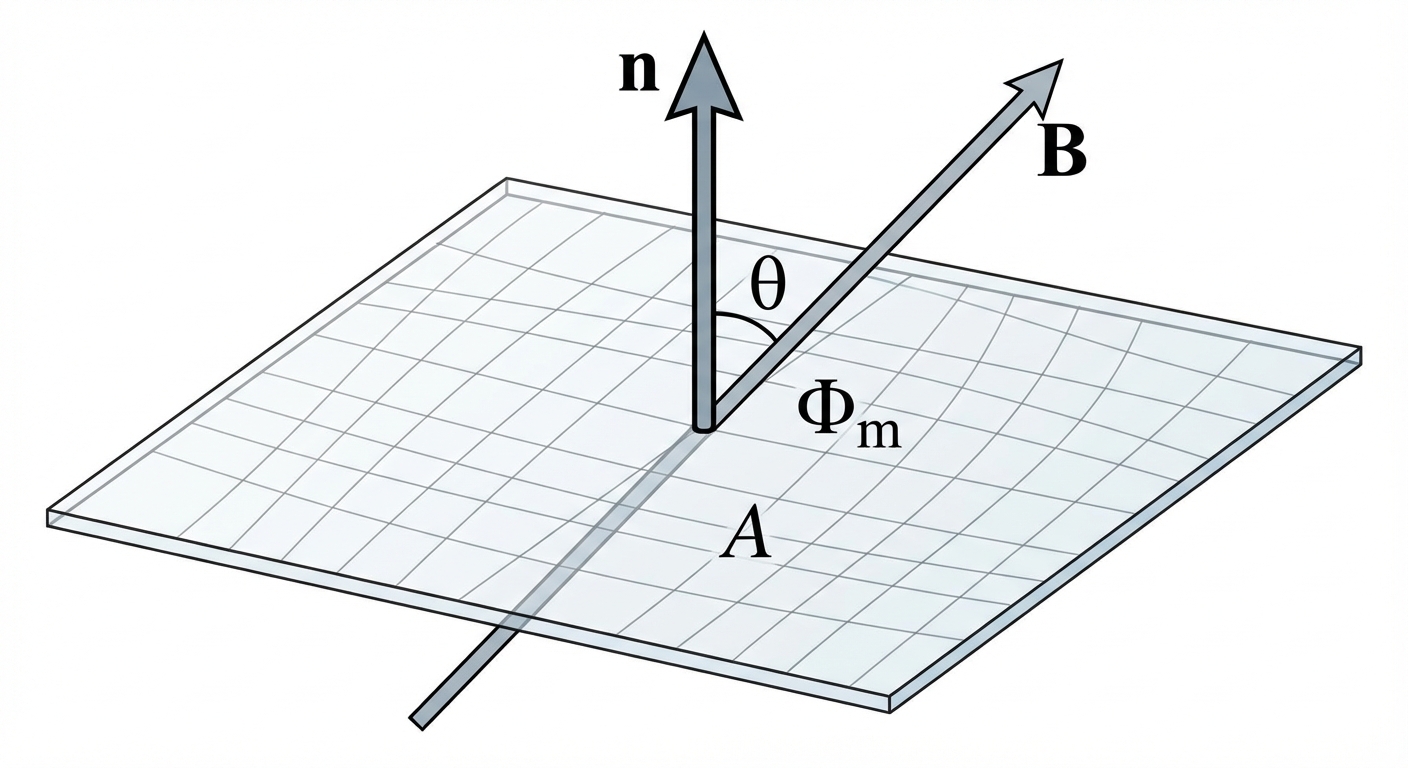
Use the Greek letter phi ($ Phi$) for flux. In AP Physics C, the magnetic field $\vec{B}$ acts over a specific area $\vec{A}$.
If the magnetic field is uniform across a flat area, this simplifies to the dot product:
Where:
- $\vec{B}$ is the magnetic field vector (Tesla, T).
- $\vec{A}$ is the area vector ($m^2$). Crucial: The area vector is always perpendicular (normal) to the surface.
- $\theta$ is the angle between $\vec{B}$ and the normal vector to the surface.
The Unit
The unit for Magnetic Flux is the Weber (Wb).
Faraday's Law of Induction
Michael Faraday discovered that a constant magnetic field produces nothing new, but a changing magnetic field creates an electric current. This is the foundation of modern power generation.
The Law
Faraday's Law states that the magnitudes of the induced EMF (Electromotive Force, $\mathcal{E}$) is determined by the rate of change of magnetic flux through a loop.
- $\mathcal{E}$: Induced EMF (Volts).
- $N$: Number of loops (turns) of wire.
- $\frac{d\Phi_B}{dt}$: Time derivative of Magnetic Flux.
Maxwell-Faraday Equation (Induced Electric Fields)
In AP Physics C, you must understand that valid EMF implies the existence of an electric field. Unlike electrostatic fields which are conservative (start on positive, end on negative), induced electric fields are non-conservative and form closed loops.
Faraday's Law in integral form (one of Maxwell's Equations):
Here, the line integral of the electric field $\vec{E}$ around a closed loop equals the negative rate of change of flux through that loop.
Three Ways to Induce EMF
Since $\Phi_B = BA\cos(\theta)$, you can induce an EMF by changing any of the three variables with respect to time ($t$):
- Change $B$: Varies the magnetic field strength (e.g., imply $\frac{dB}{dt}$).
- Change $A$: Varies the area of the loop (e.g., imply $\frac{dA}{dt}$).
- Change $\theta$: Rotates the loop in the field (e.g., generators).
Lenz's Law
The negative sign in Faraday's Law represents Lenz's Law. It is a consequence of the Conservation of Energy.
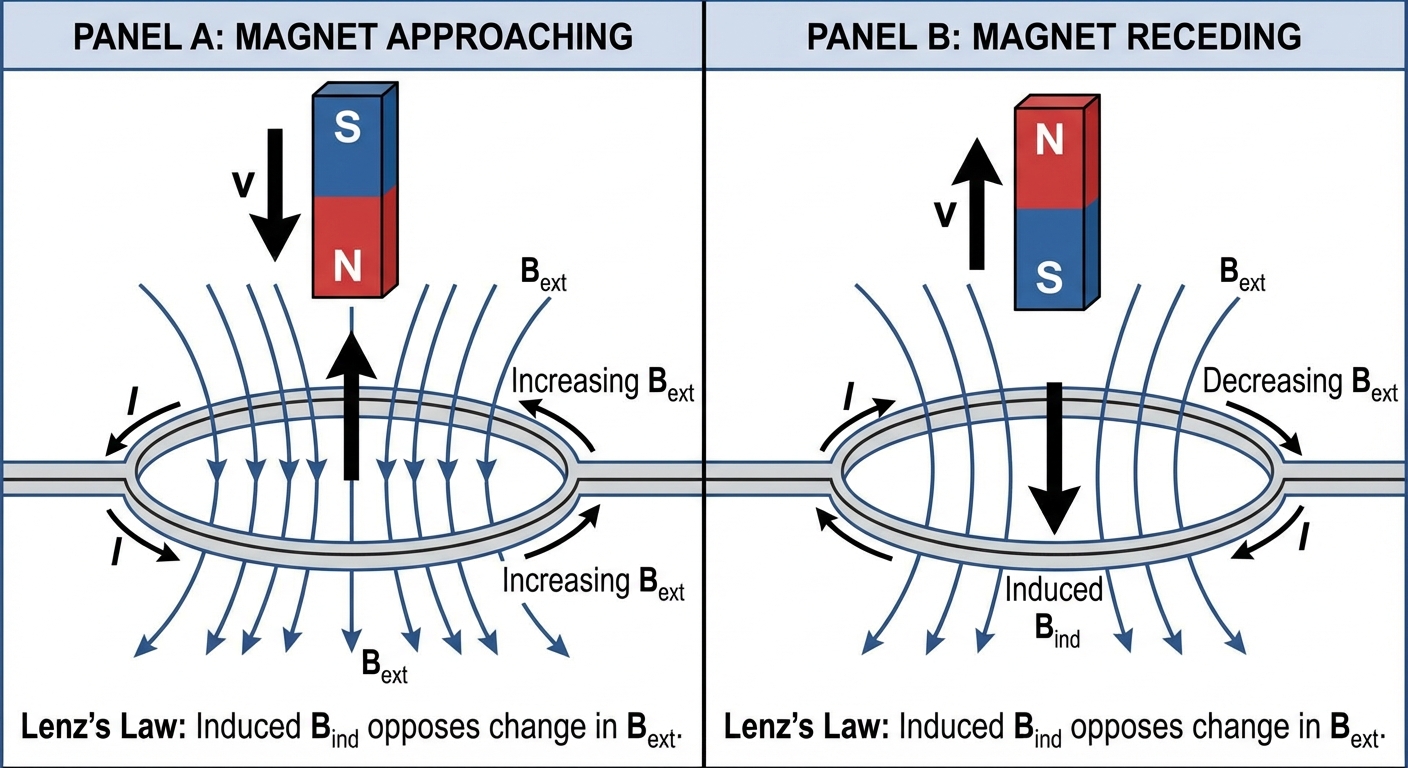
Definition: The direction of the induced current (and induced EMF) is such that it creates a magnetic field that opposes the change in magnetic flux that produced it.
How to Determine Direction (The 4-Step Method)
Don't guess. Follow this logical flow to find the direction of induced current:
- Identify $\vec{B}_{ext}$: Determine the direction of the external magnetic field passing through the loop.
- Analyze $\Delta \Phi$: Is the flux increasing or decreasing?
- Determine $\vec{B}_{induced}$:
- If flux is increasing, nature tries to cancel the gain. $\vec{B}{induced}$ points opposite to $\vec{B}{ext}$.
- If flux is decreasing, nature tries to prop it up. $\vec{B}{induced}$ points in the same direction as $\vec{B}{ext}$.
- Right Hand Rule (RHR): Point your right thumb in the direction of $\vec{B}_{induced}$. Your fingers curl in the direction of the induced current.
Motional EMF
Motional EMF refers to voltage induced when a conductor moves physically through a magnetic field. This is a common AP Physics C problem type involving "sliding bars" on rails.
Derivation
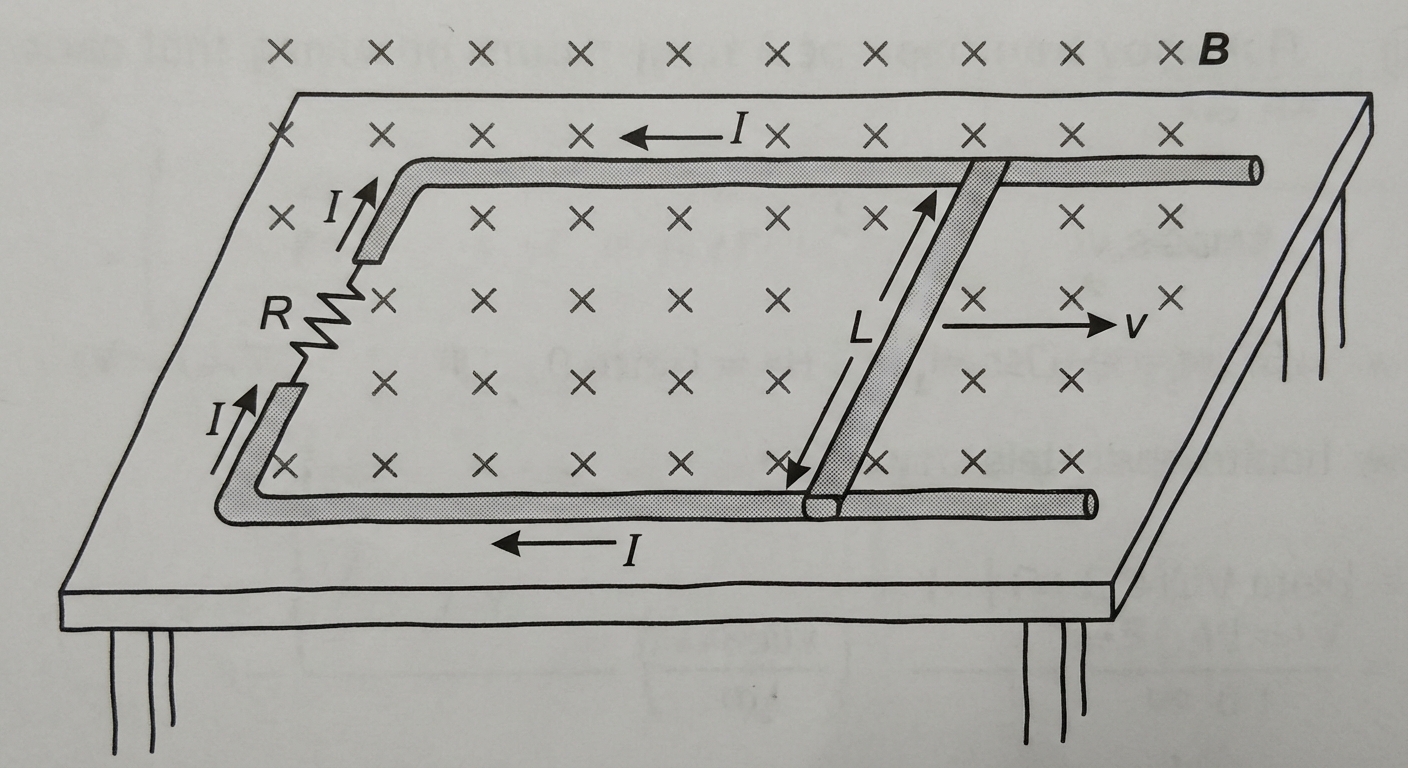
Consider a bar of length $L$ moving at velocity $v$ perpendicular to a uniform B-field.
Use Faraday's Law: The area of the loop is $A = L \cdot x$ (where $x$ is the horizontal position).
Since $v = \frac{dx}{dt}$:
(Note: This assumes $B$, $l$, and $v$ are mutually perpendicular. If not, use the cross product form: $\mathcal{E} = \int (\vec{v} \times \vec{B}) \cdot d\vec{l}$)
Worked Example: The Sliding Bar
Problem: A conductive bar of length $L = 0.5\text{ m}$ slides to the right on frictionless rails with a velocity of $v = 4\text{ m/s}$ in a uniform magnetic field $B = 2\text{ T}$ pointing into the page. The rails are connected by a resistor $R = 10\, \Omega$. Find the magnitude and direction of the current.
Solution:
Calculate EMF:
Calculate Current (Ohm's Law):
Determine Direction (Lenz's Law):
- External B: Into the page.
- Flux Change: As the bar moves right, the area increases. Therefore, inward flux is increasing.
- Induced B: Must oppose the increase. Induced B points out of the page.
- RHR: Thumb points out of page -> fingers curl Counter-Clockwise.
Applications: Generators and Induction
The Generator Principle
Mechanical energy is converted to electrical energy by rotating a coil in a magnetic field.
- $ Phi_B = BA\cos(\omega t)$, where $\omega$ is angular velocity.
- Differentiate with respect to time:
This produces an alternating current (AC) sinusoidal voltage.
Eddy Currents
When a solid conductor (like a metal plate) moves through a changing magnetic field, circulating currents called Eddy Currents are induced within the bulk of the material.
- According to Lenz's law, these currents create magnetic forces that oppose the motion of the conductor.
- Application: Magnetic braking in trains and roller coasters.
Common Mistakes & Pitfalls
| Mistake | Correction |
|---|---|
| Confusing Flux with EMF | Flux ($ Phi$) is the "stuff" passing through. EMF ($ E$) depends on how fast that "stuff" changes. You can have huge flux but zero EMF (if the flux is constant). |
| The Area Vector | Students often use the angle between the coil surface and the field. Always use the angle between the normal vector (perpendicular to surface) and the field. |
| Sign Errors in Lenz's Law | Do not automatically assume the induced field is opposite to the external field. It is opposite to the change in flux. If flux decreases, induced field is in the same direction as external. |
| Component Errors in Motional EMF | In $\mathcal{E} = Blv$, ensure the velocity component used is the one perpendicular to the B-field. Components parallel to B generate no force. |