Unit 5: Upheaval in France (1789–1815)
The French Revolution and the Napoleonic Era
The French Revolution is the pivot point of modern European history. It transitioned Europe from the age of Absolutism and Feudalism into the modern era of Nationalism, Liberalism, and Secularism. In AP European History, it is crucial to understand the distinct phases of the revolution: the Liberal Phase, the Radical Phase, and the Napoleonic Era.
The French Revolution: Causes and the Liberal Phase (1789–1792)
The Three Estates and Long-Term Causes
France’s social structure, the Ancien Régime, was divided into three legal categories known as Estates. This rigid hierarchy fueled deep resentment.
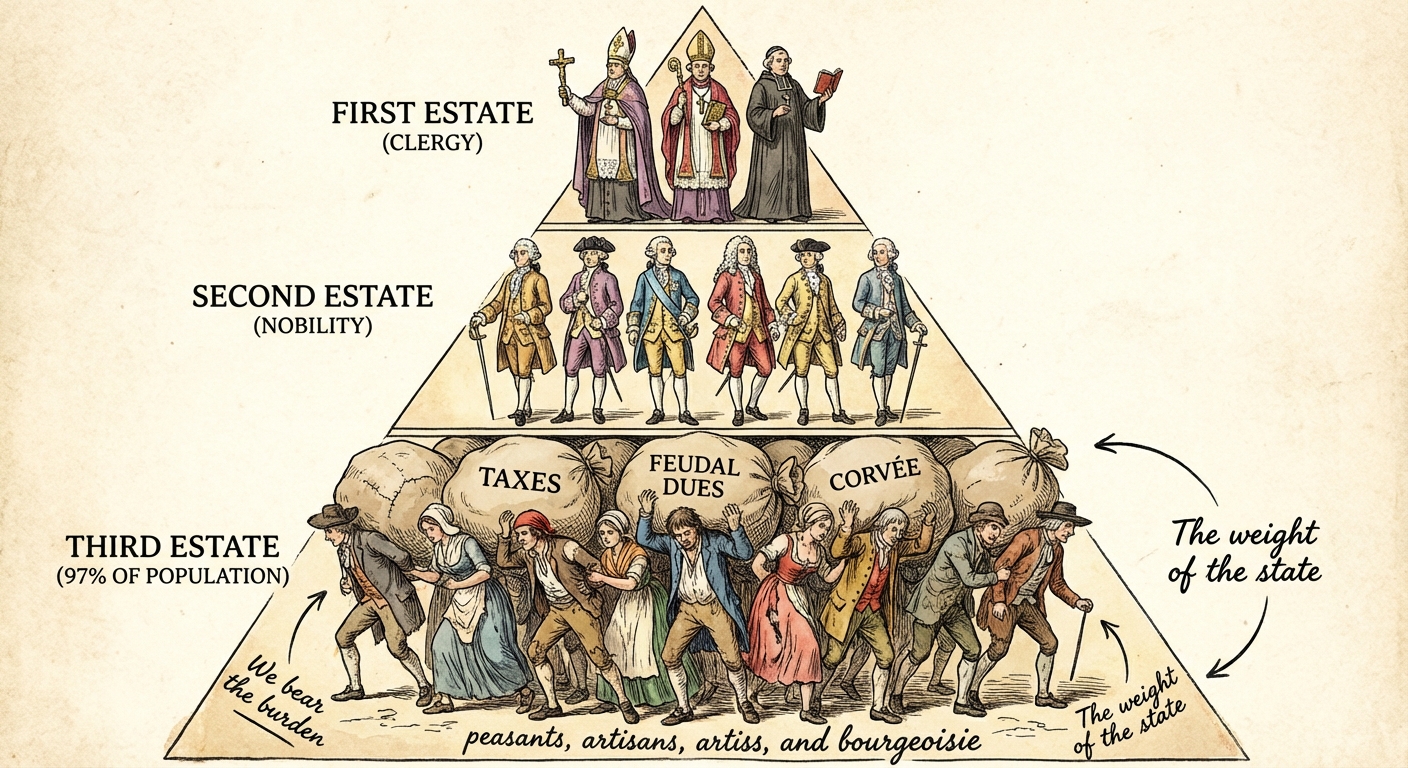
| Estate | Composition | Land Ownership | Taxes |
|---|---|---|---|
| First Estate | Clergy | ~10% | Paid voluntary "gift" only; collected tithes |
| Second Estate | Nobility | ~25–30% | Exempt from most direct taxes like the taille |
| Third Estate | Everyone else (Peasants, Urban Workers, Bourgeoisie) | ~60% | Paid the taille, gabelle (salt tax), and feudal dues |
Key Concept — The Bourgeoisie: These were the educated middle class (merchants, lawyers, doctors) within the Third Estate. They had wealth but no political power, and their embrace of Enlightenment ideals (Liberty, Equality) was a primary engine of the revolution.
Road to Revolution
- Financial Crisis: Due to wars (Seven Years' War, American Revolution) and royal extravagance, France was bankrupt. $Interest > Revenue$.
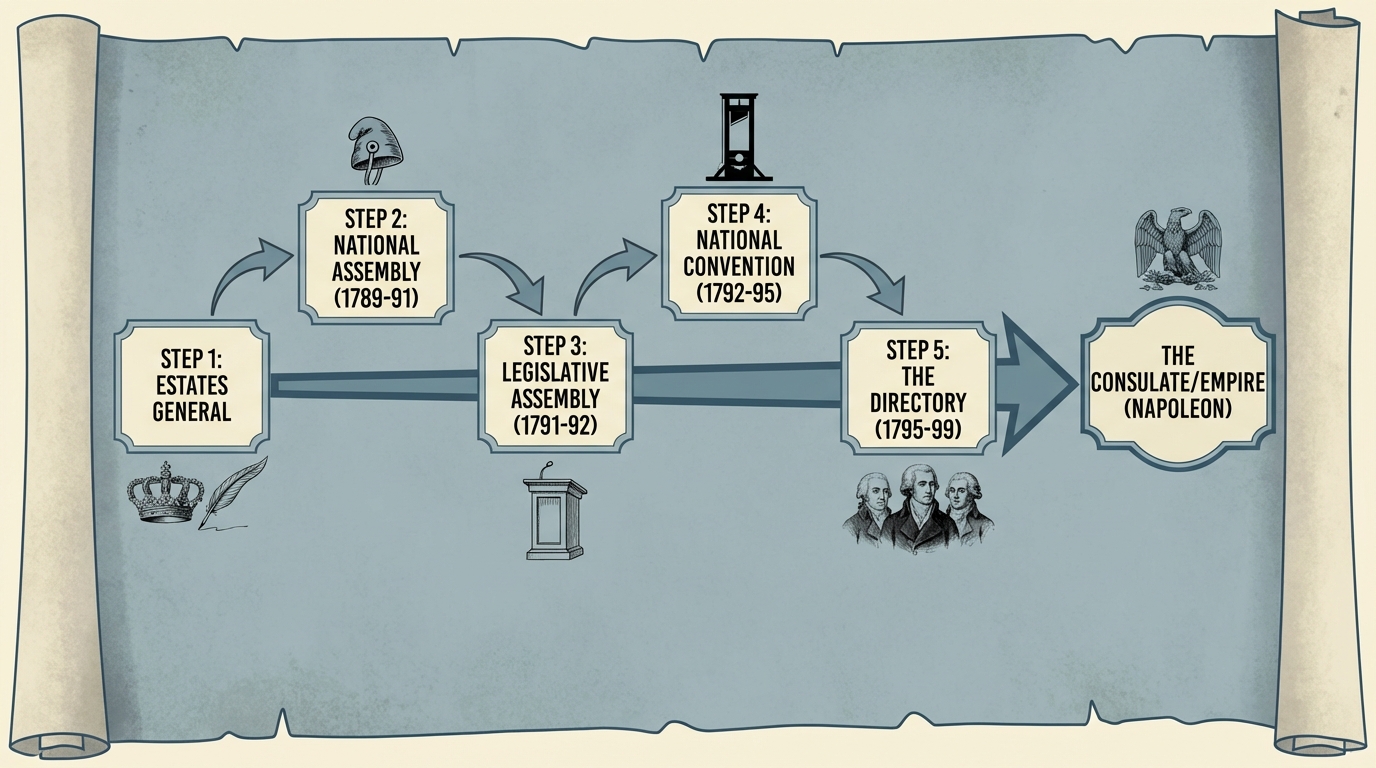
- The Estates General (1789): King Louis XVI was forced to call a meeting of representatives from all three estates to address the tax crisis. The Third Estate demanded voting by head (one man, one vote) rather than by order (one estate, one vote).
The Liberal Phase Events
- The Tennis Court Oath: Locked out of the meeting hall, the Third Estate declared themselves the National Assembly and swore not to disband until they had written a constitution.
- Storming of the Bastille (July 14, 1789): Urban workers in Paris attacked the prison to get gunpowder. This saved the National Assembly from the King's military and symbolized the fall of despotism.
- The Great Fear: Peasant uprisings in the countryside destroyed feudal documents. In response, the National Assembly issued the August 4th Decrees, abolishing feudalism and noble privileges.
Constitutional Monarchy and Reforms
The National Assembly created a new order based on Enlightenment principles:
- Declaration of the Rights of Man and of the Citizen: Guaranteed equality before the law, freedom of speech, and representative government. (Note: It excluded women, leading Olympe de Gouges to write the Declaration of the Rights of Woman).
- Civil Constitution of the Clergy (1790): A major error. It subordinated the Catholic Church to the French state, forcing priests to swear loyalty to the government. This alienated the Pope and devout French peasants.
- Constitution of 1791: Established a Constitutional Monarchy. The King remained head of state, but the Legislative Assembly held the power to make laws.
The Radical Revolution: Terror and Reaction (1792–1799)
The revolution Radicalized due to the King’s attempted escape (Flight to Varennes), the outbreak of war with Austria and Prussia, and economic instability.
The Second Revolution
- September Massacres (1792): Fear of foreign invasion and internal conspiracy led mobs to slaughter prisoners in Paris.
- The National Convention: This new elected body abolished the monarchy and declared France a Republic.
- Execution of Louis XVI (1793): The King was guillotined for treason. This shocked Europe and expanded the war against the Coalition (Britain, Spain, Austria, Prussia, etc.).
Factions within the Convention
- The Mountain (Jacobins): Radicals led by Robespierre, Danton, and Marat. They sat high in the assembly hall and allied with the Sans-culottes.
- ** The Girondins**: Moderate republicans who feared the domination of Paris and the violence of the mob.
- Sans-culottes: The laboring poor of Paris. They wore long trousers (instead of noble knee-breeches) and demanded radical economic changes like price controls on bread.
The Reign of Terror (1793–1794)
To suppress internal counter-revolution (like the Vendée rebellion) and win the war abroad, the Convention created the Committee of Public Safety (COPS), led essentially by Maximilien Robespierre.
- Planned Economy: The "Law of the Maximum" set price limits on bread to appease the Sans-culottes.
- De-Christianization: Replaced the Christian calendar with a Revolutionary one (10-day weeks) and promoted the Cult of the Supreme Being.
- The Terror: Tribunals executed roughly 40,000 people deemed "enemies of the revolution."
Robespierre's Philosophy: He believed terror was a form of political justice necessary to create a "Republic of Virtue."
The Thermidorian Reaction (1794–1799)
Fear of Robespierre led the Convention to execute him in July 1794 (month of Thermidor). The revolution swung back to the right:
- Powers of the Committee of Public Safety were curtailed.
- Jacobin clubs were closed.
- ** The Directory (1795–1799)**: A five-man executive body established. It was weak, corrupt, and increasingly relied on the military to maintain order, paving the way for Napoleon.
Napoleon and the Napoleonic Wars (1799–1815)
Napoleon Bonaparte essentially ended the Revolution by consolidating power, yet he preserved many of its moderate gains.
Rise to Power
- Coup of 18 Brumaire (1799): Napoleon overthrew the Directory and established the Consulate, naming himself First Consul.
- Emperor (1804): He crowned himself Emperor.
Domestic Reforms: "Enlightened Despot"?
- The Napoleonic Code (Civil Code of 1804): Unified French law. It guaranteed equality of all male citizens before the law and security of wealth/private property. However, it severely restricted women's rights, re-establishing the authority of the husband/father.
- The Concordat of 1801: Healed the breach with the Catholic Church. The Pope acknowledged the Republic, and Napoleon agreed to pay clergy salaries. (Important for stability).
- Meritocracy: Careers were "open to talent," not birth status, especially in the military and bureaucracy.
Foreign Policy and Empire
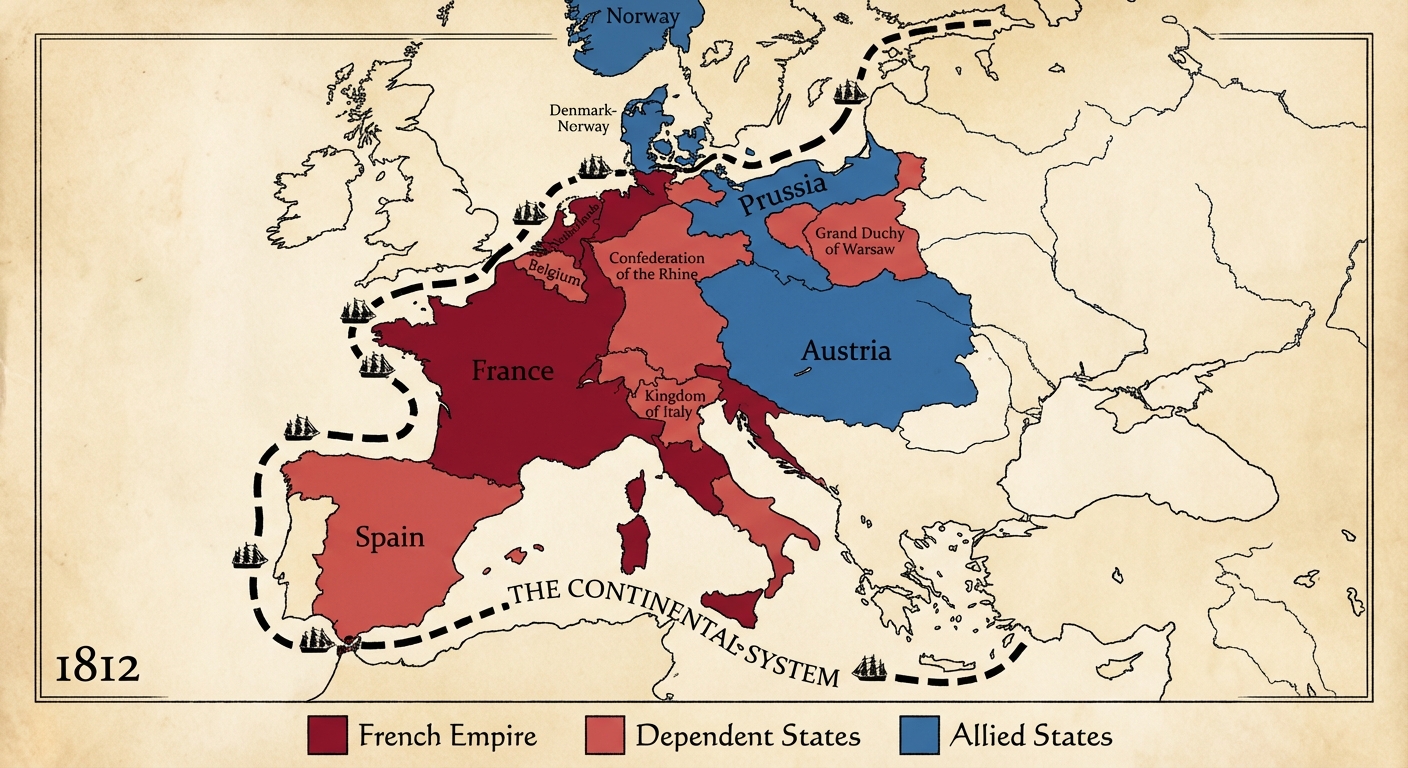
Napoleon conquered much of Europe, abolishing feudalism and spreading the Napoleonic Code in subject territories (Germany, Italy, Spain).
- Continental System: After failing to invade Britain (Battle of Trafalgar), Napoleon tried to starve them economically by forbidding the continent from trading with Britain. It failed and hurt the European economy.
- The Peninsular War: Napoleon invaded Spain to enforce the blockade. Spanish insurgents used guerilla warfare (little war), draining French resources.
- Invasion of Russia (1812): The turning point. Alexander I refused the Continental System. Napoleon invaded with the Grand Army (600,000 men). The Russians used scorched earth tactics. Winter and starvation destroyed the army; only ~30,000 returned.
The End
- The Hundred Days: After exile to Elba, Napoleon returned for a brief period.
- Battle of Waterloo (1815): Final defeat by the Duke of Wellington and Prussian forces.
- Congress of Vienna: Conservative powers met to restore the Balance of Power and undo the chaos of the revolution.
Common Mistakes & Pitfalls
- Confusing the Governments: Students often mix up the National Assembly (Liberal/Constitutional Monarchy) with the National Convention (Radical/Republic). Remember the timeline: Assembly $\rightarrow$ Convention $\rightarrow$ Directory.
- Napoleon vs. The Revolution: Do not say Napoleon "destroyed" the revolution. He destroyed the democracy of the revolution but preserved the equality (for men) and property rights of the revolution. He is a synthesizer of the Old Regime and the Revolution.
- The Jacobins vs. Girondins: Both were Republicans and members of the Jacobin club initially. The difference was radicalism: The Mountain (Jacobins) wanted to kill the King and work with the mob; the Girondins wanted to spare the King and feared the mob.
- Burke vs. The Revolution: Remember Edmund Burke. He wrote Reflections on the Revolution in France. He is the father of clear Conservatism, predicting the revolution would end in military dictatorship (which it did).
Memory Aid: The French Revolution Phases
"L.R.D.N."
- Liberal (1789-1791): Constitution, Rights of Man, Bastille.
- Radical (1792-1794): Robespierre, Guillotine, Republic.
- Directory (1795-1799): Weak, corrupt, reaction.
- Napoleon (1799-1815): Empire, War, Code.