Foundations of Motion: Kinematics
Introduction to Kinematics
Kinematics is the branch of mechanics that describes the motion of points, bodies (objects), and systems of bodies without considering the forces that cause them to move. In AP Physics 1, we focus on translational motion in one and two dimensions.
Vectors and Scalars
Before analyzing motion, you must understand the mathematical quantities used to measure it.
Definitions
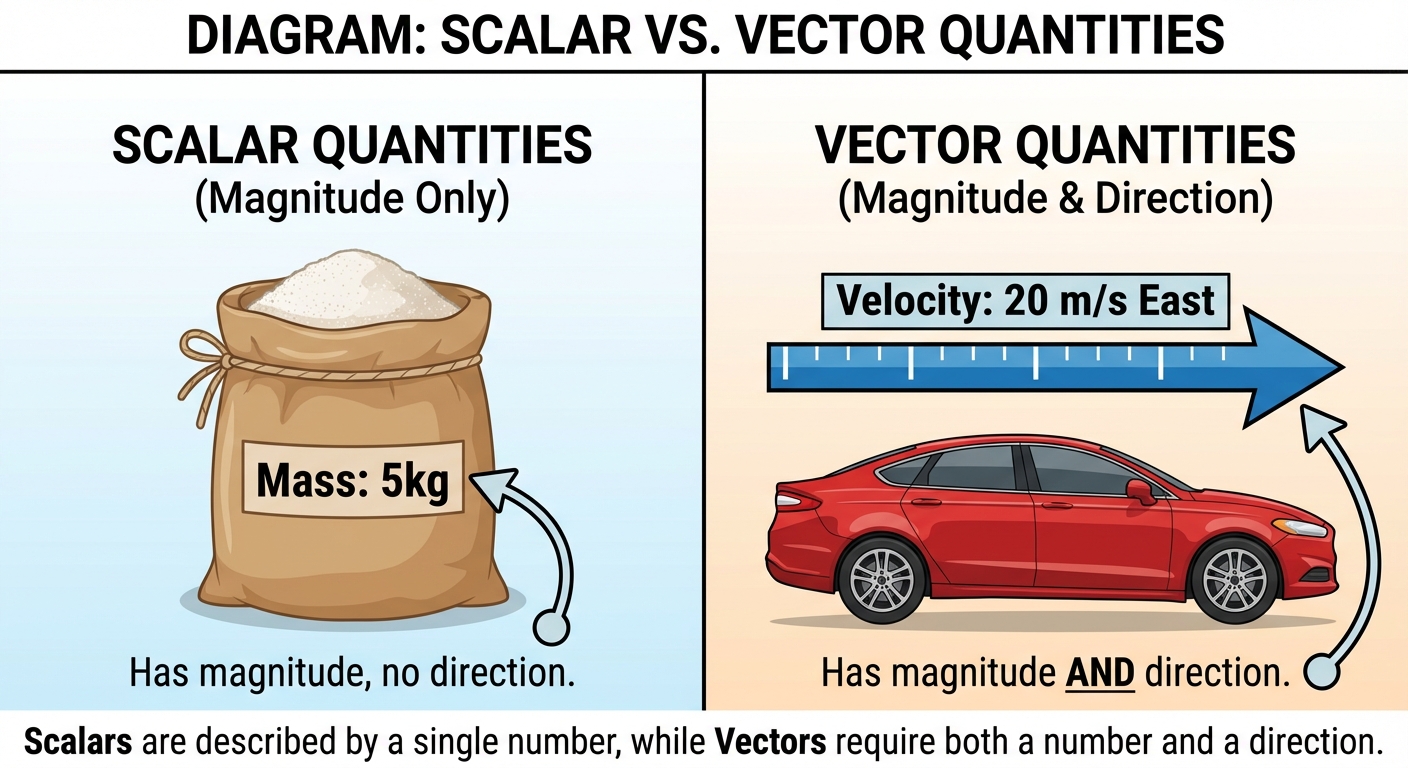
- Scalar Quantity: A physical quantity defined by magnitude (size) only. It does not contain directional information.
- Vector Quantity: A physical quantity defined by both magnitude and direction.
Comparison Table
| Feature | Scalar | Vector |
|---|---|---|
| Properties | Magnitude only | Magnitude + Direction |
| Math Rules | Simple Algebra ($3kg + 4kg = 7kg$) | Vector Algebra (Tail-to-Tip method) |
| Changes when… | Magnitude changes | Magnitude OR Direction changes |
| Examples | Distance, Speed, Time, Mass, Energy | Displacement, Velocity, Acceleration, Force |
Note: In one-dimensional algebraic calculations, direction for vectors is indicated by a positive (+) or negative (-) sign. You must define which direction is positive (usually up or to the right).
Position, Distance, and Displacement
Motion is the change in position over time.
Position ($x$ or $\vec{r}$)
Position is the location of an object relative to a specific origin (reference point). It is a vector quantity.
Distance ($d$ or $s$)
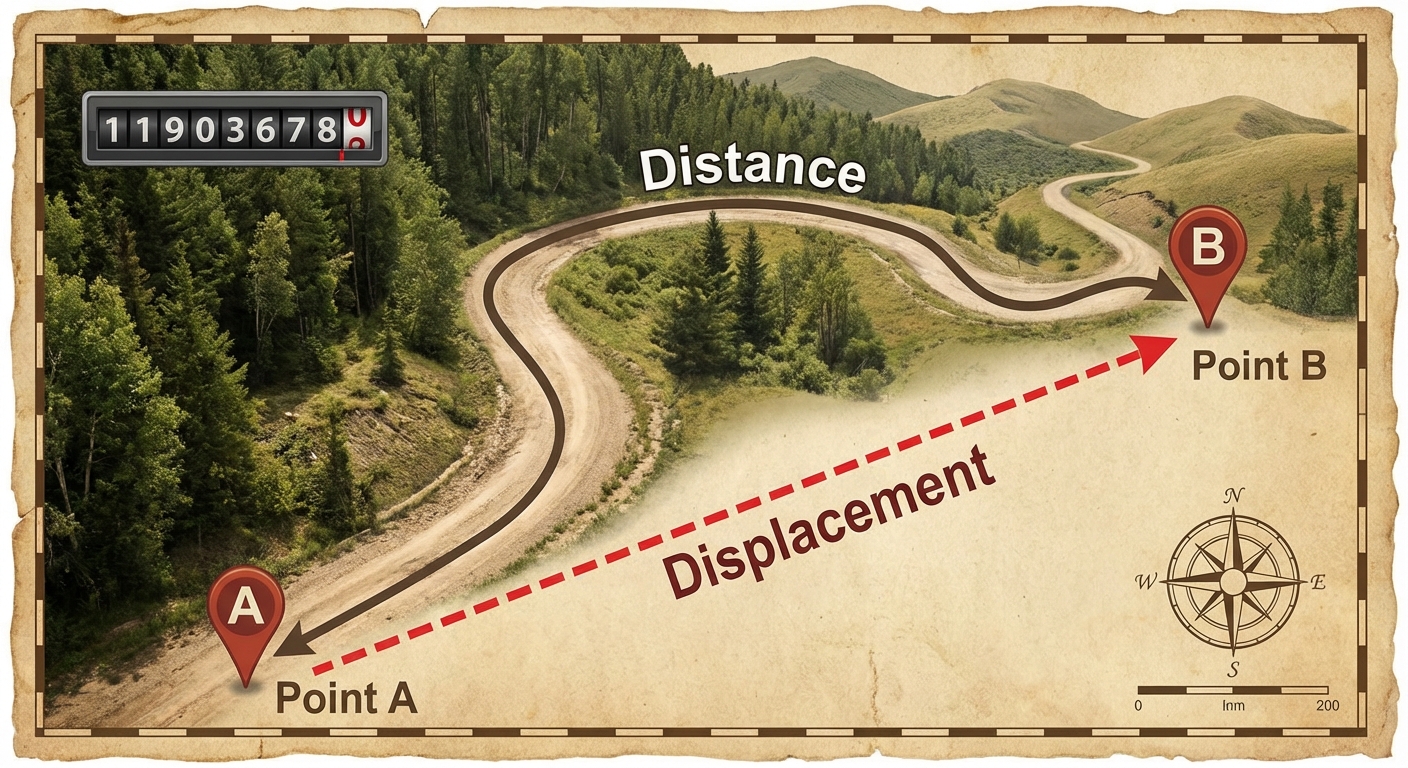
Distance is the total length of the actual path traveled between two positions.
- Type: Scalar
- Value: Always positive and cumulative. The odometer on a car measures distance.
Displacement ($\Delta x$ or $\Delta \vec{r}$)
Displacement is the straight-line change in position from the starting point to the ending point, independent of the path taken.
- Type: Vector
- Formula:
- Value: Can be positive, negative, or zero (if you return to the start).
Example 1: The difference
A runner does one full lap around a 400m circular track.
- Distance: $400\text{ m}$
- Displacement: $0\text{ m}$ (The final position is the same as the initial position).
Speed and Velocity
While often used interchangeably in daily language, they are distinct in physics.
Average Speed
Speed is how fast an object is moving. It is the rate at which distance is covered.
- Notation: $s$
Average Velocity ($\bar{v}$)
Velocity is the rate at which displacement changes. It tells you how fast an object moves and in which direction.
Instantaneous vs. Average
- Average: Calculated over a time interval.
- Instantaneous: The velocity at a specific moment in time (like a speedometer reading with a direction). In calculus terms, this is the derivative $v = dx/dt$.
Acceleration
Acceleration ($a$) is the rate of change of velocity.
Conceptualizing Acceleration
Acceleration occurs if an object:
- Speeds up.
- Slows down.
- Changes Direction (even if speed is constant, velocity changes because it is a vector).
Speeding Up vs. Slowing Down
A common misconception is that negative acceleration means slowing down. This is false. To determine the motion state, compare the signs of velocity ($v$) and acceleration ($a$):
| Velocity Sign | Acceleration Sign | Motion State |
|---|---|---|
| $+$ | $+$ | Speeding Up (in positive direction) |
| $-$ | $-$ | Speeding Up (in negative direction) |
| $+$ | $-$ | Slowing Down |
| $-$ | $+$ | Slowing Down |
Memory Aid: If $v$ and $a$ interact like friends (same sign), they work together (speed up). If they interact like enemies (opposite signs), they fight (slow down).
Graphical Analysis of Motion
Graphing is a major component of the AP Physics 1 exam. You must be able to translate between Position vs. Time ($x-t$), Velocity vs. Time ($v-t$), and Acceleration vs. Time ($a-t$) graphs.
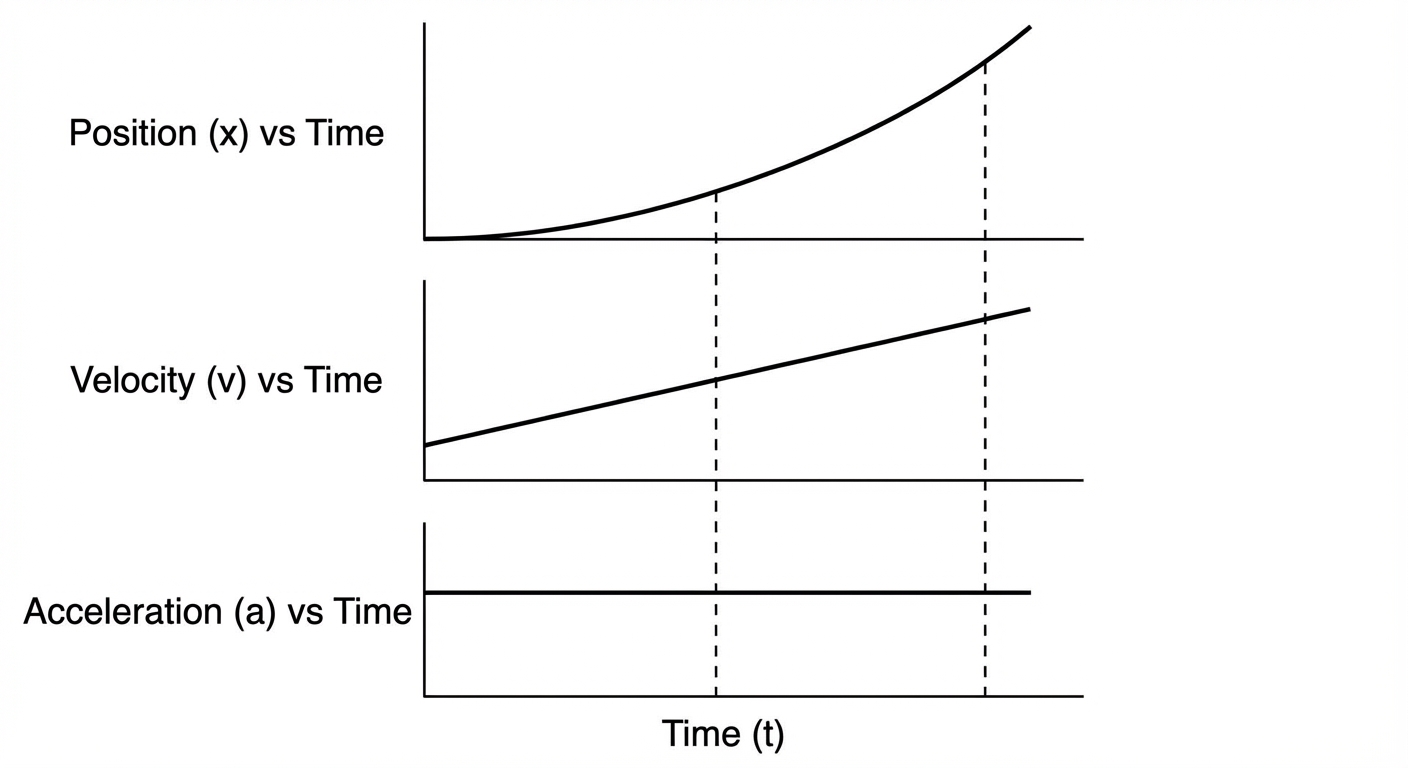
1. Position vs. Time Graph ($x-t$)
- Slope: Represents Velocity.
- Steep slope = Fast.
- Flat line (0 slope) = At rest.
- Straight slope = Constant velocity.
- Curved line = Changing velocity (Acceleration).
2. Velocity vs. Time Graph ($v-t$)
- Slope: Represents Acceleration.
- Area Under Curve: Represents Displacement ($\Delta x$).
- Area above the t-axis is positive displacement.
- Area below the t-axis is negative displacement.
3. Acceleration vs. Time Graph ($a-t$)
- Area Under Curve: Represents Change in Velocity ($\Delta v$).
One-Dimensional Kinematics Equations
When acceleration is constant, we use the "Big Three" (or Big Five) kinematic equations. These are provided on the AP Physics 1 Table of Information.
The Cheat Sheet (Formula Table)
Variables: $x$ (position), $v$ (velocity), $a$ (acceleration), $t$ (time), subscript $_0$ (initial).
| Missing Variable | Equation |
|---|---|
| Displacement ($x-x_0$) | |
| Final Velocity ($v_x$) | |
| Time ($t$) |
(Additional useful equations often derived/memorized):
- No Acceleration:
- No Initial Velocity:
Free Fall
Free fall is a special case of 1D motion where the only force is gravity.
- Acceleration is constant: $a_y = -g$ (where $g \approx 9.8 \text{ m/s}^2$ or $10 \text{ m/s}^2$ for estimation).
- At the max height of a throw, vertical velocity $v_y = 0$, but acceleration is still $-9.8 \text{ m/s}^2$.
Two-Dimensional Motion (Projectiles)
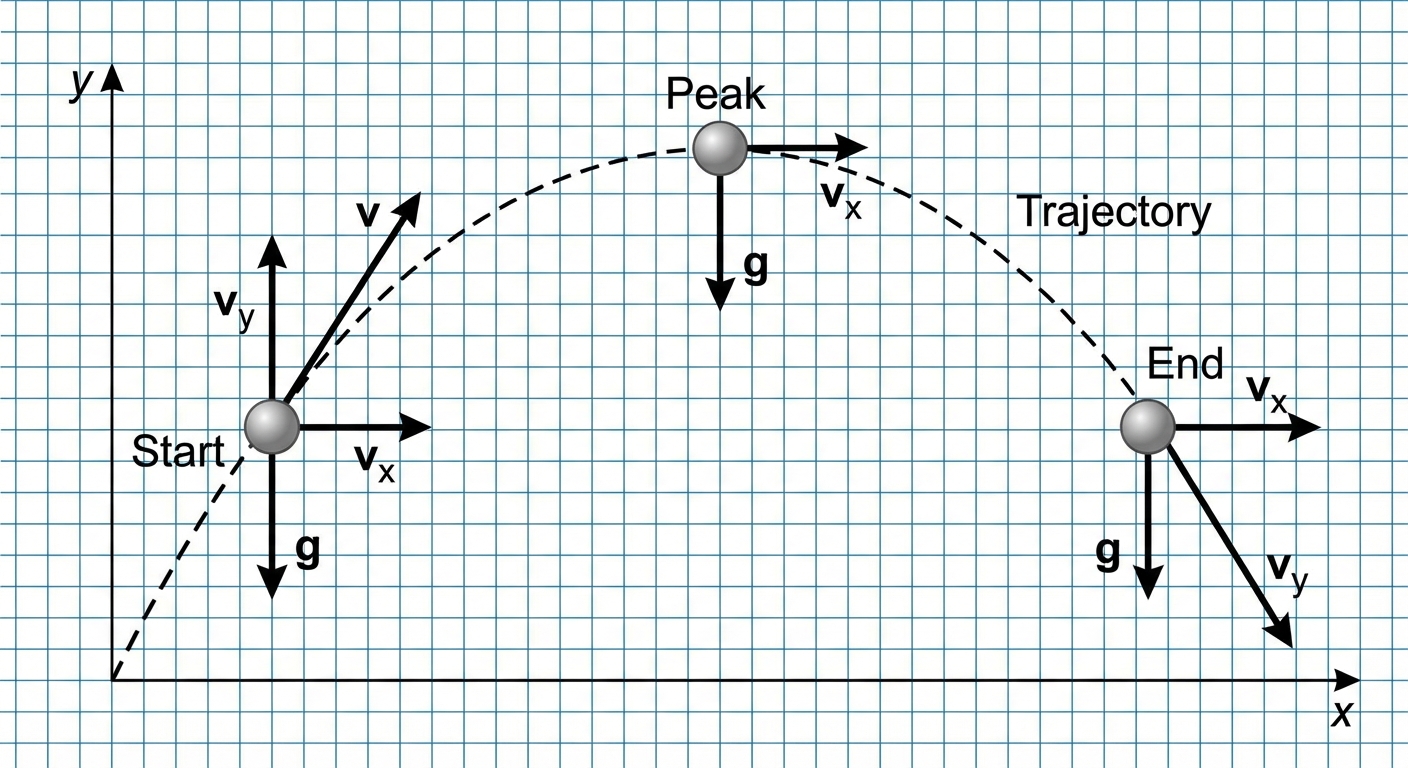
Projectile motion occurs when an object is thrown near the earth's surface and moves along a curved path under the action of gravity only. (Air resistance is ignored in AP Physics 1 unless stated otherwise).
The Golden Rule of 2D Motion
Perpendicular motions are independent.
The motion in the horizontal ($x$) direction does not affect motion in the vertical ($y$) direction, and vice versa. They share only one variable: Time ($t$).
Decomposition of Vectors
Always break the initial launch velocity ($v_0$) at angle $\theta$ into components:
Analyzing the Axes
Horizontal Axis (x-axis)
- Acceleration: $a_x = 0$ (Gravity does not pull sideways).
- Velocity: Constant ($vx = v{x0}$).
- Equation: $x = v_{x0}t$
Vertical Axis (y-axis)
- Acceleration: $a_y = -g$ (Gravity pulls down).
- Velocity: Changes continuously.
- Equation: Use the kinematic equations (replace $x$ with $y$ and $a$ with $-g$).
Key Projectile Concepts
- Maximum Height: Occurs when $v_y = 0$.
- Hang Time: Determined strictly by vertical motion ($v_{y0}$ and $h$).
- Range: Displaced horizontally ($x$). Max range occurs at $45^\circ$ on level ground.
Common Mistake Correction (from previous notes):
- Incorrect: "Acceleration acts in both horizontal and vertical directions for angled motion."
- Correct: Acceleration due to gravity acts ONLY vertically. $a_x$ is zero.
Common Mistakes & Pitfalls
- Confusing Position with Distance: A graph at $x=0$ means it is at the origin, not that it hasn't moved. A graph with 0 slope means it has stopped moving, not that it is at the origin.
- Mixing Axes: Never put a vertical variable (like $g$) into a horizontal equation. Link them only through Time ($t$).
- Sign Errors: If you define UP as positive, acceleration due to gravity ($g$) must be negative. If you throw a ball up, $v_0$ is positive, $a$ is negative.
- Acceleration at Top of Path: Students often think $a=0$ at the peak of a trajectory. $v=0$, but $a = -g$. If acceleration were zero, the object would hover there forever.
- Stopping Distance Math: If velocity doubles, stopping distance quadruples (because of the $v^2$ term in the kinematic equation), not doubles.