Comprehensive Guide to Personality Theories in Psychology
Psychoanalytic and Psychodynamic Theories
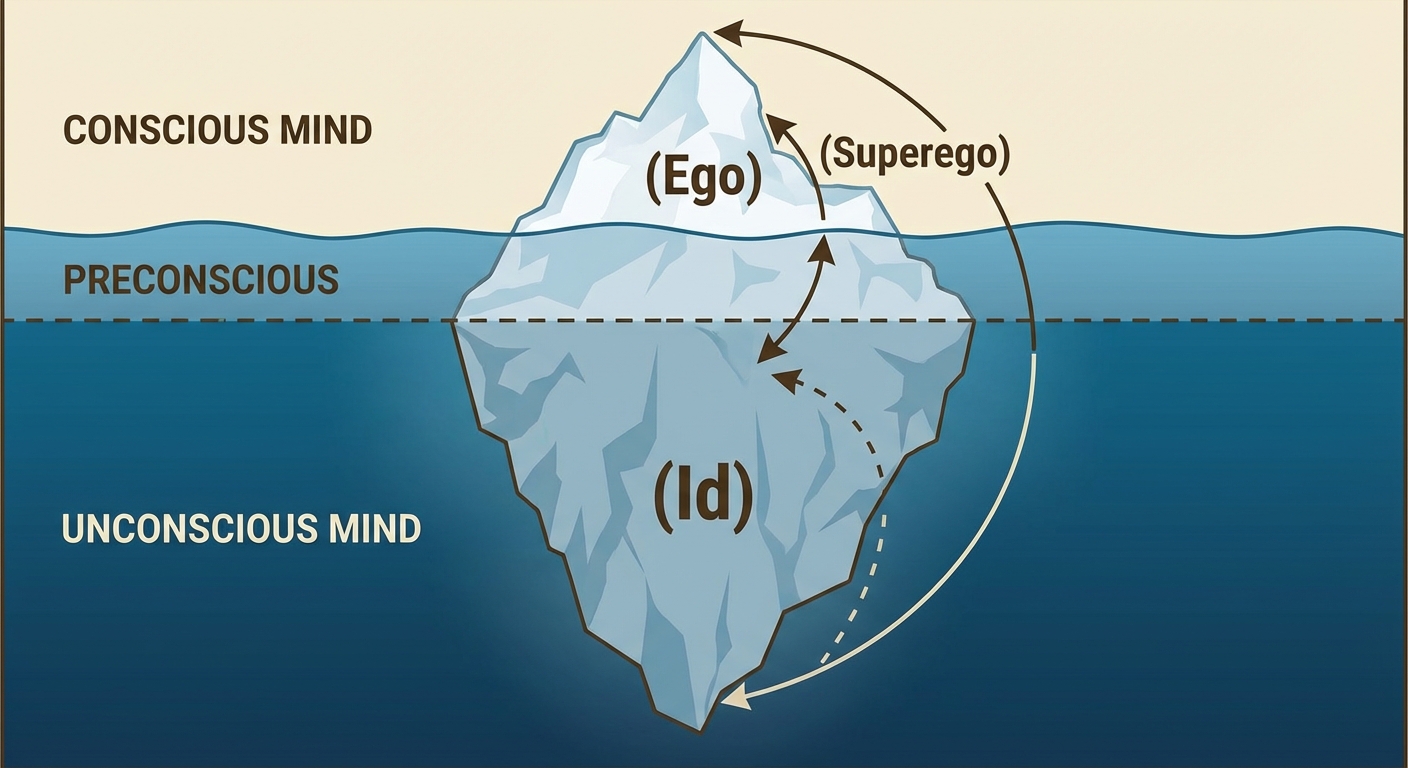
Freud’s Structure of the Mind
Sigmund Freud founded Psychoanalysis, a theory attributing thoughts and actions to unconscious motives and conflicts. Freud believed that personality arises from a conflict between impulse and restraint.
He divided the mind into three interacting systems:
Id (The Unconscious Energy):
- Operates on the Pleasure Principle (demands immediate gratification).
- Present at birth; drives basic survival, sexual, and aggressive urges.
- Example: An infant crying for food immediately, regardless of time or place.
Ego (The Executive):
- Operates on the Reality Principle (satisfies desires in realistic ways).
- Mediates between the Id, the Superego, and reality.
- Example: Waiting until your lunch break to eat rather than stealing a coworker's sandwich immediately.
Superego ( The Conscience):
- Focuses on the Moral Principle and ideal standards.
- Represents internalized ideals and provides standards for judgment (the conscience) and for future aspirations.
- Example: Feeling guilt after lying to a friend.
Defense Mechanisms
The Ego uses Defense Mechanisms to reduce anxiety by unconsciously distorting reality.
| Mechanism | Definition | Example |
|---|---|---|
| Repression | Banishing anxiety-arousing thoughts from consciousness. | A trauma victim cannot remember the details of the event. |
| Regression | Retreating to an earlier, more infantile stage of development. | An older child starts sucking their thumb on the first day of school. |
| Reaction Formation | Switching unacceptable impulses into their opposites. | A person who secretly hates their boss acts excessively friendly toward them. |
| Projection | Disguising one's own threatening impulses by attributing them to others. | A cheater constantly suspects their partner of being unfaithful. |
| Rationalization | Offering self-justifying explanations in place of real reasons. | "I drink to be social" (when actually dealing with alcoholism). |
| Displacement | Shifting sexual/aggressive impulses toward a less threatening object or person. | Kicking the dog after getting yelled at by a boss. |
| Sublimation | Transferring unacceptable impulses into socially valued motives. | Someone with aggression issues becoming a professional surgeon or boxer. |
| Denial | Refusing to believe or even perceive painful realities. | A partner refuses to admit their spouse is having an affair despite evidence. |
The Neo-Freudians
While accepting Freud’s basic ideas (id/ego/superego, unconscious, defense mechanisms), Neo-Freudians placed more emphasis on the conscious mind and debated the role of sex and aggression.
- Alfred Adler: Believed behavior is driven by efforts to conquer childhood inferiority feelings (Inferiority Complex).
- Karen Horney: Argued that childhood social tension (not sexual) triggers personality formation; countered Freud’s sexist "penis envy" assumptions with "womb envy."
- Carl Jung: Proposed the Collective Unconscious, a shared, inherited reservoir of memory traces (archetypes) from our species' history.
Humanistic Theories
Humanistic psychologists focused on the potential for healthy personal growth rather than pathology. They emphasized self-determination and self-realization.
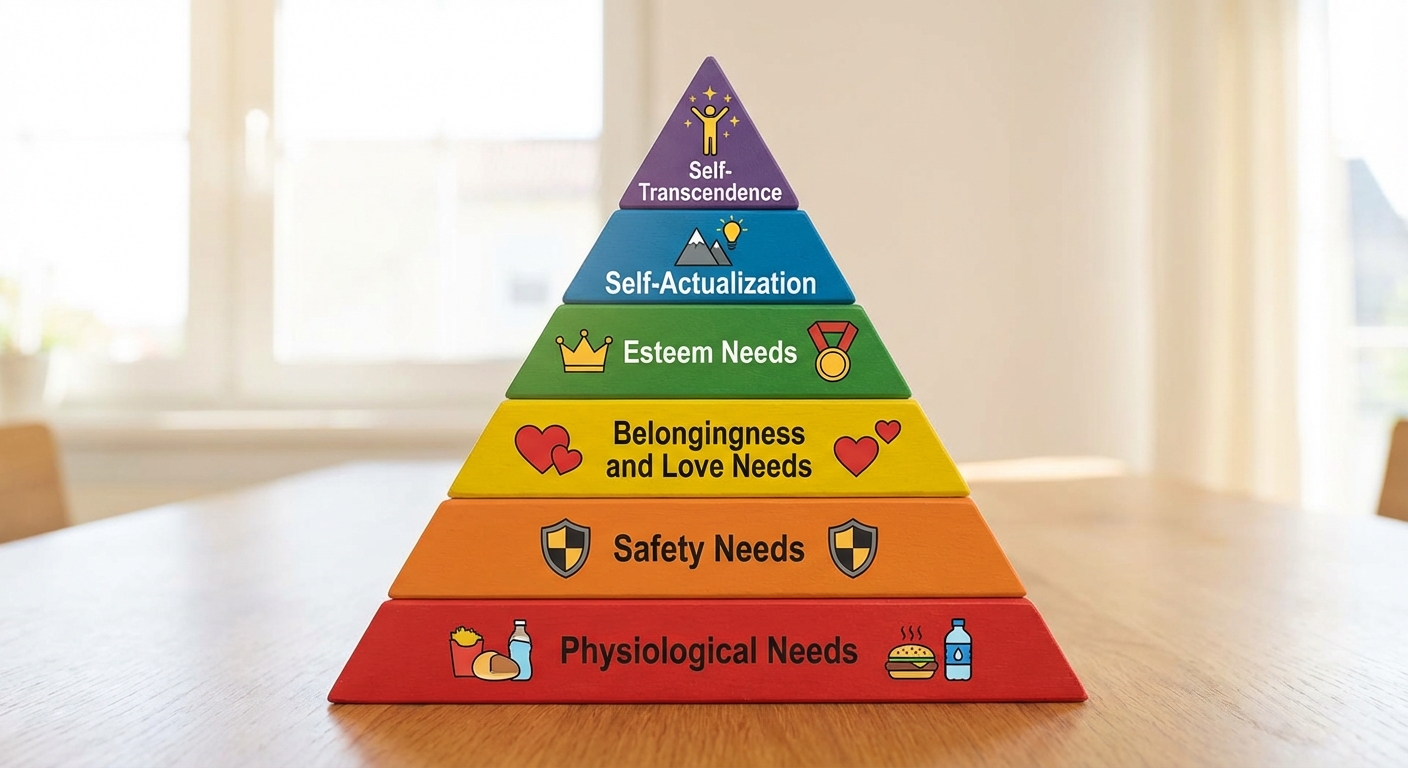
Abraham Maslow
Maslow proposed that we are motivated by a Hierarchy of Needs. Once physiological and safety needs are met, we strive for Self-Actualization (fulfilling our potential) and Self-Transcendence (finding meaning beyond oneself).
Carl Rogers
Rogers believed people are basically good and endowed with self-actualizing tendencies. He argued that a growth-promoting climate requires three conditions (The AGE mnemonic):
- Acceptance: Offering Unconditional Positive Regard (total acceptance toward another person).
- Genuineness: Being open with one's own feelings.
- Empathy: Sharing and mirroring others' feelings.
Key Concept: The Self-Concept
All our thoughts and feelings about ourselves answer the question, "Who am I?" If our Real Self (who we are) generally matches our Ideal Self (who we want to be), our self-concept is positive.
Trait Theories
Trait researchers describe personality in terms of fundamental Traits—characteristic behaviors and conscious motives. They use Factor Analysis, a statistical procedure used to identify clusters of test items that tap basic components of intelligence or personality.
The Big Five Factors
The most widely accepted contemporary trait theory is the Big Five. You can remember these traits with the mnemonic OCEAN or CANOE.
- Openness: Imaginative vs. Practical; Variety vs. Routine.
- Conscientiousness: Organized vs. Disorganized; Careful vs. Careless.
- Extraversion: Sociable vs. Retiring; Fun-loving vs. Sober.
- Agreeableness: Soft-hearted vs. Ruthless; Trusting vs. Suspicious.
- Neuroticism (Emotional Stability): Anxious vs. Calm; Insecure vs. Secure.
Assessing Traits
- Personality Inventories: Longer questionnaires covering a wide range of feelings and behaviors.
- MMPI (Minnesota Multiphasic Personality Inventory): The most widely researched and clinically used of all personality tests. Originally developed to identify emotional disorders, it is now used for many other screening purposes. It is Empirically Derived.
Social-Cognitive and Behavioral Theories
Proposed by Albert Bandura, the Social-Cognitive perspective views behavior as influenced by the interaction between people’s traits (including their thinking) and their social context.
Reciprocal Determinism
Bandura argued that personality is the result of an interaction that takes place between a person and their social context. This is Reciprocal Determinism.
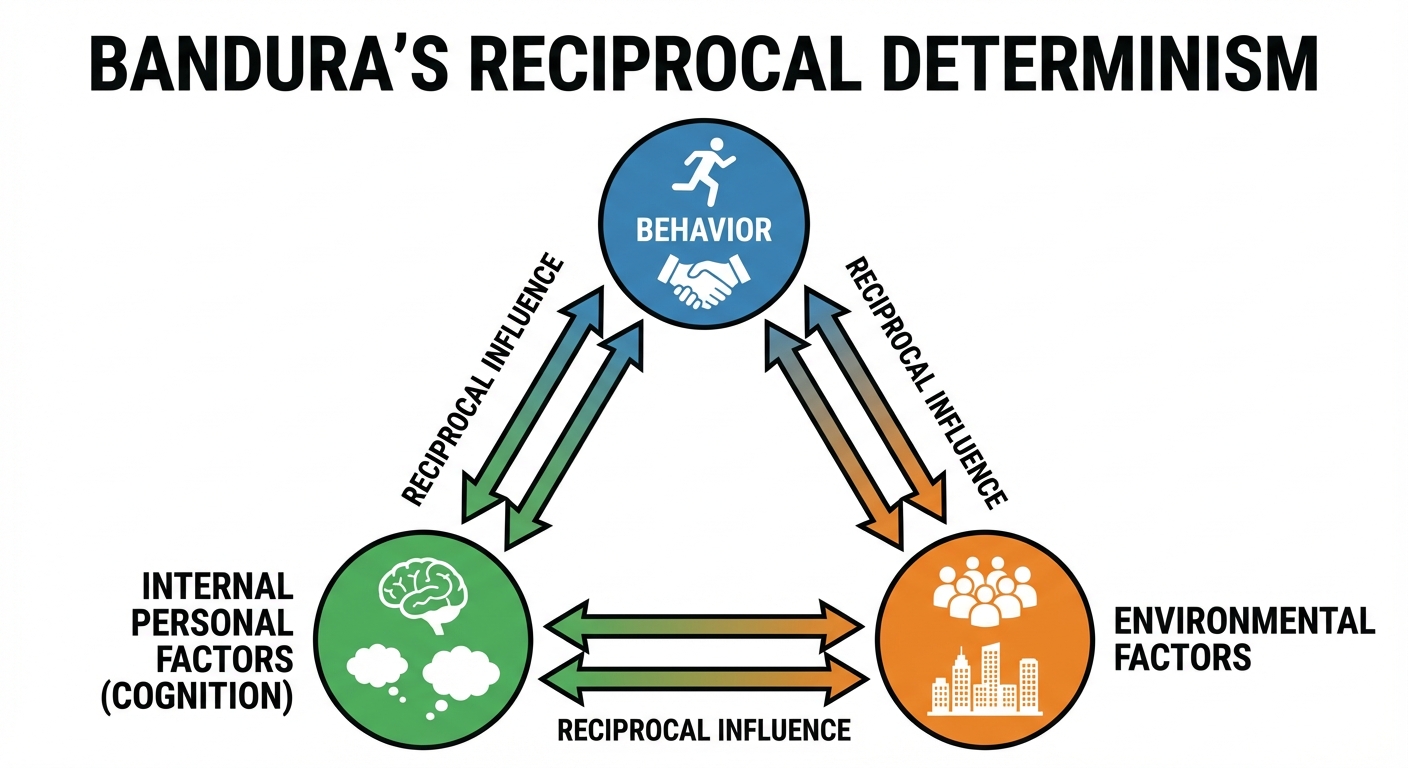
The three interacting factors are:
- Behavior: (e.g., learning to bungee jump)
- Internal Personal Factors: (e.g., thoughts and feelings about risky activities)
- Environmental Factors: (e.g., bungee-jumping friends)
Personal Control and Locus of Control
Julian Rotter introduced the concept of Locus of Control—our sense of controlling our environment rather than feeling helpless.
- Internal Locus of Control: The perception that you control your own fate.
- Correlation: Better academic achievement, better health, lower depression.
- External Locus of Control: The perception that chance or outside forces beyond your personal control determine your fate.
- Link: Learned Helplessness (Martin Seligman) occurs when an animal or human is repeatedly subjected to an aversive stimulus that it cannot escape. Eventually, the animal will stop trying to avoid the stimulus and behave as if it is utterly helpless to change the situation.
Self-Efficacy (Bandura)
Do not confuse this with self-esteem. Self-Efficacy is one's sense of competence and effectiveness in a specific task.
- Example: You might have high self-efficacy in math (you believe you can solve the problems) but low self-esteem (you generally dislike yourself).
Common Mistakes & Pitfalls
Sublimation vs. Displacement:
- Mistake: Students often treat these as identical.
- Correction: Displacement is negative/neutral (kicking a wall). Sublimation is always positive/productive (painting a masterpiece to release anger). Sublimation is the only truly healthy defense mechanism in Freudian theory.
Projection vs. Reaction Formation:
- Mistake: Confusing how the impulse is handled.
- Correction: In Projection, you keep the feeling but give it to someone else ("I'm not angry, you are!"). In Reaction Formation, you keep the feeling inside yourself but flip it to the opposite ("I hate him" becomes "I love him" externally).
Self-Esteem vs. Self-Efficacy:
- Mistake: Using the terms interchangeably.
- Correction: Self-esteem is global worth ("I am a good person"). Self-efficacy is task-specific confidence ("I can fix this car engine").
Type A vs. Type B:
- Mistake: Forgetting the physical health implications.
- Correction: Remember that Type A (competitive, hard-driving, impatient, verbally aggressive, and anger-prone) is specifically linked to an increased risk of Coronary Heart Disease, primarily due to the anger/hostility component.
Assessment Types:
- Mistake: Confusing Projective Tests with Inventories.
- Correction: Projective tests (Rorschach, TAT) are subjective and used by Psychoanalysts to reveal the unconscious. Inventories (MMPI, Big Five) are objective, scored by computer, and used by Trait theorists.