Study Guide: The Age of Rebirth and The Printing Revolution
Unit 1: The Transformation of Europe (c. 1450–1648)
Welcome to AP European History! We begin with the transition from the Middle Ages to the Early Modern era. This period is defined by a revival of classical learning, a shift in worldview, and technological innovations that permanently altered society.
Contextualizing the Renaissance
To understand why the Renaissance occurred, you must understand what Europe looked like before and during the 15th century. This wasn't a sudden explosion of genius; it was a gradual shift fueled by economic recovery and political fragmentation.
The Crisis of the Late Middle Ages
Before the Renaissance, Europe suffered through the Black Death (1347), the Hundred Years' War, and the Great Schism of the Church. These disasters shook the foundations of medieval society, creating a vacuum that allowed new ideas to emerge.
Why Italy?
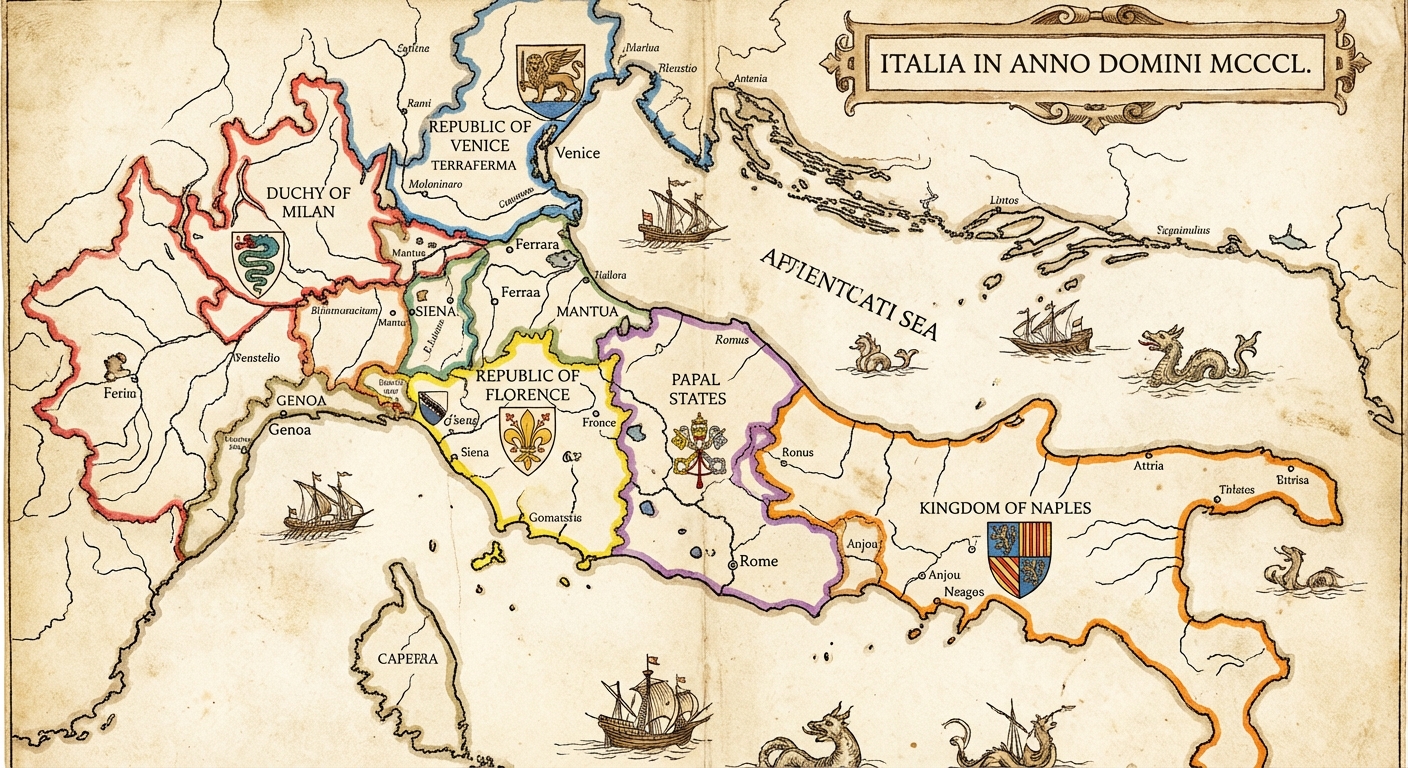
The Renaissance began in the Italian city-states (like Florence, Venice, and Milan) for three specific reasons:
- Geography: Italy was the gateway for trade between Europe and the East (Ottoman Empire). This brought wealth and re-introduced lost Greek texts.
- Wealthy Patronage: The lack of a centralized king allowed wealthy merchant families (like the Medici in Florence) to dominate politics and sponsor art to legitimize their power.
- Classical Heritage: Italians lived among the ruins of the Roman Empire, making the revival of classical culture a natural cultural goal.
The Italian Renaissance
Humanism: The Intellectual Core
Humanism was the intellectual movement that focused on the study of the classical texts of Greece and Rome to understand human nature. It emphasized the potential of the individual.
- Francesco Petrarch (The "Father of Humanism"): He characterized the Middle Ages as a "Dark Age" and scoured monasteries for lost classical manuscripts. He believed that studying the classics was essential for moral development.
- Secularism: A shift in focus from the spiritual world (afterlife) to the material world (here and now). Note: This does NOT mean atheism. Renaissance figures were deeply religious, but they believed God gave humans talent to be used.
- Individualism: The celebration of unique personal achievement and genius (virtu).
Civic Humanism
Based on the ideas of Cicero, Civic Humanism held that an educated man had a duty to be active in the political life of his city-state. Education was not just for private contemplation, but for the public good.
Politics and The State
Political theory shifted from religious ideals to pragmatic realism.
- Niccolò Machiavelli: In his seminal work, The Prince (1513), Machiavelli argued that a ruler should behave based on how the world is, not how it ought to be.
- The Maxim: "The ends justify the means."
- The Metaphor: A prince must be both a "fox" (cunning) and a "lion" (strong).
- Significance: This marked the birth of modern secular political science.
Renaissance Art (Italy)
Italian art focused on ideal beauty, anatomical precision, and classical themes.
| Concept | Definition |
|---|---|
| Linear Perspective | Using a vanishing point to create a 3D illusion on a flat surface (pioneered by Brunelleschi). |
| Naturalism | Realistic portrayal of the human body (often nude) and nature. |
| Chiaroscuro | The use of strong contrasts between light and dark to create depth. |
Impact of Patronage: Popes (like Julius II) and merchants commissioned art to display their power and prestige.
- Example: Michelangelo’s David symbolizes the independence of Florence.
- Example: Raphael’s School of Athens celebrates classical Greek philosophy within the Vatican itself.
The Northern Renaissance
By the late 15th century, Renaissance ideas spread North (to Flanders, Germany, England) via trade and printing. However, the movement adapted to the local culture.
Christian Humanism
While Italians focused on the classics for individual glory, Northern Humanists focused on early Christian texts (the Bible and Church Fathers) to reform society and the Church.
- Desiderius Erasmus: The "Prince of the Humanists." He wrote In Praise of Folly (1509), a satire criticizing the corruption and superstition of the Catholic Church. He wanted reform from within.
- Memory Aid: "Erasmus laid the egg that Luther hatched" (though Erasmus never left the Catholic Church).
- Thomas More: Wrote Utopia (1516), describing an ideal society free of poverty and religious persecution, subtly critiquing the English government.
Northern Renaissance Art
Unlike the idealized figures of Italy, Northern art was characterized by intense realism, attention to minute detail, and a focus on domestic environments or peasant life.
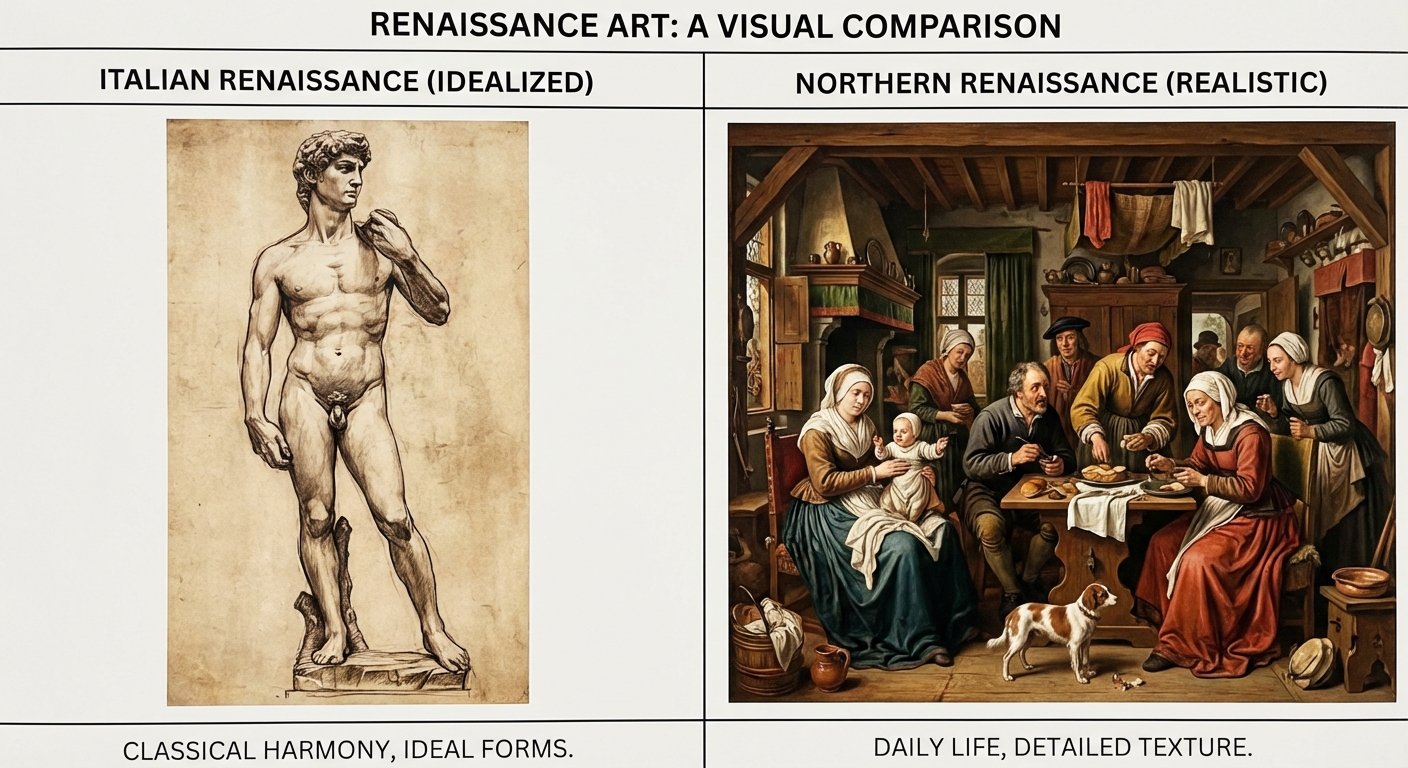
- Key Artists: Jan van Eyck (oil painting pioneer), Pieter Bruegel the Elder (peasant scenes), Albrecht Dürer (woodcuts).
Comparison Table: Italian vs. Northern
| Feature | Italian Renaissance | Northern Renaissance |
|---|---|---|
| Primary Goal | Individual excellence & Secular glory | Religious & Social Reform |
| Key Figures | Petrarch, Machiavelli, Michelangelo | Erasmus, More, Dürer |
| Art Subjects | Classical mythology, idealized bodies | Domestic interiors, portraits, peasants |
| Patrons | Wealthy Merchants, Popes | Monarchs, Wealthy Burghers |
Printing and the Spread of Ideas
Perhaps the most transformative development of the era was the invention of the movable type printing press by Johannes Gutenberg in Mainz, Germany (c. 1450).
The Impact of the Press
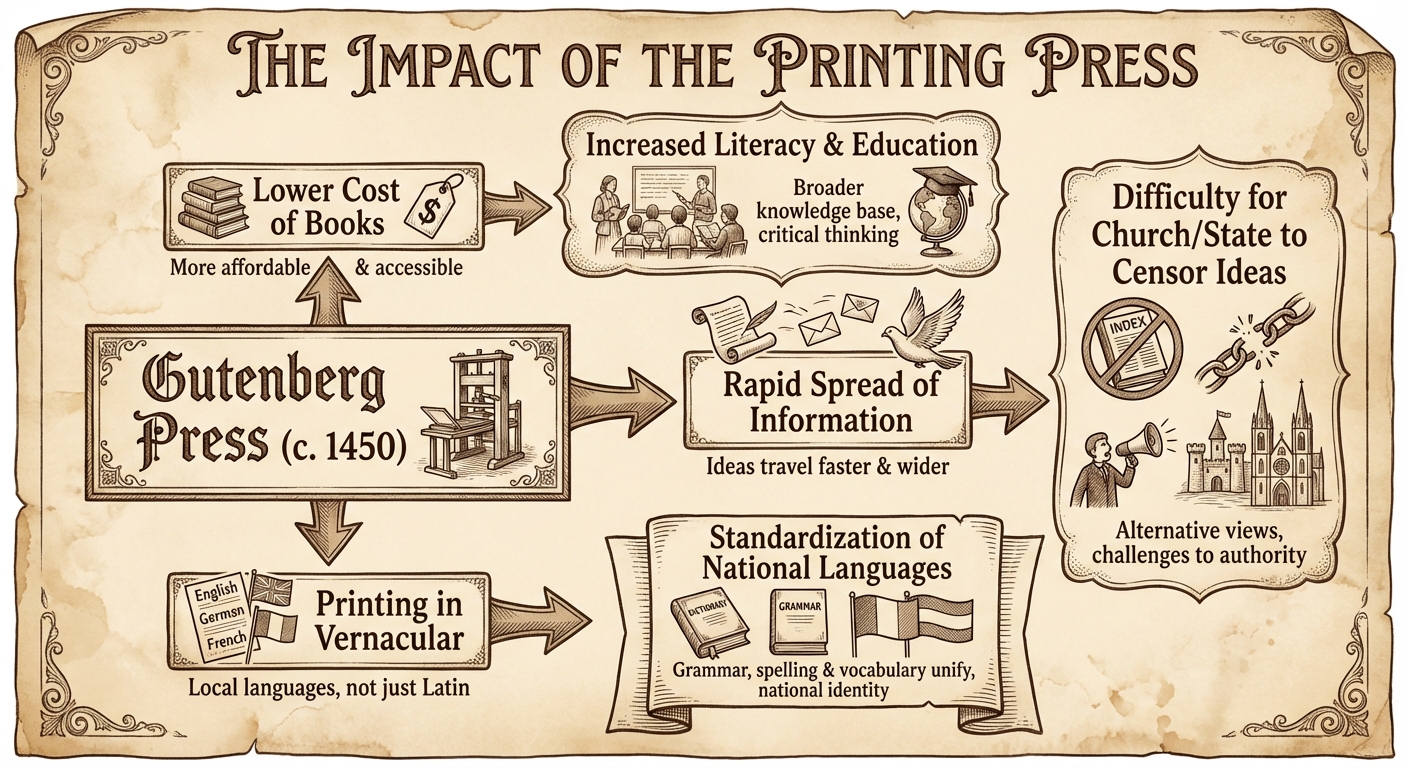
- Velocity of Ideas: Books became cheaper and faster to produce. Ideas (like Humanism and later, Luther’s 95 Theses) spread too fast for authorities to suppress.
- Rise in Literacy: As books became affordable, the demand for literacy increased among laypeople.
- Vernacular Literature: While scholars used Latin, printers wanted to sell books to the masses. They began printing in local languages (English, German, French), which standardized national languages and identities.
- Challenge to Authority: The Church lost its monopoly on knowledge. Individuals could read the Bible and interpret it themselves, paving the way for the Reformation.
Common Mistakes & Pitfalls
- Mistake: Equating "Secularism" with being anti-religious.
- Correction: Renaissance Humanists were devout Christians. They simply believed that life on earth had value in its own right, not just as preparation for heaven.
- Mistake: Thinking the Renaissance affected everyone.
- Correction: The Renaissance was an elite movement. For the vast majority of European peasants, life remained unchanged from the Middle Ages (subsistence agriculture).
- Mistake: Confusing "Civic Humanism" with "Christian Humanism."
- Correction: Civic = Be a good citizen (Italian). Christian = Be a good Christian and reform the church (Northern).
- Mistake: Assuming Italy was a unified country.
- Correction: Italy was a collection of rival city-states (Florence, Venice, Papal States, etc.) that often fought each other. Italy did not unify as a nation until 1871.