Post-Napoleonic Europe: Stability, Upheaval, and the Romantic Spirit (1815–1848)
The Congress of Vienna and the Conservative Order
Following the defeat of Napoleon, the major powers of Europe faced a monumental task: putting the continent back together. The period immediately following 1815 is defined by Conservatism—an ideology prioritizing tradition, social stability, and organized religion over the rapid changes of the French Revolution.
Architects of the Restoration
The Congress of Vienna (1814–1815) was the peace settlement that attempted to redesign Europe.
- Klemens von Metternich (Austria): The dominant figure and "Coachman of Europe." He epitomized conservative reactionism, hating liberalism and nationalism, which he viewed as threats to the multi-ethnic Austrian Empire.
- Viscount Castlereagh (Britain): Sought to prevent French resurgence but wanted to step back from continental affairs.
- Tsar Alexander I (Russia): Proposed the Holy Alliance, an agreement to rule according to Christian principles (mostly used to justify suppressing revolutions).
Guiding Principles of the Congress
To remember the goals of the Congress, think B.L.C.:
- Balance of Power: No single nation should be strong enough to dominate Europe (preventing another Napoleon).
- Legitimacy: Restoring ruling families deposed by the French Revolution (e.g., the Bourbons in France and Spain).
- Compensation: Territorial adjustments to reward victors and punish France, though France was treated leniently to maintain the balance.
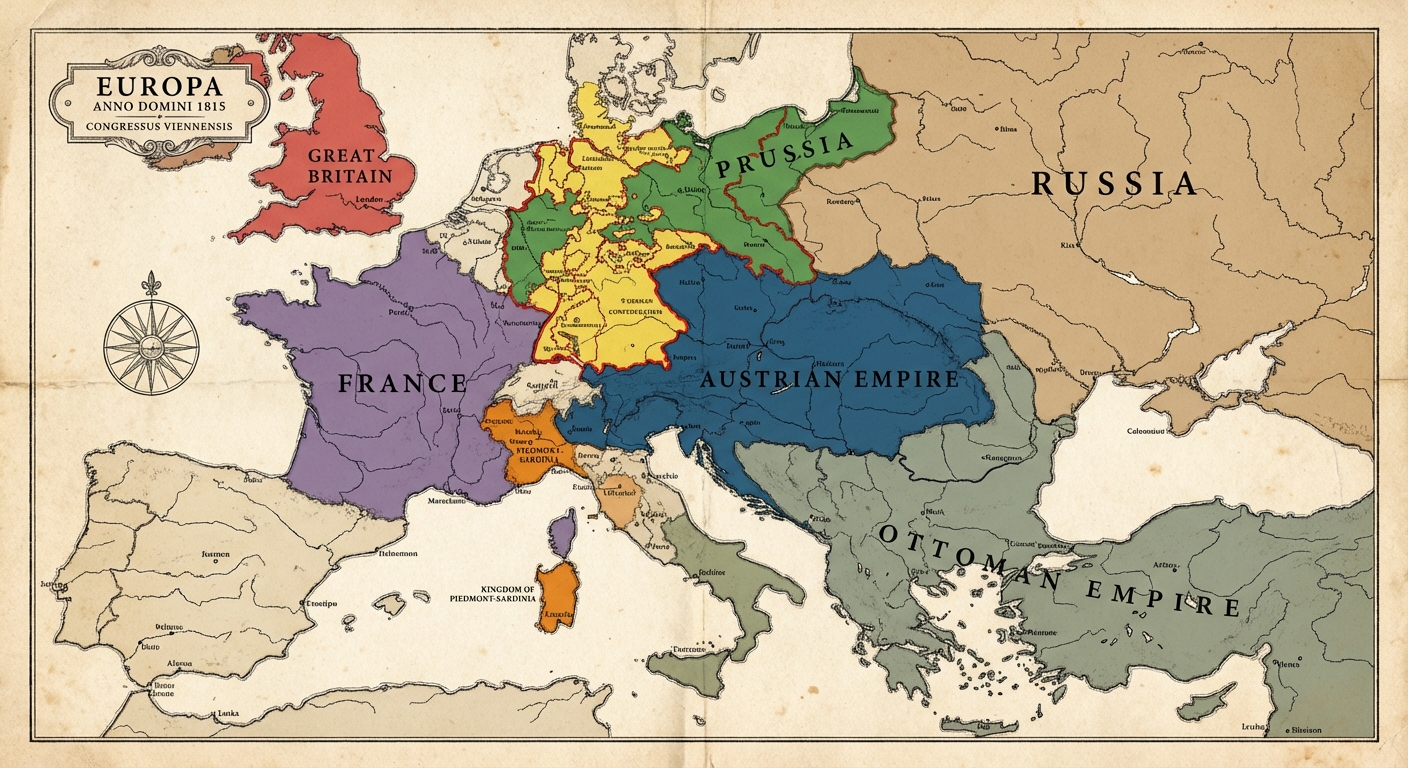
The Concert of Europe
This was the first significant experiment in collective security. The Great Powers (Great Britain, Austria, Prussia, Russia, and later France) agreed to meet periodically to discuss common interests and maintain peace.
- The Principle of Intervention: The idea that great powers had the right to send armies into countries where there were revolutions to restore legitimate monarchs. (Britain eventually rejected this).
- Example: In 1823, French troops restored the Spanish King Ferdinand VII, crushing a liberal revolt.
The Age of Revolutions (1830 & 1848)
Despite Metternich's efforts, the "dual revolution" (economic changes from industrialization + political ideas from the French Revolution) could not be contained. Two major waves of revolution swept Europe.
The "Isms" Driving Conflict
Before analyzing the revolts, you must understand the competing ideologies:
- Conservatism: Favored monarchy, aristocracy, and church. (Burke, Metternich).
- Liberalism: Favored representative government (for the propertied), civil liberties, and laissez-faire economics. (John Stuart Mill).
- Nationalism: The belief that each "people" (defined by language/history) should have their own state. This was the most dangerous threat to empires like Austria.
The Revolutions of 1830
"When France sneezes, Europe catches a cold." — Metternich
- France (The July Revolution): Reactionary King Charles X attempted to strip voting rights. Liberals revolted. Charles X fled, replaced by Louis Philippe (the "Bourgeois King"), creating a constitutional monarchy favoring the wealthy middle class.
- Belgium (Success): Inspired by France, Belgians revolted against Dutch rule. Because it didn't upset the balance of power significantly, major powers allowed Belgium to become independent.
- Poland (Failure): Polish nationalists revolted against Russian rule. Without Western support, the Russian army crushed the rebellion efficiently.
The Revolutions of 1848: The "Springtime of Peoples"
This was a continental-wide collapse of authority, triggered by poor harvests and economic depression. However, most of these revolutions failed.
| Region | The Spark | The Outcome | Why it Failed |
|---|---|---|---|
| France | Louis Philippe's government refused to expand voting rights. | Monarchy overthrown. Louis Napoleon (Napoleon's nephew) elected President, soon declares himself Emperor Napoleon III. | Class division: Middle-class liberals feared working-class socialists. |
| Prussia/Germany | Riots in Berlin; desire for a unified Germany. | The Frankfurt Assembly drafted a constitution for a unified Germany. | King Frederick William IV refused the "crown from the gutter." Division between "Big German" (with Austria) and "Little German" (without Austria) solutions. |
| Austria | Hungarians (Magyars) and students in Vienna demanded autonomy. | Metternich fled. Emperor Ferdinand I abdicated. | Ethnic divisions allowed the Austrian army to defeat groups one by one. Russia helped crush the Hungarians. |
| Italy | Giuseppe Mazzini and nationalists sought unification. | Roman Republic declared; Pope fled. | French and Austrian troops intervened to restore the Pope and the old order. |
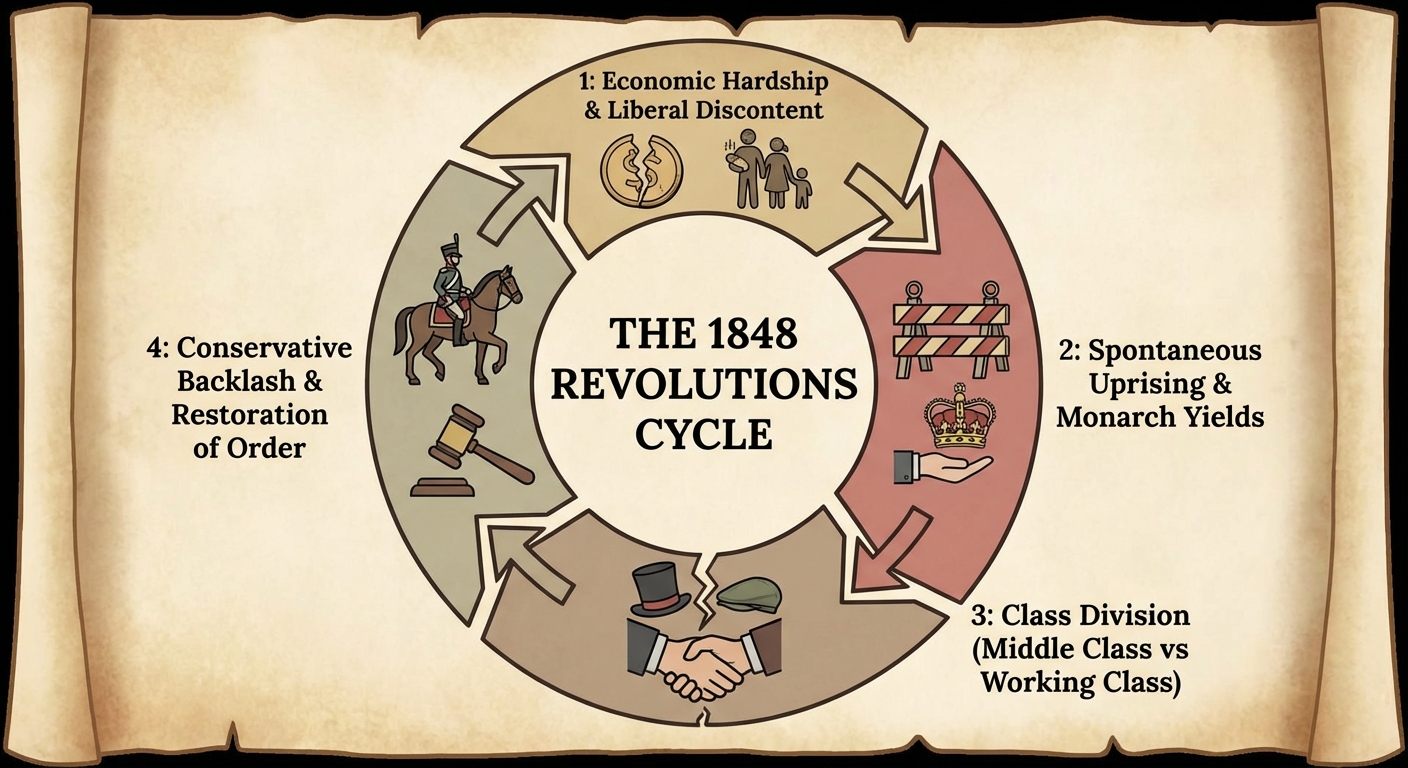
Romanticism and Reaction to Rationalism
If the Enlightenment was the "Age of Reason," Romanticism was the "Age of Feeling." It was a cultural movement that dominated the first half of the 19th century and often fueled the fires of nationalism.
Core Characteristics
- Emotion over Reason: Trusting intuition and strong emotion (joy, terror, awe) over cold calculation.
- Nature: Nature was not a machine to be analyzed (Enlightenment view) but a wild, spiritual force.
- The Past: A fascination with the Middle Ages (Neo-Gothic architecture) and folklore (Grimm Brothers).
- Religion: A revival of religious fervor (e.g., Methodism) as a response to the perceived sterility of Deism.
Key Figures & Works
Literature:
- William Wordsworth: English poet who glorified nature.
- Victor Hugo: Les Misérables. Mixed romanticism with political liberalism.
- Grimm Brothers: Collected German folk tales to demonstrate a unique German national spirit (Nationalism + Romanticism).
Art:
- Caspar David Friedrich: Famous for Wanderer above the Sea of Fog. Shows solitary figures contemplating the terrifying power of nature.
- Eugène Delacroix: Liberty Leading the People. A highly emotional, chaotic depiction of the 1830 French Revolution.
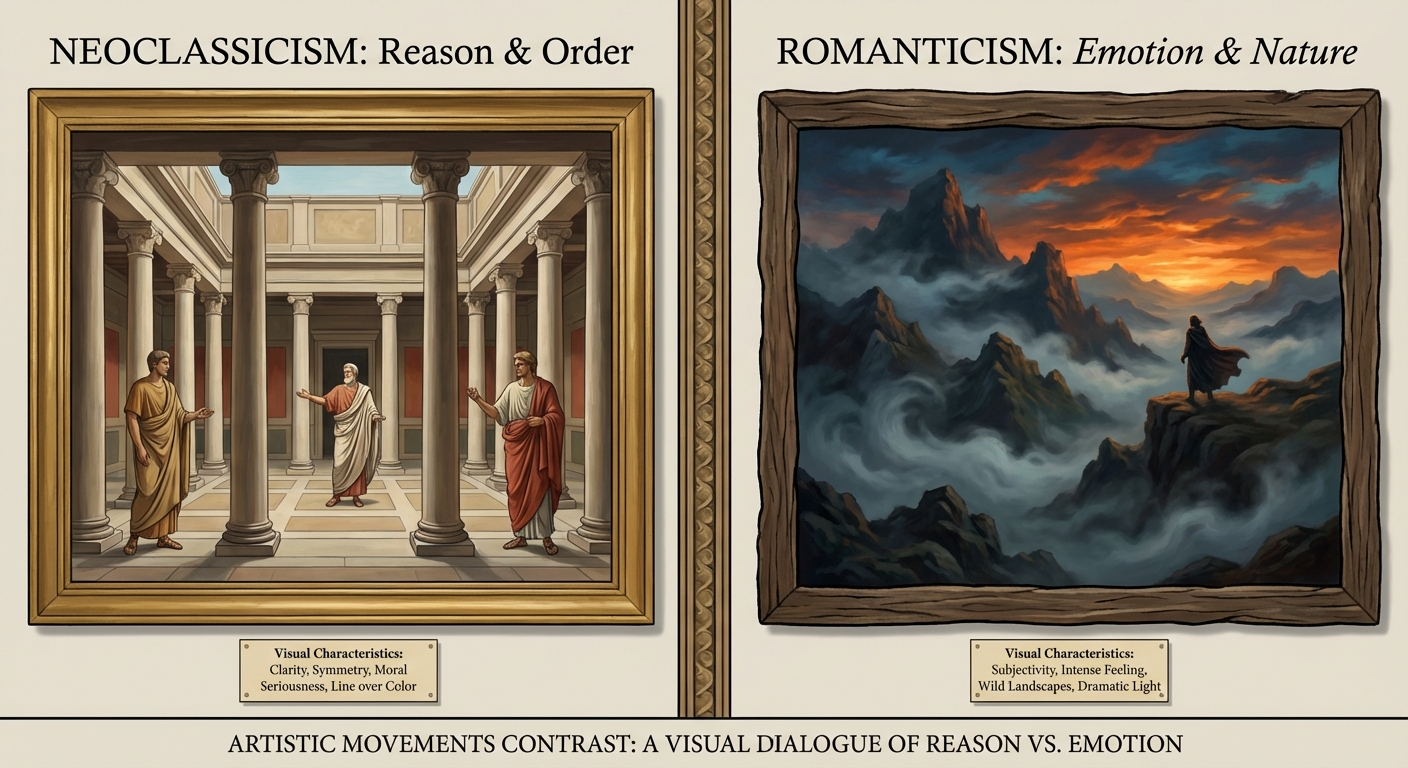
Connection to Politics
Romanticism was politically flexible.
- Conservative Romantics: Glorified the history and hierarchy of the feudal past.
- Radical Romantics: Glorified the "spirit of the people" and revolutionary heroism (like Lord Byron fighting for Greek independence).
Common Mistakes & Pitfalls
Confusing 19th-Century Liberalism with Modern Liberalism:
- Mistake: Thinking 19th-century Liberals wanted welfare, high taxes, and universal suffrage.
- Correction: In 1815, "Liberals" (Classical Liberalism) wanted Laissez-Faire economics, low taxes, and voting rights restricted to property owners. They often opposed valid working-class demands.
The "Failure" of 1848:
- Mistake: Assuming the 1848 revolutions accomplished nothing because conservative monarchs returned.
- Correction: While they failed politically in the short term, they ended serfdom in Austria and Germany permanently and established universal male suffrage in France. The old order was cracked, if not broken.
Nationalism's Alignment:
- Mistake: Thinking Nationalism was always a right-wing/conservative ideology.
- Correction: Between 1815–1848, Nationalism was usually allied with Liberalism (the Left) because both wanted to tear down the traditional empires (Austria/Russia). It shifts to the Right later in the century (Bismarck).
Misidentifying Romanticism:
- Mistake: Thinking Romanticism is just about romance/love.
- Correction: It is about intense emotion and the sublime. A painting of a shipwreck or a nightmare is "Romantic" in this context.