Unit 3: Beauty, Art, and German Culture (Einfluss von Schönheit und Kunst)
Introduction to Arts and Aesthetics
In the context of the AP German Language and Culture exam, Arts and Aesthetics (Kunst und Ästhetik) is not just about memorizing facts about famous painters. It focuses on how art reflects society, how beauty standards evolve, and how culture influences creative expression.
This unit explores the dual nature of art: its role in preserving history and its power to provoke change. You will need to be able to describe art, discuss its importance in society (e.g., funding for the arts), and compare German-speaking cultural attitudes toward beauty with those of your own culture.
Visual and Performing Arts (Bildende und Darstellende Künste)
In German, we distinguish between Bildende Kunst (Visual Arts) and Darstellende Kunst (Performing Arts). Understanding this distinction is crucial for vocabulary selection.
Visual Arts (Bildende Kunst)
This category encompasses art that is created to be looked at. It includes painting, sculpture, photography, and architecture.
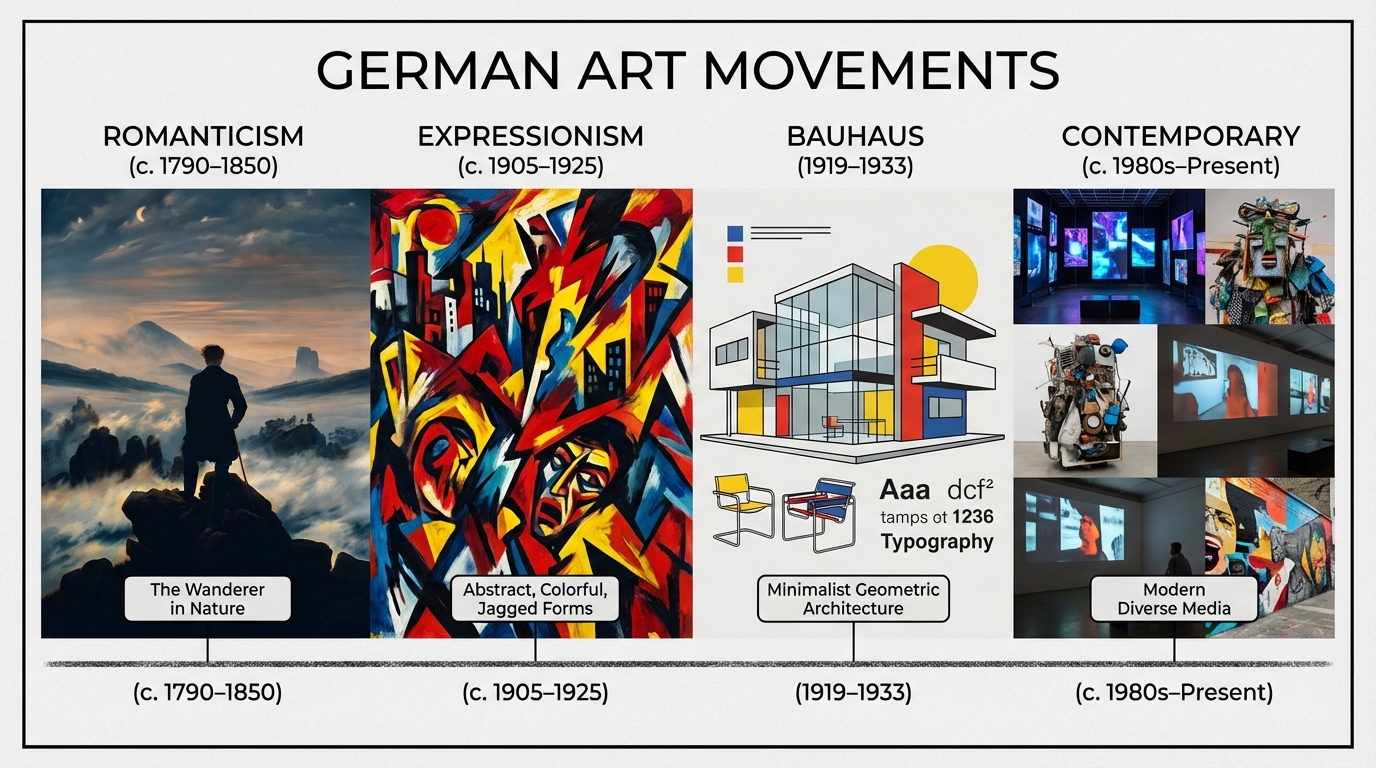
Key German Art Movements:
- Romanticism (Romantik): (Late 18th/Early 19th Century) Focuses on nature, emotion, and the sublime.
- Key Artist: Caspar David Friedrich (famous for Der Wanderer über dem Nebel).
- Theme: The insignificance of man compared to the power of nature.
- Expressionism (Expressionismus): (Early 20th Century) Prioritizes emotional experience over physical reality. Artists used vivid colors and distorted shapes.
- Key Groups: Der Blaue Reiter (Kandinsky, Franz Marc) and Die Brücke.
- Bauhaus: (1919–1933) A revolutionary school combining crafts and fine arts.
- Philosophy: "Form follows function" (Form folgt Funktion). Minimalist architecture and design that is still influential today.
- Key Figure: Walter Gropius.
Essential Vocabulary:
- Das Gemälde (The painting)
- Die Ausstellung (The exhibition)
- Der Bildhauer / Die Bildhauerin (The sculptor)
- Abstrakte Kunst (Abstract art)
- Das Stillleben (Still life)
Performing Arts (Darstellende Kunst)
This category requires an audience and a performance. It includes theater, opera, dance, and film.
Cultural Context:
Germany has a massive theater culture. Almost every medium-sized city has a state-funded theater (Stadttheater), making high culture accessible to the general public, not just the elite.
Key Concepts:
- Verfremdungseffekt (V-Effekt): A concept by playwright Bertolt Brecht. He wanted the audience to remain emotionally detached and critical of the play's message, rather than getting lost in the story. He used techniques to remind the audience they were watching a play.
- Classical Music: The German-speaking world is often called the land of Dichter und Denker (Poets and Thinkers) but also musicians. Bach, Beethoven, Mozart, and Wagner define the canon of Western classical music.
Essential Vocabulary:
- Die Bühne (The stage)
- Die Aufführung (The performance)
- Das Theaterstück (The play)
- Der Regisseur (The director)
- Die Handlung (The plot)
Literature and Literary Movements (Literatur und Literaturepochen)
German literature is central to understanding the German psyche. For the AP exam, you generally don't need deep analysis of texts, but you must know the cultural significance of major periods.
The Era of Goethe and Schiller
- Weimar Classicism (Weimarer Klassik): A period dominated by Johann Wolfgang von Goethe and Friedrich Schiller. They focused on harmony, humanism, and aesthetic perfection.
- Sturm und Drang (Storm and Stress): A proto-Romantic movement prioritizing individual subjectivity and extreme emotion.
- Example: Goethe’s The Sorrows of Young Werther (Die Leiden des jungen Werther), which sparked a cultural phenomenon across Europe.
Post-War Literature (Trümmerliteratur)
Literally "Rubble Literature." Immediately after WWII, German authors (like Heinrich Böll and Wolfgang Borchert) wrote about the physical and psychological destruction of Germany. The language was simple, stripped of Nazi-era rhetoric, and focused on truth.
Modern Reading Habits
Germans are avid readers (Leseratten). The annual Frankfurt Book Fair (Frankfurter Buchmesse) is the largest trade fair for books in the world.
| German Term | Definition | Context |
|---|---|---|
| Der Roman | Novel | Long fiction (e.g., mystery, romance). |
| Das Gedicht | Poem | Analyzed for rhyme (Reim) and meter (Metrum). |
| Das Märchen | Fairy Tale | Brothers Grimm; deeply rooted in culture. |
| Das Sachbuch | Non-fiction book | Educational or factual books. |
Ideals of Beauty Across Cultures (Schönheitsideale im Kulturvergleich)
This topic is a frequent candidate for the Cultural Comparison (Task 4) on the exam.
Perception of Beauty (Wahrnehmung von Schönheit)
Beauty ideals (Schönheitsideale) change over time and vary by region.
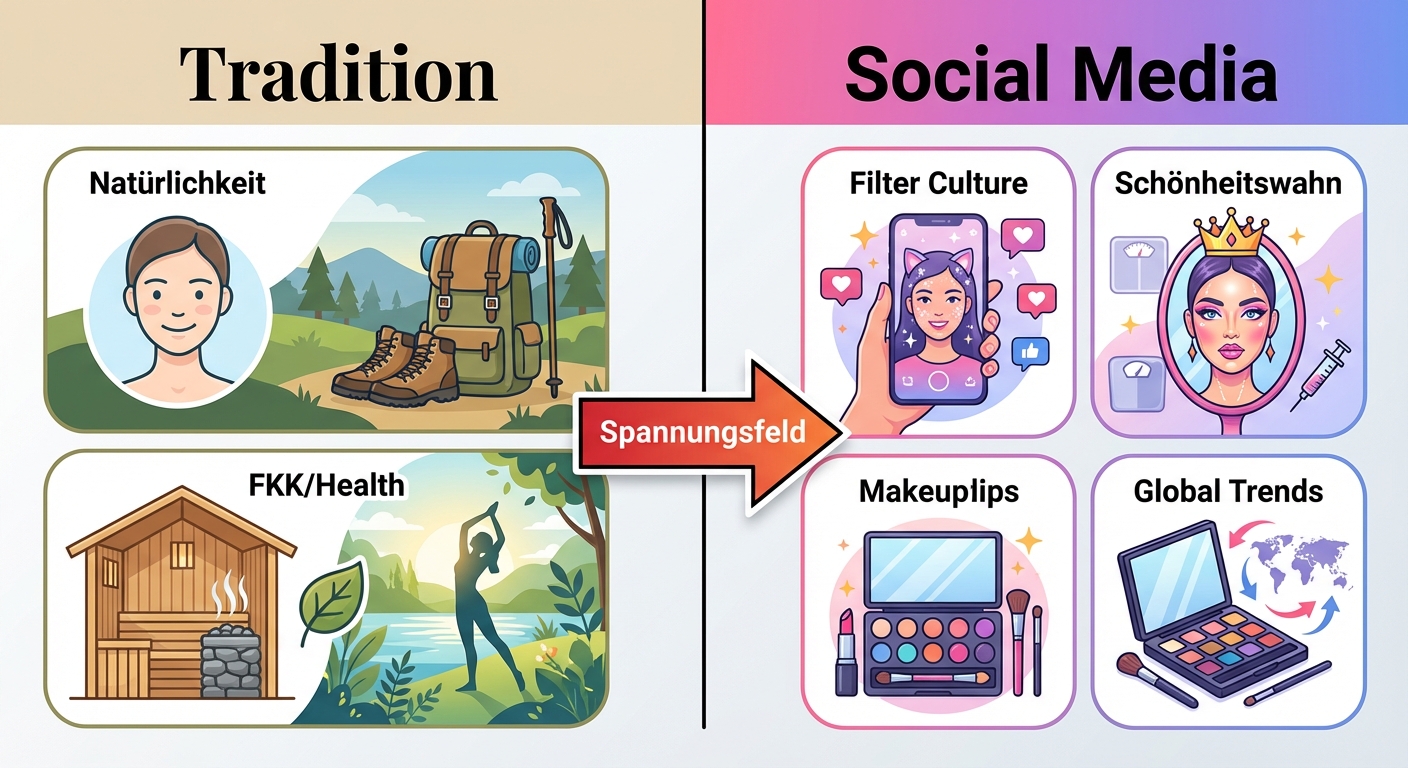
- Naturalness (Natürlichkeit): In DACH countries (Germany, Austria, Switzerland), there is often a higher value placed on a "natural look" compared to the US. Minimal makeup and practical fashion are common in daily life.
- Body Positivity: While globally influenced by media, the German culture has a historical movement called FKK (Freikörperkultur - Free Body Culture). This promotes a relaxed, non-sexualized attitude toward the naked body (e.g., in saunas or designated beaches), emphasizing health over aesthetic perfection.
The Influence of Media (Medieneinfluss)
Just like in the US, German youth are heavily influenced by "Instagram aesthetics" and influencers.
- Schönheitswahn (Obsession with beauty): A critical term used to discuss the pressure to look perfect.
- Self-confidence (Selbstbewusstsein): Discussions often center on how media consumption lowers self-esteem among teenagers.
Real-World Example for Cultural Comparison
Prompt: Compare the attitude towards beauty and fashion in your community with that of the German-speaking world.
- USA Point: High pressure for perfect teeth (orthodontics), styled hair, and