Unit 3 Study Guide: The Rise of Constitutional States (1648–1815)
Introduction to Constitutionalism
In the chaos following the religious wars and the crises of the 17th century, European states evolved in two distinct directions. While France, Prussia, and Russia moved toward Absolutism (sovereignty resides in the king), England and the Dutch Republic moved toward Constitutionalism.
Constitutionalism does not necessarily mean democracy. It is a system of government where the ruler's power is limited by law. It implies a balance between the authority of the government and the rights of the subjects.
Key Concepts
- Sovereignty: Who holds the ultimate power? In constitutional states, sovereignty resides in the law (and the representative body), not the person of the monarch.
- Republicanism: A form of government with no monarch, where power rests in the hands of the people usually through representatives (e.g., The Dutch Republic, England under Cromwell).
The Evolution of English Constitutionalism
The road to English constitutionalism was rocky, marked by a regicide (killing of a king), a military dictatorship, and a "bloodless" revolution. It was fundamentally a power struggle between the Stuart Monarchs, who believed in Divine Right, and Parliament, dominated by the landed gentry and Puritans.
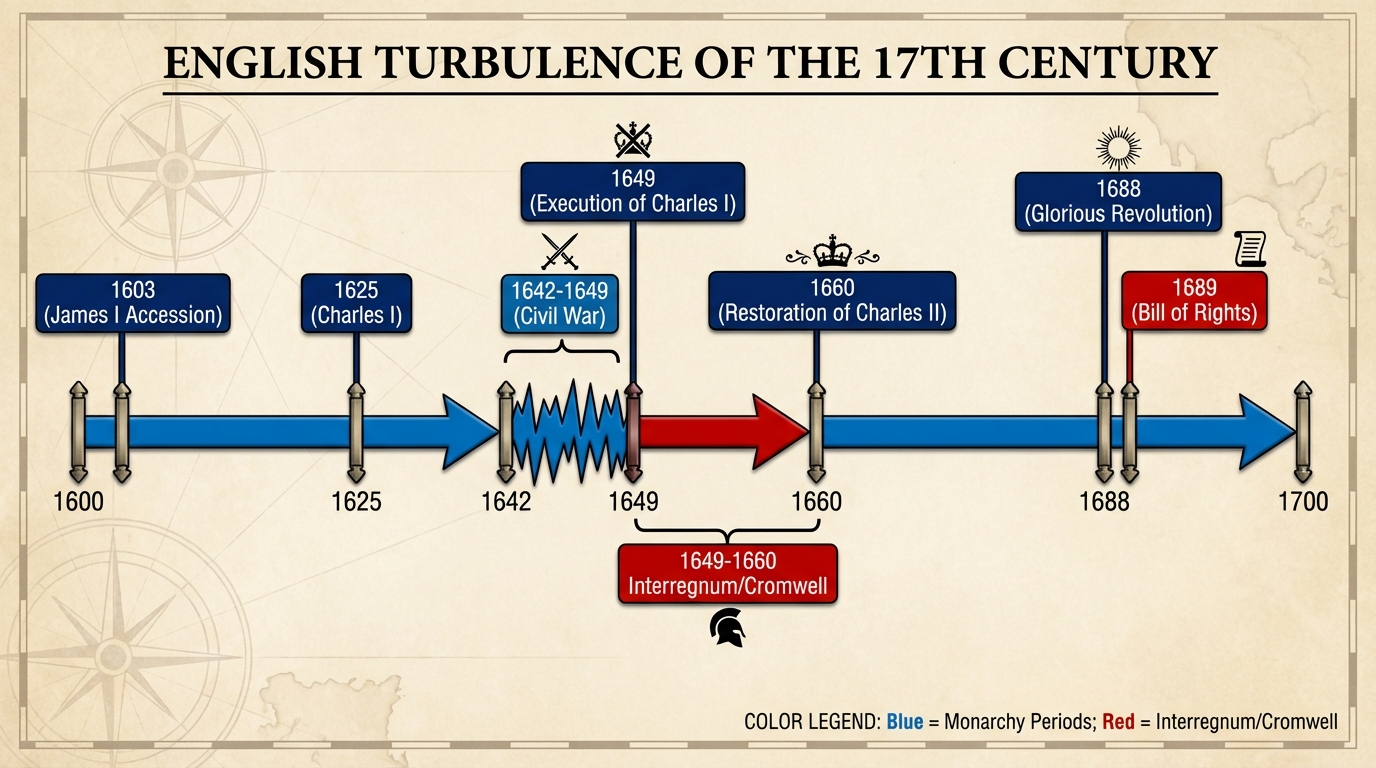
1. The Early Stuarts (1603–1649)
- James I (r. 1603–1625): Succeeded Elizabeth I. Scottish outsider. He lectured Parliament on the Divine Right of Kings (the belief that God appoints kings and they are answerable only to God). Famous quote: "No Bishop, No King."
- Charles I (r. 1625–1649): Refused to summon Parliament from 1629–1640 (the "Personal Rule"). He levied extra-legal taxes (e.g., Ship Money) to fund the government without Parliament's consent. Religious tensions exploded when he tried to force the Anglican Book of Common Prayer on Presbyterian Scotland.
2. The English Civil War (1642–1649)
Conflict erupted between two factions:
- Cavaliers: Supporters of the King (nobility, rural gentry, high church Anglicans).
- Roundheads: Supporters of Parliament (urban merchants, Puritans, lower gentry).
Oliver Cromwell emerged as the leader of the Roundheads, creating the New Model Army, a disciplined military force driven by Puritan zeal.
Outcome: Parliament won. Charles I was put on trial for treason and beheaded in 1649, sending shockwaves through Europe. This effectively slew the concept of Divine Right.
3. The Interregnum & The Protectorate (1649–1660)
England became a republic (The Commonwealth), but it essentially functioned as a military dictatorship under Cromwell, who took the title Lord Protector.
- Domestic Policy: Imposed strict Puritan social codes (censored press, banned sports/theater). Ruthlessly crushed revolts in Ireland (Drogheda massacre).
- Navigation Act (1651): Required English goods to be transported on English ships. This was a mercantilist move targeting Dutch trade dominance.
4. The Restoration (1660–1688)
After Cromwell's death, the English tired of military rule and restored the monarchy.
- Charles II (r. 1660–1685): The "Merry Monarch." He worked with Parliament but had secret Catholic sympathies.
- Test Act (1673): Parliament passed this law excluding Catholics from voting, holding office, or teaching.
- James II (r. 1685–1688): Openly Catholic. He violated the Test Act by appointing Roman Catholics to positions in the army and universities. Parliament feared a permanent Catholic dynasty.
5. The Glorious Revolution (1688–1689)
Parliament invited James II’s Protestant daughter, Mary, and her Dutch husband, William of Orange, to invade England. James II fled to France.
- Why "Glorious"? It replaced one king with another with very little bloodshed.
- The Bill of Rights (1689): William and Mary accepted this document to take the throne. It established that:
- Law is made in Parliament; the King cannot suspend it.
- Parliament must be called at least every three years.
- Protestants have the right to bear arms (but not Catholics).
- No standing army in peacetime without Parliament's consent.
John Locke defended this revolution in his Second Treatise of Civil Government (1690), arguing that if a government oversteps its function to protect life, liberty, and property, the people have a right to change it.
The Dutch Republic (United Provinces)
While almost all of Europe turned monarchical (either Absolute or Constitutional), the Dutch Republic formed a unique decentralized oligarchy. It was the "Golden Age" of the Netherlands.
Political Structure
It was a confederation of seven provinces, each with its own autonomy.
- States General: The federal assembly responsible for foreign affairs and war. However, all issues had to be referred back to the local Estates for approval.
- The Stadtholder: A representative appointed by the States General (usually from the House of Orange) to lead the military. Tensions often existed between the republican Estates (who wanted peace/trade) and the Stadtholder (who favored military power).
- Oligarchy: Real power lay with the urban gentry and wealthy merchants (Regents) in the seminal province of Holland.
Economic Dominance & Religious Toleration
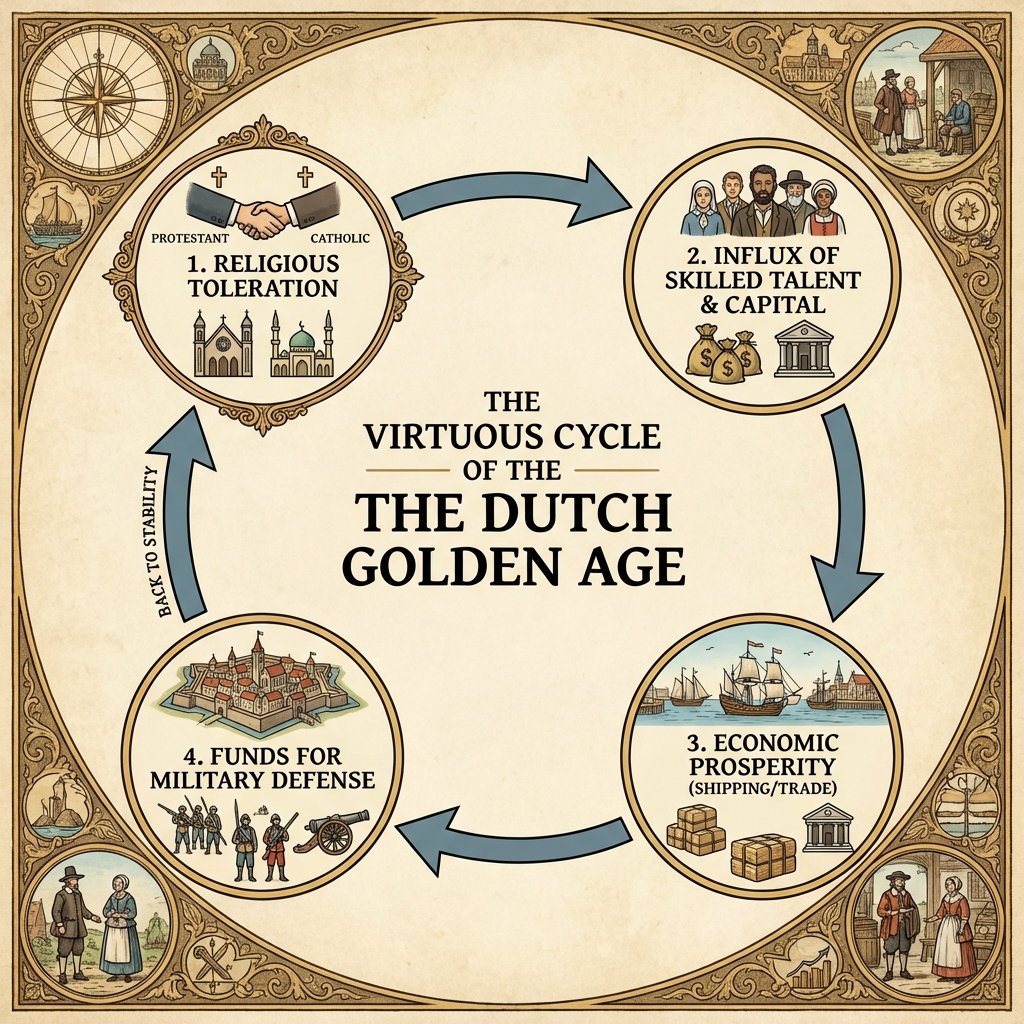
- Religious Toleration: The Dutch were Calvinist but allowed Jews and Catholics to practice privately. This attracted skilled labor and capital from all over Europe (e.g., Huguenots fleeing France).
- Commercial Supremacy: They possessed the largest merchant marine in Europe. They were the "middlemen" of Europe (shipping carriers).
- Financial Innovation: The Bank of Amsterdam (est. 1609) became the main European clearinghouse for currency exchange, making Amsterdam the financial center of the continent.
- Dutch East India Company (VOC): A joint-stock company that dominated the Asian spice trade.
Decline
By the early 1700s, the Dutch Republic declined due to costly wars with England (over trade) and France (resisting Louis XIV), causing their resources to drain away to the rising power of Great Britain.
Mercantilism and State-Building
In the 17th and 18th centuries, both Absolutist and Constitutional states used Mercantilism to build strength.
Core Tenets of Mercantilism
- Finite Wealth: Wealth is limited; for one nation to gain, another must lose.
- Bullionism: A nation's power is measured by its supply of gold and silver.
- Balance of Trade: Political priority was to export more than you import.
- State Intervention: The government regulates the economy to augment state power.
Anglo-Dutch Commercial Wars
The application of mercantilism fueled conflict between the constitutional states of England and the Netherlands.
| Concept | Explanation |
|---|---|
| Navigation Acts | English laws requiring goods imported into England to be carried on English ships. Directly targeted the Dutch shipping industry. |
| Colonial Expansion | Both nations established colonies to provide raw materials and closed markets for manufactured goods. |
| Zero-Sum Game | England realized they could not expand their trade without destroying Dutch hegemony. |
Summary: Comparing Systems
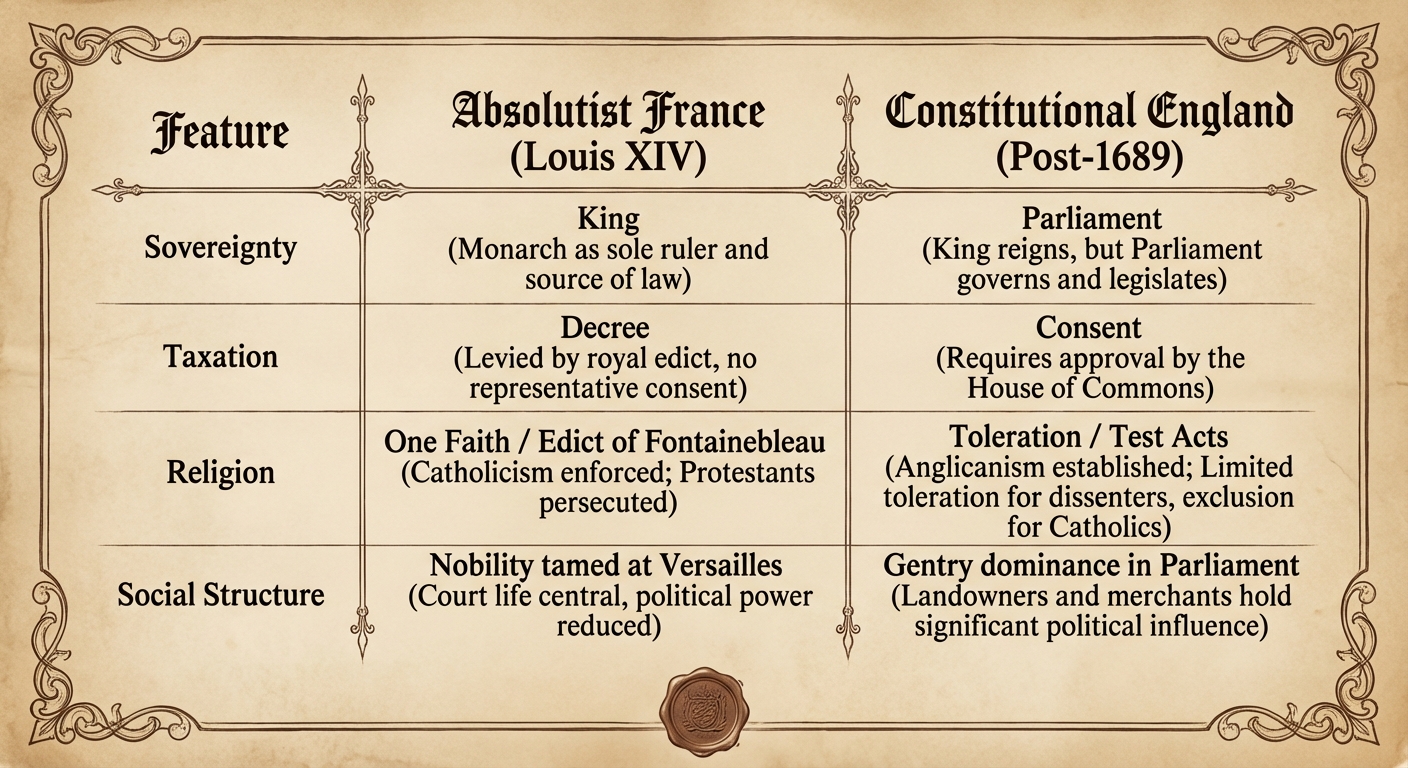
Mnemonics & Memory Aids
To remember the order of English rulers in the 17th Century use "Burger King" style:
J - C - (C) - C - J
- James I
- Charles I
- (C)romwell (The "patty" in the middle—not a king)
- Charles II
- James II
Common Mistakes & Pitfalls
- Confusing "Constitutionalism" with "Democracy":
- Correction: England in 1689 was not a democracy. Only a tiny percentage of wealthy, land-owning men could vote. It was an elitist system that checked the King, not a system of popular sovereignty.
- The Timeline of the Bill of Rights:
- Correction: The English Bill of Rights (1689) came after the Civil War and after the Restoration, as part of the Glorious Revolution. Do not confuse it with the Petition of Right (1628).
- Dutch Monarchy:
- Correction: Students often think the House of Orange were Kings of the Dutch Republic. They were Stadtholders (military leaders/stewards). Paradoxically, William of Orange became King of England before the Netherlands officially became a monarchy (which happened much later).
- Reason for the English Civil War:
- Correction: It wasn't just about taxes. It was equally about religion. The fear that the Stuart kings were too "Catholic" or "Papist" (Arminian Anglicanism) terrified the Puritan Parliament.