Unit 4: Comprehensive Guide to Social Psychology
Understanding Social Thinking: Attribution Theory
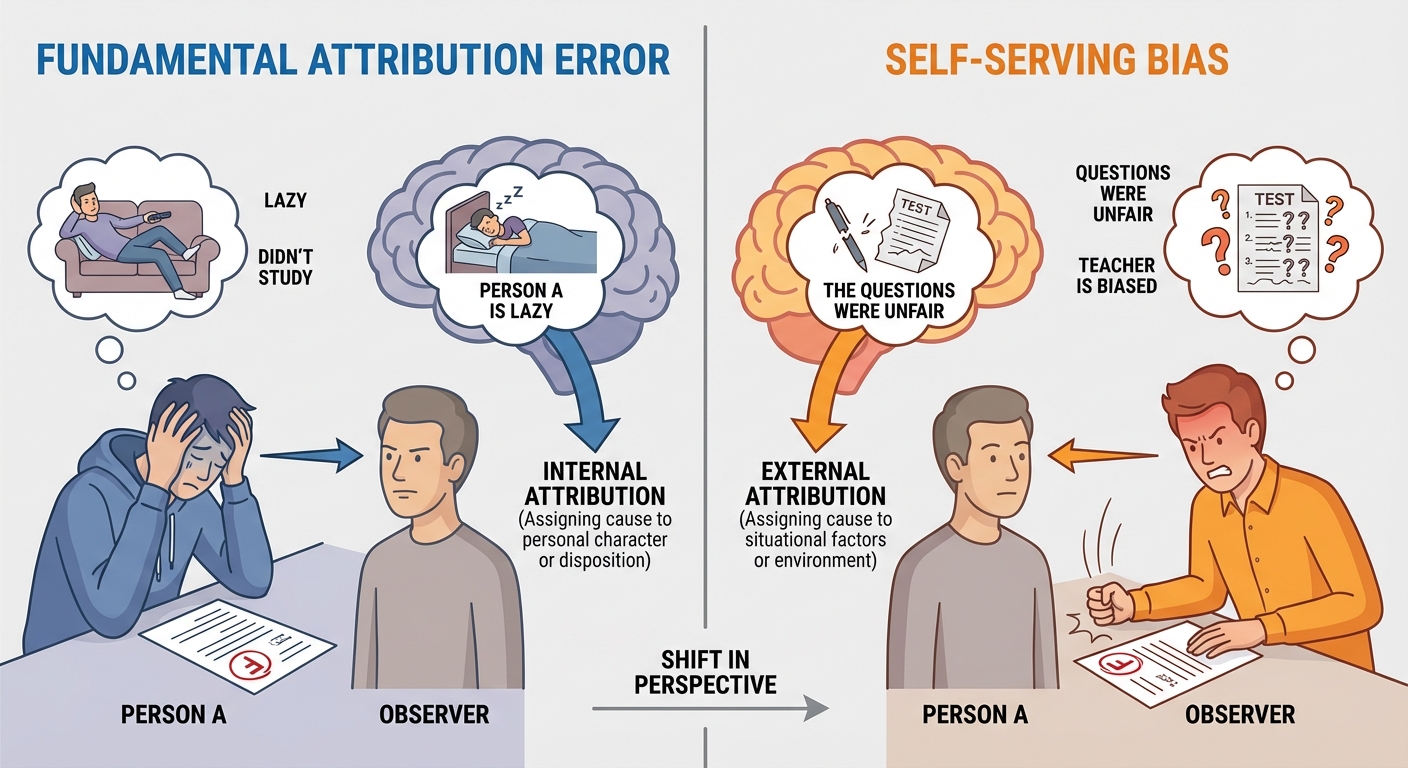
Social psychology begins with how we perceive ourselves and others. Attribution Theory, proposed by Fritz Heider, suggests that we tend to explain the behavior of others by crediting either the situation (situational attribution) or the person's disposition (dispositional attribution).
The Fundamental Attribution Error (FAE)
This is the most frequent error made in social perception. When analyzing others' deviation behavior, we tend to:
- Overestimate the influence of personality (disposition).
- Underestimate the influence of situations.
Example: If a classmate fails a test, you might think they are lazy (dispositional). However, if you fail a test, you are likely to blame the tricky questions or lack of sleep (situational).
Other Attributional Biases
- Self-Serving Bias: The tendency to attribute our successes to our own efforts (dispositional) and our failures to external factors (situational). This protects self-esteem.
- False Consensus Effect: The tendency to overestimate the extent to which others share our beliefs and behaviors.
- Just-World Phenomenon: The cognitive bias that the world is just and that people get what they deserve. This often leads to victim-blaming.
Attitudes, Persuasion, and Actions
Attitudes are feelings, often influenced by our beliefs, that predispose us to respond in a particular way to objects, people, and events.
The Elaboration Likelihood Model
There are two primary distinct paths to persuasion:
- Central Route to Persuasion: Occurs when interested people focus on the arguments and respond with favorable thoughts. This is deep processing based on logic and evidence. Is more durable.
- Peripheral Route to Persuasion: Occurs when people are influenced by incidental cues, such as a speaker's attractiveness or celebrity status. This is shallow processing and often yields temporary changes.
Compliance Strategies
- Foot-in-the-Door Phenomenon: The tendency for people who have first agreed to a small request to comply later with a larger request. (Start small $\rightarrow$ Build up).
- Door-in-the-Face Phenomenon: asking for a large commitment and being refused and then asking for a smaller commitment. (Start big $\rightarrow$ Scale down).
Cognitive Dissonance Theory
Proposed by Leon Festinger, this theory addresses the mental discomfort (dissonance) we experience when two of our thoughts (beliefs) or actions are inconsistent.
- The Rule: When our attitudes and actions clash, we can reduce the resulting dissonance by changing our attitudes.
- Example: A smoker knows smoking causes cancer (belief) but smokes anyway (action). To reduce dissonance, they may conclude, "The research is probably flawed anyway" (attitude change).
Social Influence: Conformity and Obedience
Social influence looks at how the presence of others changes our behavior.
Conformity
Adjusting our behavior or thinking to coincide with a group standard.
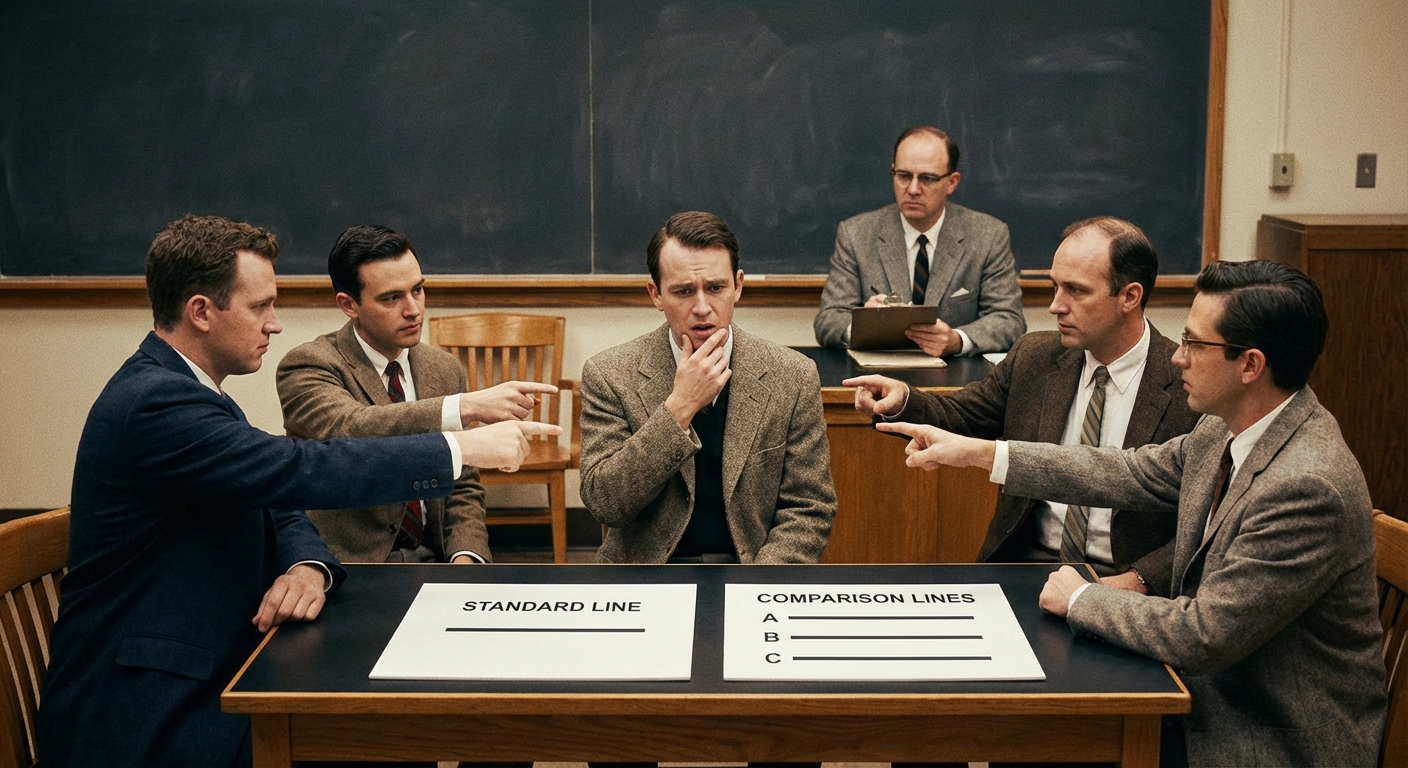
- Solomon Asch's Line Study: Demonstrated that people will agree with an obvious untruth to fit in with a group. About 1/3 of participants conformed to the group's wrong answer.
Why do we conform?
- Normative Social Influence: Influence resulting from a person's desire to gain approval or avoid disapproval.
- Informational Social Influence: Influence resulting from one's willingness to accept others' opinions about reality (we assume the group knows better).
Obedience
Complying with direct commands, usually from an authority figure.
- Stanley Milgram's Shock Experiment: Investigated the effects of authority on obedience. Ordinary people delivered what they believed were dangerous electric shocks to a "learner" simply because an authority figure told them to.
- Key Finding: Over 60% of participants complied fully to the highest voltage.
Role-Playing
- Zimbardo's Stanford Prison Experiment: Philip Zimbardo assigned students to be "guards" or "prisoners." The simulation became too real too quickly. It illustrated deindividuation and how adopting a social role can drastically alter behavior.
Group Dynamics and Behavior
How do we behave when we are part of a collective?
| Concept | Definition | Example scenario |
|---|---|---|
| Social Facilitation | Improved performance on simple/well-learned tasks in the presence of others. | A professional athlete plays better in a packed stadium. |
| Social Impairment | Worse performance on difficult/new tasks in the presence of others. | Stumbling through a speech you didn't practice because people are watching. |
| Social Loafing | The tendency for people in a group to exert less effort when pooling their efforts toward a common goal. | Doing less work in a group project because you think others will pick up the slack. |
| Deindividuation | The loss of self-awareness and self-restraint occurring in group situations that foster arousal and anonymity. | Cyberbullying or rioting (mob mentality). |
Group Polarization vs. Groupthink
These two are often confused but distinct.
- Group Polarization: The enhancement of a group's prevailing inclinations through discussion within the group. If a group is like-minded, discussion strengthens their existing opinions (becoming more extreme).
- Groupthink: The mode of thinking that occurs when the desire for harmony in a decision-making group overrides a realistic appraisal of alternatives. Dissent is suppressed to keep the peace.
Prejudice, Discrimination, and Stereotyping
- Prejudice (Attitude): An unjustifiable (and usually negative) attitude toward a group and its members. Mnemonic: Prejudice = Pre-judgment.
- Stereotype (Belief): A generalized (sometimes accurate but often overgeneralized) belief about a group of people.
- Discrimination (Action): Unjustifiable negative behavior toward a group and its members.
Roots of Prejudice
- In-group vs. Out-group Bias: We favor our own group (in-group bias) and perceive the out-group as "all the same" (out-group homogeneity).
- Scapegoat Theory: Prejudice offers an outlet for anger by providing someone to blame (e.g., blaming economic problems on immigrants).
- Mere Exposure Effect: The phenomenon that repeated exposure to novel stimuli increases liking of them. This suggests that familiarity reduces prejudice.
Aggression and Prosocial Behavior
Aggression
Any physical or verbal behavior intended to hurt or destroy.
- Frustration-Aggression Principle: Frustration (the blocking of an attempt to achieve some goal) creates anger, which can generate aggression.
- Social Scripts: Culturally modeled guides for how to act in various situations (e.g., violent video games providing scripts for conflict resolution).
Prosocial Behavior (Altruism)
Unselfish regard for the welfare of others.
The Bystander Effect
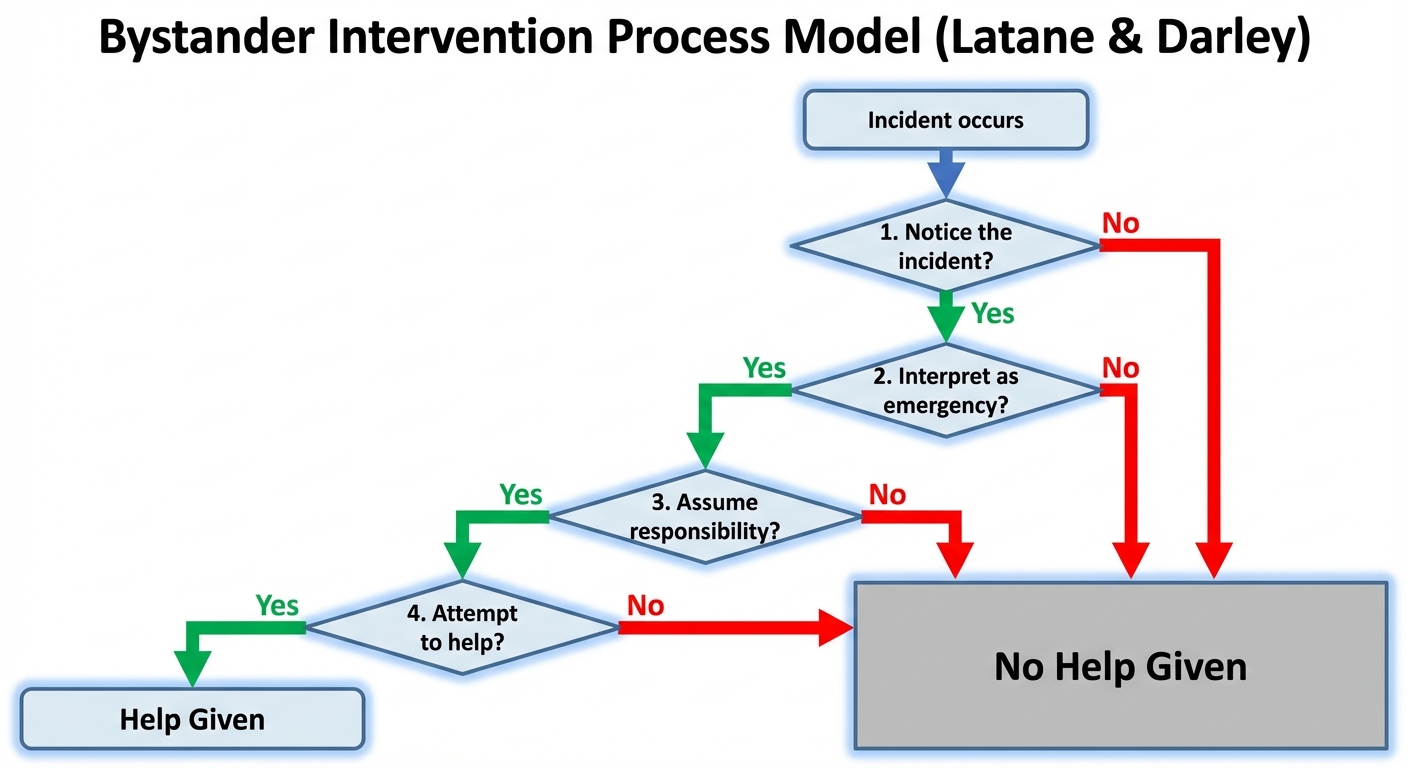
Researched by Darley and Latané. The tendency for any given bystander to be less likely to give aid if other bystanders are present.
- Diffusion of Responsibility: We assume someone else will help, so we don't need to.
Why do we help?
- Social Exchange Theory: Our social behavior is an exchange process, the aim of which is to maximize benefits and minimize costs.
- Reciprocity Norm: An expectation that people will help, not hurt, those who have helped them.
- Social-Responsibility Norm: An expectation that people will help those dependent upon them (e.g., children, the elderly).
Peacemaking
- Superordinate Goals: Shared goals that override differences among people and require their cooperation. (Demonstrated in Muzafer Sherif's Robbers Cave Experiment).
- GRIT: Graduated and Reciprocated Initiatives in Tension-Reduction—a strategy designed to decrease international tensions.
Common Mistakes & Pitfalls
MAE vs. Self-Serving Bias:
- Fundamental Attribution Error is usually giving others a hard time (blaming their personality).
- Self-Serving Bias is giving yourself a break (blaming the situation for your failures).
Prejudice vs. Discrimination:
- Remember PAD: Prejudice is an Attitude; Discrimination is a behavior/action.
Systematic vs. Heuristic:
- Students often forget the Elaboration Likelihood Model names. Remember Central = Center of the issue (facts). Peripheral = On the side/superficial (glitz and glam).
Negative Reinforcement vs. Punishment in Obedience:
- In Milgram’s study, the "teacher" stopped the shock to remove the anxiety of the screaming learner. This is negative reinforcement (removing a stimulus to increase behavior), not punishment.