AP Psychology: Lifespan Development
AP Psychology: Lifespan Development Study Notes
Developmental Psychology is the branch of psychology that studies physical, cognitive, and social change throughout the life span. It focuses heavily on three major issues: Nature vs. Nurture, Continuity vs. Stages, and Stability vs. Change.
Prenatal and Newborn Development
Life begins at conception, where a single sperm cell unites with an ovum (egg) to form a Zygote. From this point, development occurs in three distinct phases.
The Three Stages of Prenatal Development
- Zygote (Conception to 2 weeks): Rapid cell division; less than half survive past two weeks.
- Embryo (2 weeks to 8 weeks): Organs begin to form and function; the heart begins to beat. This is the most critical period for teratogens.
- Fetus (9 weeks to birth): Organs develop sufficiently for survival; responsiveness to sound begins.
Key Concept: Teratogens
Agents, such as chemicals, viruses, or drugs, that can reach the embryo or fetus during prenatal development and cause harm.
- Fetal Alcohol Syndrome (FAS): Physical and cognitive abnormalities in children caused by a pregnant woman's heavy drinking. Symptoms include noticeable facial misproportions.
The Competent Newborn
Infants are born with specific reflexes—unlearned, automatic responses to sensory stimuli that aid survival.
| Reflex | Description |
|---|---|
| Rooting | When touched on the cheek, the baby turns toward the touch and opens the mouth. |
| Sucking | Automatic sucking when an object is placed in the mouth. |
| Moro (Startle) | When startled, the baby flings limbs out and slowly retracts them. |
| Babinski | When the foot is stroked, toes fan out (this disappears later). |
| Grasping | The baby will hold tightly to a finger placed in their palm. |
Habituation: Decreasing responsiveness with repeated stimulation. As infants gain familiarity with repeated exposure to a visual stimulus, their interest wanes and they look away sooner.
Cognitive Development (Piaget & Vygotsky)
Jean Piaget’s Stage Theory
Piaget believed that children construct their understanding of the world through Schemas (concepts or frameworks that organize and interpret information). We process new info via:
- Assimilation: Interpreting our new experiences in terms of our existing schemas (e.g., calling a cat a "dog" because it has four legs).
- Accommodation: Adapting our current understandings (schemas) to incorporate new information (e.g., realizing not all four-legged animals are dogs).
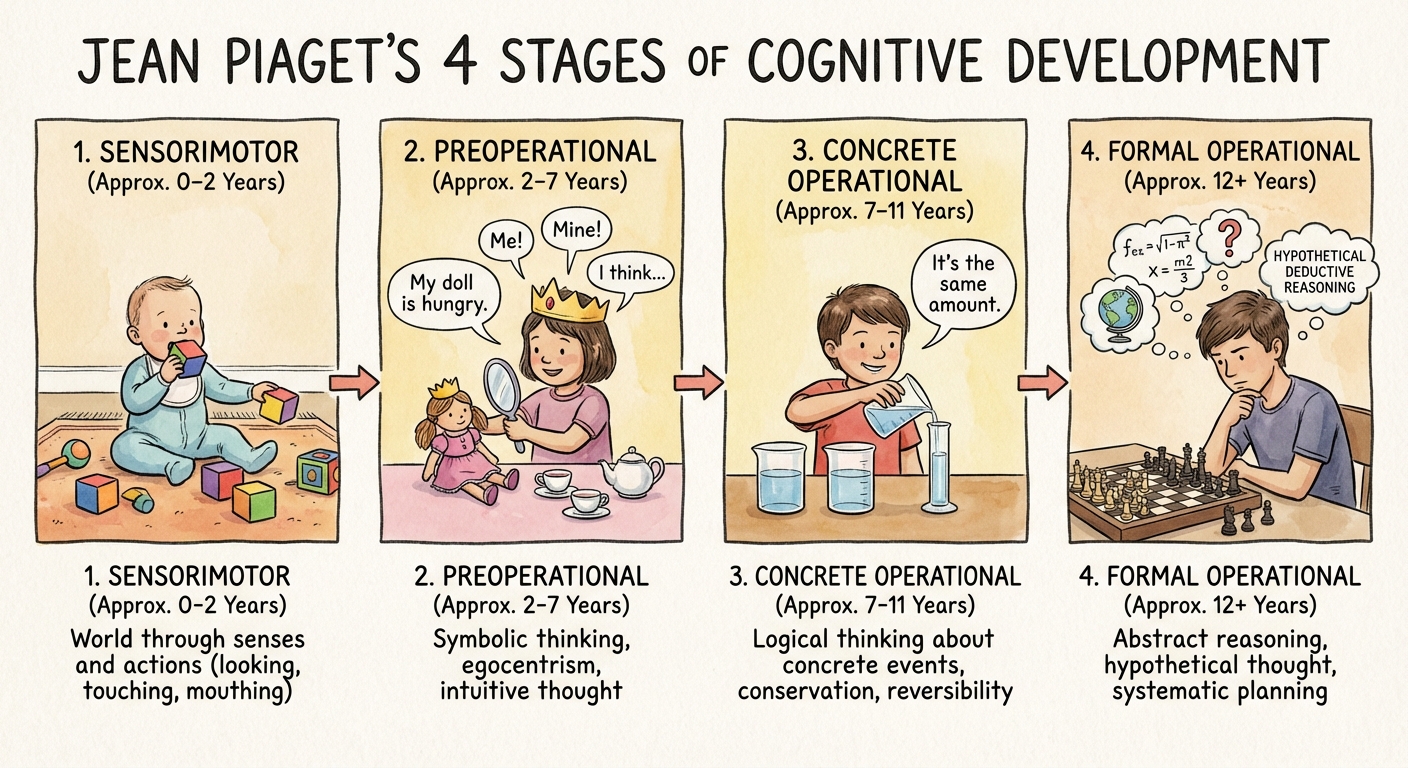
The Four Stages of Cognitive Development
Sensorimotor Stage (Birth to ~2 years)
- Experiencing the world through senses and actions.
- Object Permanence: The awareness that things continue to exist even when not perceived. (Developed around 8 months).
Preoperational Stage (2 to ~6/7 years)
- Representing things with words and images; using intuition rather than logic.
- Egocentrism: The preoperational child’s difficulty taking another's point of view.
- Animism: Believing inanimate objects have feelings/life.
- Lack of Conservation.
Concrete Operational Stage (7 to 11 years)
- Thinking logically about concrete events.
- Conservation: The principle that properties such as mass, volume, and number remain the same despite changes in the forms of objects.
Formal Operational Stage (12 through adulthood)
- Abstract reasoning and hypothetical logic.
Lev Vygotsky’s Sociocultural Theory
Unlike Piaget, who focused on physical interaction, Vygotsky emphasized social interaction.
- Zone of Proximal Development (ZPD): The specific range of tasks a child can perform with help (scaffolding) but cannot yet perform independently.
- Scaffolding: Temporary support given by a teacher/parent to help the learner.
Social and Emotional Development
Attachment Theory
Attachment is an emotional tie with another person.
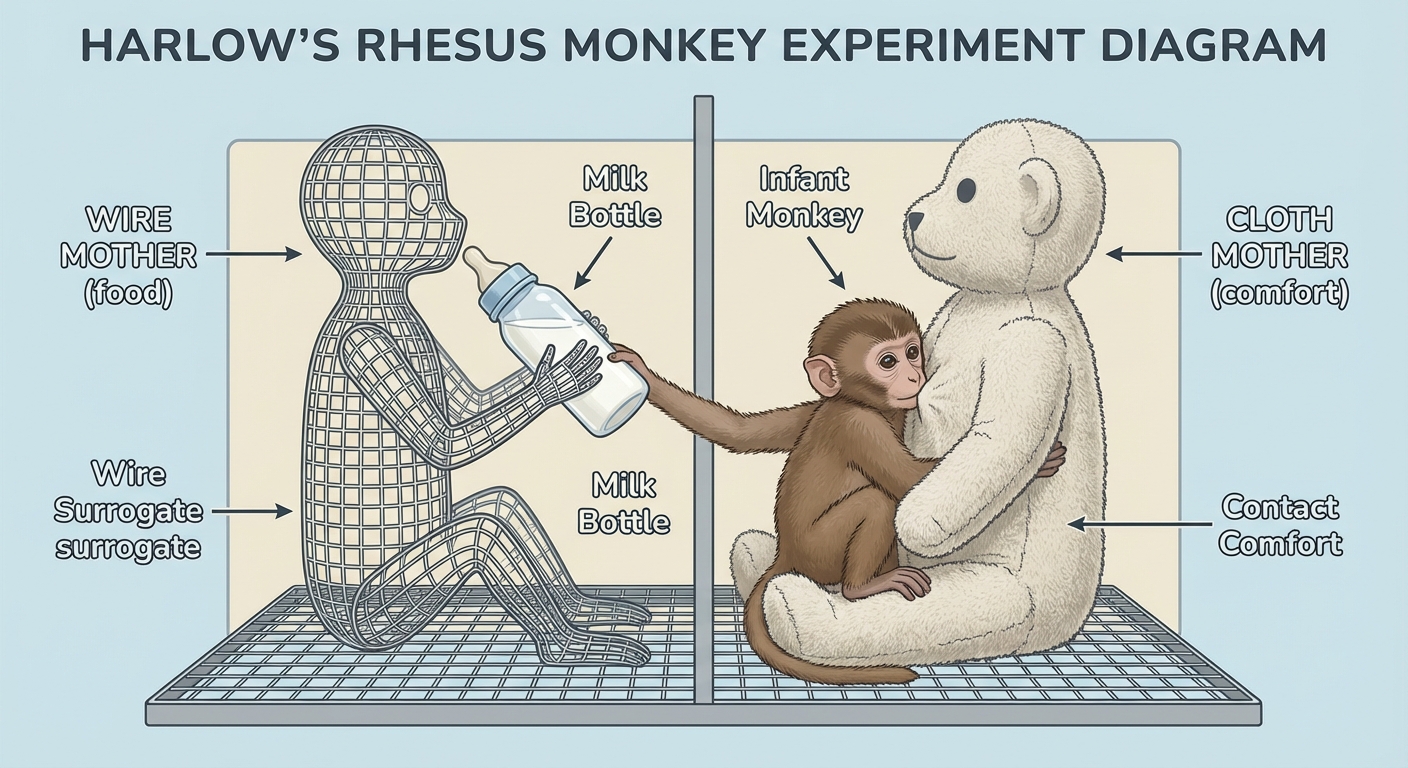
Harry Harlow’s Monkey Studies:
Harlow separated infant monkeys from mothers and provided two artificial mothers: one made of wire (with food) and one made of cloth (no food). The monkeys overwhelmingly preferred the cloth mother.
- Conclusion: Contact Comfort is more important than feeding in forming attachment.
Konrad Lorenz and Imprinting:
Certain birds form an attachment during a Critical Period very early in life. This rigid attachment process is called Imprinting.
Mary Ainsworth’s "Strange Situation":
Ainsworth observed infants in a strange room when the mother left and returned.
- Secure Attachment: Distress when mother leaves; seeks contact when she returns (result of responsive parenting).
- Insecure Avoidant: Little distress when she leaves; ignores her upon return.
- Insecure Ambivalent/Resistant: Extreme distress when she leaves; upset/angry upon return.
Parenting Styles (Diana Baumrind)
| Style | Description | Outcome for Child |
|---|---|---|
| Authoritarian | "Because I said so." Strict rules, high expectations, low responsiveness. | Lower self-esteem, less social skill. |
| Permissive | "Whatever you want." Few demands, little punishment, high responsiveness. | Aggressive, immature. |
| Authoritative | "Let's discuss this." Demanding but responsive; sets rules but explains reasons. | High self-esteem, self-reliance, social competence. |
| Uninvolved | Absent or negligent. | Poor academic and social outcomes. |
Erik Erikson’s Psychosocial Stages
Erikson believed we pass through 8 stages of social development, each with a crisis to resolve.
- Trust vs. Mistrust (Infancy): If needs are dependably met, infants develop a sense of basic trust.
- Autonomy vs. Shame/Doubt (Toddler): Toddlers learn to exercise their will and do things for themselves.
- Initiative vs. Guilt (Preschool): Learn to initiate tasks and carry out plans.
- Industry vs. Inferiority (Elementary): Learn the pleasure of applying themselves to tasks.
- Identity vs. Role Confusion (Adolescence): Teenagers work at refining a sense of self by testing roles.
- Intimacy vs. Isolation (Young Adulthood): Struggling to form close relationships.
- Generativity vs. Stagnation (Middle Adulthood): A sense of contributing to the world (family/work).
- Integrity vs. Despair (Late Adulthood): Reflecting on life, feeling satisfaction or failure.
Moral Development (Kohlberg & Gilligan)
Lawrence Kohlberg’s Levels of Moral Thinking
Kohlberg posed moral dilemmas (e.g., the Heinz Dilemma) to determine how people reason about ethics.
- Preconventional Morality (Before age 9): Self-interest.
- "I follow rules to avoid punishment or gain a reward."
- Conventional Morality (Early adolescence): Upholding laws and social rules.
- "I follow rules because they are the law and to gain social approval."
- Postconventional Morality (Adolescence and beyond): Abstract principles.
- "I follow rules because they affirm agreed-upon rights or basic ethical principles."
Carol Gilligan’s Critique:
Gilligan argued Kohlberg’s study was gender-biased (only tested boys). She suggested men prioritize an "ethics of justice" (rules), while women prioritize an "ethics of care" (relationships).
Adolescence and Adulthood
Adolescence
- Puberty: The period of sexual maturation.
- Brain Development: The Limbic System (emotion) develops faster than the Frontal Lobes (judgment/impulse control), explaining risky teenage behavior.
- Personal Fable: The belief that one is unique and invulnerable (form of adolescent egocentrism).
Adulthood and Aging
- Physical Changes: Women experience Menopause (end of menstrual cycle) around age 50. Telomeres shorten, leading to cellular aging.
- Cognitive Changes:
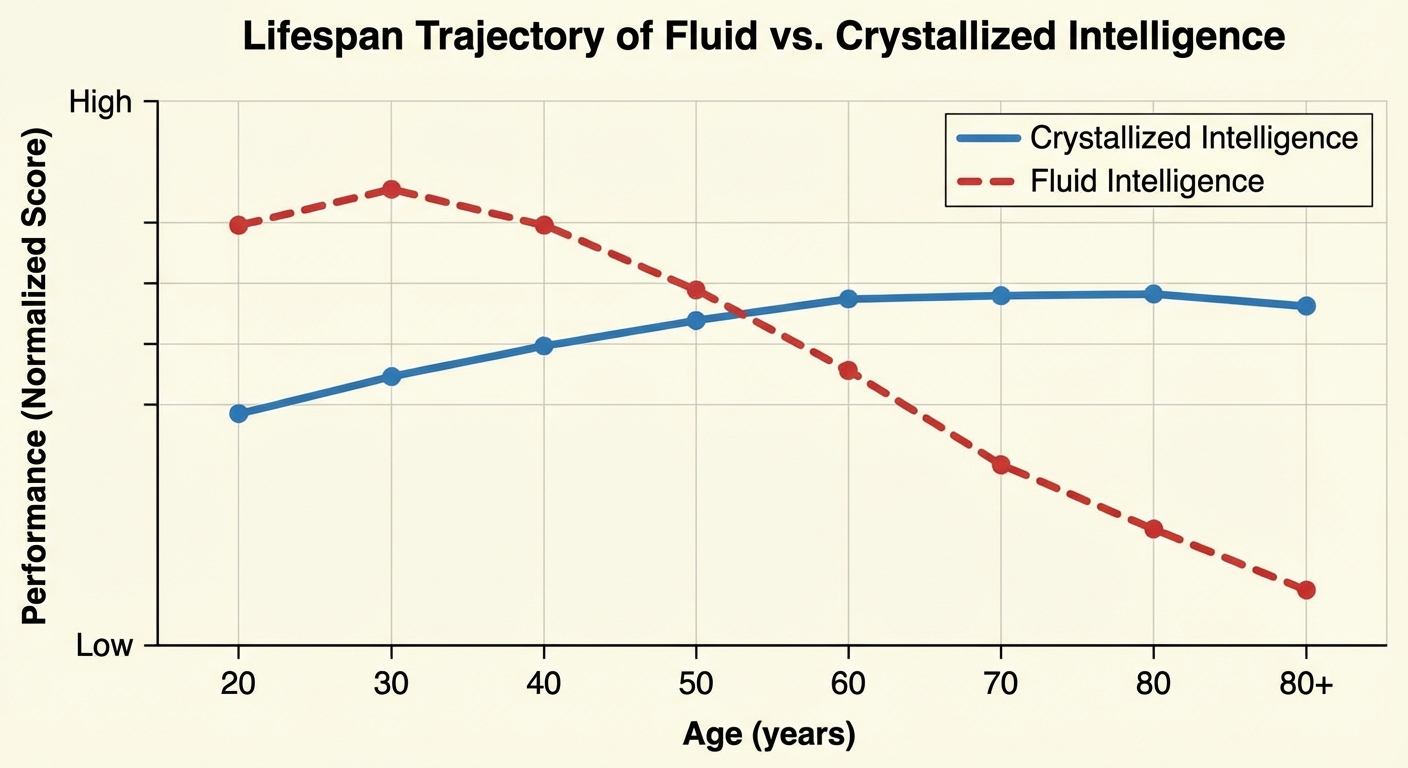
- Fluid Intelligence: Ability to reason speedily and abstractly (e.g., solving puzzles). Decreases with age.
- Crystallized Intelligence: Accumulated knowledge and verbal skills (e.g., vocabulary). Increases or stays stable with age.
Common Mistakes & Mnemonics
Mnemonics
- Piaget’s Stages: Some People Can Fly
- Sensorimotor, Preoperational, Concrete, Formal.
- Kohlberg’s Levels: PCP
- Preconventional, Conventional, Postconventional.
- Parenting Styles: AuthoritaTive vs. AuthoritaRian
- AuthoritaTive = Teacher (Good, explains things).
- AuthoritaRian = Rigid (Bad, strict, no explanation).
Common Student Pitfalls
- Assimilation vs. Accommodation: Students often swap these. Remember: Assimilation has two s's—Same Schema (fitting new into old). Accommodation has two c's—Change/Create (changing the schema).
- Imprinting vs. Attachment: Humans do NOT imprint. Imprinting is immediate and rigid (ducks/geese). Humans form attachment gradually.
- Fluid vs. Crystallized Intelligence: Students forget which one declines. Think: Fluid dries up (declines); Crystals grow stronger over time (increases/stable).
- Sex vs. Gender: In AP Psychology, "Sex" refers to biological traits; "Gender" refers to the social characteristics and roles. Do not use them interchangeably.