APUSH Unit 7: The Great War and the Roaring Twenties
Crisis and Transformation: America in WWI and the 1920s
World War I: Military and Diplomatic
The United States' involvement in World War I marked a decisive shift from a tradition of non-intervention to a role as a global power. This period tests your understanding of foreign policy shifts, constitutional rights during wartime, and the tension between internationalism and isolationism.
The Path to Intervention
Initially, President Woodrow Wilson encouraged Americans to remain "neutral in thought, as well as in deed." However, several factors made neutrality impossible to maintain:
- Unrestricted Submarine Warfare: Germany's policy of sinking merchant ships without warning (including the Lusitania in 1915 and the resumption of attacks in 1917) threatened U.S. freedom of the seas and trade.
- The Zimmerman Telegram: A partially intercepted German dispatch proposing an alliance with Mexico against the U.S. This inflamed public sentiment and was viewed as a direct threat to national security.
- "Safe for Democracy": Wilson framed the war not as a land grab, but as a moral crusade to protect democratic ideals against authoritarianism.
The American Expeditionary Forces (AEF)
Unlike European allies who wanted to use American troops as reinforcements for depleted British and French units, General John J. Pershing insisted that the American Expeditionary Forces (AEF) fight as an independent American unit.
- Impact: Although the U.S. entered late (1917) and saw combat primarily in 1918 (e.g., Meuse-Argonne Offensive), the influx of fresh troops and vast industrial supplies tipped the balance of the war, leading to the Armistice on November 11, 1918.
The Home Front and Civil Liberties
Total war required total mobilization. The government expanded its power significantly to control the economy and public opinion.
- War Industries Board (WIB): Directed military production and allocated resources.
- Committee on Public Information (CPI): The government's propaganda arm, headed by George Creel, spread anti-German sentiment and promoted war bonds.
Constitutional Crisis: To suppress dissent, Congress passed the Espionage Act (1917) and the Sedition Act (1918), criminalizing criticism of the war effort.
Key Court Case: Schenck v. United States (1919)
The Supreme Court upheld the conviction of a socialist distributing anti-draft leaflets. Justice Oliver Wendell Holmes Jr. established the "Clear and Present Danger" test, ruling that free speech can be limited if it poses a significant threat to national security.
Treaty of Versailles and the League of Nations
Post-war diplomacy is a frequent APUSH exam topic. Wilson arrived in Paris with his Fourteen Points, a vision for peace based on free trade, arms reduction, and self-determination.
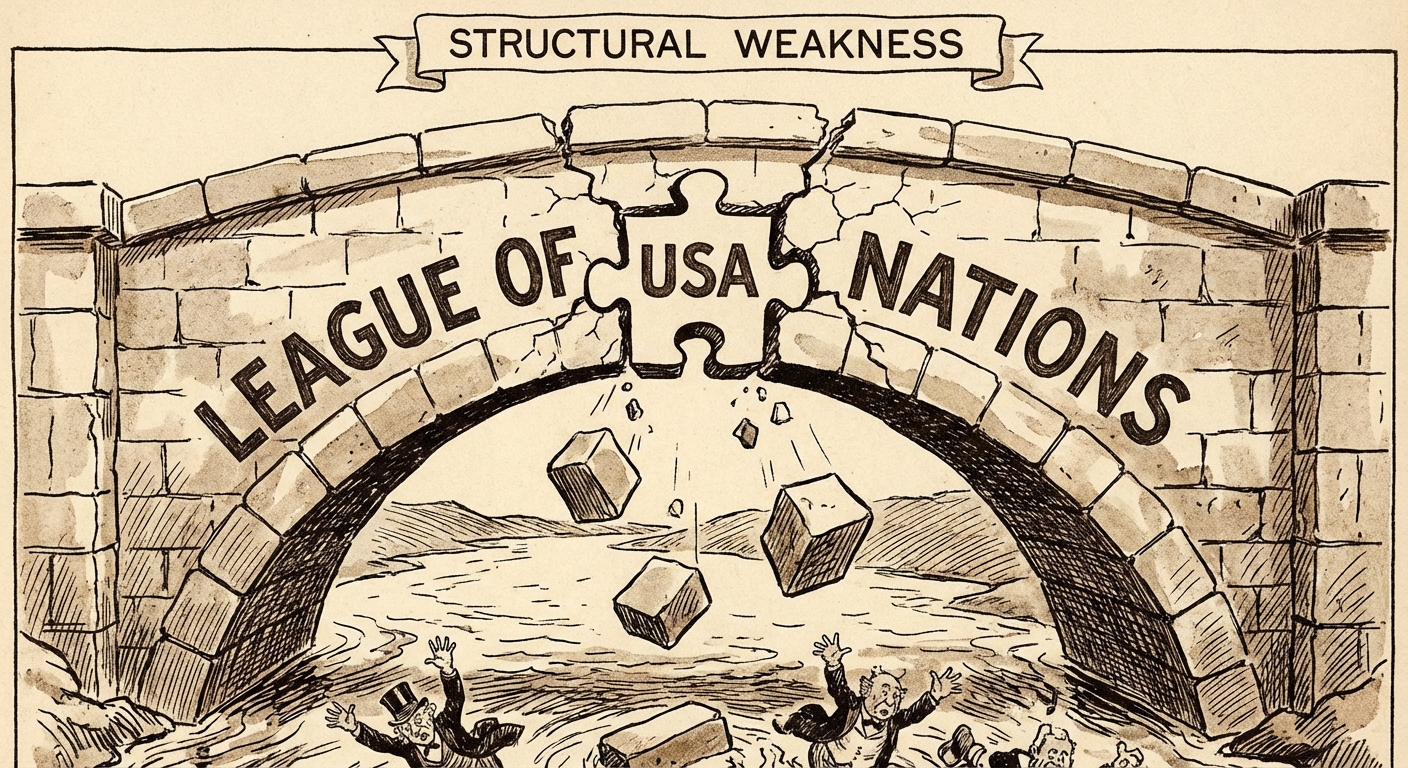
- The League of Nations: The 14th point called for an international organization to resolve disputes peacefully and prevent future wars.
- The Senate Battle: The U.S. Senate, led by Republican Henry Cabot Lodge, refused to ratify the Treaty of Versailles. They feared Article X of the League covenant would strip Congress of its war-declaring powers and drag the U.S. into European conflicts without consent.
- Outcome: The U.S. never signed the Treaty of Versailles and never joined the League of Nations, retreating into a foreign policy of unilateralism (often called isolationism) during the 1920s.
The 1920s: Innovation, Culture, and Tension
Often called the "Roaring Twenties," this decade was defined by a booming economy, technological shifts, and intense cultural wars between modernism and traditionalism.
Mass Media and Consumerism
Technological innovations transformed daily life and created a national culture for the first time.
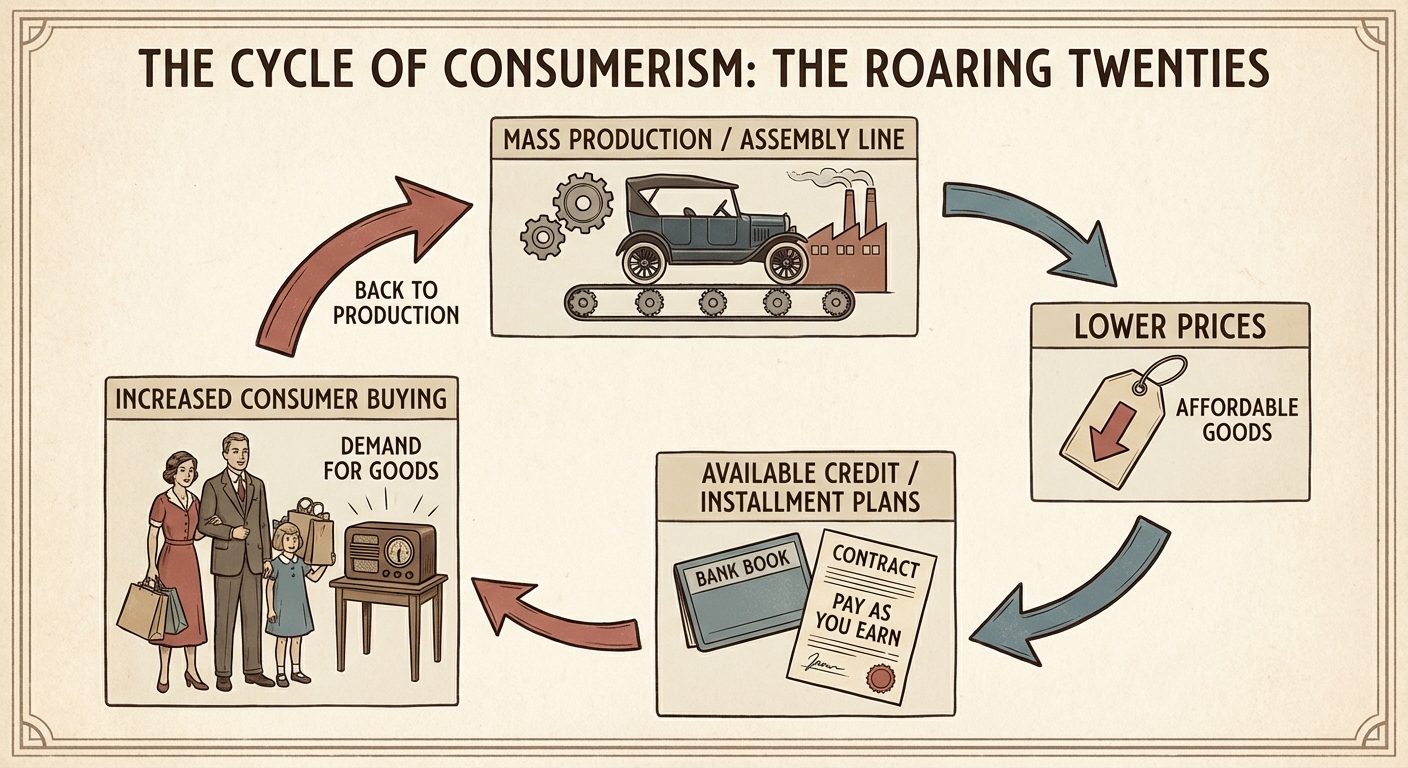
- The Radio: By linking households across the nation to the same news and entertainment, radio homogenized American culture.
- Automobiles: Henry Ford's perfection of the assembly line made the Model T affordable. This spurred suburbanization, road construction, and the oil industry.
- Consumer Credit: Americans began buying goods on installment plans (credit), shifting the ethic from thrift to consumption.
The Harlem Renaissance
Fueled by the Great Migration—the movement of African Americans from the rural South to the urban North during and after WWI—Harlem became the cultural capital of Black America.
- Definition: A flowering of African American art, literature, and music that expressed pride in Black culture and identity.
- Key Figures:
- Langston Hughes: Poet who wrote about the working-class Black experience.
- Zora Neale Hurston: Writer who celebrated rural Black southern culture.
- Louis Armstrong & Duke Ellington: Pioneers of Jazz, the soundtrack of the decade.
- Marcus Garvey: Promoted Black nationalism and the "Back to Africa" movement via the United Negro Improvement Association (UNIA).
The Culture Wars: Modernism vs. Fundamentalism
The 1920s saw a backlash against the rapid changes in society.
| Conflict Area | Description | Key Event/Symbol |
|---|---|---|
| Religion | Scientific Modernism vs. Religious Fundamentalism | The Scopes "Monkey" Trial (1925): A teacher was tried for teaching evolution in Tennessee. While Scopes lost, the trial publicly ridiculed fundamentalism. |
| Gender Roles | Traditional women's roles vs. The "New Woman" | Flappers: Young women who cut their hair short, smoked, drank, and challenged Victorian sexual norms. |
| Alcohol | Rural traditionalism vs. Urban modernism | Prohibition (18th Amendment/Volstead Act): Intended to improve morals, it instead led to the rise of organized crime and speakeasies. |
Immigration Policy and Nativism
Anxiety leading up to and following WWI resulted in severe restrictions on immigration and the targeting of minority groups.
The First Red Scare (1919–1920)
Following the Bolshevik Revolution in Russia, hysteria spread across the U.S. regarding communists, anarchists, and radical labor unions.
- Palmer Raids: Attorney General A. Mitchell Palmer orchestrated raids to arrest and deport suspected foreign radicals, often without due process.
- Sacco and Vanzetti Case: Two Italian anarchist immigrants were convicted of murder. Their trial was widely seen as biased by their immigrant status and political beliefs, illustrating the height of 1920s xenophobia.
Quota Acts and the Resurgence of the KKK
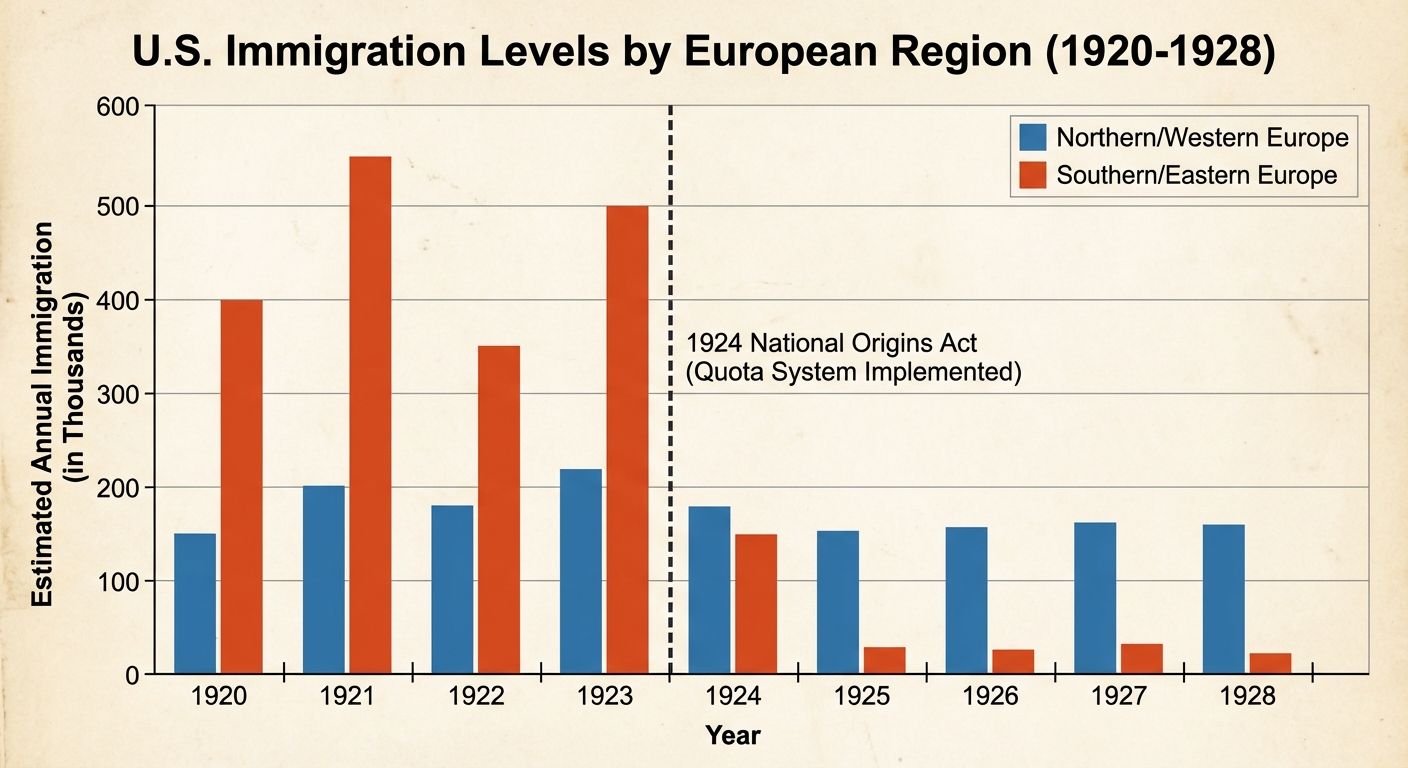
Nativists believed that immigrants from Southern and Eastern Europe (Italy, Poland, Russia) were culturally inferior and politically dangerous.
- Emergency Quota Act (1921): Restricted immigration to 3% of a nationality's U.S. population in 1910.
- National Origins Act (1924): The harshest restriction. It lowered the quota to 2% based on the 1890 census.
- Why 1890? It pushed the baseline back to before the major wave of "New Immigrants" from Southern/Eastern Europe arrived, effectively banning them while allowing "Old Immigrants" from Western Europe.
The Ku Klux Klan (KKK) Resurgence:
Unlike the Reconstruction-era KKK, the 1920s Klan:
- Was a national organization (strong in the Midwest, not just the South).
- Broadened its hate to include Catholics, Jews, and immigrants, in addition to African Americans.
- Marketed itself as a defender of "100% Americanism" and Protestant morality.
Common Mistakes & Pitfalls
- Confusing the Red Scares: Do not confuse the First Red Scare (1919–1920) with the Second Red Scare (McCarthyism, 1950s). The first was about anarchists/Bolshevik workers; the second was about communist infiltration in the government.
- The Lusitania Misconception: Students often think the sinking of the Lusitania (1915) caused the U.S. to join WWI immediately. It didn't. The U.S. did not join until 1917, after Germany resumed unrestricted submarine warfare.
- U.S. and the League: The U.S. President (Wilson) proposed the League of Nations, but the U.S. never joined it. This is a critical distinction in understanding the failure of the League to prevent WWII.
- The "Roaring" Economy: While the 1920s were prosperous for urban consumers and corporations, farmers struggled immensely during this decade due to post-war overproduction and falling prices. The Great Depression essentially started early for the agricultural sector.