AP Physics C: E&M — Unit 4: Statics and Dynamics of Magnetic Fields
4.1 Forces on Moving Charges in Magnetic Fields
Defines of Magnetic Field ($\vec{B}$)
Magnetic Fields are vector fields produced by moving electric charges or intrinsic magnetic moments of elementary particles. Unlike electric fields which originate from static charges, magnetic fields have no "monopoles"; magnetic field lines always form closed loops.
- Symbol: $\vec{B}$
- SI Unit: Tesla (T). Note: $1 \text{ T} = 1 \frac{\text{N}}{\text{C} \cdot \text{m/s}} = 10^4 \text{ Gauss}$.
- Visual Representation: Field lines emerge from the North pole and enter the South pole. The density of lines indicates field strength.
The Lorentz Force
A charged particle moving through a magnetic field experiences a magnetic force. This is the fundamental interaction in magnetostatics.
Where:
- $q$ is the electric charge Magnitude and sign matter.
- $\vec{v}$ is the velocity vector of the particle.
- $\vec{B}$ is the magnetic field vector.
- $\times$ denotes the vector cross product.
Key Consequences Calculation:
- Magnitude: $F_B = |q|vB \sin(\theta)$, where $\theta$ is the angle between $\vec{v}$ and $\vec{B}$.
- Zero Force Conditions: The force is zero if the particle is stationary ($v=0$) or moving parallel/anti-parallel to the field ($\sin(0^\circ) = 0$).
- Direction: Perpendicular to the plane defined by $\vec{v}$ and $\vec{B}$. Determined by the Right-Hand Rule.
- Work: The magnetic force is always perpendicular to motion ($ \vec{F}_B \perp \vec{v} $). Therefore, magnetic forces do NO work on charged particles ($ W = \int \vec{F} \cdot d\vec{r} = 0 $). They can change direction, but not speed or kinetic energy.
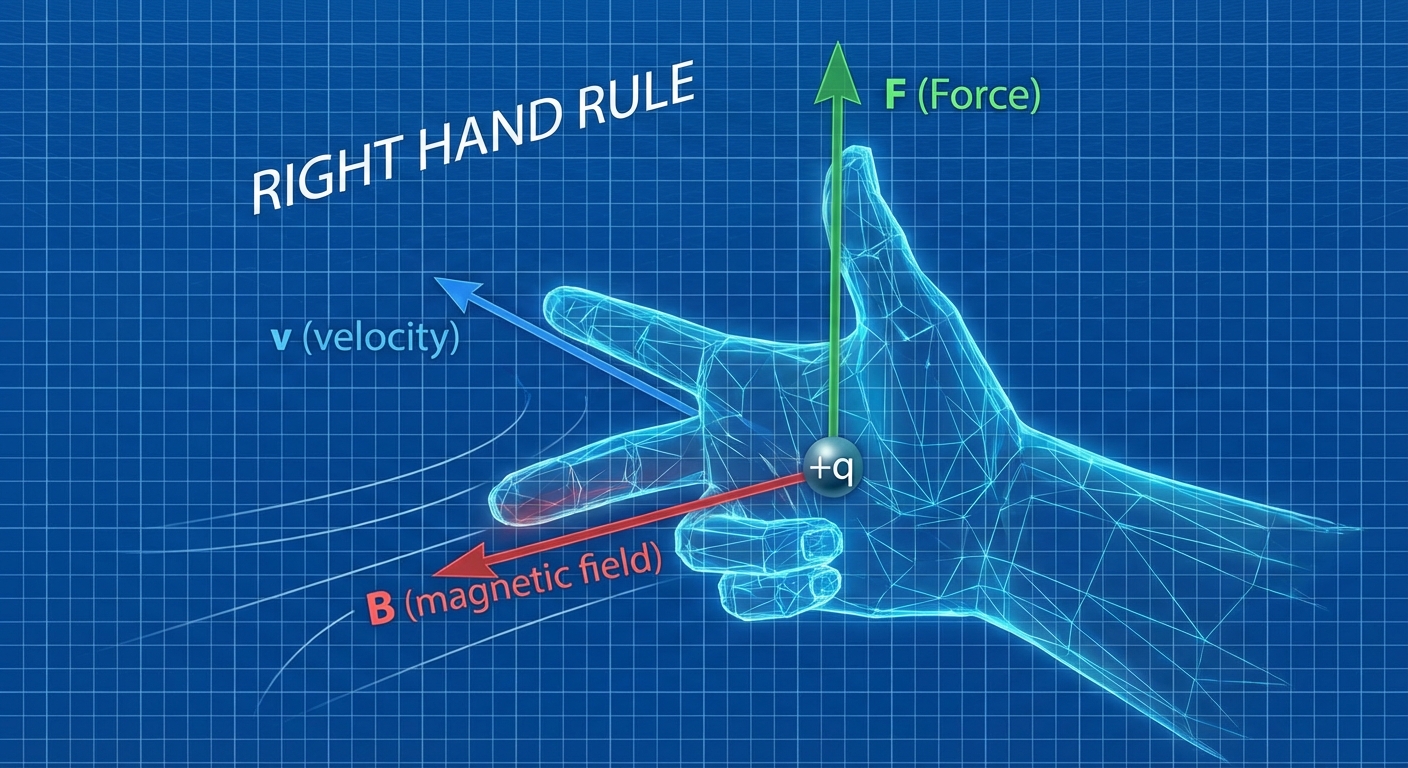
The Right-Hand Rule (RHR) for Forces
Used to determine the cross-product direction for a positive charge.
- Point fingers of right hand in direction of velocity $\vec{v}$.
- Curl fingers toward magnetic field $\vec{B}$.
- Thumb points in direction of Force $\vec{F}_B$.
Note: For a negative charge (like an electron), find the direction for a positive charge and flip it 180 degrees.
Motion in a Uniform Magnetic Field
When a charged particle enters a uniform magnetic field with velocity perpendicular to the field, it undergoes Uniform Circular Motion.
- Centripetal Force: The magnetic force acts as the centripetal force.
- Radius of Path (Cyclotron Radius):
- Period ($T$) & Frequency ($f$):
Helical Motion: If the velocity has a component parallel to the field ($v_{\parallel}$), the particle moves in a helix. The parallel component remains constant (pitch), while the perpendicular component drives the circular motion.
Applications
- Velocity Selector: Crossed $\vec{E}$ and $\vec{B}$ fields create opposing forces. Only particles with $v = \frac{E}{B}$ pass through undeflected ($qE = qvB$).
- Mass Spectrometer: Uses a velocity selector followed by a region of pure $\vec{B}$ field to separate ions by mass-to-charge ratio ($m/q$) based on the radius of curvature.
4.2 Forces on Current-Carrying Wires
Current is simply a collection of moving charges. Therefore, a wire carrying current in a magnetic field experiences a cumulative force.
Force Formula
For a straight wire of length $L$ carrying current $I$ in a uniform field:
For a curved wire or non-uniform field, we integrate along the path:
- $\vec{L}$ or $d\vec{l}$ points in the direction of conventional current.
Maxwell's Note: If a wire forms a complete closed loop in a uniform magnetic field, the net force is zero.
Torque on a Current Loop
While the net force on a closed loop in a uniform field is zero, the net torque ($\tau$) is not. This is the principle behind electric motors.
- Magnetic Dipole Moment ($\vec{\mu}$): A vector defined for a current loop.
- $N$: Number of turns.
- $I$: Current.
- $A$: Area of the loop.
- $\hat{n}$: Normal vector (direction determined by RHR—curl fingers with current, thumb points to $\hat{n}$).
Potential Energy of a Dipole:
- Lowest energy (stable equilibrium) when $\vec{\mu}$ is parallel to $\vec{B}$.
- Highest energy (unstable) when anti-parallel.
4.3 Biot-Savart Law: Sources of Magnetic Fields
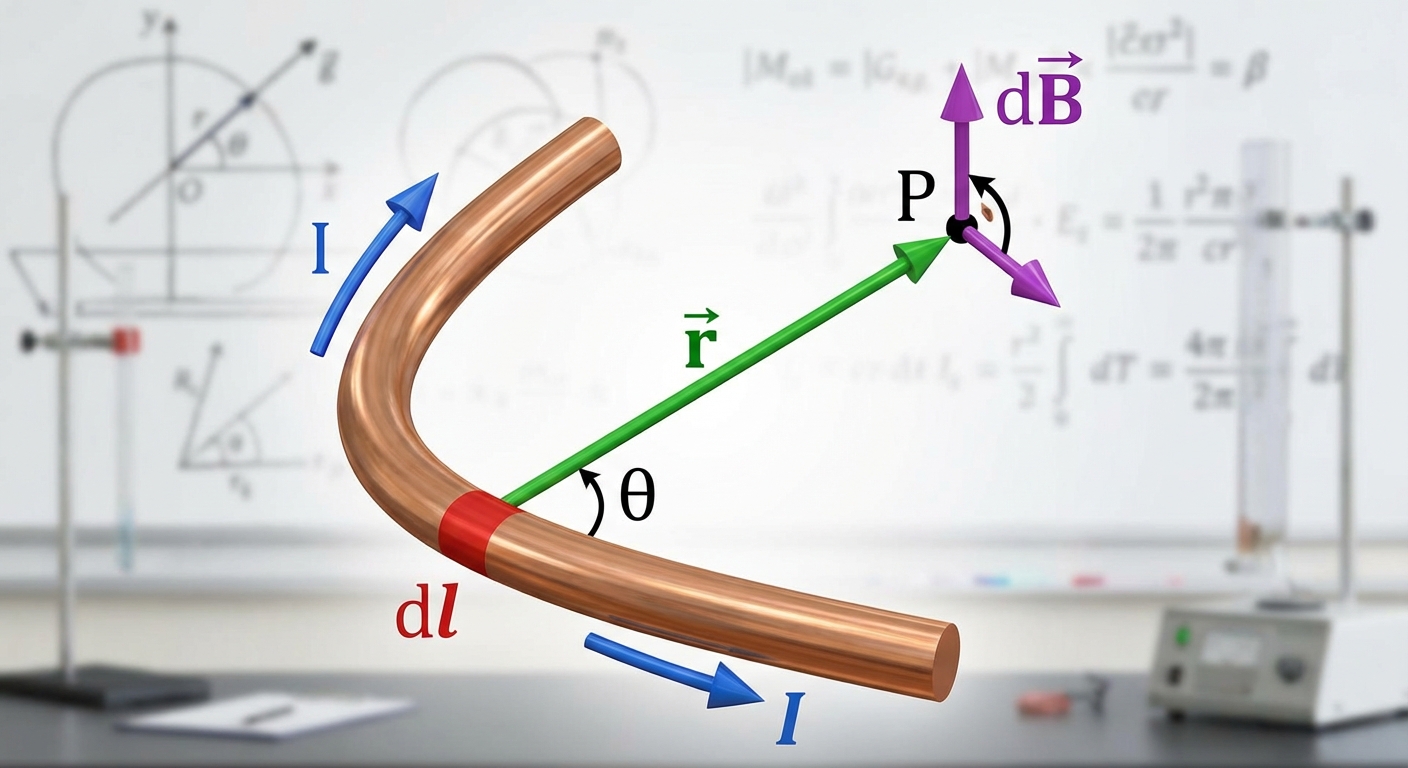
Just as Coulomb’s Law calculates the E-field from a point charge, the Biot-Savart Law calculates the B-field produced by a moving charge or current element.
General Formula
- $\mu_0$: Permeability of free space ($4\pi \times 10^{-7} \text{ T}\cdot\text{m/A}$).
- $d\vec{l}$: Infinitesimal length vector pointing in current direction.
- $\hat{r}$: Unit vector pointing from the wire element to the point of interest.
- $r$: Distance from the wire element to the point.
Important Derivations (AP C Learning Objectives)
1. Long Straight Wire
Integrating Biot-Savart for an infinite line of current yields:
- Direction: Circular loops around the wire (RHR: thumb along current, fingers curl along B).
2. Center of a Circular Loop (Radius $R$)
3. On the Axis of a Current Loop
At a distance $z$ from the center of a loop of radius $R$:
- At $z=0$, this reduces to the "center of loop" formula.
- At $z \gg R$, it approximates the field of a dipole ($B \propto 1/z^3$).
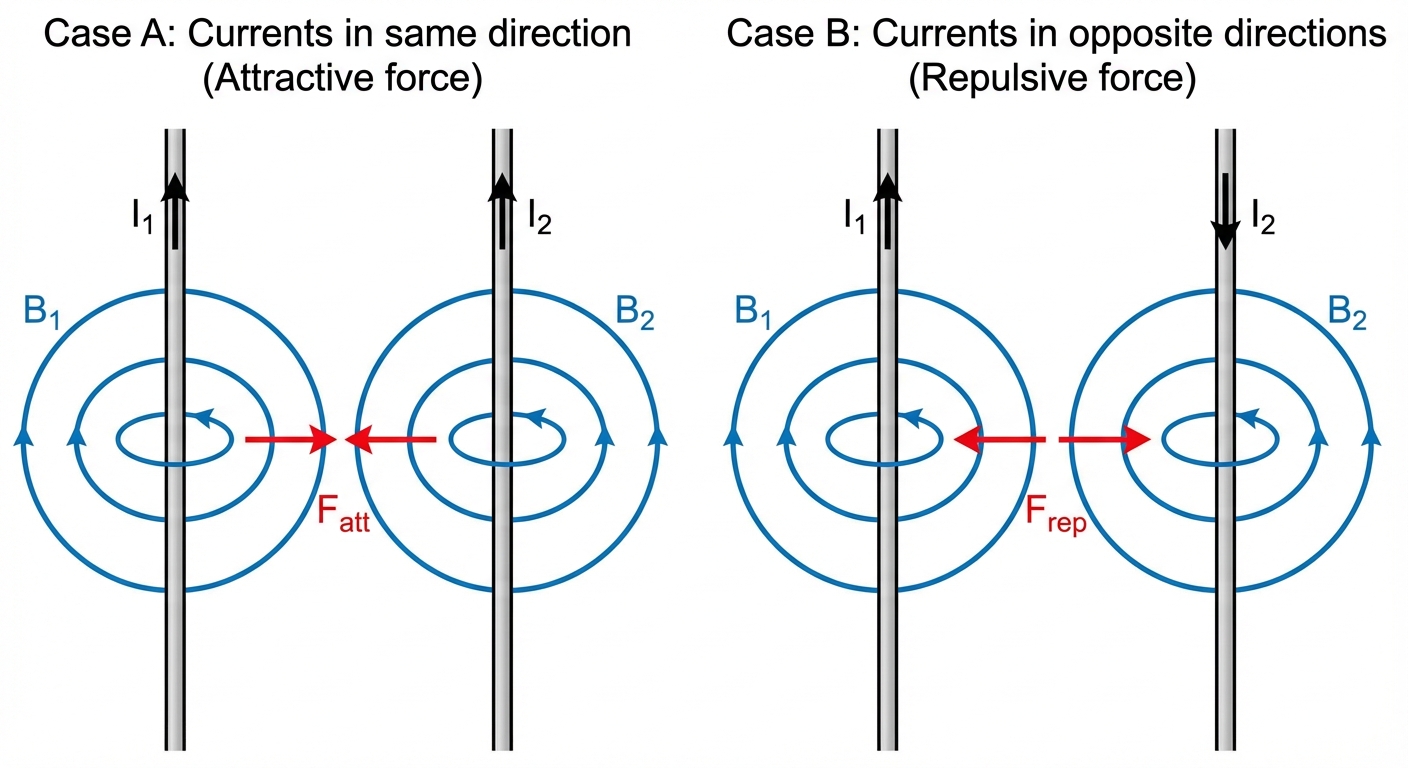
Force Between Parallel Wires
Two parallel wires exert magnetic forces on each other. Wire 1 creates a field at the location of Wire 2, which exerts a force on Wire 2.
- Parallel Currents: Attract.
- Anti-Parallel Currents: Repel.
4.4 Ampère’s Law
Ampère’s Law is the magnetic equivalent of Gauss’s Law. It is useful for finding magnetic fields in highly symmetric situations.
The Integral Form
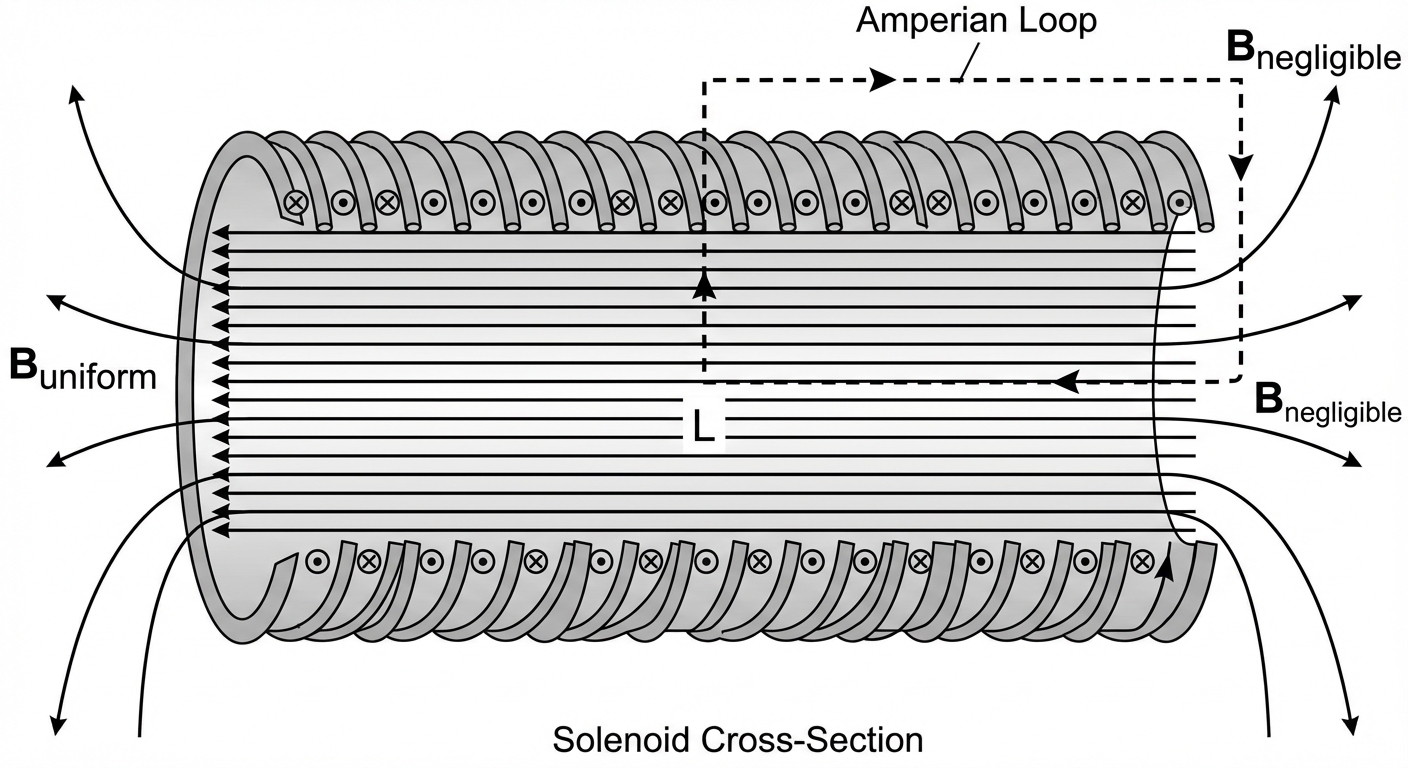
- $\oint$: Line integral around a closed loop (Amperian loop).
- $d\vec{l}$: Vector along the path of the loop.
- $I_{enc}$: Net current penetrating the area defined by the loop.
Sign Convention: Curl your right fingers in the direction of integration ($d\vec{l}$). Your thumb defines the positive direction for current.
Applications of Ampère's Law
1. Long Straight Wire (Outside vs. Inside)
- Outside ($r > R$): We draw a circular loop radius $r$. $\oint B dl = B(2\pi r) = \mu0 I$.
- Inside ($r < R$): Assuming uniform current density $J = I / (\pi R^2)$.
The field increases linearly from the center to the surface.
2. Solenoid
An ideal solenoid (long, tightly wound) has a uniform field inside and zero field outside.
- $n = N/L$: Number of turns per unit length.
- The field is parallel to the axis. Direction given by RHR (curl fingers with current, thumb points North).
3. Toroid
A solenoid bent into a donut shape. Determine the field at a radius $r$ inside the coils ($N$ total turns).
- The field is non-uniform (stronger at the inner radius, weaker at the outer radius).
- $B = 0$ outside the toroid entirely.
4.5 Common Mistakes & Pitfalls
- Magnetic Work: A common trick question asks for the work done by the magnetic force on a charge moving in a circle. The answer is always Zero. Magnetic force changes direction, not Kinetic Energy.
- Cross Product Order: $\vec{v} \times \vec{B} \neq \vec{B} \times \vec{v}$. The order matters. Reversing them flips the sign (direction). Always use $\vec{v}$ (fingers) then $\vec{B}$ (curl).
- Electric vs. Magnetic Force: Electric force ($FE = qE$) acts on moving and stationary charges parallel to the field. Magnetic force ($FB = qv \times B$) acts only on moving charges perpendicular to the field.
- $\,\mu0$ vs $\epsilon0$: Don't confuse the constants. $\mu0$ is for magnetism ($4\pi \times 10^{-7}$); $\epsilon0$ is for electricity.
- Using Ampère's Law for Finite Wires: Ampère's law in the simple form $B(2\pi r) = \mu_0 I$ requires symmetry. You cannot use it easily for a short wire segment; you must use Biot-Savart for that.
- Current Direction in Parallel Wires: Students often confusingly apply the "likes repel" rule from electrostatics to currents. For wires: Like currents Attract; Opposite currents Repel.