Foundations of Electric Circuits: Current, Resistance, and Ohm’s Law
Electric Current
Definition and Nature of Current
Electric current is defined as the rate at which electric charge passes through a specific cross-sectional area. It is not simply the speed of the charges, but the quantity of charge flowing per unit of time.
Think of current like the flow rate of water in a river (gallons per minute). In a circuit, the \"water\" is electric charge, and the \"pipe\" is the conducting wire.
- Symbol: $I$
- SI Unit: Ampere (A), where $1 \text{ A} = 1 \text{ Coulomb/second} (C/s)$.
- Measurement: Measured using an Ammeter, which must be placed in series with the component being measured.
Formulating Current
There are two primary ways to describe current mathematically in AP Physics 2.
1. Macroscopic Definition
The average current over a time interval $\Delta t$ is:
Where:
- $\Delta Q$ is the amount of net charge passing a cross-section.
- $\Delta t$ is the time interval.
2. Microscopic Model (Drift Velocity)
Inside a conductor, electrons move randomly at high speeds due to thermal energy. However, when a potential difference is applied, they gain a slow net motion called drift velocity.
Where:
- $n$ = charge carrier density (number of charges per unit volume, $m^{-3}$).
- $q$ = magnitude of charge on each carrier ($1.6 \times 10^{-19} C$ for electrons).
- $v_d$ = drift velocity ($m/s$).
- $A$ = cross-sectional area of the wire ($m^2$).
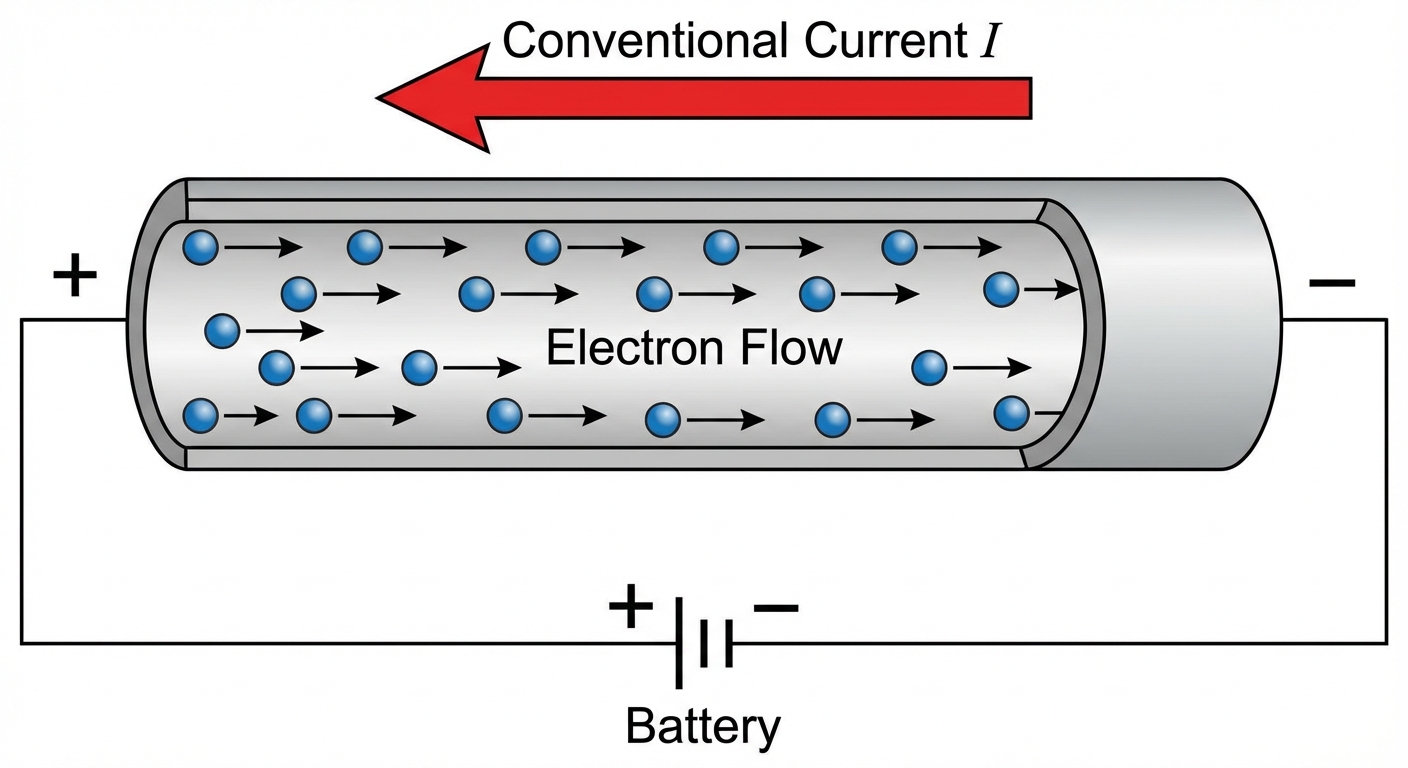
Conventional Current vs. Electron Flow
This is a historical convention that often confuses students.
- Conventional Current ($I$): The direction positive charge carriers would move. It flows from High Potential (+) to Low Potential (-).
- Electron Flow: The actual physical movement of electrons in metal wires. Electrons flow from Low Potential (-) to High Potential (+).
Rule for AP Physics: Unless specified otherwise, always analyze circuits using Conventional Current. The arrows on schematic symbols (like diodes and transistors) point in the direction of conventional current.
Resistance and Resistivity
Understanding Resistance
Resistance ($R$) is the measure of how much an object opposes the flow of electric current. It is analogous to friction in a mechanical system or a narrowing in a water pipe. When electrons move through a conductor, they collide with the atomic lattice; these collisions convert electrical potential energy into internal energy (heat).
- Symbol: $R$
- SI Unit: Ohm ($\Omega$)
Resistivity: A Material Property
While Resistance is a property of a specific object (like a specific wire), Resistivity ($\rho$) is a property of the material itself.
- Copper has low resistivity (good conductor).
- Rubber has high resistivity (good insulator).
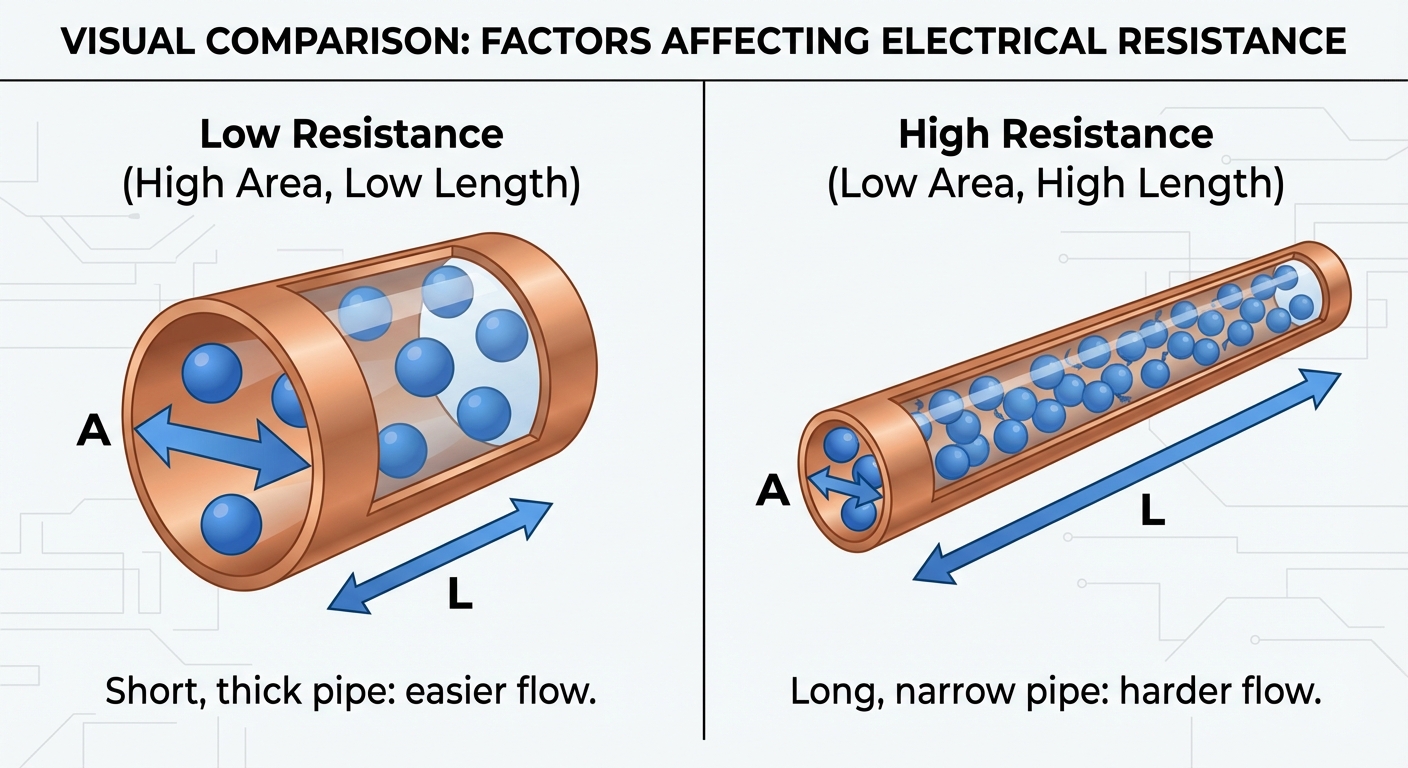
Geometric Factors of Resistance
The resistance of a wire depends on its geometry and material properties according to the equation:
| Variable | Meaning | Relationship to $R$ |
|---|---|---|
| $\rho$ (Rho) | Resistivity ($\Omega \cdot m$) | Direct: Higher $\rho \to$ Higher $R$ |
| $L$ | Length of the conductor ($m$) | Direct: Longer wire $\to$ Higher $R$ |
| $A$ | Cross-sectional Area ($m^2$) | Inverse: Thicker wire $\to$ Lower $R$ |
Analogy: It is harder to suck a milkshake through a straw that is long (high $L$) and thin (low $A$).
Worked Example: The "Stretched Wire" Problem
This is a classic AP Physics question pattern.
Scenario: A cylindrical copper wire has resistance $R0$. The wire is stretched so that its length doubles ($L{new} = 2L_0$) while its volume remains constant. What is the new resistance?
Solution:
- Volume Conservation: Since volume $V = A \times L$, if $L$ doubles, $A$ must be halved to keep volume constant ($A{new} = A0/2$).
- Apply Formula:
- Simplify:
- Result: The new resistance is $4R_0$.
Ohm's Law
The Relationship
Ohm's Law states that for many materials, the current flowing through a conductor is directly proportional to the potential difference (voltage) across it and inversely proportional to the resistance.
Mathematically:
Or solved for current:
Note: $\Delta V$ is the potential difference across the component, not the potential at a point.
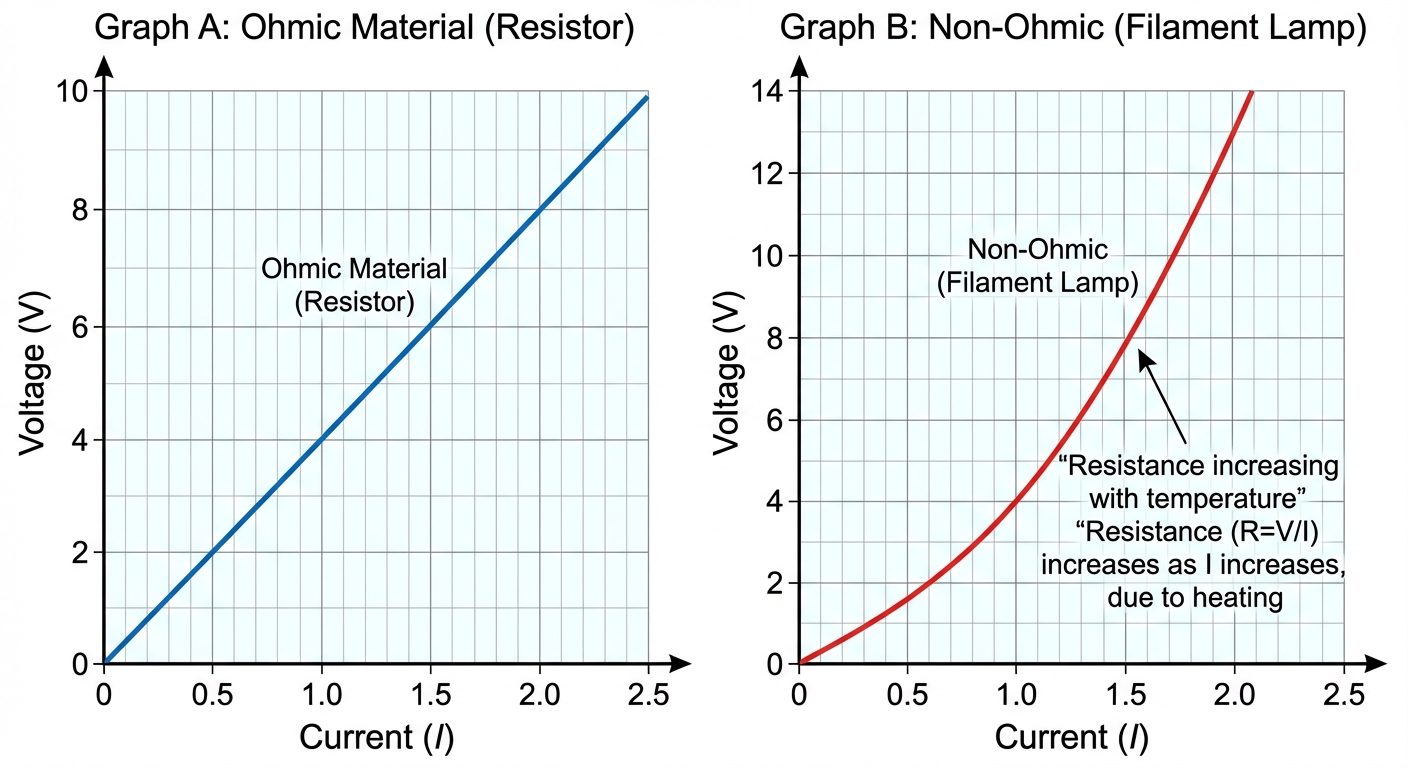
Ohmic vs. Non-Ohmic Materials
Not all devices follow Ohm's Law. It is an empirical model, not a fundamental law of the universe.
Ohmic Materials (Resistors, Copper wire):
- Resistance is constant regardless of voltage.
- The graph of Current ($I$) vs. Voltage ($V$) is a straight line passing through the origin.
- Slope of $V$ vs $I$ graph represents $R$.
Non-Ohmic Materials (Lightbulbs, Diodes):
- Resistance changes as current/temperature changes.
- Filament Lightbulb: As current increases, the filament gets hot, causing atoms to vibrate more, which increases collisions and resistance. The $I-V$ graph curves, showing increasing slope (if plotting V vs I) or decreasing slope (if plotting I vs V).
- Diode: Allows current to flow easily in only one direction.
Common Mistakes & Pitfalls
1. "Current is Used Up"
Misconception: Students often think current decreases after passing through a resistor (e.g., 5A enters, 3A leaves).
Reality: Charge is conserved. Current is the flow of charge. Just as water does not disappear when it flows through a turbine, current is the same entering and exiting a resistor (in a single branch). Voltage (Energy) is what is "used up" (dropped).
2. Voltage Flows \"Through\"
Misconception: Saying "Calculate the voltage moving through the resistor."
Reality: Current flows through; Voltage is applied across. Always imagine voltage as a height difference between two points. You cannot have a height difference "flowing through" a pipe.
3. Batteries provide Constant Current
Misconception: A 9V battery always pumps out the same amount of Amps.
Reality: A battery provides a constant potential difference (EMF). The current depends on the resistance attached to it ($I = \Delta V / R$). If you add more resistance, current drops; the battery voltage stays (mostly) constant.
4. Confusing Resistance and Resistivity
Misconception: Treating them as synonyms.
Reality: Resistance ($R$) changes if you cut the wire. Resistivity ($\rho$) stays the same because the material (copper, gold, etc.) hasn't changed.