Foundations of Big Idea 1: Inquiry and Research Strategies
In AP Seminar, Big Idea 1 (Question and Explore) is the bedrock of the course. It challenges you to move beyond simply "Googling an answer" to a more sophisticated process of identifying complex problems, formulating targeted research questions, and finding evidence that matters. The content below covers the essential framework for the Individual Research Report (IRR) and the initial stages of the Team Multimedia Presentation (TMP).
Identifying and Contextualizing a Problem or Issue
Research begins with curiosity, but curiosity must be disciplined to be useful.
Moving from Topic to Problem
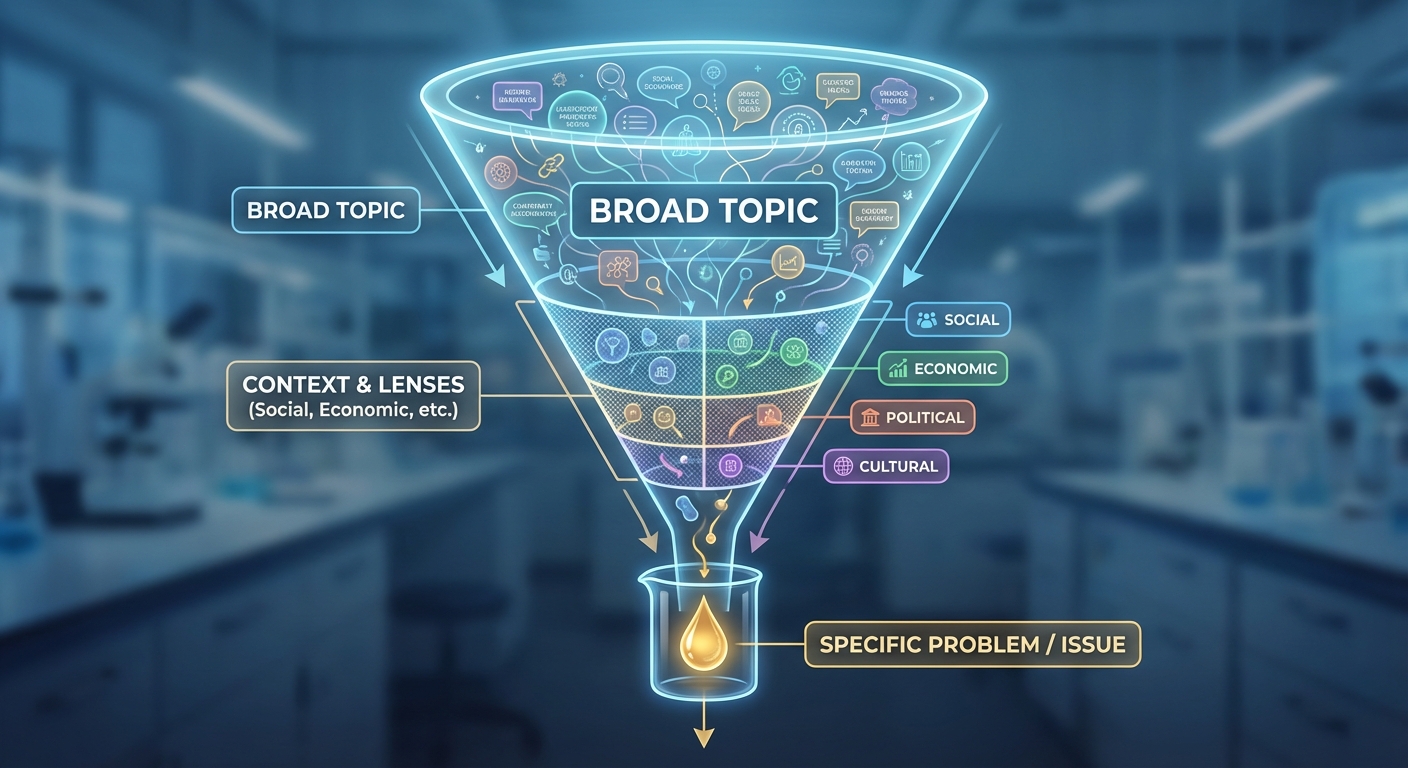
A Topic is a general subject area (e.g., "Climate Change"). A Problem or Issue is a specific contradiction, difficulty, or conflict within that topic that invites investigation (e.g., "The economic impact of rising sea levels on Miami's real estate market").
The Importance of Context
To understand an issue, you must situate it within its Context. This is the background information necessary to understand the scope and urgency of the problem.
When standardizing your context, look for the Scope (how broad is the impact?) and the Stakeholders (who is affected?). Use the reporter's questions to establish context:
- Time: When did this start? Is it historical or current?
- Place: Is this local, national, or global?
- Population: Who is directly involved vs. indirectly involved?
Using Lenses and Perspectives
AP Seminar requires you to view problems through specific filters called Lenses. These help you narrow a broad topic into a specific line of inquiry.
Common AP Seminar Lenses:
- Cultural / Social: How does this affect society, traditions, or interactions?
- Artistic / Philosophical: What are the moral or expressive implications?
- Ethical: What is right or wrong? usage of utilitarianism vs. deontology.
- Political / Historical: How does government policy or past events shape this?
- Futuristic: What are the long-term projections?
- Economic: What are the costs, jobs, or financial incentives involved?
- Scientific: What does the data or physical reality tell us?
- Environmental: How does this impact the natural world?
Distinction Alert:
- A Lens is a filter (e.g., Economic).
- A Perspective is a specific point of view or argument within that lens (e.g., "Keynesian economists believe…").
Developing Research Questions
The formulation of your Research Question (RQ) is arguably the most critical step in your performance task. A weak question leads to weak research.
Criteria for a Strong Research Question
To score well, your question must be researchable and complex. We often look for questions that are "focused but open-ended."
- Open-Ended: It cannot be answered with a simple "Yes" or "No," or a quick dictionary definition. It requires synthesis of multiple viewpoints.
- Complex: It must have multiple valid sides or perspectives. If everyone agrees on the answer, it is not a seminar-level question.
- Focused: It must be specific enough to be answered within the word count (1200 words for the IRR).
- Debatable: There must be room for argument.
The Goldilocks Principle of RQs
Your question needs to sit in the "just right" zone between too broad and too narrow.
| Type | Example | Why it fails/succeeds |
|---|---|---|
| Too Broad | "How does technology affect us?" | Too many variables; impossible to cover deeply. |
| Too Narrow | "What was the iPhone's sales revenue in 2018?" | This is a fact, not an argument. No research needed. |
| Just Right | "To what extent does the integration of smartphones in secondary classrooms impact student retention of complex math concepts?" | Specific population, specific variable, debatable outcome. |
Evolution of a Question
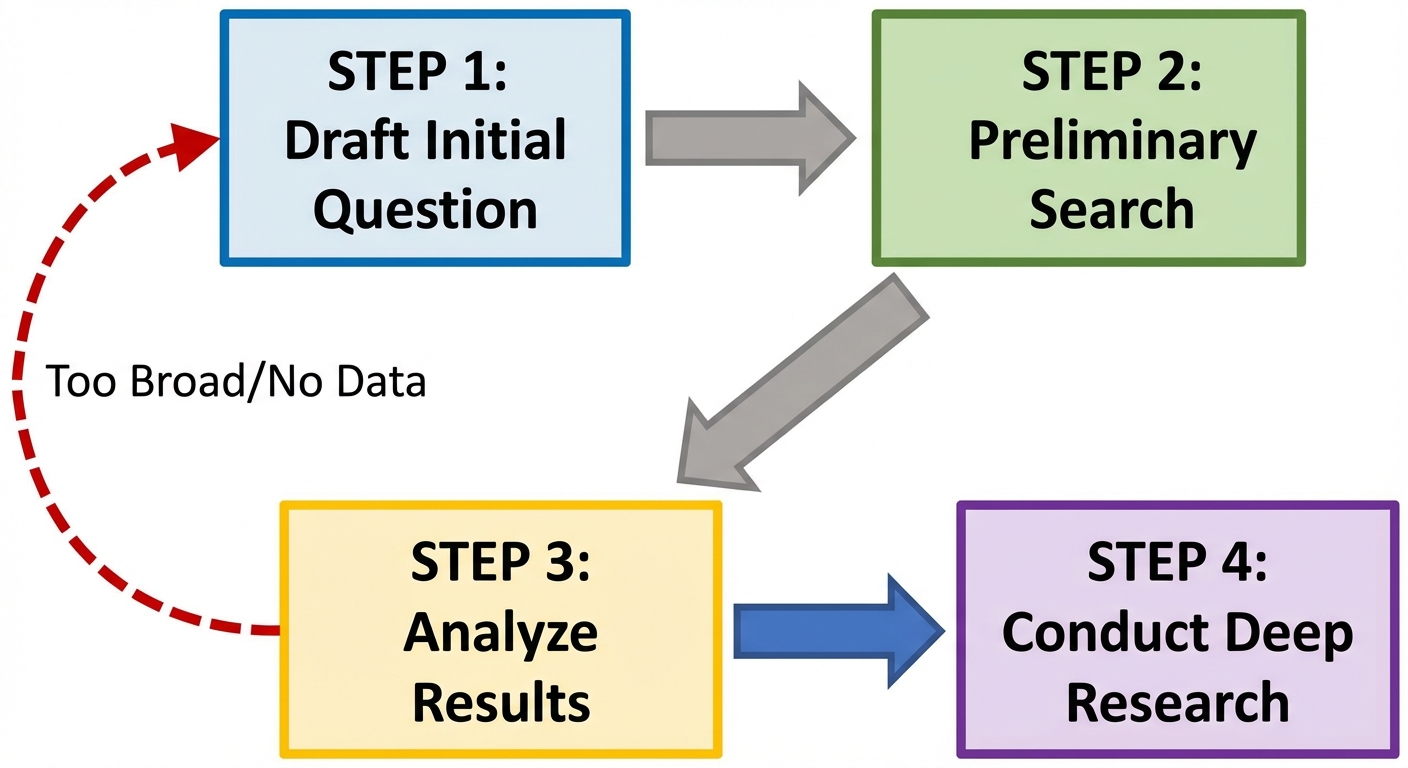
Research is iterative. You will likely change your question multiple times.
The Iterative Cycle:
- Draft Initial Question.
- Preliminary Research (Search).
- Refine Question based on available data.
- Deep Research.
- Finalize Question.
Searching for and Selecting Credible Sources
Once you have a question, you need evidence. AP Seminar places heavy emphasis on the credibility and relevance of sources.
Search Strategies
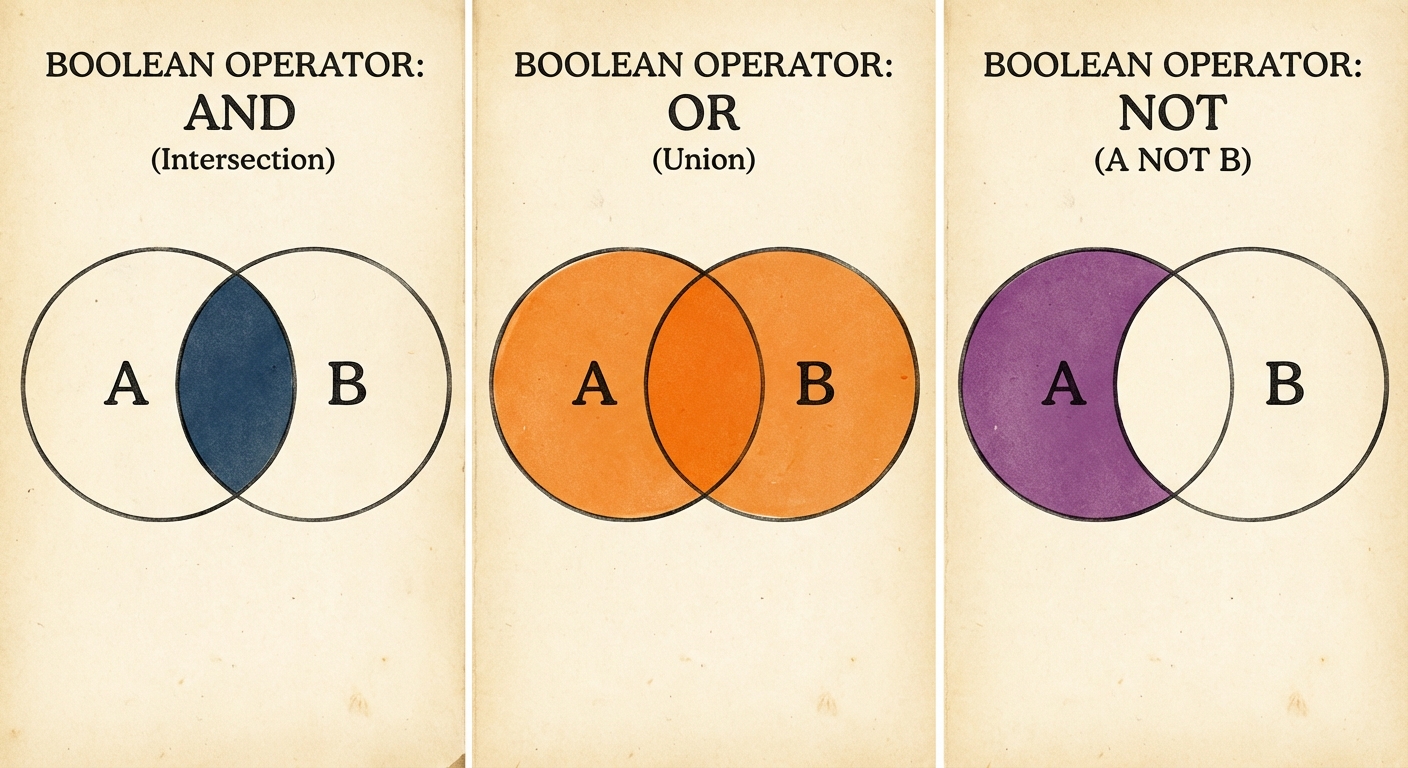
Do not rely solely on natural language searches (typing a full sentence into Google). Use Boolean Logic to filter results in academic databases (like EBSCO, JSTOR, or Google Scholar).
- AND: Narrows results.
"Climate Change" AND "Economy"$
ightarrow$ results must have BOTH terms.
- OR: Broadens results (good for synonyms).
"Teenagers" OR "Adolescents"$
ightarrow$ results can have EITHER term.
- NOT: Excludes results (removes clutter).
"Jaguar" NOT "Car"$
ightarrow$ gives you the animal, not the vehicle.
Evaluating Credibility: The RAVEN Mnemonic
When analyzing a source, you must determine why you should trust it. Use the RAVEN acronym to assess credibility and potential bias.
- R - Reputation: Is the source (author or publication) known for accuracy? Is it peer-reviewed?
- A - Ability to Observe: Was the author actually there? Do they have access to the primary data?
- V - Vested Interest: Does the author gain anything (money, status, political power) by convincing you?
- Note: Having a vested interest doesn’t automatically disqualify a source, but you must acknowledge the bias.
- E - Expertise: Does the author have relevant degrees, experience, or credentials in this specific field?
- N - Neutrality: Is the tone objective, or is it emotionally charged and inflammatory?
Differentiating Sources
- Scholarly/Academic: Peer-reviewed journals. Written by experts for experts. High credibility, density, and jargon.
- Journalistic: Newspapers/Magazines (New York Times, The Atlantic). Written for the general public. Good for current events and broad context.
- Primary Source: Original data, speeches, photographs, diaries, or legal documents from the time period.
- Secondary Source: Analysis or interpretation of primary sources.
Credibility vs. Relevance
A source can be credible (written by a Nobel prize winner) but irrelevant (about a totally different topic). You must evaluate both.
Common Mistakes & Pitfalls
The "Yes/No" Trap:
- Mistake: Asking "Is nuclear energy bad?"
- Correction: Change it to "To what extent…" or "What are the ethical implications of…"
Cherry-Picking (Confirmation Bias):
- Mistake: Only selecting sources that agree with your preconceptions.
- Correction: Specifically hunt for opposing viewpoints. In AP Seminar, ignoring the counter-argument will significantly lower your score.
Confusing Topics with Arguments:
- Mistake: Your research report just lists facts about a topic (e.g., "The History of Soccer").
- Correction: You must synthesize the information to make an argument or evaluate a debate.
Misidentifying Vested Interest:
- Mistake: Assuming that because a source is an advocacy group (e.g., Greenpeace), their data is "fake."
- Correction: Acknowledge the bias ("Greenpeace argues…") but evaluate the methodology of their data usage.