Unit 8: Age of Conflict and Global War (1914–1945)
8.1: Context of 20th-Century Global Conflicts
The Breakdown of the Balance of Power
At the turn of the 20th century, the long-standing "Concert of Europe" (established in 1815) was crumbling. The stability that had defined the 19th century was eroded by intensifying rivalries, shifting alliances, and the aggressive rise of a unified Germany.
Key Tensions
- Total War: The concept that war requires the mobilization of all a nation's resources (economic, industrial, social) and targets the entire enemy population, not just the military.
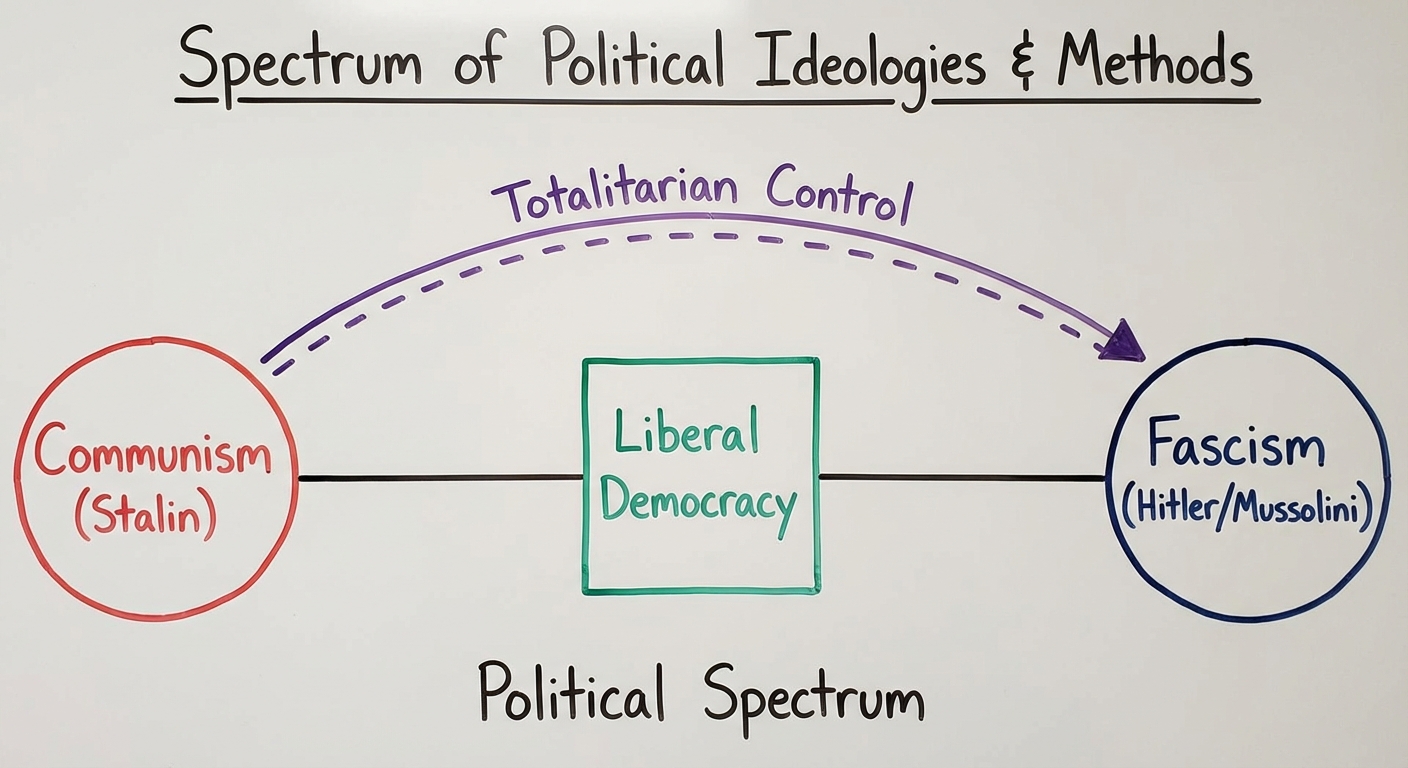
- Ideological Struggle: By the middle of the century, the world witnessed a clash between three distinct ideologies: Liberal Democracy, Communism, and Fascism.
- Technology: Rapid industrialization transformed warfare from cavalry charges to mechanized slaughter, creating a disconnect between 19th-century military tactics and 20th-century weaponry.
8.2: World War I (1914–1918)
Causes of the Great War (M.A.N.I.A.)
Historians generally categorize the causes of WWI using the acronym MANIA. While the assassination was the trigger, the other four factors created the powder keg.
- Militarism: The glorification of military power and the "Arms Race."
- Example: The Anglo-German Naval Race, where Germany tried to build a fleet to rival the British Royal Navy, creating panic in London.
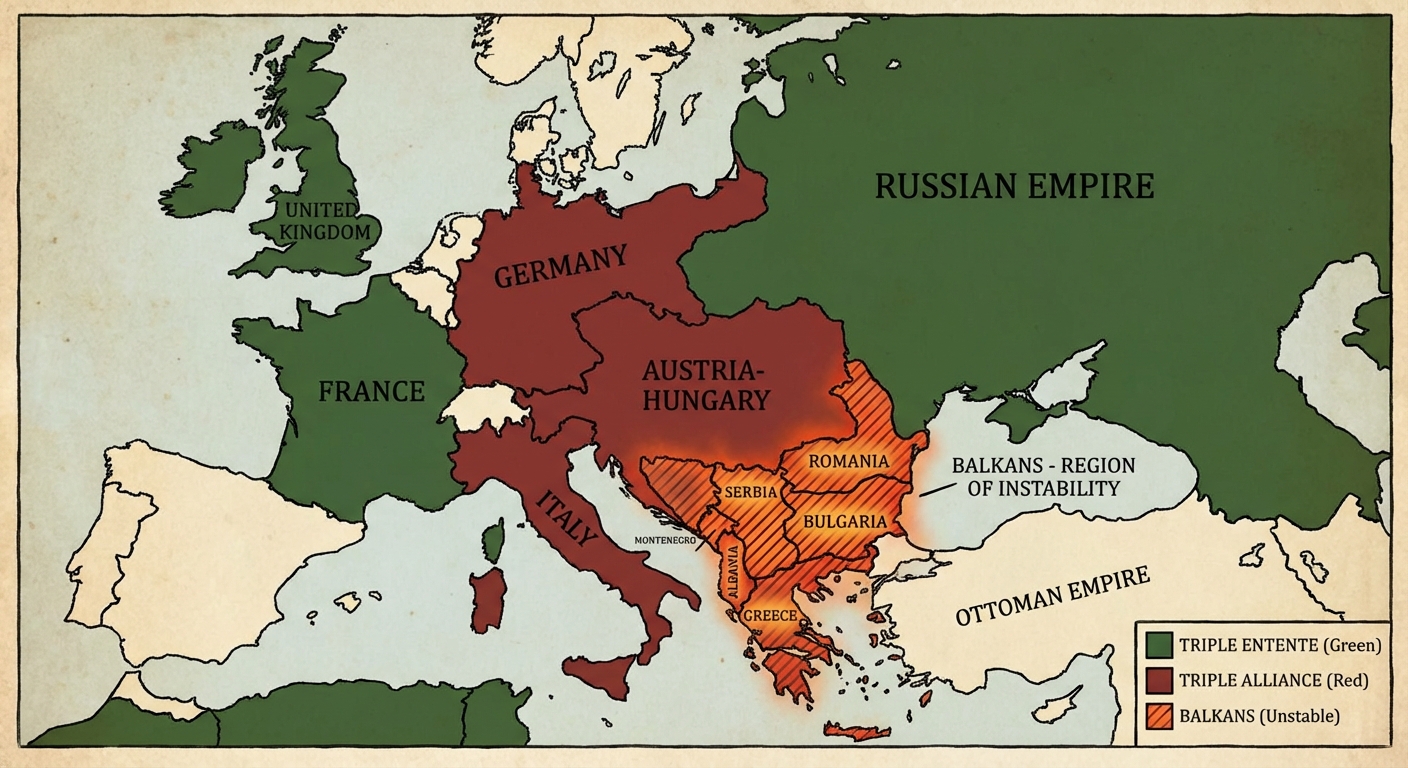
- Alliances: A tangled web of secret treaties meant that a local conflict would inevitably become continental.
- Triple Alliance (Central Powers): Germany, Austria-Hungary, Italy (switched sides in 1915).
- Triple Entente (Allies): Great Britain, France, Russia.
- Nationalism: Intense patriotism and the desire for self-determination.
- The Tinderbox: The Balkans were known as the "Powder Keg of Europe" due to Slavic nationalism and the declining Ottoman Empire.
- Imperialism: Competition for colonies in Africa and Asia heightened distrust between European powers.
- Assassination: On June 28, 1914, Archduke Franz Ferdinand, heir to the Austro-Hungarian throne, was killed by Gavrilo Princip, a member of the Serbian nationalist group the Black Hand.
The Nature of the War
The Western Front: Stalemate
Following the failure of the Schlieffen Plan (Germany's plan to quickly knock out France before Russia mobilized), the war settled into a stalemate.
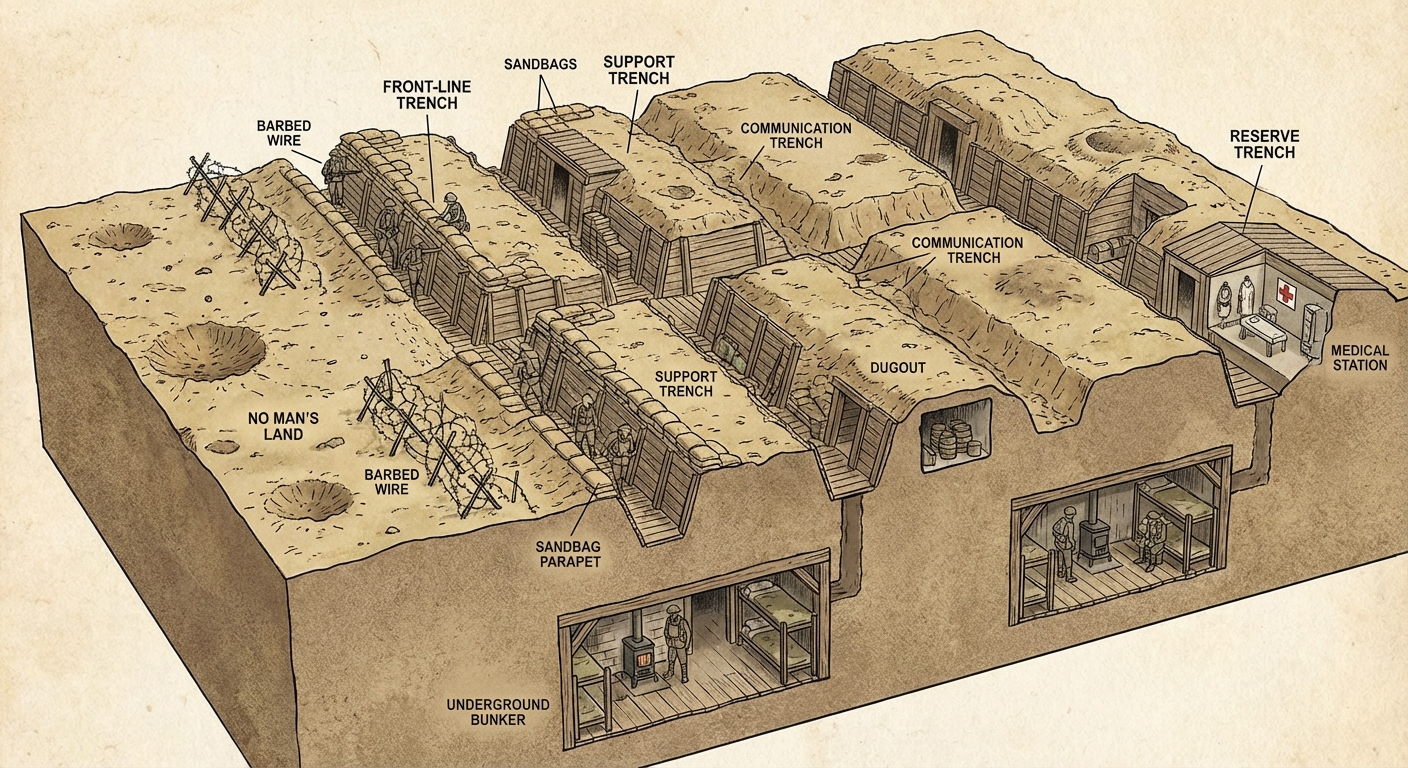
- Trench Warfare: A 400-mile line of fortifications from the Swiss border to the North Sea. Conditions were horrific (lice, rats, Trench Foot).
- War of Attrition: The strategy shifted from taking territory to simply killing enough enemy soldiers to force a surrender.
- Example: Battle of Verdun (1916) eventually resulted in 700,000 casualties for negligible land gain.
New Technologies
The industrialization of murder changed the face of combat forever:
- Machine Guns: Made cavalry obsolete and traditional charges suicidal.
- Poison Gas: Chlorine and Mustard gas introduced psychological terror (first used by Germany at Ypres).
- Tanks: Introduced by the British to break the trench deadlock (initially unreliable).
- Submarines (U-Boats): Germany employed Unrestricted Submarine Warfare to starve Britain, sinking merchant ships like the Lusitania, which helped draw the USA into the war.
The Home Front
- Total War: Governments took control of economies. production quotas were set, and rationing was introduced.
- Propaganda: Used to dehumanize the enemy, sell war bonds, and encourage enlistment.
- Women's Roles: With millions of men at the front, women entered the workforce in munitions factories. This contribution proved decisive in women gaining suffrage (the right to vote) in Britain (1918), Germany (1918), and the US (1920) shortly after the war.
The Peace Settlement
The war ended with the Armistice on November 11, 1918. The subsequent Paris Peace Conference (1919) was dominated by the "Big Four" (UK, France, USA, Italy).
The Treaty of Versailles
This treaty primarily dealt with Germany and is often cited as a cause of WWII due to its severity.
- War Guilt Clause (Article 231): Germany was forced to accept full responsibility for the war.
- Reparations: Germany was ordered to pay massive fines (approx. 132 billion gold marks), crippling their economy.
- Territorial Losses: Alsace-Lorraine returned to France; loss of all colonies; the Rhineland became a demilitarized zone.
- Mandate System: Middle Eastern territories of the Ottoman Empire were not given independence but transferred to British and French control (e.g., Palestine, Iraq, Syria) under the guise of League of Nations "mandates."
Wilson’s Fourteen Points vs. Reality
US President Woodrow Wilson proposed a plan for "Peace without Victory," centered on Self-Determination and the creation of a League of Nations. While the League was created, the European powers rejected Wilson’s idealism in favor of punishing Germany.
8.3: The Russian Revolution (1917)
Background to Revolution
Russia was the most backward major power: an autocracy under Tsar Nicholas II, with a small industrial working class and a massive, impoverished peasantry.
- 1905 Revolution: After a humiliating defeat to Japan, unrest forced the Tsar to create a parliament (Duma), but he retained real power.
- WWI trigger: Russia was ill-equipped for WWI. Food shortages and massive casualties (Battle of Tannenberg) destroyed the Tsar's legitimacy.
Two Revolutions of 1917
- February Revolution: Spontaneous riots over bread prices led to the army mutinying. The Tsar abdicated. A Provisional Government was established but made the fatal mistake of staying in WWI.
- October Revolution (Bolshevik): Vladimir Lenin and the Bolsheviks promised "Peace, Land, and Bread." They seized power in a coup, withdrew Russia from WWI (Treaty of Brest-Litovsk), and seized land for peasants.
Lenin to Stalin
- Civil War (1918-1921): The Reds (Communists/Bolsheviks) defeated the Whites (Monarchists/Liberals/Foreign troops) thanks to the organization of Leon Trotsky.
- New Economic Policy (NEP): Finding the economy ruined, Lenin temporarily introduced a mix of capitalism and socialism (small businesses allowed) to stabilize the economy.
Stalin’s Rise
After Lenin’s death (1924), Joseph Stalin outmaneuvered Trotsky. He implemented totalitarian control:
- Five-Year Plans: Rapid, state-forced industrialization (heavy industry over consumer goods).
- Collectivization: Forced consolidation of peasant farms into state-run collectives. The Kulaks (wealthier peasants) were liquidated as a class. This caused a man-made famine in Ukraine (Holodomor) killing millions.
- The Great Purge: Stalin executed perceived political enemies, military leaders, and intellectuals to secure absolute power.
8.4: The Interwar Period & The Great Depression
Economic Instability
The 1920s were volatile. The German Weimar Republic suffered hyperinflation in 1923 (people used money as wallpaper) due to printing money to pay reparations. The US Dawes Plan temporarily stabilized this with loans, creating a fragile cycle of debt.
The Great Depression (1929)
The US Stock Market crash triggered a global collapse due to the interconnected web of loans.
- Impact: Massive unemployment (30%+ in Germany), bank failures, and a collapse of global trade due to protectionist tariffs.
- Political Consequence: Liberal democracies appeared weak. Voters increasingly turned to radical solutions: Communism on the left, Fascism on the right.
Economic Theories
- Keynesian Economics (John Maynard Keynes): Argued that during depressions, governments must spend money (deficit spending) to stimulate demand, even if it causes debt. This challenged the traditional "austerity" view.
- Popular Fronts: In France and Spain, left-wing parties (Socialists, Communists, Liberals) formed alliances to block the rise of Fascism.
8.5: Rise of Fascism and Totalitarianism
Totalitarianism vs. Authoritarianism
- Authoritarianism: Traditional conservative dictatorships (like Horthy in Hungary or Pilsudski in Poland) sought to preserve the status quo and limit political freedom.
- Totalitarianism: A new 20th-century phenomenon attempting to control every aspect of life (social, intellectual, cultural) to transform human nature.
Italian Fascism
Benito Mussolini invented Fascism (from fasces, a Roman symbol of unity).
- Ideology: Extreme nationalism, militarism, anti-communist, state over individual.
- Rise: Using his paramilitary Blackshirts, he intimidated opponents. The "March on Rome" (1922) coerced the King into naming him Prime Minister.
German Nazism
Adolf Hitler and the NSDAP (Nazis) leveraged humiliation from Versailles and the Great Depression.
- Beer Hall Putsch (1923): Failed coup; Hitler wrote Mein Kampf in prison, outlining his ideology of Lebensraum (living space) and Aryan supremacy.
- Rise to Power: The Nazis became the largest party in the Reichstag by 1932. Hitler was legally appointed Chancellor in 1933.
- Consolidation: The Reichstag Fire was used to suspend civil liberties (Enabling Act). The Gestapo and SS enforced the police state.
Spanish Civil War (1936–1939)
Often called the "Dress Rehearsal for WWII."
- Francisco Franco (Fascist/Nationalist) rebelled against the democratically elected Republic.
- Intervention: Hitler and Mussolini sent troops and planes (bombing of Guernica) to aid Franco; the Soviet Union aided the Republicans. The Western democracies (UK, France) remained "neutral," dooming the Republic.
8.6: 20th-Century Cultural & Scientific Developments
Science and Uncertainty
The certainty of the Newtonian universe crumbled.
- Physics: Albert Einstein (Relativity) and Werner Heisenberg (Uncertainty Principle) showed that the universe was relative and unpredictable.
- Psychology: Sigmund Freud argued that human behavior is driven by irrational subconscious forces (Id, Ego, Superego), undermining the Enlightenment belief in human reason.
Modern Art
Art reflected the trauma and absurdity of WWI.
- Dadaism: Rejected logic and reason; celebrated nonsense (e.g., Marcel Duchamp).
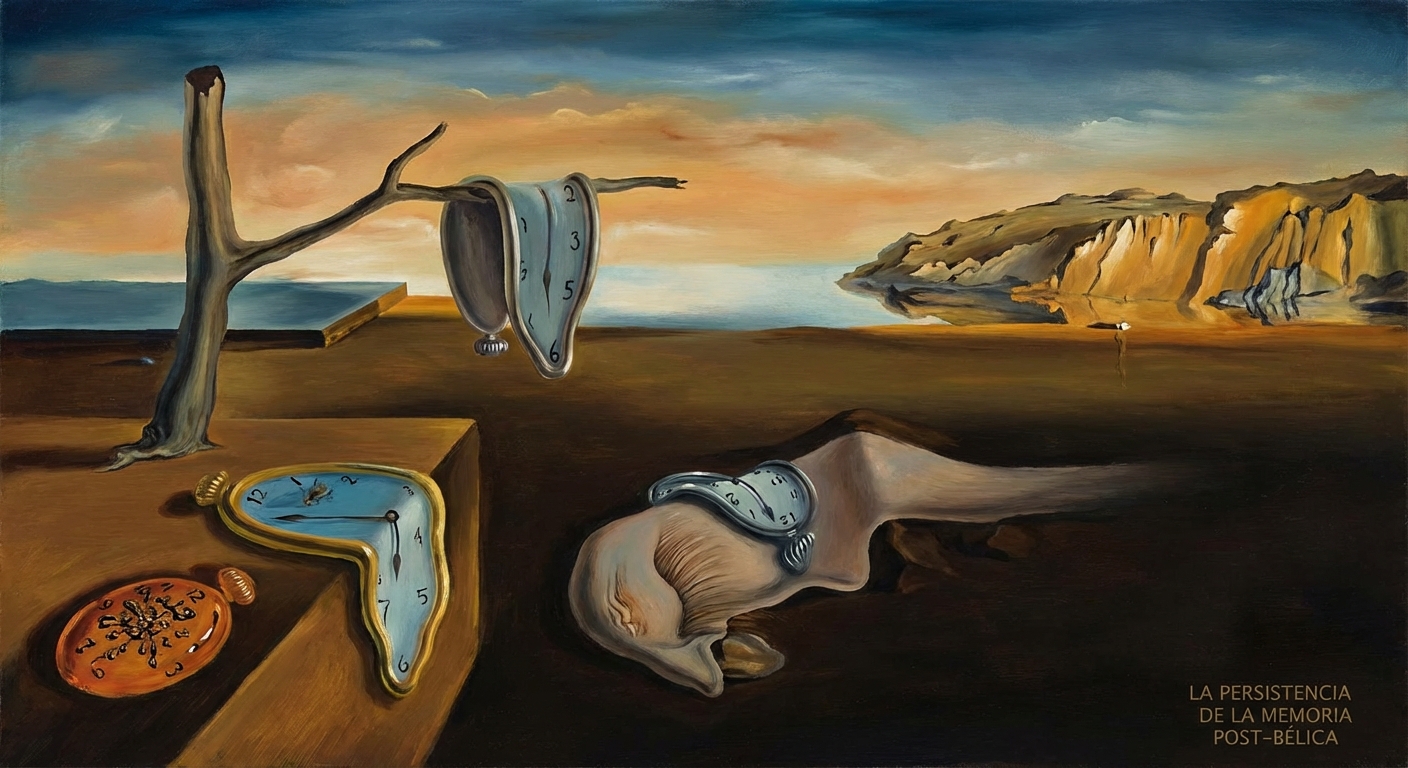
- Surrealism: Influenced by Freud, depicted the world of dreams and the unconscious (e.g., Salvador Dalí).
- Bauhaus Architecture: Emphasized functionalism, clean lines, and mass production in Germany.
8.7: World War II (1939–1945)
The Road to War: Appeasement
Western democracies wanted to avoid war at all costs.
- Appeasement: The policy of giving in to an aggressor's demands to maintain peace. Championed by British PM Neville Chamberlain.
- Hitler's Aggressions:
- Remilitarization of the Rhineland (1936).
- Anschluss: Annexation of Austria (1938).
- Sudetenland: At the Munich Conference (1938), Britain/France gave Hitler this Czech territory in exchange for a promise of peace.
- Poland: Hitler signed the Nazi-Soviet Non-Aggression Pact with Stalin to divide Poland. Germany invaded Poland on Sept 1, 1939, starting WWII.
conduct of the War
- Blitzkrieg: "Lightning War" using tanks and aircraft to overwhelm defenses. France fell in just 6 weeks (1940).
- Battle of Britain (1940): An air war. The RAF defeated the Luftwaffe, preventing a German invasion.
- Operation Barbarossa (1941): Hitler violated his pact and invaded the Soviet Union. The sheer size of the front and the Russian winter halted the Germans.
Turning Points
- Stalingrad (1942–43): The deadliest battle. Soviets destroyed the German 6th Army. The tide turned in the East.
- El Alamein (1942): British victory in North Africa secured the Suez Canal.
- D-Day (June 6, 1944): Massive Allied amphibious invasion of Normandy, opening a Western Front.
The Holocaust
The Nazi state implemented a systematic, state-sponsored genocide.
- Nuremberg Laws (1935): Dehumanized Jews, stripping citizenship.
- Kristallnacht (1938): State-organized pogrom destroying Jewish businesses/synagogues.
- The Final Solution: Decided at the Wannsee Conference (1942). Industrialized murder using gas chambers at camps like Auschwitz-Birkenau.
- Victims: 6 million Jews and 5-6 million others (Roma, LGBTQ+, disabled, political dissidents).
Outcomes
- Yalta & Potsdam Conferences: The Allies divided Germany into occupation zones. Tensions between the US and USSR hinted at the coming Cold War.
- United Nations: Established to replace the failed League of Nations, with enforcement power.
- Shift in Power: Europe was devastated. Global dominance shifted to the two new superpowers: the USA and the USSR.
8.8: Common Mistakes & Exam Tips for Unit 8
Mnemonic: MANIA (Causes of WWI)
- Militarism
- Alliances
- Nationalism
- Imperialism
- Assassination
Common Student Errors
- Confusing the Revolutions: Students often mix up the February Revolution (Liberal/Provisional Govt) with the October Revolution (Communist/Bolshevik). Remember: February failures lead to October oppression.
- Appeasement vs. Isolationism: Appealsment was European (Chamberlain giving Hitler land). Isolationism was American (staying out of the war entirely). Do not confuse them.
- Totalitarianism vs. Conservatism: Not all dictators are totalitarians. A traditional monarch wants you to obey; a totalitarian wants to brainwash you. Stalin and Hitler were totalitarian; Franco was largely authoritarian.
- The Chronology of Alliances: Italy was with Germany in WWI but switched sides. The USSR was allied with Germany (1939) then fought against them (1941). Keep the timeline straight.
AP Exam Focus
- Continuity and Change: Be able to trace anti-Semitism from medieval religious hatred to 19th-century racial theories to 20th-century industrial genocide.
- Comparison: Compare the economic policies of Lenin (NEP) vs. Stalin (Five Year Plans). Comparisons of Italian Fascism vs. German Nazism are also frequent.