Unit 8: Strategic Stylistic Choices in Rhetoric
Mastering Style and Tone in AP English Language
In Unit 8, the College Board moves beyond simply identifying what an author argues to analyzing how they argue it through the micro-level nuances of writing. This is the domain of Style—the cumulative effect of choices regarding words, sentence structures, and figurative language.
The Components of Style: Diction and Syntax
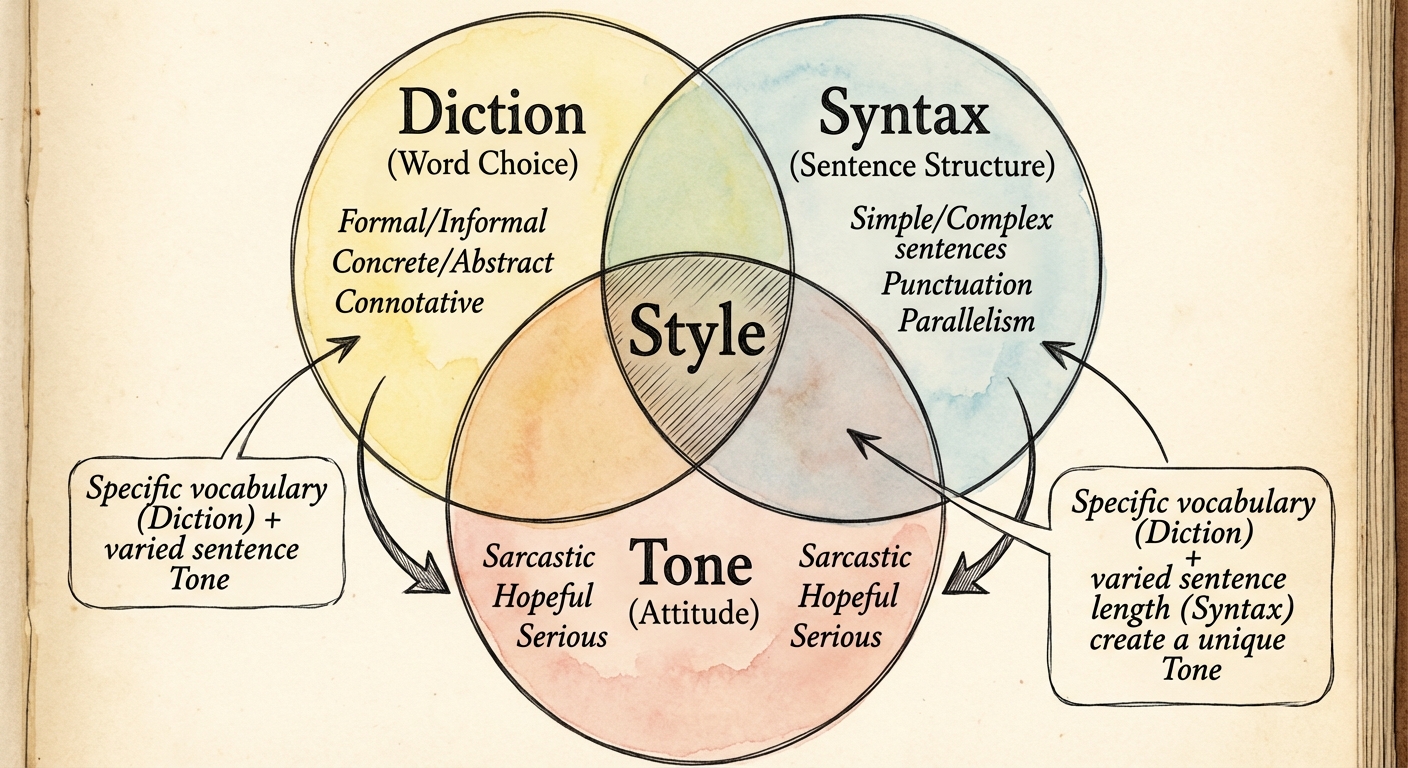
Style is not a decoration added to writing; it is the method by which meaning is shaped. We can conceptualize style using a simple relationship:
To analyze style effectively, you must dismantle the writing into two primary structural pillars: Diction (word choice) and Syntax (sentence structure).
Analyzing Diction
Diction refers to the specific word choices a writer makes. In AP English, saying "the author uses diction" is redundant (everyone uses words). You must describe the type of diction.
Denotation vs. Connotation:
- Denotation: The literal dictionary definition of a word.
- Connotation: The emotional or cultural associations carried by a word.
- Example: A person can be described as committed (positive), stubborn (negative), or tenacious (admiring). The fact remains the same, but the style guides the reader's judgment.
Levels of Diction:
- Formal/Elevated: Polysyllabic words, no contractions, professional tone (e.g., "The experiment yielded significant results").
- Colloquial/Informal: Conversational, slang, contractions (e.g., "The test results were pretty huge").
- Abstract vs. Concrete:
- Abstract: Ideas, qualities (truth, freedom, evil).
- Concrete: Tangible, sensory details (grit, chains, mud).
Analyzing Syntax
While diction focuses on what words are used, syntax focuses on how they are arranged. Syntax controls the pacing and emphasis of an argument.
- Sentence Length: Short, choppy sentences often create tension, speed, or emphasis. Long, flowing sentences can suggest contemplation, confusion, or overwhelm.
- Active vs. Passive Voice:
- Active: "The committee made a mistake." (Assigns responsibility).
- Passive: "Mistakes were made." (Defects responsibility/obscures the actor).
Tone: The Author's Attitude
Tone is the author's attitude toward the subject or the audience. It is the most common stylistic feature tested in AP Lang.
Crucial Distinction: Do not confuse Tone (author's attitude) with Mood (the atmosphere or emotion felt by the reader).
The DIDLS Strategy
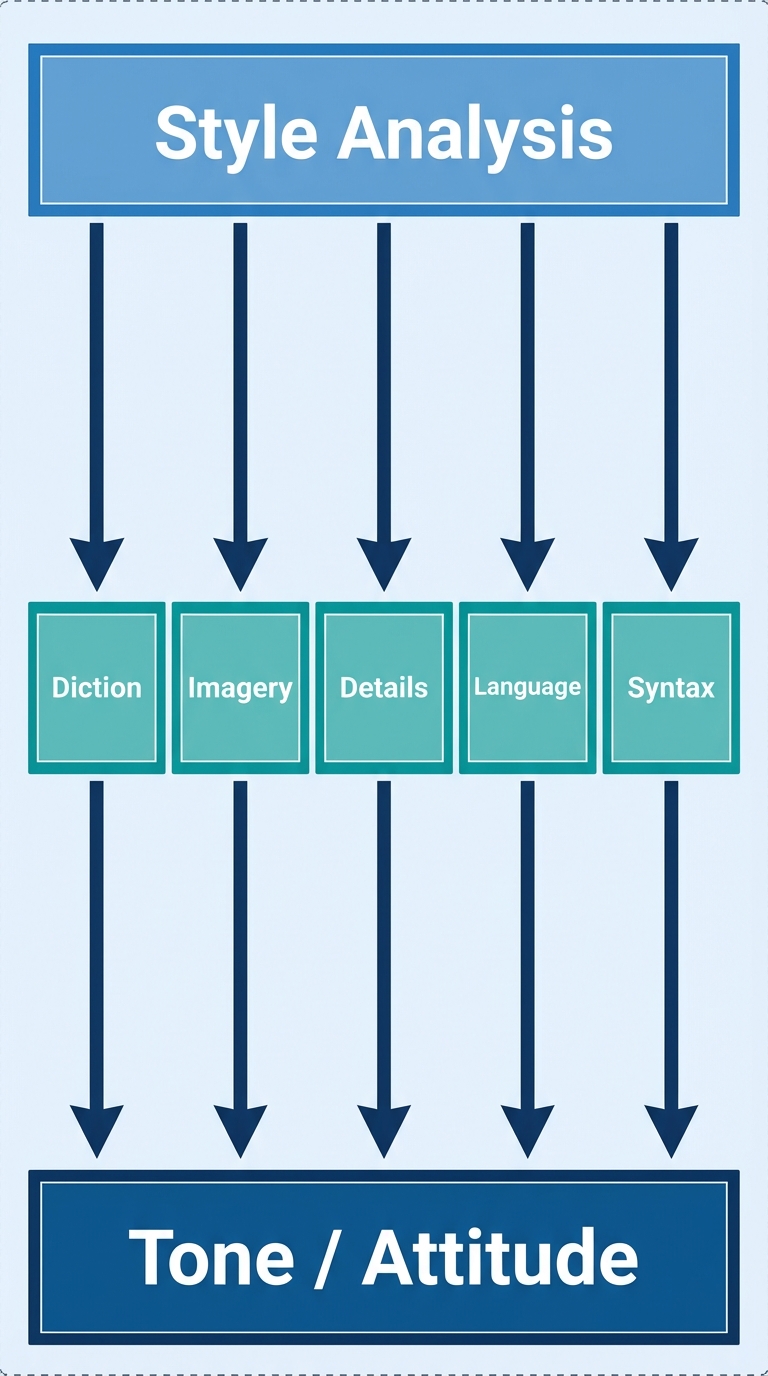
A reliable mnemonic for analyzing tone is DIDLS:
- Diction: What words carry strong negative/positive connotations?
- Imagery: What sensory details are used? (e.g., blood and decay vs. light and growth).
- Details: What facts are included? What facts are omitted?
- Language: Is the overall register formal, clinical, jargon-heavy, or emotional?
- Syntax: How does sentence structure affect the "voice"?
Complexity of Tone
Sophisticated writing rarely has a single, static tone. In Unit 8, look for shifts in tone.
- Example: An author might begin with a sympathetic tone to disarm the audience, then shift to a critical or urgent tone to deliver the call to action.
- AP Tip: When describing tone, use two adjectives to capture nuance (e.g., "cautiously optimistic" or "bitterly sarcastic" rather than just "happy" or "sad").
Figurative Language and Imagery
Figurative language transcends the literal meanings of words to achieve complex rhetorical effects. In Unit 8, you analyze these not as poetic devices, but as argumentative tools.
Imagery as Argument
Imagery uses sensory language (sight, sound, taste, touch, smell) to make abstract arguments concrete.
- Concept: Poverty is bad.
- Imagery: "The hollow eyes of the children stared past the empty grain sacks."
- Effect: The imagery evokes pathos (emotion), making the logical argument emotionally resonant.
Key Figures of Speech
- Metaphor & Simile: Comparing two unlike things to clarify an unfamiliar concept using a familiar one.
- Rhetorical Effect: framing the debate. If you call a policy a "cancer," you imply it must be cut out entirely. If you call it a "roadblock," it just needs to be moved.
- Irony (Verbal): Stating the opposite of what is meant.
- Rhetorical Effect: Highlights absurdity or hypocrisy effectively; creates a bond with the audience who "get" the joke.
- Hyperbole: Exaggeration for effect.
- Rhetorical Effect: Used to emphasize urgency or ridicule an opposing view.
Sentence Structure and Rhetorical Effect
Advanced syntax analysis involves looking at how the structure of a sentence mirrors its meaning.
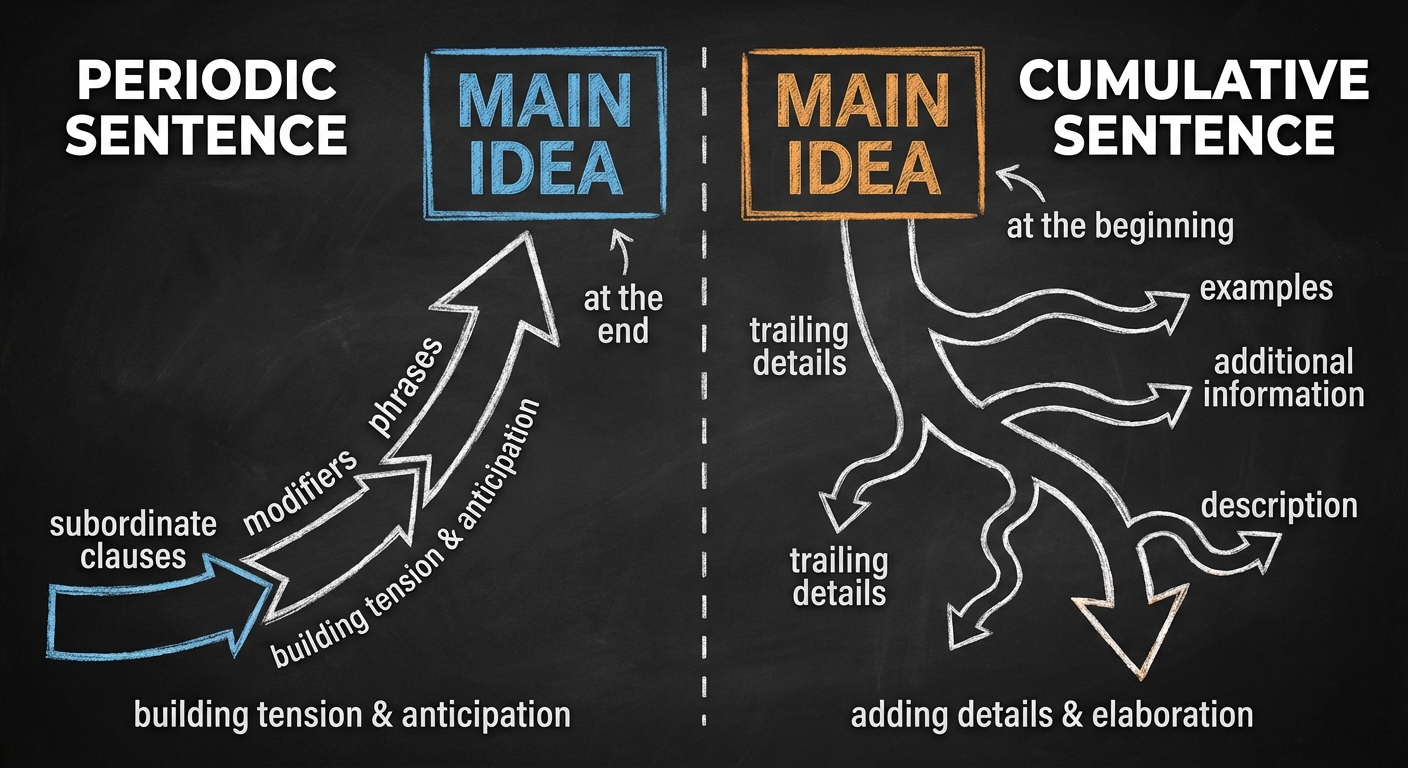
Periodic vs. Cumulative Sentences
| Sentence Type | Definition | Rhetorical Effect | Example |
|---|---|---|---|
| Periodic Sentence | The main clause (subject + verb) is withheld until the very end. | Creates suspense; emphasizes the final point; demonstrates control. | "After years of struggle, despite the doubts of peers and the lack of funding, we succeeded." |
| Cumulative (Loose) Sentence | The main clause comes first, followed by modifying phrases. | Conversational; descriptive; adds texture and detail. | "We succeeded, bringing an end to the struggle, silencing the doubters, and securing our future." |
Parallelism
Parallelism acts as the "rhythm" of persuasion. It involves using similar grammatical structures for related ideas.
- Function: It equates ideas. If three things are listed in parallel structure, the author implies they are of equal importance.
- Example: "We shall fight on the beaches, we shall fight on the landing grounds, we shall fight in the fields…" (Churchill).
- Antithesis: A form of parallelism that contrasts two opposing ideas (e.g., "It was the best of times, it was the worst of times"). This emphasizes conflict or disparity.
Common Mistakes & Pitfalls
- The "Easter Egg Hunt": Identifying a device (e.g., "The author uses a metaphor") without explaining its function.
- Correction: Always allow the "so what?" to drive your analysis. "The author uses a metaphor regarding machinery to characterize the educational system as rigid and unfeeling."
- Confusing Tone with Mood: Writing "The author uses a sad tone."
- Correction: The author's tone might be melancholic or somber, which makes the reader feel sad (mood).
- Simplistic Tone Vocabulary: Describing tone as "mad," "happy," or "bad."
- Correction: Build a precise vocabulary. Use words like indignant, jubilant, condescending, objective, or wistful.
- Ignoring Context: Analyzing style in a vacuum.
- Correction: Syntax choices in a eulogy (slow, reverent) will naturally differ from a political attack ad (sharp, aggressive). Always connect style back to the Rhetorical Situation.