Comprehensive Guide to Unit 1: Electric Fields and Gauss's Law
The Concept of the Electric Field
The electric field is a fundamental vector field that surrounds electric charges, exerting forces on other charges placed within it. Unlike Coulomb's Law, which describes a direct interaction between two charges, the field concept suggests that a charge modifies space, and a second charge interacts with that modified space.
Definition and Formula
The Electric Field ($\vec{E}$) at a specific point in space is defined as the electric force ($\vec{F}E$) experienced by a positive test charge ($q0$) divided by the magnitude of that test charge.
Based on Coulomb’s Law, the electric field generated by a single point charge $Q$ at a distance $r$ is:
Where:
- $k \approx 9.0 \times 10^9 \, \text{N}\cdot\text{m}^2/\text{C}^2$ (Coulomb's Constant)
- $\epsilon_0 \approx 8.85 \times 10^{-12} \, \text{C}^2/\text{N}\cdot\text{m}^2$ (Permittivity of free space)
- $\hat{r}$ is the unit vector pointing radially away from the source charge.
Field Lines and Superposition
Visualizing electric fields is crucial for AP Physics C. We use Electric Field Lines to represent the vector field:
- Lines originate on positive charges and terminate on negative charges (or infinity).
- The number of lines leaving/entering a charge is proportional to the magnitude of the charge.
- The density of lines (lines per unit area) represents the field strength.
- Field lines never cross.
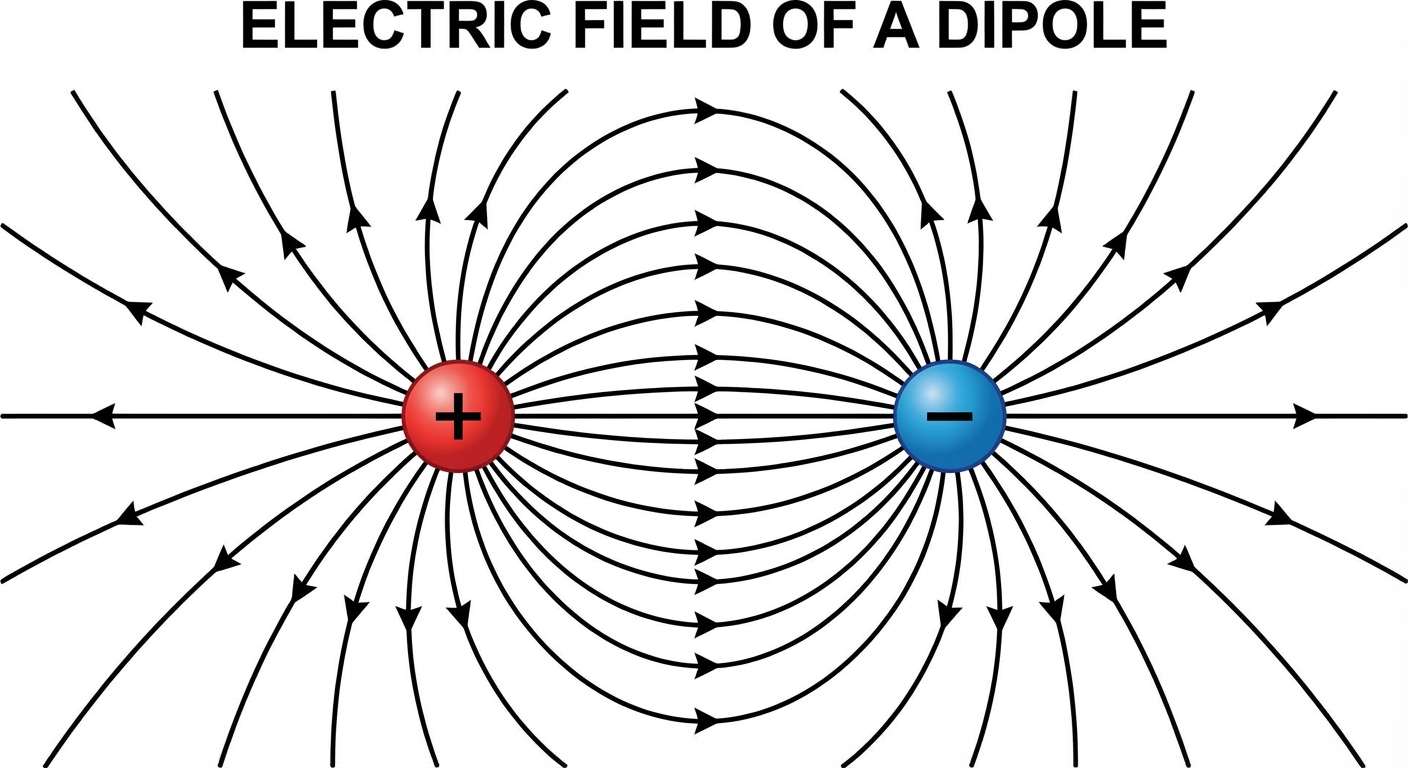
The Principle of Superposition:
If multiple point charges are present, the total electric field at a point $P$ is the vector sum of the individual fields produced by each charge.
Electric Field Due to Continuous Charge Distributions
In AP Physics C, you move beyond point charges to objects where charge is spread continuously (rods, rings, disks, spheres). To find the field, you must treat the object as a collection of infinitesimal point charges ($dq$) and integrate.
Charge Density Definitions
First, define how the charge is distributed using the appropriate density variable:
| Type | Symbol | Definition | Relationship |
|---|---|---|---|
| Linear | $\lambda$ | Charge per unit length | $dq = \lambda \, dl$ |
| Surface | $\sigma$ | Charge per unit area | $dq = \sigma \, dA$ |
| Volume | $\rho$ | Charge per unit volume | $dq = \rho \, dV$ |
General Integration Strategy
- Select a differential element $dq$ somewhere on the object.
- Draw the vector $d\vec{E}$ produced by $dq$ at the point of interest.
- Use Symmetry: If the object is symmetric, components of $\vec{E}$ perpendicular to the axis of symmetry often cancel out. Only integrate the surviving components.
- Write $r$ and $dq$ in terms of spatial variables ($x, y, \theta$, or $z$) and integrate.
Worked Example: Field on the Axis of a Uniformly Charged Ring
Scenario: A ring of radius $R$ has a total positive charge $Q$ distributed uniformly. Find the electric field at a point $P$ located a distance $z$ along the central axis perpendicular to the ring.
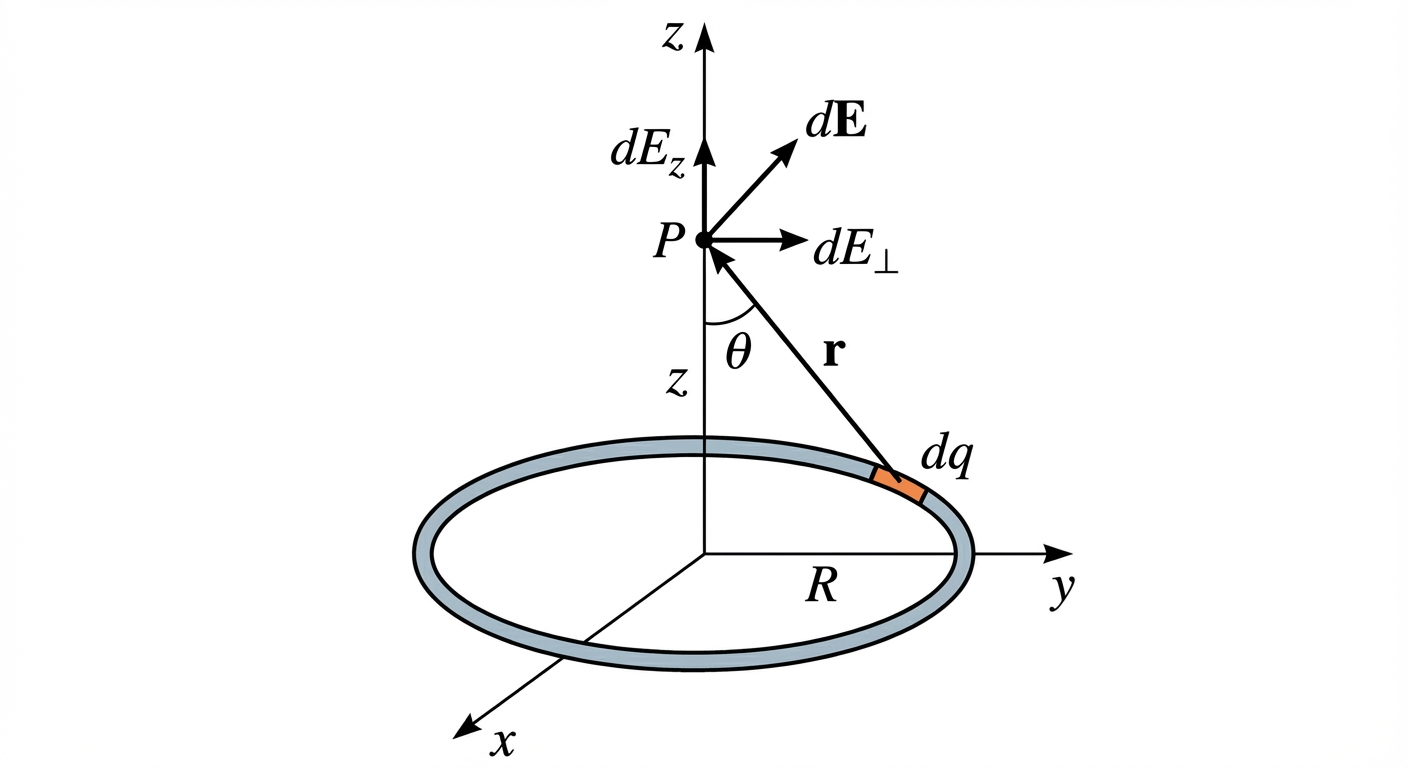
Solution Steps:
- Identify $dq$: Consider a small segment of charge $dq$ on the ring.
- Geometry: The distance from any $dq$ on the rim to point $P$ is $r = \sqrt{R^2 + z^2}$.
- Symmetry: For every $dq$, there is an identical $dq$ on the opposite side. The horizontal components ($dEy$) cancel. Only the vertical components ($dEz$) along the axis add up.
Where $\cos(\theta) = \frac{z}{r} = \frac{z}{\sqrt{R^2 + z^2}}$. - Integrate:
Since $z$ and $R$ are constants for the integral over the ring, $\int dq = Q$.
Gauss's Law
Gauss's Law relates the electric flux passing through a closed surface to the net charge enclosed within that surface. It is a powerful tool for calculating electric fields of highly symmetric charge distributions.
Electric Flux ($\Phi_E$)
Electric flux measures the "flow" of the electric field through an area. It corresponds to the number of field lines penetrating a surface.
- The dot product indicates that only the component of $\vec{E}$ parallel to the area vector (normal to the surface) contributes to flux.
- If $\vec{E}$ is uniform and the surface is flat: $\Phi_E = \vec{E} \cdot \vec{A} = EA \cos(\theta)$.
The Law
Gauss's Law states that the net electric flux through any hypothetical closed surface (called a Gaussian Surface) is equal to the enclosed charge ($Q_{enc}$) divided by the permittivity of free space.
Applying Gauss's Law
To use this effectively to find $E$, you must choose a Gaussian Surface that matches the symmetry of the charge distribution so that $E$ is constant over the integrate surface or the dot product is zero.
- Spherical Symmetry (Point charges, spheres): Use a Concentric Sphere.
- Surface Area: $4\pi r^2$
- Cylindrical Symmetry (Infinite lines, long cylinders): Use a Coaxial Cylinder.
- Curved Surface Area: $2\pi rl$ (Flux through flat caps is usually zero).
- Planar Symmetry (Infinite sheets): Use a "Gaussian Pillbox" (cylinder crossing the sheet).
- Area: $2A$ (Top and bottom caps).
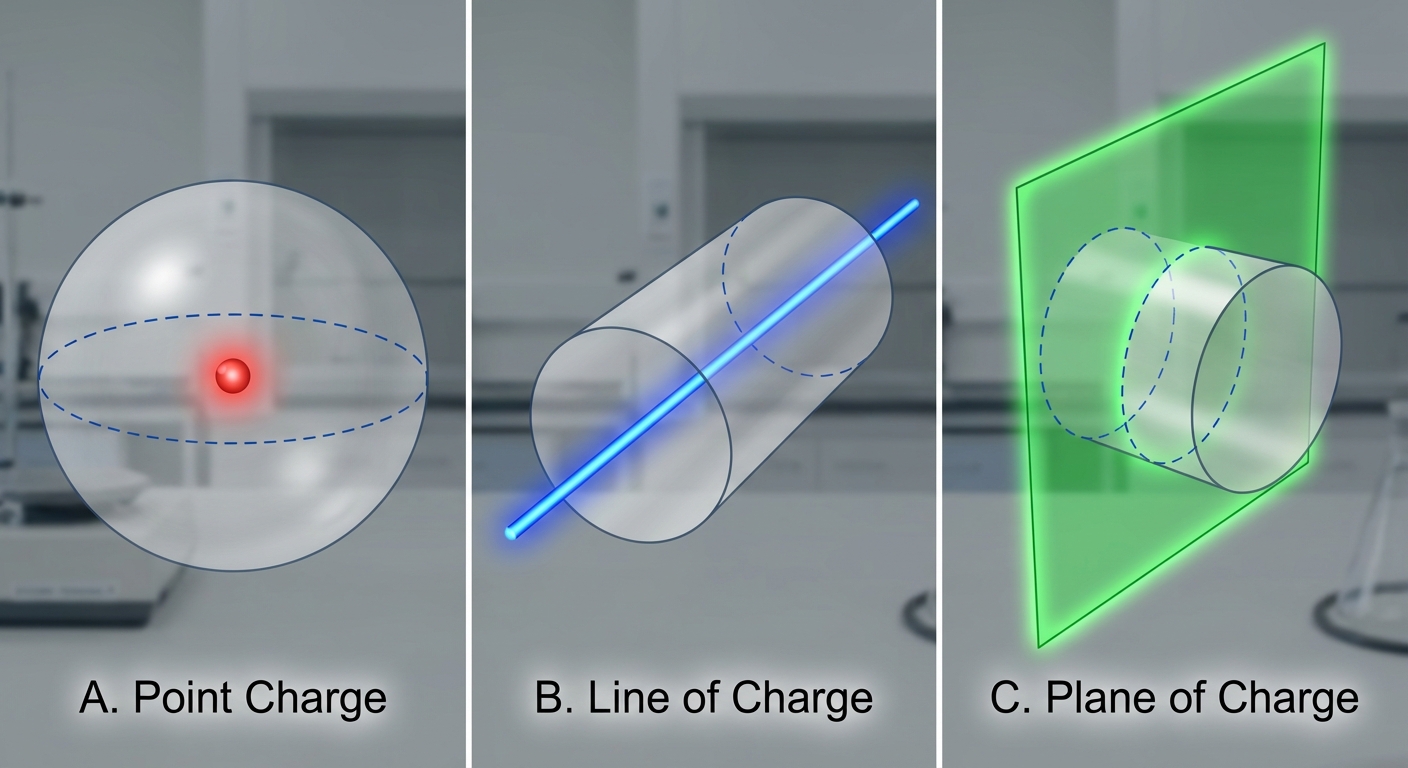
Example: Insulating Solid Sphere
Consider a solid insulating sphere of radius $R$ with uniform volume charge density $\rho$.
Case 1: Outside the sphere ($r > R$)
Construct a spherical Gaussian surface with radius $r$. The enclosed charge is the total charge $Q$.
(Acts exactly like a point charge!).
Case 2: Inside the sphere ($r < R$)
Construct a spherical Gaussian surface with radius $r < R$. The enclosed charge is only a fraction of the total.
Using Gauss's Law:
Inside the sphere, the field increases linearly with distance from the center.
Fields and Potential of Conductors
Conductors contain free charge carriers (electrons) that are free to move. This mobility leads to specific electrostatic properties when the conductor is in electrostatic equilibrium (net charges have stopped moving).
Key Properties of Conductors in Equilibrium
Field Inside is Zero:
Inside the material of a conductor, $\vec{E} = 0$. If there were a non-zero field, the free electrons would experience a force ($F=qE$) and accelerate. They move until they cancel out any external field, resulting in zero net field inside.Excess Charge on Surface:
Any net charge placed on a conductor resides entirely on its outer surface. Since like charges repel, they move as far apart as possible.Field Perpendicular to Surface:
Just outside the conductor, the electric field is perpendicular to the surface. If there were a parallel component, charges on the surface would flow along the surface, violating equilibrium.Field Strength at Surface:
The magnitude of the field just outside a conductor is proportional to the local surface charge density:Shielding:
A cavity inside a conductor has $\vec{E}=0$, essentially shielding the interior from external static fields. This is the principle behind the Faraday Cage.
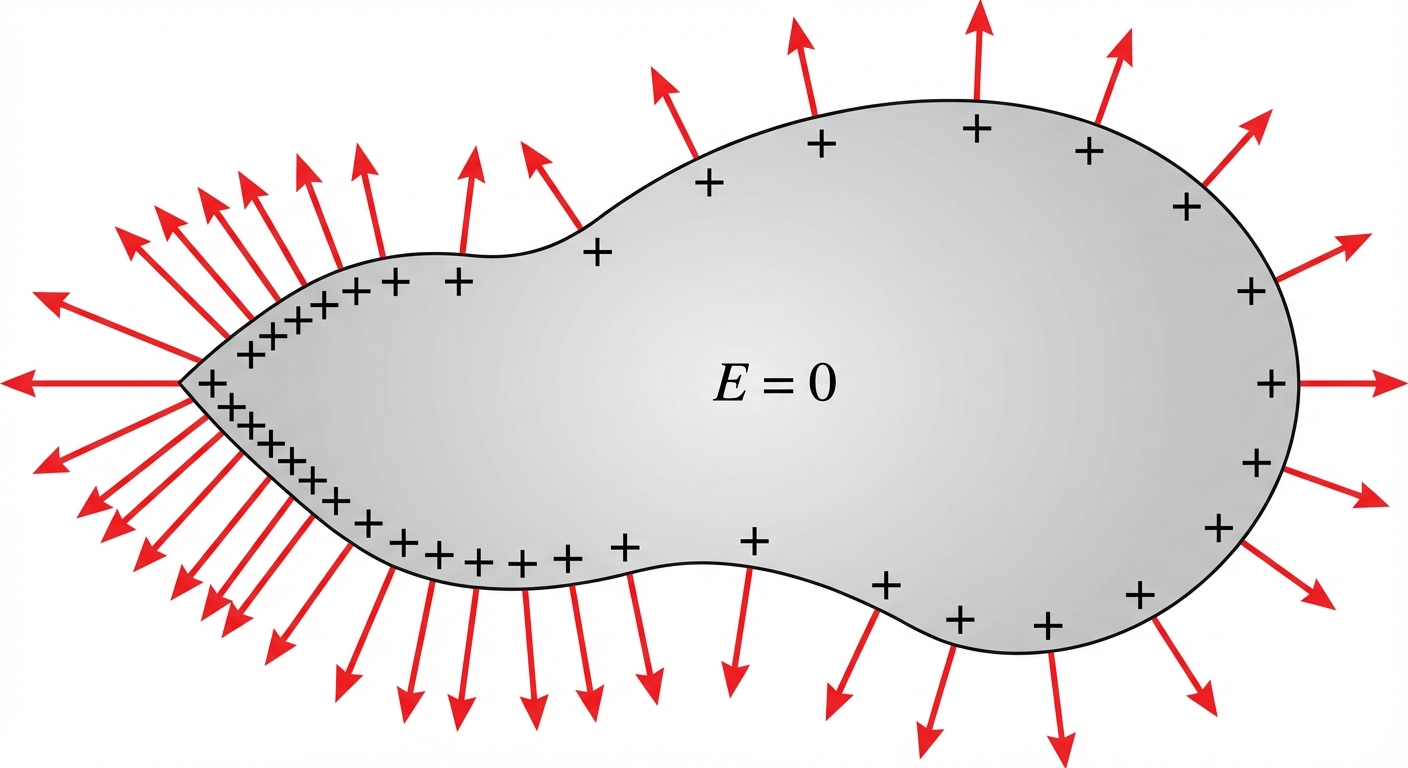
Example Scenarios
- Irregular Shapes: Charge accumulates more densely at sharp points (areas of small radius of curvature). Consequently, the electric field is strongest at sharp tips (this is how lightning rods work).
- Concentric Shells: If you have a point charge $+Q$ inside a neutral hollow conducting shell:
- Inner surface develops $-Q$ (induced charge to make net field in conductor zero).
- Outer surface develops $+Q$ (conservation of charge).
Common Mistakes & Pitfalls
Confusing Flux with Field: Remember, $\Phi_E$ is a scalar quantity representing total "flow," while $\vec{E}$ is a vector representing intensity at a point. You can have zero net flux but non-zero field (e.g., a dipole inside a box has zero net flux, but the field is definitely not zero).
Ignoring Symmetry in Integration: When calculating fields for charged rings or disks, students often integrate the entire vector. Always check for symmetry components (like $dE_y$) that sum to zero before you integrate math.
Gaussian Surface vs. Object Surface: Do not confuse the radius of the charged object ($R$) with the radius of your Gaussian surface ($r$). In the formula, the area is always the surface area of your imaginary Gaussian shape ($4\pi r^2$), not the physical sphere ($4\pi R^2$), unless you are specifically on the surface.
Conductors vs. Insulators: Always identify the material first. If a problem says "uniform volume charge density," it is an insulator. A conductor cannot have volume charge density (all charge is on the surface).