Unit 4: Systems of Particles and Linear Momentum
Dynamic Foundations: Understanding Linear Momentum
Defining Linear Momentum
In classical mechanics, linear momentum (often just called momentum) is a vector quantity that describes the "quantity of motion" an object possesses. It depends on both the object's mass and its velocity. For a single particle or a non-rotating rigid body, linear momentum is defined as:
Where:
- $\vec{p}$ is the linear momentum vector ($kg \cdot m/s$)
- $m$ is the mass ($kg$)
- $\vec{v}$ is the velocity vector ($m/s$)
Because momentum is a vector, it has both magnitude and direction. The direction of the momentum vector is always the same as the direction of the velocity vector. This vector nature is crucial when analyzing motion in two or three dimensions.
Newton's Second Law Revisited
While most introductory physics students learn Newton's Second Law as $\vec{F}_{net} = m\vec{a}$, Isaac Newton actually originally formulated it in terms of momentum. This form is more general and applies even when mass changes (like a rocket burning fuel).
The net external force acting on a system is equal to the time rate of change of its linear momentum:
If mass $m$ is constant, this simplifies to the familiar form:
Impulse and Momentum Change
The Concept of Impulse
When a force acts on an object over a specific time interval, it transfers momentum to or from the object. This transfer is quantified as Impulse ($\vec{J}$). Like momentum, impulse is a vector quantity.
For a constant force, the impulse is simply the product of the force and the time interval:
However, in AP Physics C, forces are often variable (functions of time). For a time-dependent force $\vec{F}(t)$, impulse is defined as the definite integral of force with respect to time:
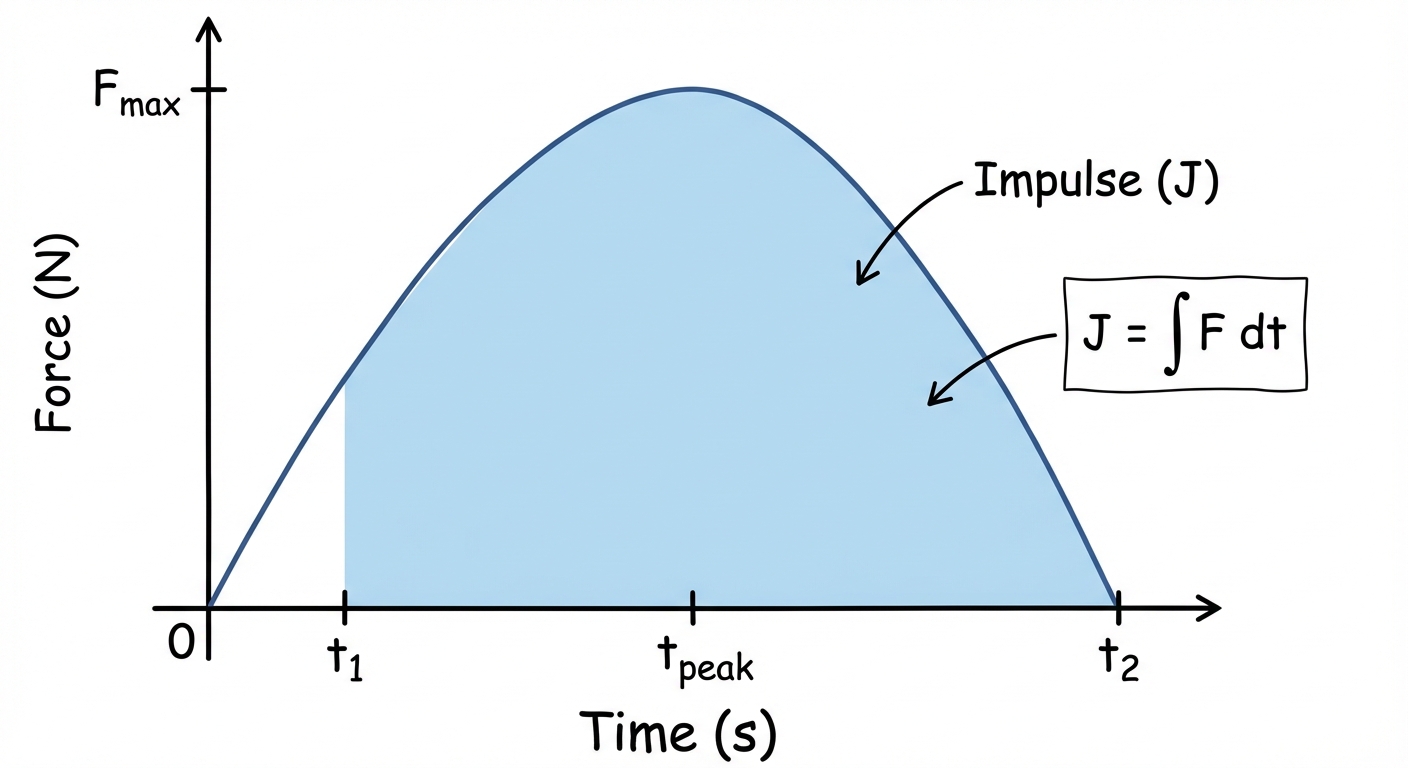
The Impulse-Momentum Theorem
The Impulse-Momentum Theorem connects forces directly to motion. It states that the impulse exerted on an object is equal to the change in that object's momentum:
Substituting kinematic definitions:
This theorem is incredibly useful for solving collision problems where ensuring the exact details of the forces during impact is difficult, but the duration and net effect are measurable.
Real-World Application: Safety Engineering
This theorem explains why airbags are vital in cars. In a crash, the change in momentum ($\Delta \vec{p}$) required to stop a passenger is fixed by their mass and initial speed.
Since $\Delta \vec{p} = \vec{F}{avg} \Delta t$, increasing the time of contact ($\Delta t$) using an airbag must decrease the average force ($\vec{F}{avg}$) exerted on the passenger, thereby reducing injury.
Worked Example: Bouncing Ball
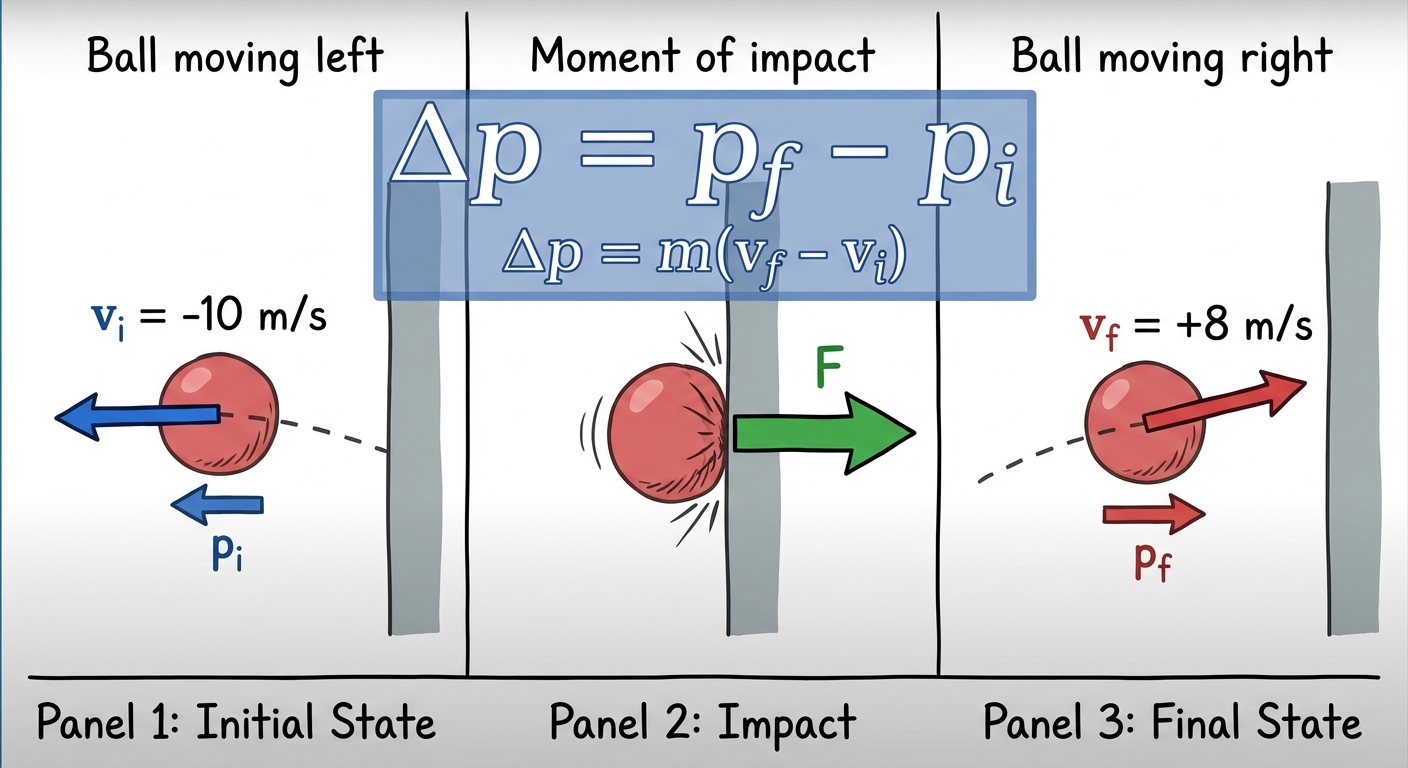
Problem: A $0.5 \, kg$ tennis ball strikes a wall horizontally at $10 \, m/s$ to the left and bounces back at $8 \, m/s$ to the right. If the contact lasts $0.05 \, s$, what is the average force exerted by the wall on the ball?
Solution:
Define a coordinate system: Let Right be positive ($+$) and Left be negative ($-$).
- $v_i = -10 \, m/s$
- $v_f = +8 \, m/s$
Calculate Change in Momentum:
Apply Impulse-Momentum Theorem:
Answer: The average force is $180 \, N$ directed to the right (away from the wall).
Conservation of Linear Momentum
Determining the System
Before applying conservation laws, you must define your system.
- Closed System: No mass enters or leaves the system.
- Isolated System: No net external forces act on the system ($\vec{F}_{net, ext} = 0$).
The Law of Conservation
If a system is isolated, the total linear momentum of that system remains constant in time, regardless of internal interactions (like collisions or explosions).
Or explicitly for two objects, $A$ and $B$:
This law is derived from Newton's Third Law. The forces two particles exert on each other are equal and opposite ($\vec{F}{AB} = -\vec{F}{BA}$). Over the same time interval $\Delta t$, the impulses are equal and opposite ($\vec{J}{AB} = -\vec{J}{BA}$), meaning the momentum gained by one particle is exactly lost by the other.
Types of Interactions
While momentum is conserved in all isolated collisions, Mechanical Energy is not always conserved.
| Interaction Type | Linear Momentum | Mechanical Energy (Kinetic) | Description |
|---|---|---|---|
| Elastic Collision | Conserved | Conserved | Objects bounce perfectly; no energy lost to heat/sound. |
| Inelastic Collision | Conserved | Not Conserved | Objects bounce but lose kinetic energy. |
| Perfectly Inelastic | Conserved | Not Conserved (Max Loss) | Objects stick together and move with a common final velocity. |
| Explosion/Separation | Conserved | Increases | Stored potential energy is converted into kinetic energy. |
Worked Example: 1D Inelastic Collision
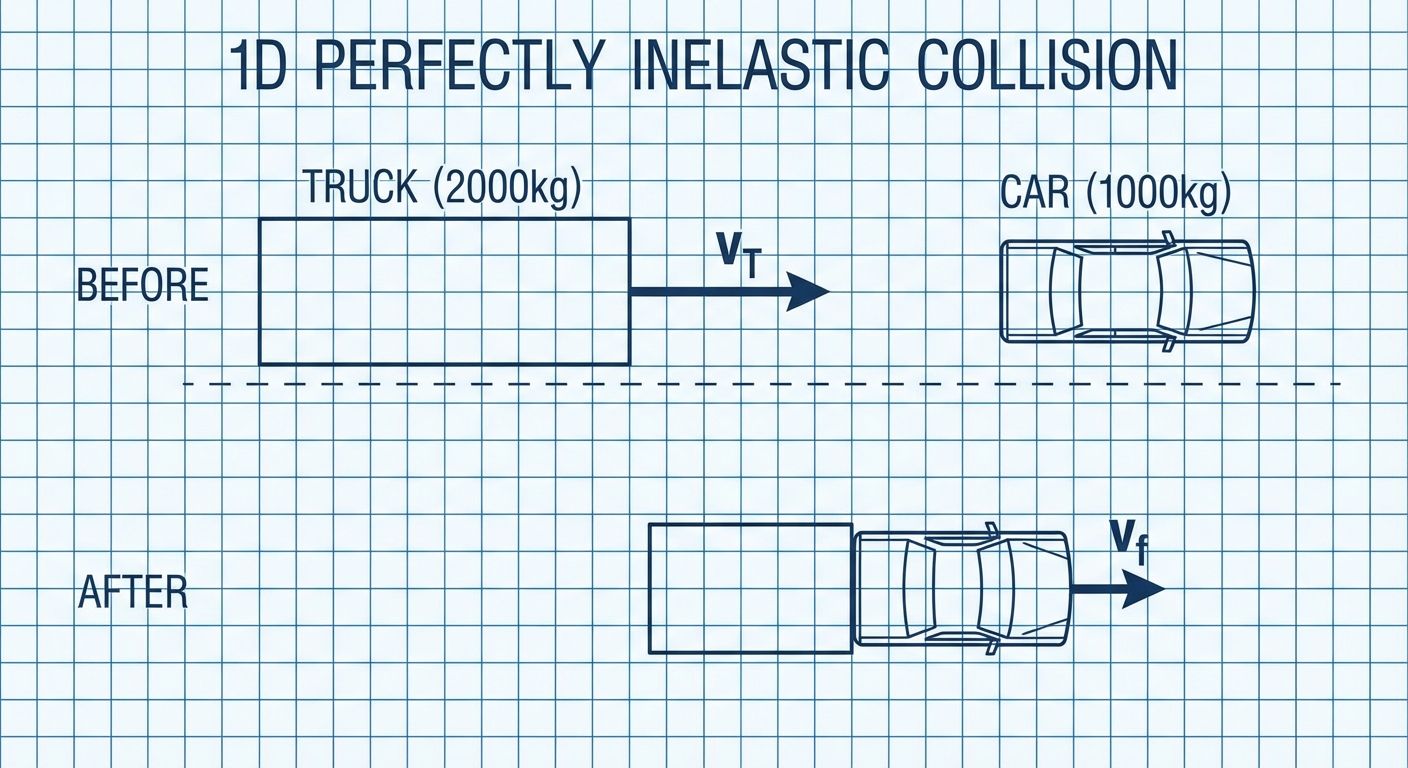
Problem: A $2000 \, kg$ truck moving east at $10 \, m/s$ collides with a $1000 \, kg$ car stationary at a red light. If they lock bumpers and move together, what is their final velocity?
Solution:
- Identify System: The truck and car form an isolated system (ignoring friction for the brief collision impact).
- Equation: Perfectly Inelastic Collision (objects stick).
- Substitute Values:
Answer: They move together at $6.67 \, m/s$ to the east.
Common Mistakes & Pitfalls
1. The Vector Trap
Mistake: Treating momentum as a scalar and simply adding magnitudes.
Correction: Momentum is a vector! Use signs ($+/-$) for 1D motion and breakdown components ($x$ and $y$) for 2D motion.
- Example: If two cars hit at a 90-degree angle, you cannot add their speeds linearly. You must use Pythagorean algebraic addition on the momentum vectors $\sqrt{px^2 + py^2}$.
2. Confusing Impulse with Force
Mistake: Thinking a large force always means a large impulse.
Correction: Impulse depends on time ($\vec{J} = \int \vec{F}dt$). A huge force acting for a nanosecond might deliver less impulse than a small push lasting a minute.
3. The "Bouncing" Error
Mistake: Thinking an object coming to a stop undergoes a larger momentum change than one that bounces back.
Correction: Bouncing requires a greater change in momentum. To stop, you go from $v$ to $0$ ($\Delta v = v$). To bounce, you go from $v$ to $-v$ ($\Delta v = 2v$). Therefore, bouncing exerts a greater impulse (and force) on the object.
4. Ignoring External Forces
Mistake: Applying Conservation of Momentum when external forces (like friction or gravity) are significant over the time interval.
Correction: Conservation only strictly applies if $\vec{F}_{net, ext} = 0$. However, closely approximate conservation applies during collisions (the "Impulse Approximation") because internal collision forces are usually much, much larger than external forces like gravity during the brief impact time.