Exploration of Cognitive Processes: From Concepts to Communication
Thinking, Concepts, and Creativity
Cognition refers to all the mental activities associated with thinking, knowing, remembering, and communicating. To process the vast amount of information we encounter daily, our brains rely on mental shortcuts and structures.
Concepts and Prototypes
Without concepts, every time you saw a chair, you would have to figure out what it was from scratch.
- Concept: A mental grouping of similar objects, events, ideas, or people. This is the brain’s way of filing information for quick retrieval.
- Prototype: A mental image or best example of a category. Matching new items to a prototype provides a quick and easy method for sorting items into categories.
- Example: When asked to imagine a "bird," you likely picture a robin (which fits the prototype well) rather than a penguin or an ostrich (which are outliers).
Creativity
Creativity is the ability to produce ideas that are both novel and valuable. High IQ does not automatically guarantee creativity; they involve different mental processes.
- Convergent Thinking: Narrowing the available problem solutions to determine the single best solution. This is tested by standard intelligence tests.
- Example: Solving a math equation ().
- Divergent Thinking: Expanding the number of possible problem solutions (creative thinking that diverges in different directions).
- Example: Listing all the possible uses for a brick.
Robert Sternberg’s 5 Components of Creativity:
- Expertise: A well-developed base of knowledge.
- Imaginative Thinking Skills: The ability to see things in novel ways.
- A Venturesome Personality: Seeking new experiences and tolerating risk.
- Intrinsic Motivation: Being driven more by interest and satisfaction than external pressure.
- A Creative Environment: Sparks, supports, and refines creative ideas.
Problem Solving and Decision Making
When we face a challenge where the solution isn't immediately obvious, we engage in problem-solving. However, our brains often make mistakes when calculating risks or making choices.
Strategies for Problem Solving
| Strategy | Definition | Pros | Cons |
|---|---|---|---|
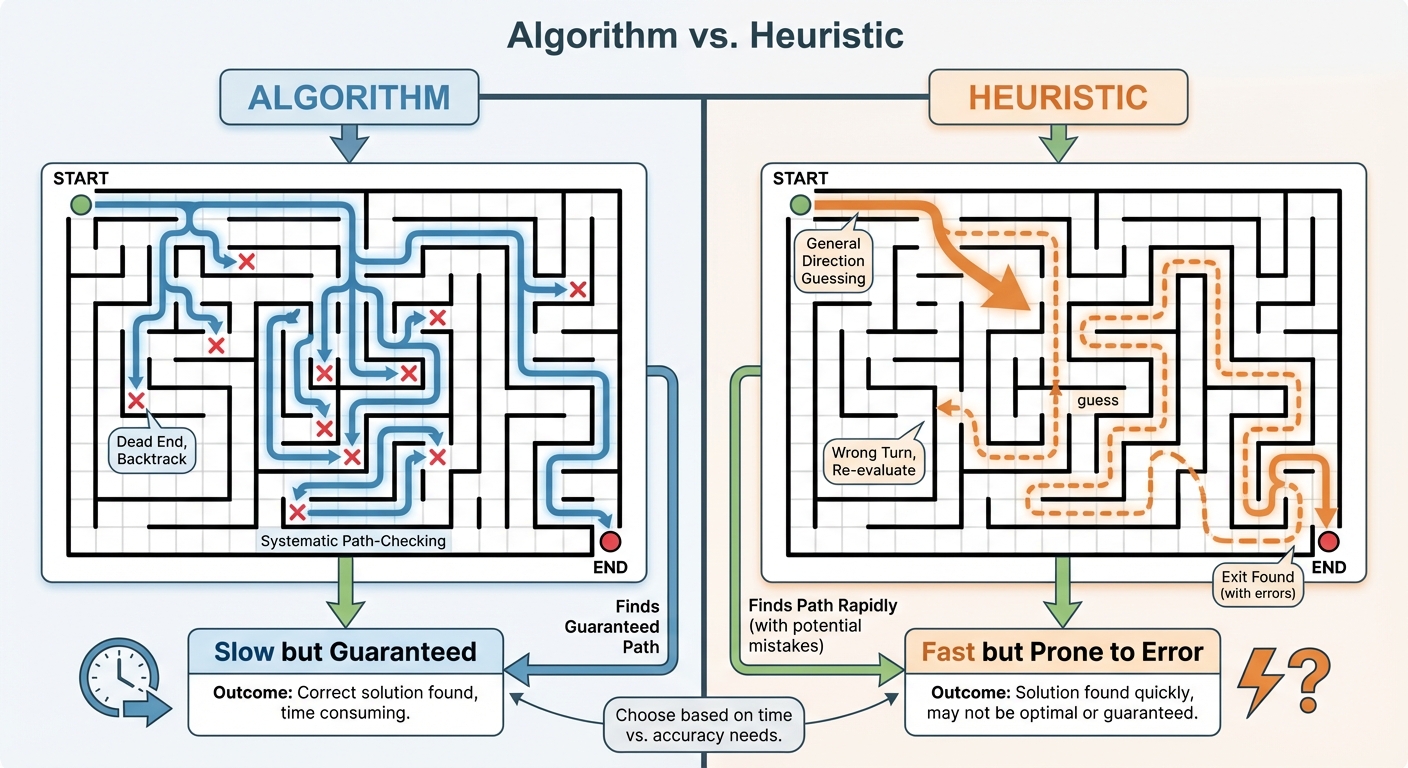
| Algorithm | A methodical, logical rule or procedure that guarantees solving a particular problem. | Guaranteed accuracy if followed correctly. | Very time-consuming and labor-intensive. |
| Heuristic | A simple thinking strategy (rule of thumb) that allows us to make judgments and solve problems efficiently. | Fast and efficient. | More prone to error; does not guarantee a solution. |
| Insight | A sudden realization of a problem's solution; contrasts with strategy-based solutions. | Immediate solution ("Aha!" moment). | Unpredictable; specific brain activity in the right temporal lobe. |
Obstacles to Problem Solving
Sometimes, our existing cognitive frameworks prevent us from finding the answer.
- Confirmation Bias: The tendency to search for information that supports our preconceptions and to ignore or distort contradictory evidence.
- Real-World Example: A person who believes a conspiracy theory will only visit websites that support that theory and dismiss fact-checking sites as "fake news."
- Fixation: An inability to see a problem from a fresh perspective.
- Mental Set: A tendency to approach a problem in one particular way, often a way that has been successful in the past but may not work now.
- Functional Fixedness: The tendency to think of things only in terms of their usual functions (e.g., failing to see that a coin can be used as a screwdriver).
Heuristics and Biases in Decision Making
Students often confuse the following two heuristics. Pay close attention to the difference:
1. The Representativeness Heuristic
Judging the likelihood of things in terms of how well they seem to represent, or match, particular prototypes.
- The Trap: If someone is described as "quiet, bespectacled, and loves reading," we might guess they are a librarian rather than a farmer, even though statistically there are far more farmers than librarians. We ignore base rates because the person matches our prototype of a librarian.
2. The Availability Heuristic
Estimating the likelihood of events based on their availability in memory; if instances come readily to mind (perhaps because of their vividness), we presume such events are common.
- The Trap: We fear plane crashes more than car crashes because plane crashes are highly televised and vivid (available in memory), despite car crashes being statistically much more likely.
Other Decision-Making Factors
- Overconfidence: The tendency to be more confident than correct—to overestimate the accuracy of our beliefs and judgments.
- Belief Perseverance: Clinging to one's initial conceptions after the basis on which they were formed has been discredited.
- Framing: The way an issue is posed; how an issue is framed can significantly affect decisions and judgments.
- Example: A surgeon saying "There is a 90% survival rate" is more reassuring than saying "There is a 10% death rate," even though the stats are identical.
Language Development and Structure
Language is our spoken, written, or signed words and the ways we combine them to communicate meaning.
The Structure of Language
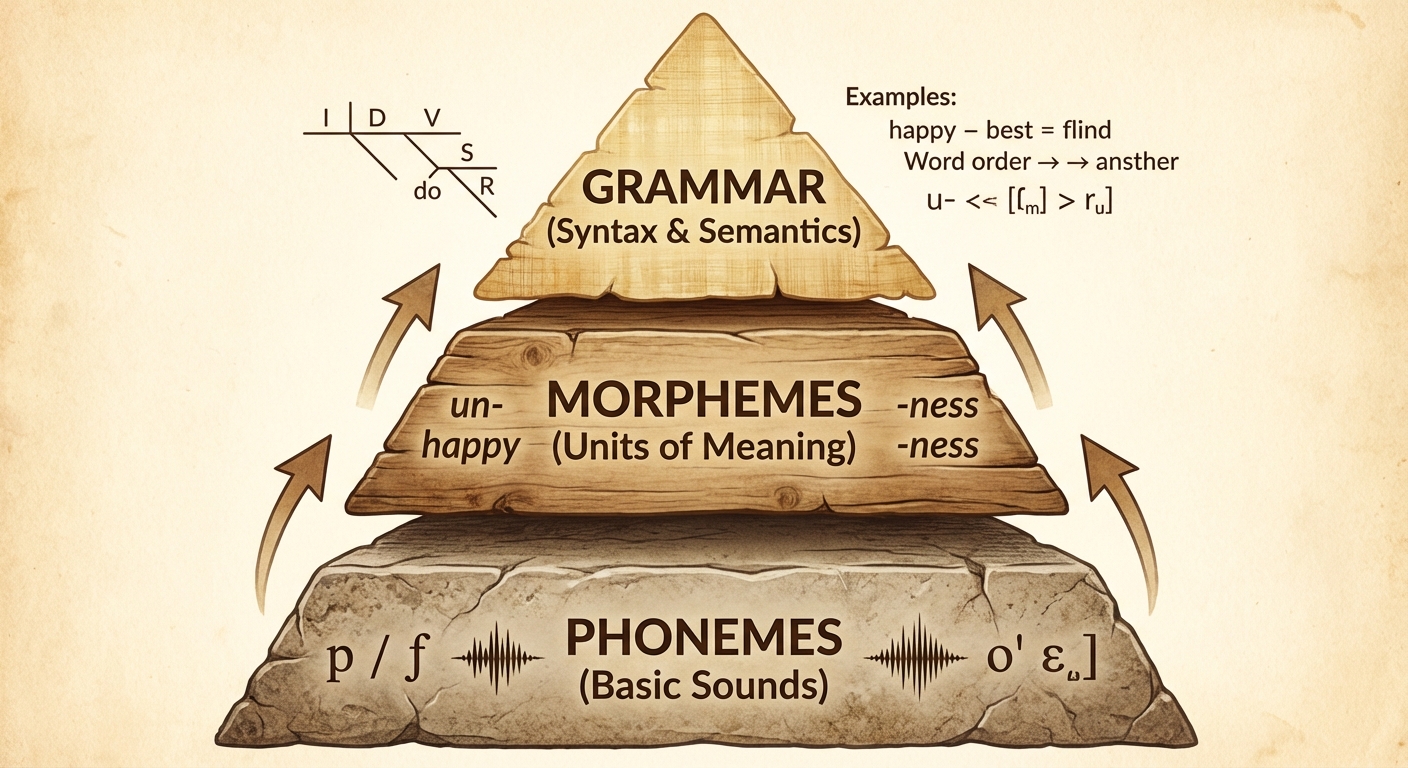
Language is built hierarchically from small sounds to complex meanings.
- Phonemes: The smallest distinctive sound unit in language.
- Note: "Chat" has 3 phonemes: ch-a-t.
- Mnemonic: Phoneme = Phone (sound).
- Morphemes: The smallest unit that carries meaning; may be a word (like "I") or a part of a word (like a prefix).
- Note: "Preview" has 2 morphemes: "pre" (before) and "view" (to look).
- Mnemonic: Morpheme = Meaning.
- Grammar: A system of rules that enables us to communicate with and understand others.
- Semantics: Rules for deriving meaning from sounds.
- Syntax: Rules for combining words into grammatically sensible sentences.
Language Development Stages
Children acquire language at an astonishing rate, moving through universal stages regardless of the specific language they are learning.
- Babbling Stage (approx. 4 months): Spontaneous utterance of various sounds; not an imitation of adult speech.
- One-Word Stage (approx. 1 year): The child speaks mostly in single words (Holophrases—e.g., "Doggy" implies "Look at the dog out there").
- Two-Word Stage (approx. 2 years): The child speaks mostly in two-word statements.
- Telegraphic Speech: Early speech stage where a child speaks like a telegram—"go car"—using mostly nouns and verbs.
Theories of Language Acquisition
B.F. Skinner: Operant Learning
Skinner (Behaviorist) believed language is learned through:
- Association (sights of things with sounds of words)
- Imitation (modeling other's words/syntax)
- Reinforcement (smiles and hugs when the child says something right)
Noam Chomsky: Inborn Universal Grammar
Chomsky argued that the rate of language acquisition is too fast to be explained by creating associations alone.
- Language Acquisition Device (LAD): A biological predisposition to learn language.
- Universal Grammar: All human languages share the same basic building blocks (nouns, verbs, etc.).
- Critical Period: There is a specific window (childhood) for mastering language. If language isn't exposed by age 7, the ability to master any language diminishes extensively.
Language and Thought
Does language determine the way we think?
- Linguistic Determinism (The Whorf Hypothesis): The hypothesis by Benjamin Lee Whorf that language determines the way we think.
- Example: If a language has no words for the past tense, Whorf argued those speakers cannot think about the past.
- Modern Consensus: Whorf's hypothesis is considered too strong. Psychologists now believe in Linguistic Relativity—language influences thought, but does not strictly determine it. We can think about things for which we have no words, but words make thinking about those things easier.
Common Mistakes & Pitfalls
- Phonemes vs. Morphemes:
- Mistake: Thinking phonemes are letters (syllables).
- Correction: Phonemes are sounds. The word "Though" has 6 letters but only 2 phonemes (th-o).
- Availability vs. Representativeness Heuristics:
- Mistake: Using them interchangeably.
- Correction: Ask yourself: Is the judgment based on a memory popping into your head (Availability) or based on a stereotype/mental image (Representativeness)?
- Whorf's Hypothesis:
- Mistake: Assuming Whorf is 100% correct.
- Correction: Current psychology rejects strict determinism. We know we can think in images without words. The correct view is that language shapes or influences thought context.
- Syntax vs. Semantics:
- Mistake: Confusing structure with meaning.
- Correction: You can have correct syntax but no semantics. (e.g., "Colorless green ideas sleep furiously"—grammatically correct, but meaningless).