AP Psychology: The Mechanics of Memory
Foundations of Memory
Memory is learning that has persisted over time—information that has been acquired, stored, and can be retrieved. In AP Psychology, we view memory not as a video recording, but as an active, reconstructive process variously modeled by psychologists to explain how we learn.
Models of Memory
Psychologists use models to understand how the brain processes information. The two most critical models for the exam are:
Information-Processing Model: This likens the human mind to a computer.
- Encoding: Get information into our brain.
- Storage: Retain that information.
- Retrieval: Get the information back out.
Atkinson-Shiffrin Three-Stage Model: A specific historical model that breaks memory into three systems.
- Sensory Memory: The immediate, very brief recording of sensory information.
- Short-Term Memory (STM): Activated memory that holds a few items briefly (like a phone number) before the information is stored or forgotten.
- Long-Term Memory (LTM): The relatively permanent and limitless storehouse of the memory system.
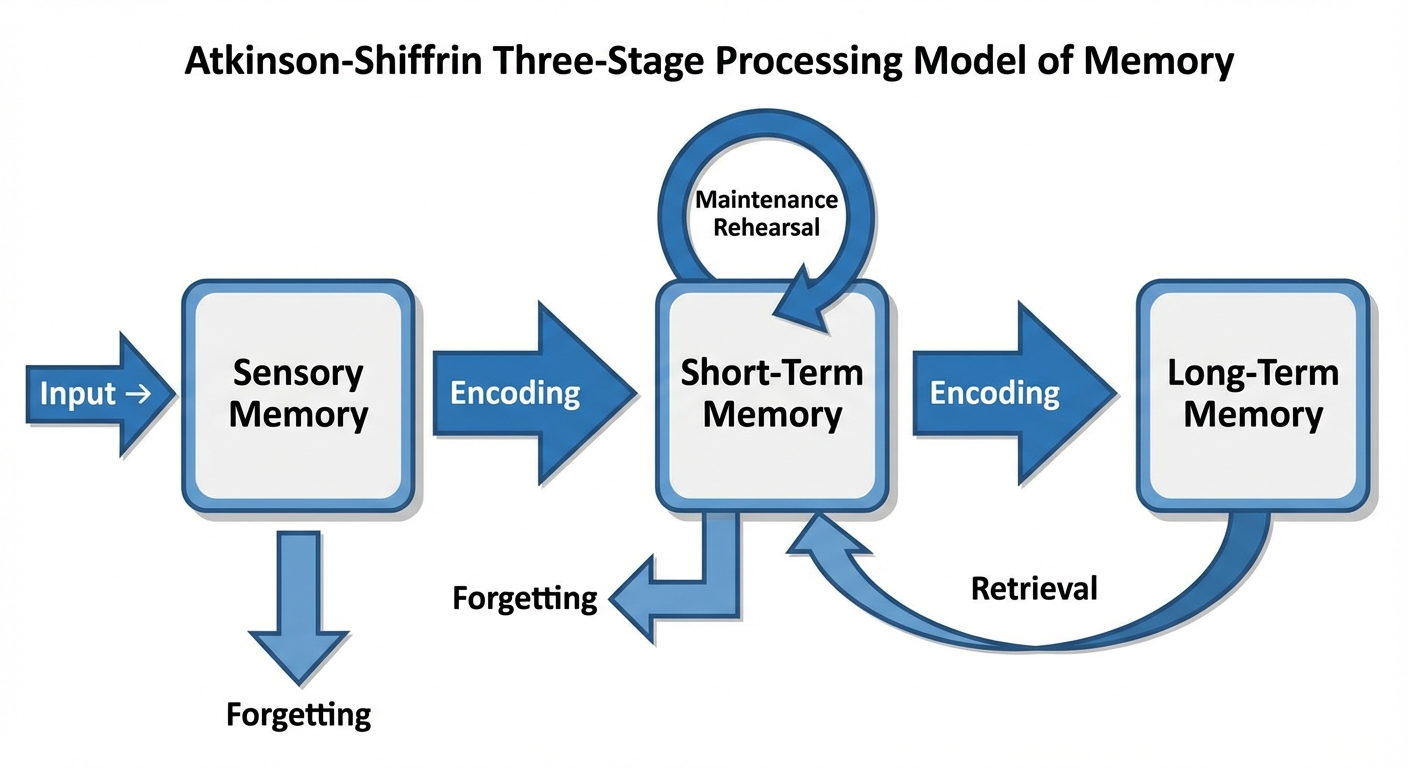
Note: Modern psychology has updated this model to include Working Memory, which emphasizes the active processing of auditory and visual-spatial information in the short-term stage.
Encoding: The Input Process
How do we get information into the system? This occurs through two main mechanisms:
- Automatic Processing: Unconscious encoding of incidental information, such as space, time, and frequency, and of well-learned information, such as word meanings.
- Effortful Processing: Encoding that requires attention and conscious effort. This produces Explicit Memories (also called declarative memories).
Factors Affecting Encoding
- Spacing Effect: We retain information better when our rehearsal is distributed over time rather than crammed (massed practice).
- Serial Position Effect: Our tendency to recall best the last (Recency Effect) and first items (Primacy Effect) in a list. When tested immediately, you remember the end of the list; when tested later, you remember the beginning.
- Levels of Processing: PROPOSED BY CRAIK & TULVING.
- Shallow Processing: Encoding on a basic level based on the structure or appearance of words (e.g., is the word in capital letters?).
- Deep Processing: Encoding semantically, based on the meaning of the words. Deep processing yields the best retention.
Memory Aids and Mnemonics
- Chunking: Organizing items into familiar, manageable units (e.g., viewing 1-9-8-4 as the year 1984 rather than four separate digits).
- Mnemonics: Memory aids, especially those using vivid imagery and organizational devices (e.g., PEMDAS).
- Hierarchies: Dividing broad concepts into narrower concepts and facts.
Storage: The Retention Process
Once encoded, information must be stored. We store information in three main areas corresponding to the Atkinson-Shiffrin model.
1. Sensory Memory
- Iconic Memory: A momentary sensory memory of visual stimuli (lasts no more than a few tenths of a second).
- Echoic Memory: A momentary sensory memory of auditory stimuli (sounds can be recalled within 3 or 4 seconds).
2. Short-Term / Working Memory
- Capacity: Described by George Miller as the "Magical Number Seven, plus or minus two." We can hold about 7 bits of information.
- Duration: Without active processing (rehearsal), short-term memories have a limited life (approx. 20–30 seconds).
3. Long-Term Memory (LTM)
LTM is divided into two distinct systems processed by different parts of the brain.
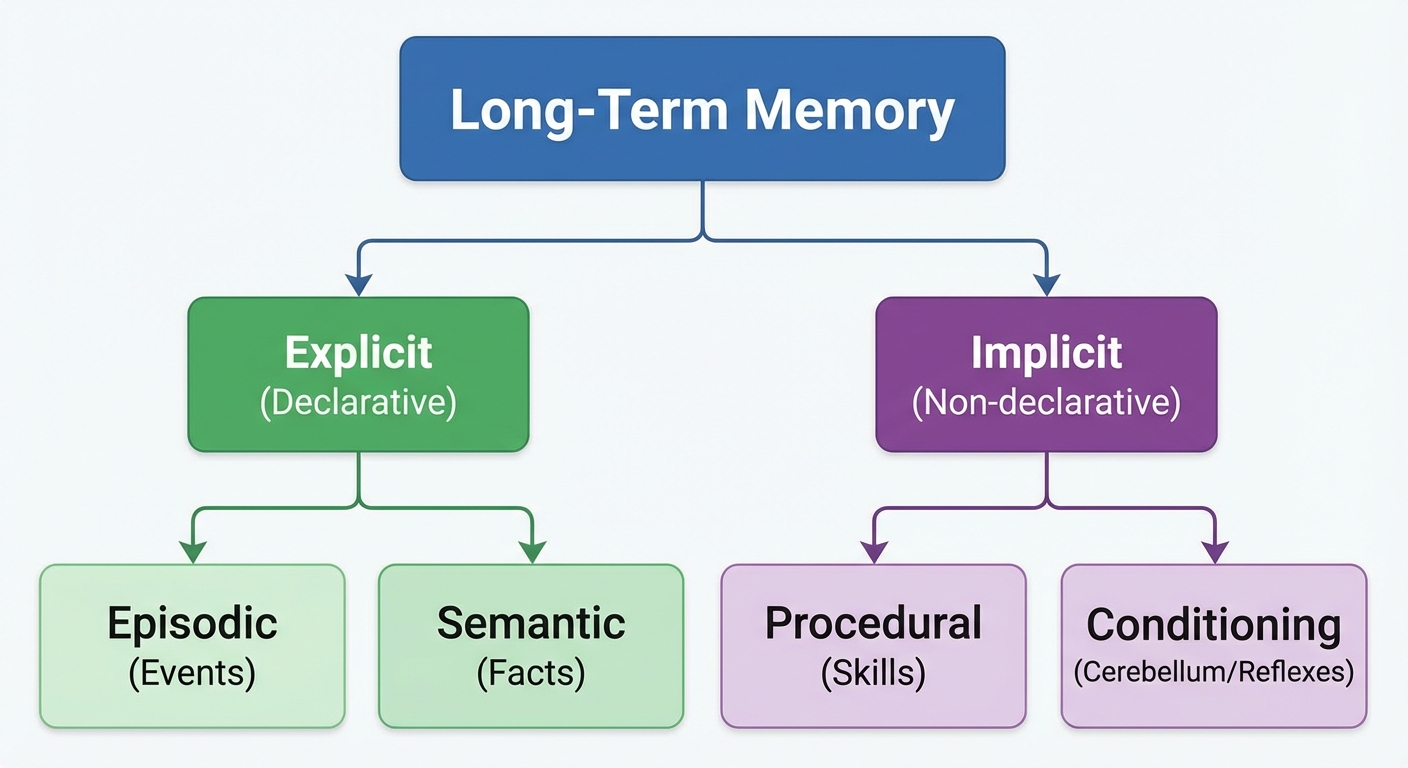
A. Explicit Memory (Declarative)
Memory of facts and experiences that one can consciously know and "declare."
- Semantic Memory: Facts and general knowledge (e.g., the capital of France).
- Episodic Memory: Personally experienced events (e.g., your 10th birthday party).
- Biological Basis: Processed in the Hippocampus (saves the memory) and stored in the Frontal Lobes.
B. Implicit Memory (Non-declarative)
Retention independent of conscious recollection.
- Procedural Memory: Skills and habits (e.g., riding a bike).
- Classically Conditioned Associations: Conditioned responses (e.g., tensing up when a dog barks).
- Biological Basis: Processed in the Cerebellum (conditioning) and Basal Ganglia (motor skills).
The Synaptic Basis of Memory
- Long-Term Potentiation (LTP): An increase in a cell's firing potential after brief, rapid stimulation. Believed to be a neural basis for learning and memory. Drugs that block LTP interfere with learning.
Retrieval: Getting It Out
Retrieval is the process of getting information out of memory storage.
Measures of Retention
- Recall: Retrieving information that is not currently in your conscious awareness but that was learned at an earlier time (e.g., a Fill-in-the-Blank test).
- Recognition: Identifying items previously learned (e.g., a Multiple Choice test). Recognition is generally faster and easier than recall.
- Relearning: Learning something more quickly when you learn it a second or later time.
Retrieval Cues
- Priming: The activation, often unconsciously, of particular associations in memory (e.g., seeing a picture of a rabbit leads you to spell the spoken word "hair/hare" as h-a-r-e).
- Context-Dependent Memory: Putting yourself back in the context where you experienced something can prime your memory retrieval (e.g., taking a test in the same seat where you learned the material).
- State-Dependent Memory: What we learn in one state (drunk vs. sober, sad vs. happy) may be more easily recalled when we are again in that state.
- Mood-Congruent Memory: The tendency to recall experiences that are consistent with one's current good or bad mood.
Forgetting and Memory Distortion
We do not remember everything. Forgetting can occur at any stage: encoding failure, storage decay, or retrieval failure.
The Forgetting Curve
Hermann Ebbinghaus pioneered the study of memory. His Forgetting Curve shows that the course of forgetting is initially rapid, then levels off with time.
Interference
Sometimes, other information blocks retrieval. Remember this acronym: PORN.
- Proactive Interference: Old information blocks the recall of New information. (Example: You keep typing your old password instead of the new one).
- Retroactive Interference: New information blocks the recall of Old information. (Example: You learn Spanish, and now you can't recall the French you learned last year).
Amnesia
- Anterograde Amnesia: An inability to form new memories (Subject H.M. is the famous case study; damage to the hippocampus).
- Retrograde Amnesia: An inability to retrieve information from one's past.
Memory Construction Errors
Memory is malleable. We re-weave our memories every time we recall them.
- Misinformation Effect: Incorporated leading information into one's memory of an event. Studied extensively by Elizabeth Loftus (e.g., asking how fast cars were going when they "smashed" vs. "hit" changes the witness's memory of speed and broken glass).
- Source Amnesia: Attributing to the wrong source an event we have experienced, heard about, read about, or imagined. This is at the heart of many false memories.
Common Mistakes & Pitfalls
- Negative Reinforcement vs. Punishment vs. Memory: Students often mix up Learning terms with Memory terms. Ensure you separate Operant Conditioning (Skinner) from Memory models (Information Processing).
- Short-Term vs. Working Memory: While related, STM is a passive store (holding the info), while Working Memory is active (manipulating the info).
- Retroactive vs. Proactive Interference: This is the #1 tested confusion. Use the PORN acronym. If the Old info is the problem, it's Proactive. If the New info is the problem, it's Retroactive.
- Implicit vs. Explicit: Remember, Explicit requires "explaining" (facts/stories). Implicit implies it's "implied" by action (muscle memory).
- Role of the Hippocampus: The hippocampus does not permanently store memories; it acts as a loading dock or "save button" to transfer them to the cortex for permanent storage (consolidation).