AP Human Geography Unit 7: Pathways to Prosperity and Global Equity
Quantifying Progress: Measures of Development
Development is the process of improving the material conditions of people through the diffusion of knowledge and technology. Because —development— is complex, geographers use various statistical measures to construct a complete picture of a country's status.
Economic Indicators
Measuring the monetary value of a country's output is the most common way to assess development, though it often overlooks the distribution of wealth.
- Gross Domestic Product (GDP): The total value of goods and services produced within a country's borders in a given year. It does not account for money leaving or entering the country.
- Gross National Income (GNI): The value of the output of goods and services produced by a country in a year, including money that leaves and enters the country. GNI is currently the primary economic indicator used by the World Bank.
- Measuring per Capita: To compare countries of different sizes, economists divide GNI by the total population:
- Purchasing Power Parity (PPP): An adjustment made to the GNI to account for differences in the cost of goods. For example, a loaf of bread in India costs significantly less than in the USA; PPP levels the playing field to show true buying power.
The Human Development Index (HDI)
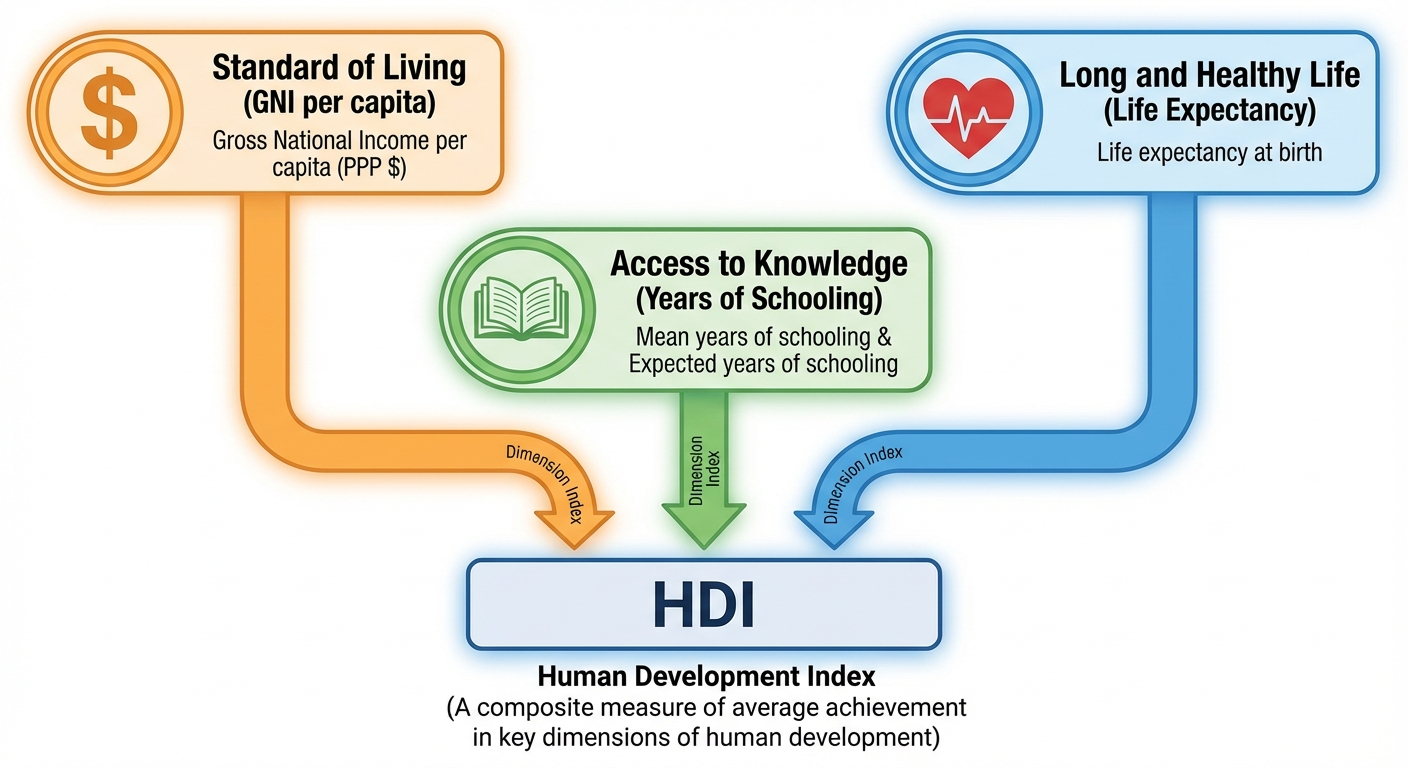
Recognizing that money isn't everything, the UN created the Human Development Index (HDI). It measures development based on three dimensions. A score of 1.0 is perfect; generally, MDC (More Developed Countries) are >0.8.
- Standard of Living: Measured by GNI per capita at PPP.
- Access to Knowledge: Measured by the mean years of schooling for adults and expected years of schooling for children.
- Long and Healthy Life: Measured by life expectancy at birth.
Economic Sectors and Development
As countries develop, their workforce shifts sectors:
- Primary Sector: Extraction (agriculture, mining). Dominant in LDCs (Least Developed Countries).
- Secondary Sector: Processing and manufacturing. Dominant in developing countries (NICs).
- Tertiary Sector: Services (retail, banking, education). Dominant in MDCs.
- Quaternary/Quinary: Information handling and high-level decision making (research, government). Exclusive to highly developed economies.
Women and Economic Development
A comprehensive analysis of development must look at gender equity. A country cannot achieve high development if half its population is marginalized.
Gender Inequality Index (GII)
The UN measures the extent of each country's gender inequality using the GII. The higher the score (closer to 1.0), the greater the inequality.
It combines three metrics:
- Empowerment: The percentage of seats held by women in the national legislature and the percentage of women completing secondary school.
- Labor Force Participation: The percentage of women holding full-time jobs outside the home.
- Reproductive Health: Measured by the Maternal Mortality Rate (MMR) and the Adolescent Fertility Rate.
Key Trend: There is a strong inverse relationship between HDI and GII. As countries develop economically (high HDI), gender inequality usually drops (low GII).
Microloans and Empowerment
In many LDCs, women face barriers to obtaining credit. Microfinance (or microloans) provides small loans to individuals and small businesses in developing countries.
- The Grameen Bank Model: Pioneered by Muhammad Yunus in Bangladesh, these loans are overwhelmingly given to women.
- Impact: Loans allow women to buy cows, sewing machines, or stock for small shops. This increases household income, reduces child mortality, and increases female leverage in village politics.
- Critique: Some argue high repayment interest rates can lead to debt traps for the poor.
Theories of Development
Geographers use two contrasting theoretical frameworks to explain why some countries are rich and others are poor. One is optimistic (liberal) and one is structuralist (pessimistic).
Rostow’s Stages of Economic Growth (Modernization Theory)
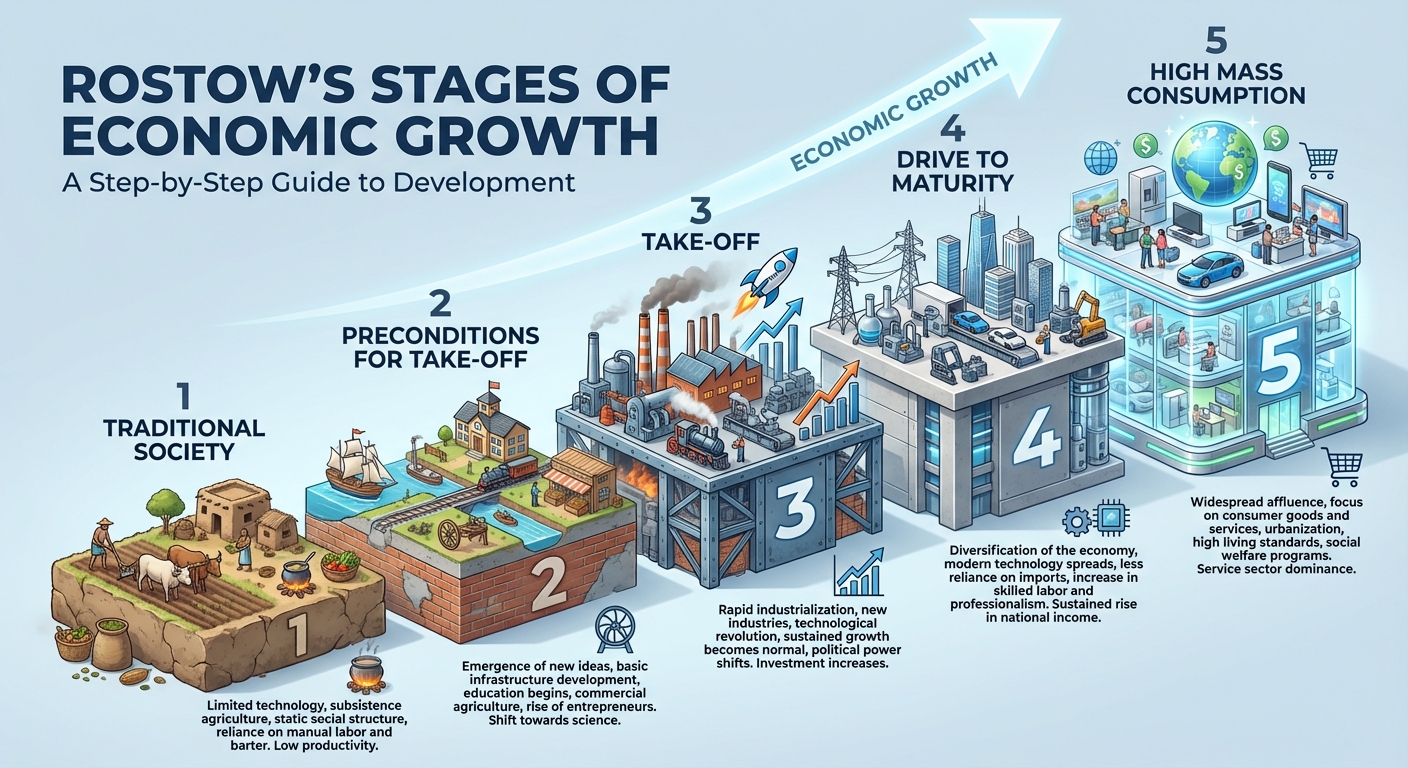
Walt Rostow proposed that all countries follow a similar, linear path to development, modeled after Western successes.
The Five Stages:
- Traditional Society: Subsistence agriculture, high investment in "non-productive" activities (military/religion).
- Preconditions for Take-off: An elite group initiates innovative economic activities; investment in new technology and infrastructure (water/transport).
- Take-off: Rapid growth in a few specific economic activities (textiles/food). Industrialization begins.
- Drive to Maturity: Modern technology diffuses to a wide variety of industries, not just the original few. Workers become more skilled.
- Age of High Mass Consumption: Shift from heavy industry (steel) to consumer goods (cars/refrigerators).
Wallerstein’s World Systems Theory (Dependency Theory)
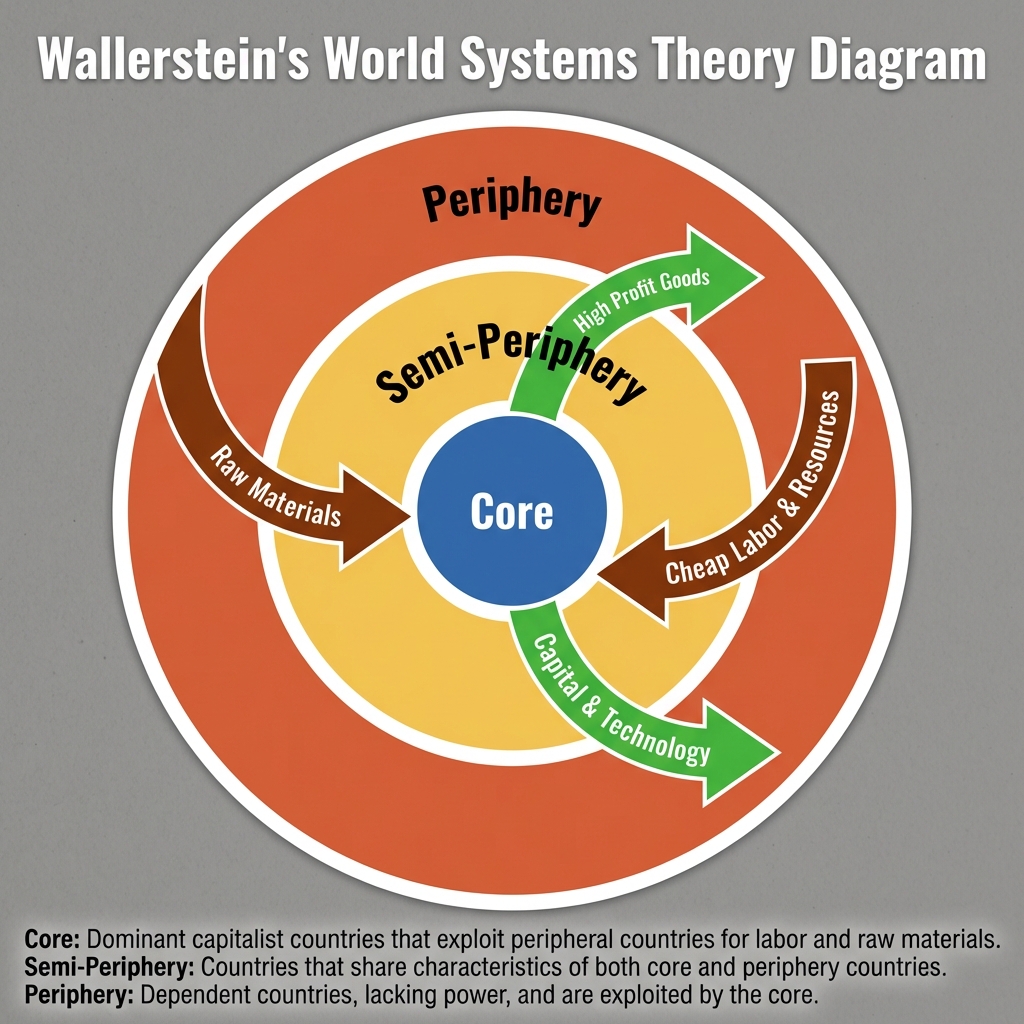
Immanuel Wallerstein argues that development is not linear. Instead, the world is a static, unified capitalist system where the rich rely on the exploitation of the poor.
The Three Tiers:
- Core: High education, salaries, and wealth (USA, Western Europe, Japan, Australia). They buy raw materials from the periphery and sell high-profit consumer goods back to them.
- Semi-Periphery: Intermediate places that manufacture and export goods (Brazil, India, China, Mexico). buffer between Core and Periphery.
- Periphery: Low education, salaries, and wealth (Sub-Saharan Africa, parts of Asia/Latin America). They export raw materials to the core.
| Feature | Rostow (Modernization) | Wallerstein (Dependency) |
|---|---|---|
| View of World | National level; each country develops independently | Global level; countries are interdependent |
| Idea of Change | Anyone can succeed if they follow the path | Structural barriers make it hard for poor countries to rise |
| Bias | Capitalist/Western-centric | Structuralist/Marxist-influenced |
Sustainability and Trade
International Trade Concepts
Trade is the lifeblood of economic development. Two concepts determine who trades with whom:
- Complementarity: Trade is successful when one country has a supply of a commodity that another country specifically demands (e.g., USA needs coffee; Colombia produces coffee).
- Comparative Advantage: The ability of a country to produce a good at a lower opportunity cost than another country. Countries should specialize in what they do best and trade for the rest.
Sustainable Development
Sustainability is the use of Earth's resources in ways that ensure their availability in the future. The classic conflict in development is Economic Growth vs. Environmental Protection.
Ecotourism:
A strategy used by countries like Costa Rica and Kenya. It involves tourism directed toward exotic, often threatened natural environments, intended to support conservation efforts and observe wildlife.
- Benefit: Keeps money in the local economy and incentivizes locals to protect the environment rather than destroy it for farming/logging.
The UN Sustainable Development Goals (SDGs):
A collection of 17 interlinked global goals designed to be a "blueprint for a better and more sustainable future for all" by 2030. Key goals include "No Poverty," "Gender Equality," and "Climate Action."
Common Mistakes & Pitfalls
- confusing GNI and GDP: Remember, National (GNI) is everything the Nation owns (including money from abroad), while Domestic (GDP) is just what happens in the Dirt (inside borders).
- Rostow's Applicability: Students often try to apply Rostow to every country. Remember that Rostow assumes countries start independently. He does not account for the legacy of Colonialism, which often sets LDCs back, making the "Take-off" nearly impossible without outside help.
- Wallerstein vs. North-South Split: While the Core is roughly the "Global North" and the Periphery is the "Global South," do not treat them as synonyms. Australia is in the South geographically but is part of the Core economically.
- High GDP vs. High Development: A country can have a massive GDP (like China) but still have lower GNI per capita or HDI due to massive population size or uneven wealth distribution. Always look at per capita data.