Comprehensive Guide to Unit 3: Cultural Patterns and Processes
Introduction to Culture
Culture is the sum total of knowledge, attitudes, and habitual behavior patterns shared and transmitted by the members of a society. It is the invisible force that guides how people act and the physical objects they create.
Components of Culture
To analyze culture geographically, we break it down into three distinct layers. This framework is crucial for identifying how culture manifests on the landscape:
- Artifacts (Material Culture): The visible, physical objects created by a culture (houses, clothing, tools, artwork). This is what you can touch.
- Mentifacts (Non-Material Culture): The ideas, beliefs, values, and knowledge of a culture (language, religious beliefs, folklore). This is what you think.
- Sociofacts (Social Institutions): The institutions and links between individuals and groups that unite a culture, including family structure and political, educational, and religious institutions. This is how you relate.
Habit vs. Custom
Students often confuse these two terms, but the scale is different:
- Habit: A repetitive act performed by a particular individual (e.g., wearing jeans to class every day).
- Custom: A repetitive act performed by a group, to the extent that it becomes a characteristic of the group (e.g., American university students wearing jeans to class).
Cultural Relativism vs. Ethnocentrism
When geographers observe a new culture, they adopt a specific viewpoint:
- Ethnocentrism: Judging another culture based on the standards and values of one's own culture (often implies superiority).
- Cultural Relativism: The practice of evaluating a culture by its own standards rather than viewing it through the lens of one's own culture. This is the preferred approach in AP Human Geography.
Cultural Landscapes
The Cultural Landscape is likely the most important concept in this unit. Coined by geographer Carl Sauer, it is defined as the "forms superimposed on the physical environment by the activities of man." essentially, it is the built environment.
Reading the Landscape
Geographers look for clues in the landscape to understand cultural values, including:
- Land use patterns: How agriculture or urban planning reflects social values (e.g., large centralized plazas in Spanish colonial cities).
- Architecture: Building materials (adobe, brick, wood) often reflect local resources and climatic needs.
- Sacred Spaces: Cemeteries, shrines, and temples (e.g., the orientation of mosques toward Mecca or the height of church steeples).
Sequent Occupance
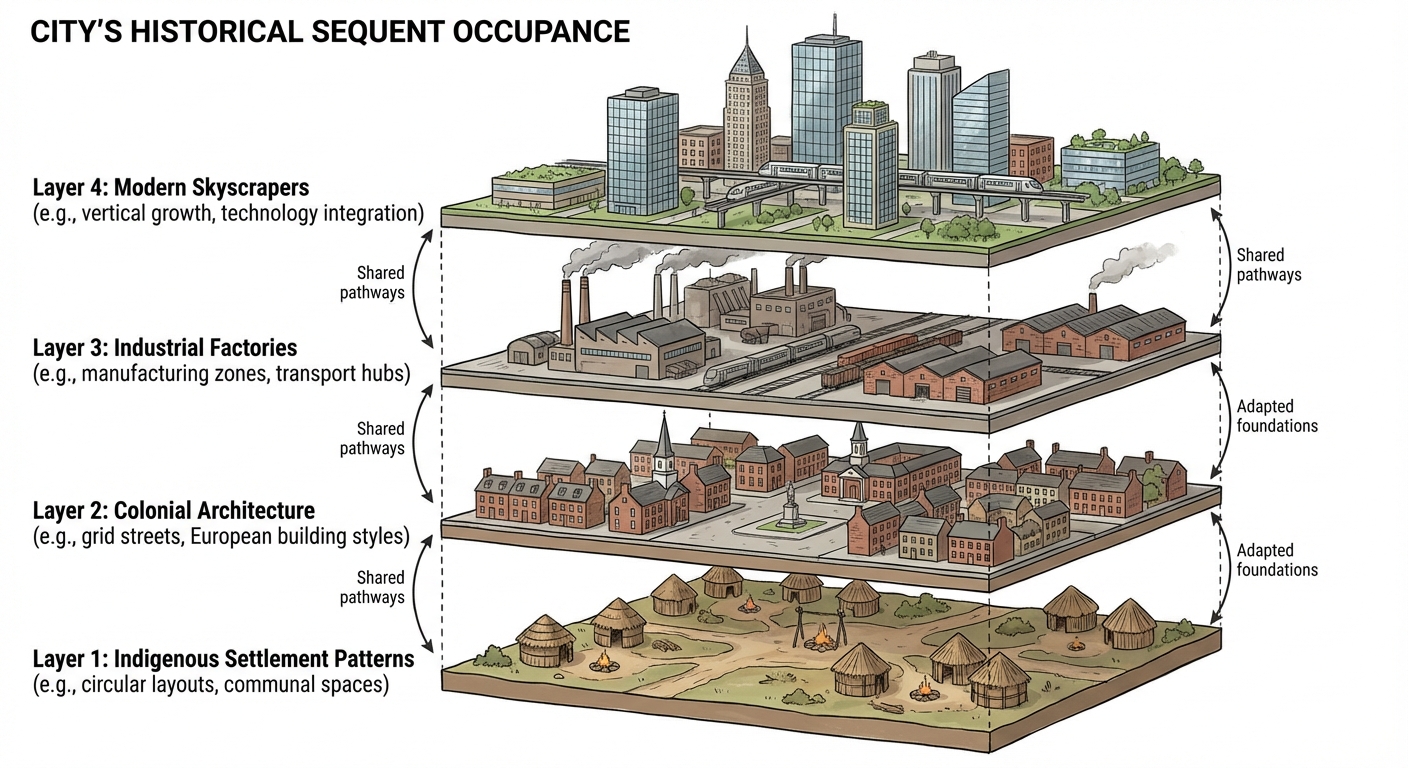
Few places have been inhabited by only one culture. Sequent Occupance refers to the notion that successive societies leave their cultural imprints on a place, each contributing to the cumulative cultural landscape.
- Example: In New Orleans, the cultural landscape contains layers of Native American, French, Spanish, African, and American influences. You can see French architecture mixed with Spanish street names and American commercial buildings.
Place and Identity
The landscape helps define identity.
- Gendered Spaces: Areas in which particular genders of people, and particular types of gender expression, are considered welcome or appropriate (e.g., traditional restrictions on women in public spaces in certain societies).
- Indigenous Land Use: Often characterized by a spiritual connection to the land and communal ownership, contrasted with the precise, legalistic property lines of colonial powers.
Centripetal vs. Centrifugal Forces
- Centripetal Forces: Forces that unite a group of people (e.g., a shared language, national anthem, common religion).
- Centrifugal Forces: Forces that divide a group of people (e.g., linguistic diversity within a state, religious conflict, uneven economic development).
Cultural Diffusion
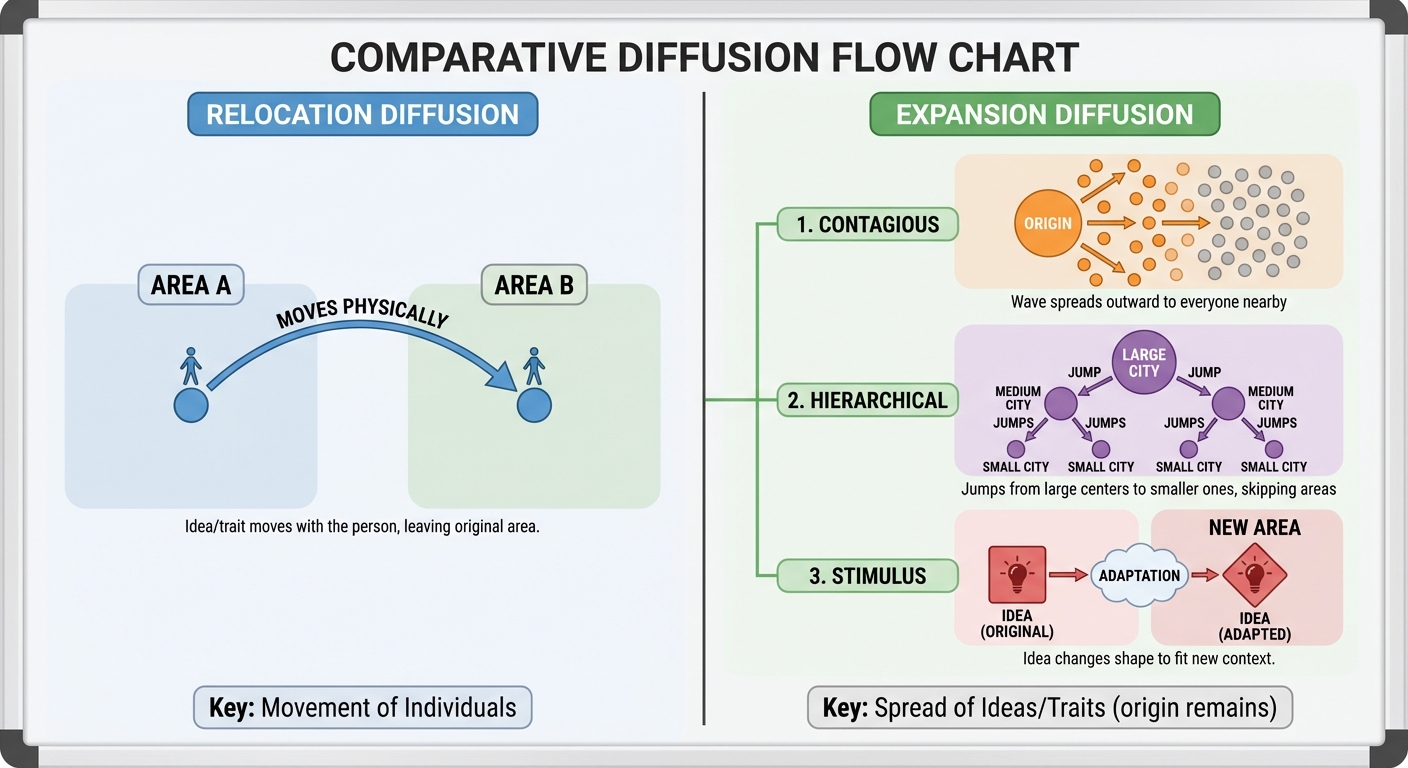
Cultural diffusion is the spread of an idea, innovation, or cultural trait from its hearth (place of origin) to other places. Diffusion falls into two main buckets: Relocation and Expansion.
1. Relocation Diffusion
The spread of a feature or trend through the physical movement of people from one place to another.
- Key Mechanic: People migrate and take their culture with them.
- Example: The spread of Spanish into Latin America via colonization; the spread of Chinatown neighborhoods due to Chinese migration.
2. Expansion Diffusion
The spread of a feature or trend among people from one area to another in a snowballing process. The idea moves; the people generally stay put. This is subdivided into four types:
A. Contagious Diffusion
Rapid, widespread diffusion of a feature or trend throughout a population. Everyone adjacent is affected, like a disease.
- Example: Viral videos on TikTok, influenza, or the initial spread of Islam from Mecca to the surrounding region.
B. Hierarchical Diffusion
The spread of an idea from persons or nodes of authority or power to other persons or places. It leaps from one key city/leader to another, skipping rural areas or lower social classes initially.
- Example: High fashion (Paris $\rightarrow$ NYC $\rightarrow$ Chicago), or the spread of hip-hop music from urban centers to suburbs.
C. Reverse Hierarchical Diffusion
The spread of a trait from a lower class/non-authority group upwards to positions of power.
- Example: Walmart starting in small-town Arkansas and spreading to major global cities; tattoos moving from counter-culture to mainstream.
D. Stimulus Diffusion
The spread of an underlying principle, even though a specific characteristic is rejected.
- Example: The McDonald’s Maharaja Mac in India. The concept of "fast food burger" spread, but the beef (a specific characteristic) was rejected due to religious taboos and replaced with chicken or veggie patties.
Globalization and Cultural Change
Time-Space Compression
Modern technology (internet, airplanes, container ships) has effectively shrunk the world. The time it takes for culture to diffuse has dropped dramatically. This phenomenon reduces Distance Decay, the likelihood of diffusion decreasing as distance increases.
Outcomes of Interactions
When cultures interact, several outcomes are possible:
| Term | Definition | Example |
|---|---|---|
| Acculturation | An immigrant group adopts values/practices of the dominant group but maintains major elements of their own culture. | A family speaking their native language at home but English at work/school. |
| Assimilation | An ethnic group can no longer be distinguished from the receiving group; complete integration. | Third-generation immigrants who no longer speak the heritage language. |
| Syncretism | The blending of traits from two different cultures to form a new trait. | Santería (mixing Catholicism with West African traditions) or Tex-Mex cuisine. |
| Multiculturalism | The coexistence of several distinct cultural or ethnic groups within a society. | Policies in Canada that officially recognize and promote cultural diversity. |
Common Mistakes & Pitfalls
Confusing Relocation vs. Expansion Diffusion:
- Mistake: Thinking all languages spread via expansion.
- Correction: If people physically moved to bring the language there (like English to Australia), it is Relocation. If the language was learned by locals without mass migration of speakers (like English as a lingua franca on the internet), it is Expansion (Contagious or Hierarchical).
Sequent Occupance vs. Assimilation:
- Mistake: Applying Sequent Occupance to people.
- Correction: Sequent Occupance applies to the landscape (buildings, fields). Assimilation applies to people.
Folk vs. Pop Culture (Local vs. Global):
- Mistake: Thinking "Folk" culture is only ancient history.
- Correction: Local/Indigenous cultures exist today. The key difference is the scale (small/homogeneous vs. large/heterogeneous) and the hearth (anonymous/traditional vs. specific/commercial).
Environmental Determinism vs. Possibilism:
- Mistake: Believing the physical environment strictly dictates culture (Determinism).
- Correction: Possibilism is the modern view—the environment sets limits, but humans have the ability to adjust and overcome those limits (e.g., air conditioning in the desert).