Unit 2 Guide: Concepts and Calculations of the Electric Field
Defining the Electric Field
The fundamental concept of this section is the Electric Field. In classical mechanics, objects communicate forces through direct contact. In electrostatics, however, charges exert forces on one another over a distance. To explain this interaction, physicists utilize the field model.
An Electric Field ($\vec{E}$) exists in the region of space around a charged object (the source charge). When another charged object (the test charge) enters this field, the field exerts an electric force on it.
The Definition Formula
Mathematically, the electric field is defined as the electric force experienced by a positive test charge divided by the magnitude of that test charge.
Where:
- $\vec{E}$ is the Electric Field vector (measured in Newtons per Coulomb, N/C or Volts per meter, V/m).
- $\vec{F}_E$ is the Electric Force vector (Newtons, N).
- $q_0$ is the magnitude of the small positive test charge (Coulombs, C).
The Electric Field of a Point Charge
By combining Coulomb's Law ($FE = k \frac{|q1 q_2|}{r^2}$) with the definition above, we derived the specific equation for the field created by a single point charge $Q$:
Where:
- $k$ is Coulomb's Constant ($9.0 \times 10^9 \text{ N}\cdot\text{m}^2/\text{C}^2$).
- $Q$ is the source charge creating the field.
- $r$ is the distance from the source charge to the point in space where you are measuring the field.
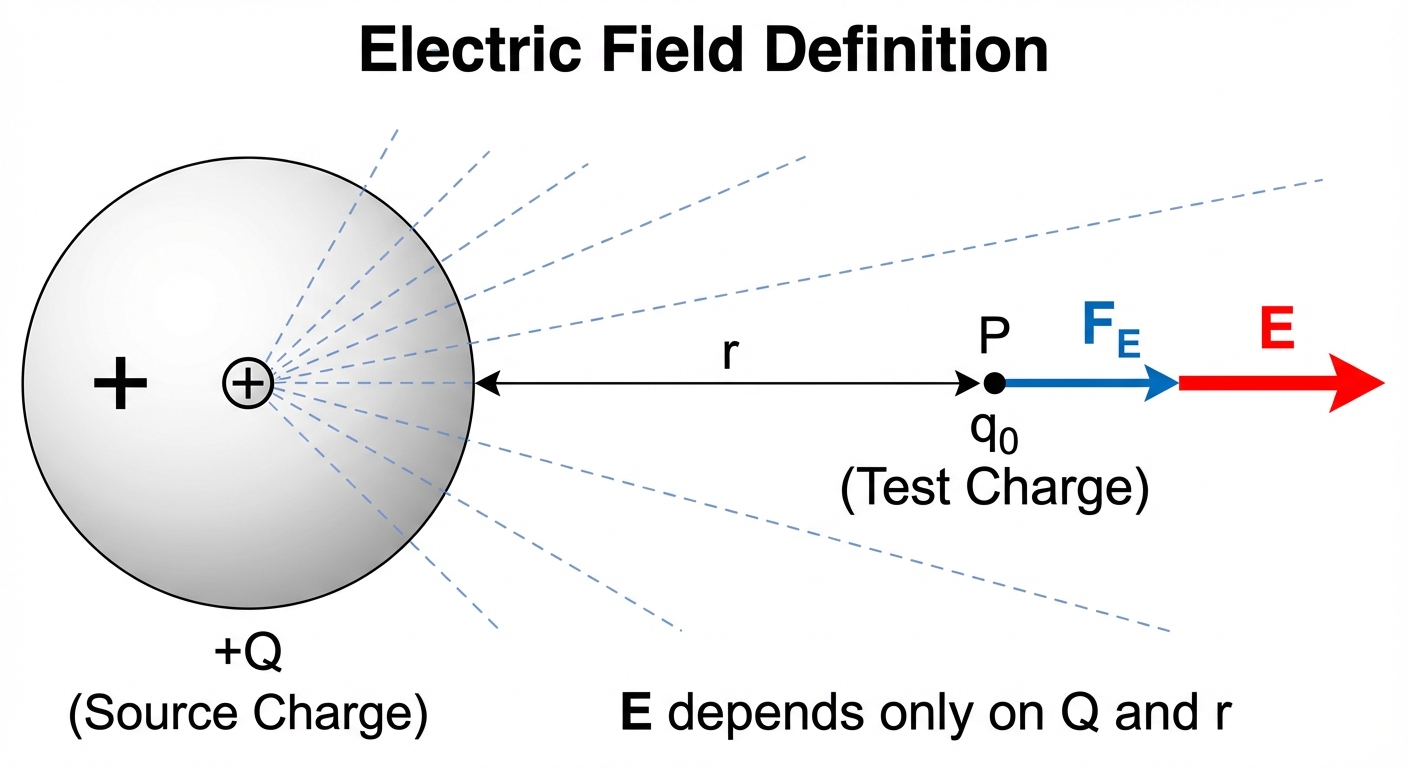
Key Concept: The electric field is a property of the source charge and the location in space. It exists regardless of whether a test charge is actually present to feel it.
Visualizing the Field: Electric Field Lines
Because electric fields are invisible vectors at every point in space, we use Electric Field Lines as a visual tool to represent the field's strength and direction.
Rules for Drawing Field Lines
When analyzing or sketching field lines on the AP Physics 2 exam, you must adhere to these specific rules:
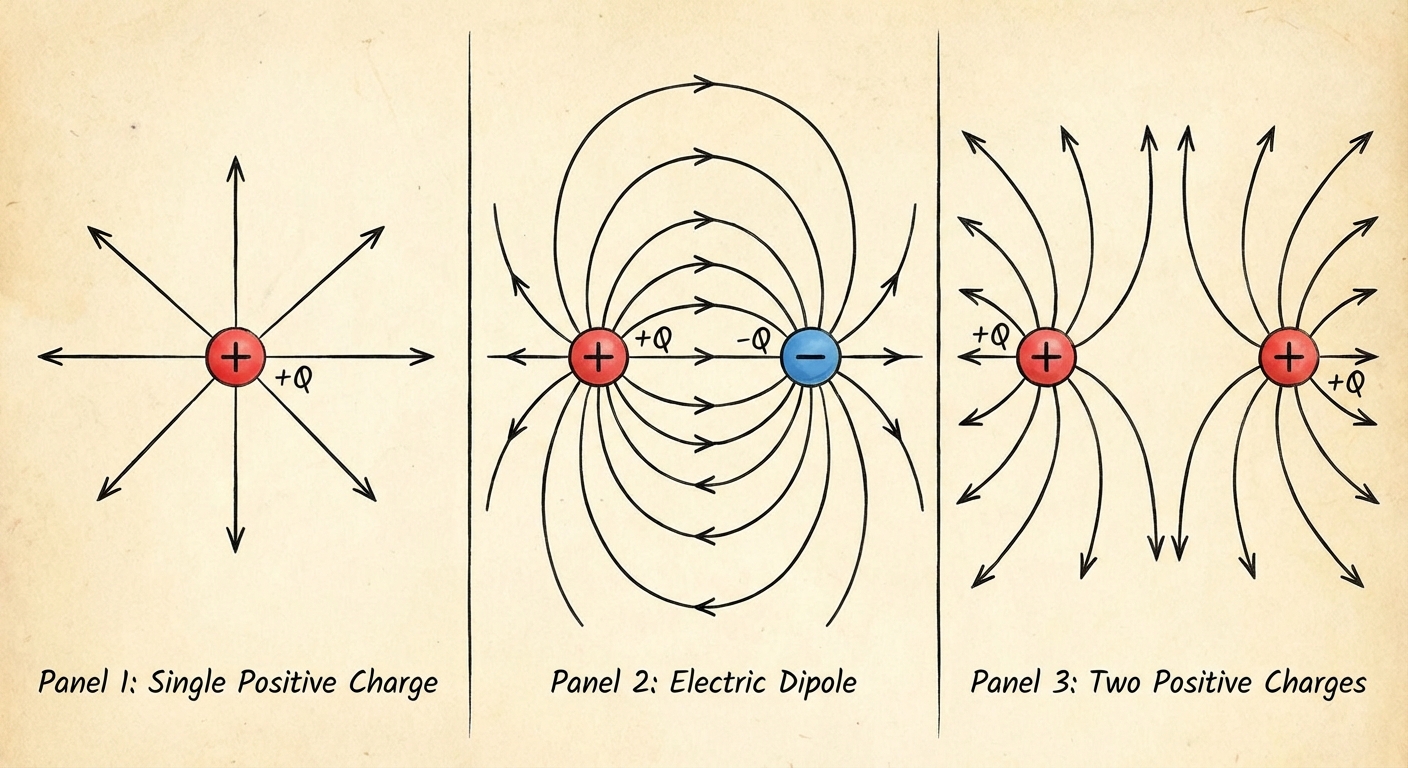
- Direction: Lines originate from positive charges and terminate on negative charges (or extend to infinity).
- Tangent: The direction of the electric field vector at any specific point is tangent to the field line passing through that point.
- Density equals Strength: The number of lines per unit area (line density) represents the magnitude of the field. Lines are closer together where the field is strong (near charges) and further apart where the field is weak.
- No Crossing: Field lines can never cross each other. If they did, it would imply the electric field has two different directions at the exact same point, which is physically impossible.
Common Configurations
- Isolated Point Charge: Radiates outward (if positive) or inward (if negative) symmetrically.
- Electric Dipole: A positive and a negative charge of equal magnitude. Lines curve from the positive to the negative charge.
- Two Like Charges: Lines repel each other, creating an asymptote-like region between them where the field is zero.
Electric Fields of Charge Distributions
In AP Physics 2, you are expected to analyze fields not just from single points, but from collections of charges and geometric distributions.
1. The Principle of Supervision
If multiple point charges are present, the total electric field at any point $P$ is the vector sum of the individual fields produced by each charge.
Process for solving superposition problems:
- Draw a diagram.
- Determine the magnitude of the field from each charge using $E = k|Q|/r^2$.
- Determine the direction of each field vector based on the sign of the source charge (Away from +, Toward -).
- Resolve vectors into $x$ and $y$ components if necessary.
- Add components to find the resultant vector.
2. Uniform Electric Fields (Parallel Plates)
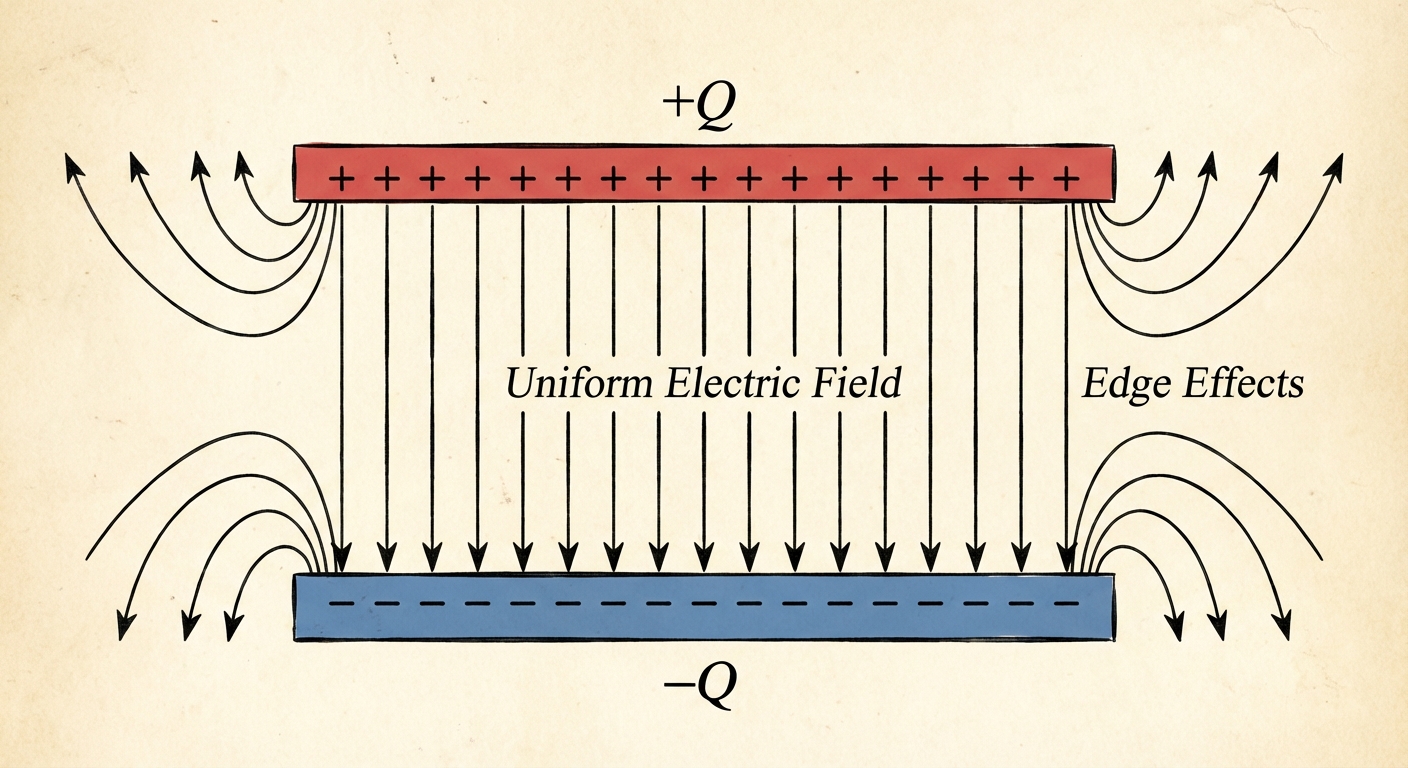
A very common application in Unit 2 is the capacitor—two parallel conducting plates with equal and opposite charges.
Between the plates (away from the edges), the electric field is uniform. This means the field strength and direction are constant everywhere between the plates.
Note: While you may not always calculate this from $Q$ and Area ($A$) directly in Algebra-based physics, you must understand conceptually that magnitude is constant regardless of position between the plates.
3. Conductors in Electrostatic Equilibrium
Conductors (like copper or gold) allow electrons to move freely. When a conductor is in electrostatic equilibrium (charges have stopped moving), specific rules apply:
- Internal Field is Zero: The net electric field anywhere inside the material of the conductor is zero. (If it weren't, the free electrons would experience a force and move, contradicting the definition of equilibrium).
- Surface Interaction: Any net charge on the conductor resides entirely on the outer surface.
- Perpendicular Lines: Electric field lines just outside a charged conductor are always perpendicular to the surface. Any parallel component would cause surface charges to flow.
Comparison: Gravity vs. Electricity
It is often helpful to compare the Electric Field to the Gravitational Field ($g$) learned in Unit 1 concepts.
| Feature | Gravitational Field | Electric Field |
|---|---|---|
| Source | Mass ($m$) | Charge ($q$) |
| Field Variable | $\vec{g}$ (N/kg) | $\vec{E}$ (N/C) |
| Force Formula | $\vec{F}_g = m\vec{g}$ | $\vec{F}_E = q\vec{E}$ |
| Point Source | $g = G\frac{M}{r^2}$ | $E = k\frac{ |
| Nature | Always Attractive | Attractive or Repulsive |
Common Mistakes & Pitfalls
Confusing Source and Test Charges:
- Mistake: Using the test charge $q_0$ in the $kQ/r^2$ formula.
- Correction: Remember that $E = k|Q|/r^2$ depends only on the source charge $Q$. The test charge $q$ falls out of the equation. A field exists even if no test charge is there to feel it.
Neglecting Vector Direction:
- Mistake: Adding field magnitudes arithmetically (e.g., $E_{net} = 5 + 5 = 10$) when the vectors point in opposite directions or at angles.
- Correction: Always draw vectors. If two fields point in opposite directions, you subtract them. If they are perpendicular, use the Pythagorean theorem.
Field Lines vs. Trajectories:
- Mistake: Assuming a charged particle released in a field will follow the field line exactly.
- Correction: Field lines indicate the direction of acceleration (force), not necessarily velocity. A particle with initial velocity may cross field lines (just as a projectile moves across gravitational field lines).
The Sign of the Charge in Formulas:
- Mistake: Plugging negative signs into the calculation for field magnitude.
- Correction: Calculate the magnitude using absolute values ($|Q|$). Determine the direction strictly by looking at the diagram (Away from +, Toward -). Then combine them.