Identity Dynamics in Japanese Society
Language and Identity
In Japanese culture, the language you speak is not just a tool for communication; it is a primary marker of your identity and your relationship to the listener. The structure of the Japanese language forces speakers to constantly assess their social standing relative to others, deeply influencing their sense of self within the social hierarchy.
Keigo (Honorifics) as Social Positioning
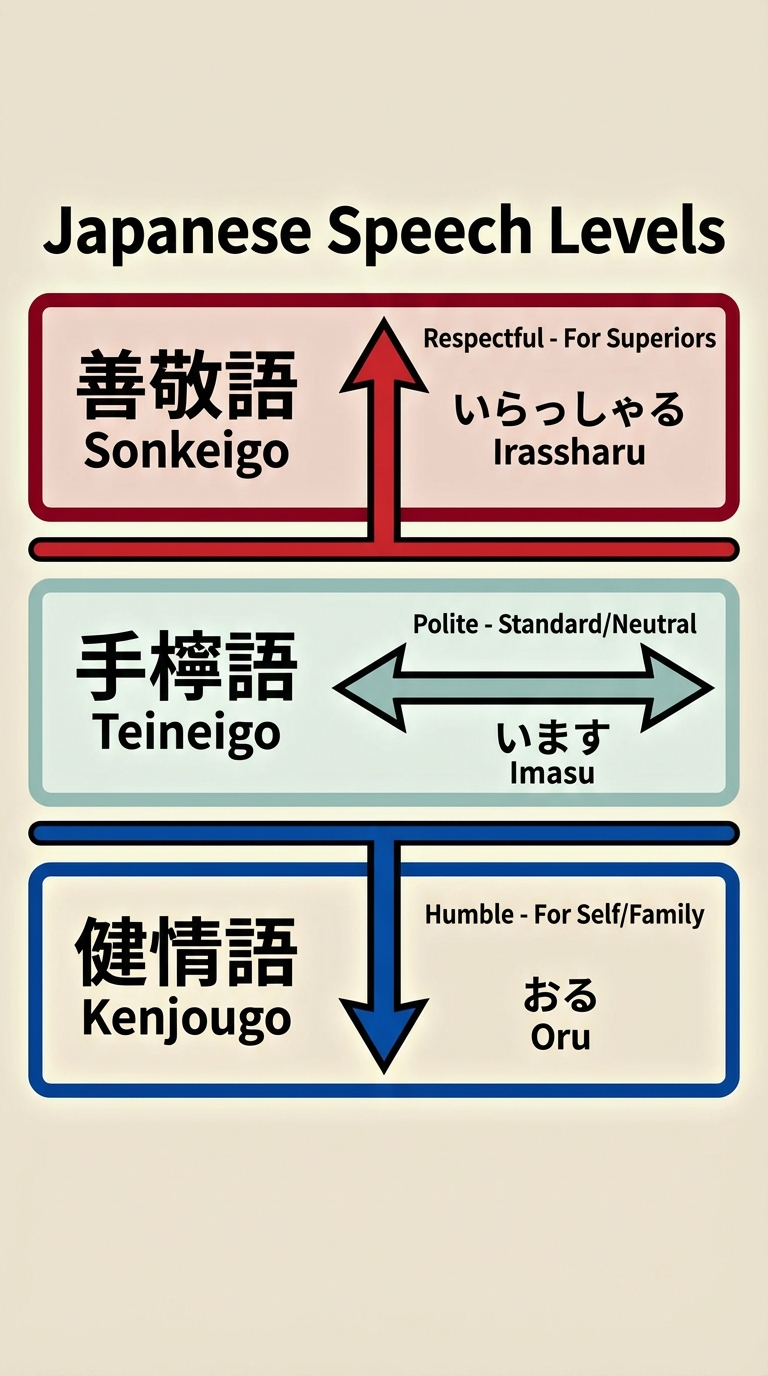
Keigo (Honorifics) is the system of polite speech that reflects social distance, intimacy, and hierarchy. It is a fundamental aspect of Japanese identity, reinforcing the concept of a Tate-shakai (Vertical Society).
When a Japanese speaker uses Keigo, they are actively defining their identity as a subordinate, a superior, or an outsider. Using Keigo correctly is considered a sign of a mature, educated adult (Shakaijin).
The Three Pillars of Keigo
- Sonkeigo (Respectful Language): Used to elevate the listener. You talk up to someone.
- Example: Teacher, boss, customer.
- Verb: irassharu (to go/come/be).
- Kenjougo (Humble Language): Used to lower oneself. You talk down about yourself or your group to show respect to the listener.
- Example: Talking about your own actions to a superior.
- Verb: mairu (to go/come).
- Teineigo (Polite Language): The standard Desu/Masu form used to maintain general politeness.
Regional Dialects and Local Identity
While standard Japanese (Hyojungo) is taught in schools and used in media, regional dialects (Hogen) are vital to local identities.
- Kansai-ben: Spoken in Osaka/Kyoto/Kobe. It is associated with humor, warmth, and directness. Speakers often retain this dialect even when moving to Tokyo to maintain their regional identity.
- Standard: Arigatou (Thank you) → Kansai-ben: Ookini.
- Standard: Dame (No good) → Kansai-ben: Akan.
- Code-Switching: Many Japanese people switch between Hyojungo (public/formal identity) and their Hogen (private/emotional identity) depending on the context.
Gendered Language
Traditionally, Japanese has distinct sentence-ending particles for men (Danseigo) and women (Joseigo). While these distinctions are blurring in modern youth culture, they still influence how identity is projected.
| Feature | Male Speech Markers | Female Speech Markers |
|---|---|---|
| First Person Pronoun | Ore, Boku | Watashi, Atashi |
| Ending Particles | Ze, Zo, Na | Wa, No, Kashira |
| Function | Emphasizes assertiveness or roughness | Emphasizes softness or uncertainty |
Cultural Beliefs and Values
Japanese identity is collectively oriented. Understanding the unwritten rules of social interaction is crucial for understanding how Japanese people view themselves within the community.
Uchi and Soto (Inside and Outside)
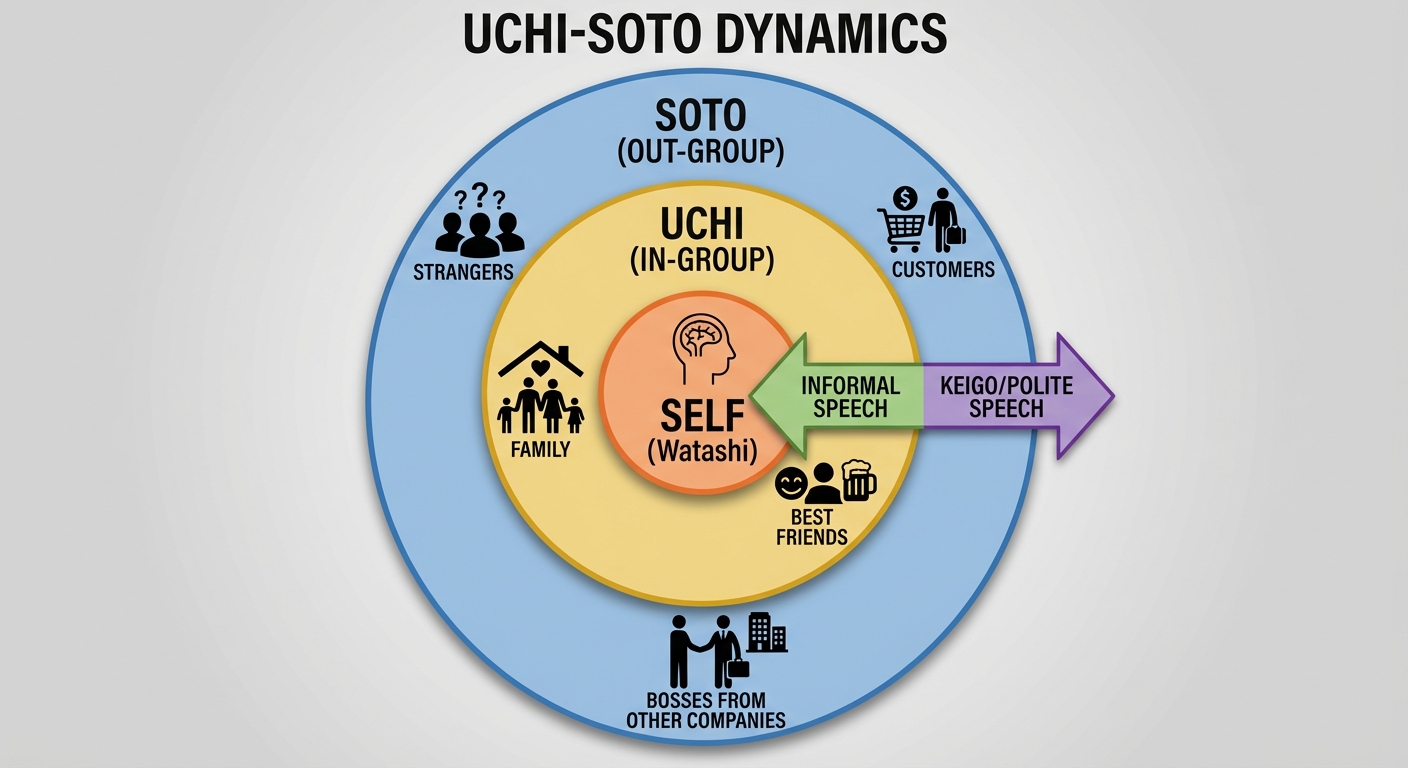
The concept of Uchi (Inside) and Soto (Outside) dictates behavior, language, and social obligation.
- Uchi: Your in-group (Family, Close Friends, Company). Inside this circle, you can be casual and open.
- Soto: The out-group (Strangers, Customers, Other Companies). Toward this group, you must be formal and polite.
This concept explains why a Japanese person will humble their own family members (i.e., using Haha instead of Okaasan) when speaking to outsiders. The family is identifying as a single humble unit facing the outside world.
Honne and Tatemae
closely related to Uchi-Soto is the duality of public and private faces.
- Honne (Real Sound): A person's true feelings and desires. Usually only shared with the Uchi group.
- Tatemae (Built Front): The behavior and opinions one displays in public to satisfy social expectations.
Students often mistake Tatemae for dishonesty. However, in Japanese culture, Tatemae is a virtue allowing for Wa (Harmony). It prevents conflict and embarrassment, preserving the group's social cohesion over the individual's need to express disagreement.
Giri and Ninjo
Key values in literature and traditional drama (Kabuki/Rakugo), these concepts still influence modern identity.
- Giri (Duty/Obligation): The burden of social obligation. Giving gifts (Oseibo in winter, Ochugen in summer) or returning favors (Okaeshi) falls under Giri.
- Ninjo (Human Emotion): The natural human feelings of love, compassion, or sympathy.
Conflict: A classic Japanese dilemma involves the clash between Giri (duty to the company/family) and Ninjo (personal empathy or love).
Multiculturalism and Assimilation
Japan is often stereotyped as a homogeneous society (Tan'itsu Minzoku), but the reality is more complex. Modern Japanese identity is grappling with globalization and changing demographics.
Changing Demographics
Several groups challenge the traditional definition of "Japanese" (assumed to be Japanese by blood, language, and culture).
- The Ainu: Indigenous people of Hokkaido with a distinct language and culture, historically subject to forced assimilation.
- The Ryukyuans: Indigenous people of Okinawa/Ryukyu islands.
- Zainichi Koreans: Long-term Korean residents in Japan. Many speak only Japanese but retain a distinct ethnic identity.
- Nikkeijin: Descendants of Japanese emigrants (mostly from Brazil and Peru) who have returned to Japan for work. They look Japanese but may struggle with the language and cultural nuances.
"Hafu" and Mixed Roots
The term Hafu (derived from the English "half") refers to people of mixed Japanese and foreign heritage.
- Celebrity Culture: Many models and athletes (e.g., Naomi Osaka) are Hafu, leading to a "cool" image.
- Identity Struggle: Despite visibility, mixed-race individuals often face questions about whether they are "truly" Japanese if they look different or do not speak the language perfectly.
Gairaigo: Linguistic Assimilation
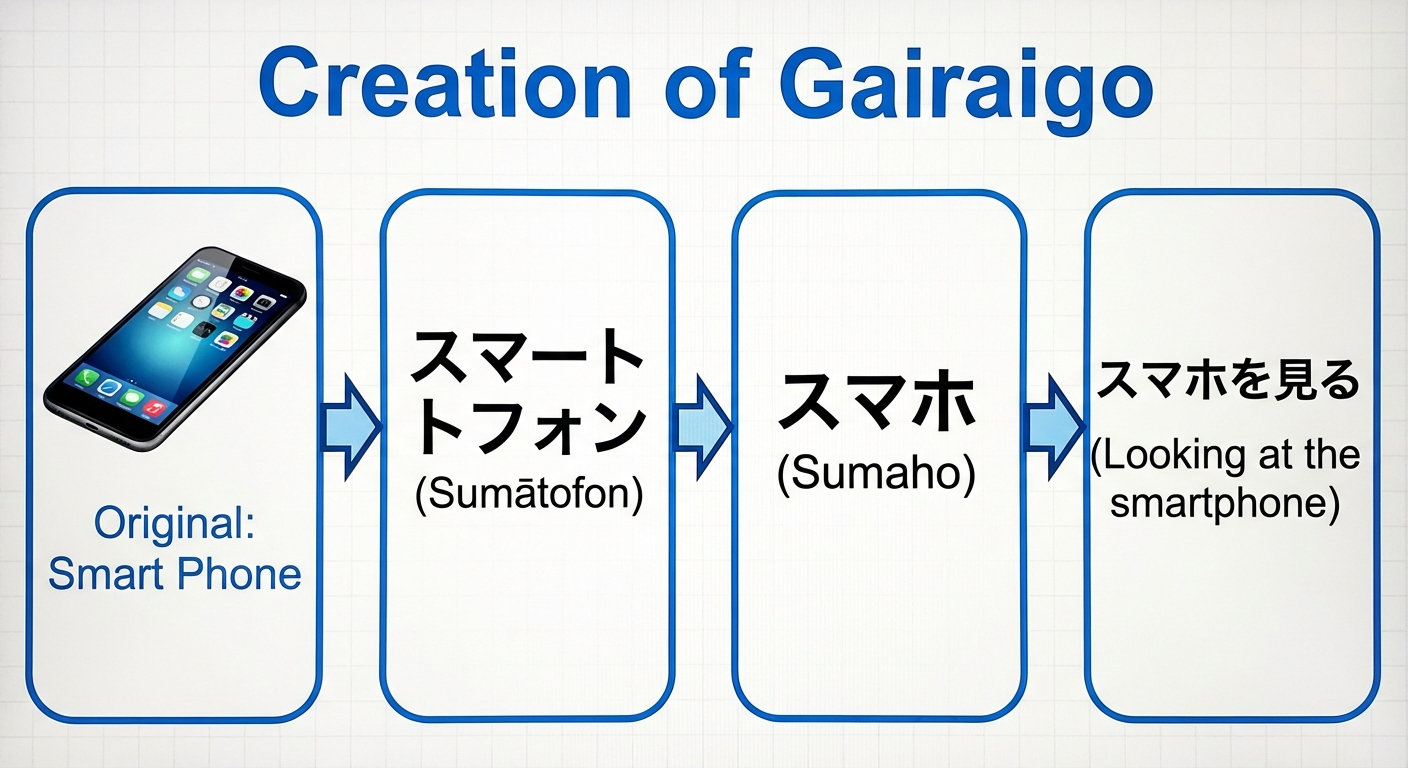
Japan assimilates foreign concepts through language. Gairaigo (loanwords), usually written in Katakana, are fully integrated into Japanese identity.
- Examples: Internet (Intaanetto), Convenience Store (Konbini), Milk (Miruku).
- Wasei-Eigo: These are "Japanese-made English" words that don't exist in English but are part of modern Japanese lexicon.
- Salaryman (Office worker)
- Skinship (Physical bonding/intimacy)
These words show Japan's ability to absorb outside influences and redefine them as part of their own cultural identity.
Common Mistakes and Pitfalls
- The Keigo Trap: Students often use Sonkeigo (respect) for themselves.
- Wrong: Watashi wa Sensei ni irasshaimashita. (I graciously went to the teacher.)
- Right: Watashi wa Sensei no tokoro ni mairimashita. (I humbled myself and went to the teacher.)
- Stereotyping Homogeneity: Avoid arguing that "All Japanese people are the same." In Cultural Perspective presentations, acknowledge generational gaps and regional differences (Tokyo vs. Osaka, Old vs. Young).
- Misunderstanding Tatemae: Do not label Tatemae as "lying." In an exam context, explain it as a tool for maintaining social Wa (harmony).
- Uchi-Soto Confusion: Remember that your "group" changes boundaries. When talking to a client, your boss is Uchi. When talking to your boss, your boss is superior. Context is everything.