Comprehensive Guide to Electrostatics, Fields, and Potentials
Electrostatics and Coulomb's Law
Electrostatics is the study of electric charges at rest. This forms the foundation of the AP Physics C: Electricity and Magnetism curriculum. Understanding how charges interact forces us to combine vector calculus with physical intuition.
Electric Charge Properties
There are two fundamental types of charge: positive (protons) and negative (electrons).
- Charge Quantization: Electric charge is not continuous; it comes in discrete packets. The fundamental unit of charge ($e$) is the magnitude of the charge of an electron or proton.
Total charge $Q$ is always an integer multiple of $e$: $Q = ne$, where $n$ is an integer. - Conservation of Charge: In an isolated system, the total arithmetic sum of electric charge remains constant. Charge cannot be created or destroyed, only transferred.
Coulomb's Law
The electrostatic force between two point charges is described by Coulomb's Law. It states that the force is directly proportional to the product of the magnitudes of the charges and inversely proportional to the square of the distance between them.
Where:
- $k = \frac{1}{4\pi\epsilon_0} \approx 8.99 \times 10^9 \text{ N}\cdot\text{m}^2/\text{C}^2$ is Coulomb's Constant.
- $\epsilon_0 \approx 8.85 \times 10^{-12} \text{ C}^2/(\text{N}\cdot\text{m}^2)$ is the Permittivity of Free Space.
- $r$ is the center-to-center distance.
- $\hat{r}$ is the unit vector pointing from the source charge to the test charge.
Key Concept: The Principle of Superposition
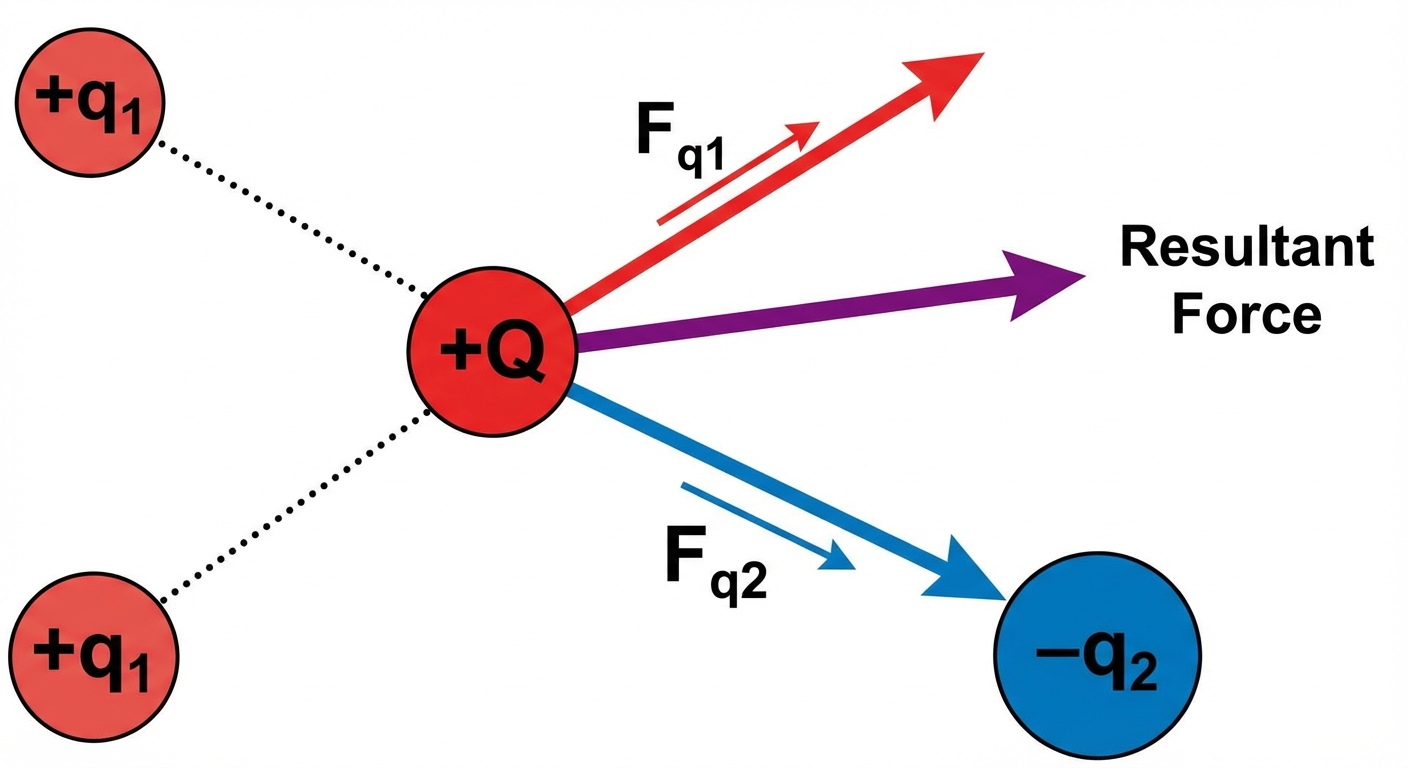
If multiple point charges are present, the net force on a specific charge is the vector sum of the individual forces denoted by Coulomb's Law.
Electric Fields
Definition and Point Charges
The Electric Field (E) is defined as the force per unit positive charge exerted on a test charge placed at that location. It is a vector field.
For a single point charge $Q$, the magnitude of the electric field at distance $r$ is:
- Direction: The field points away from positive charges and toward negative charges.
Electric Fields of Continuous Charge Distributions
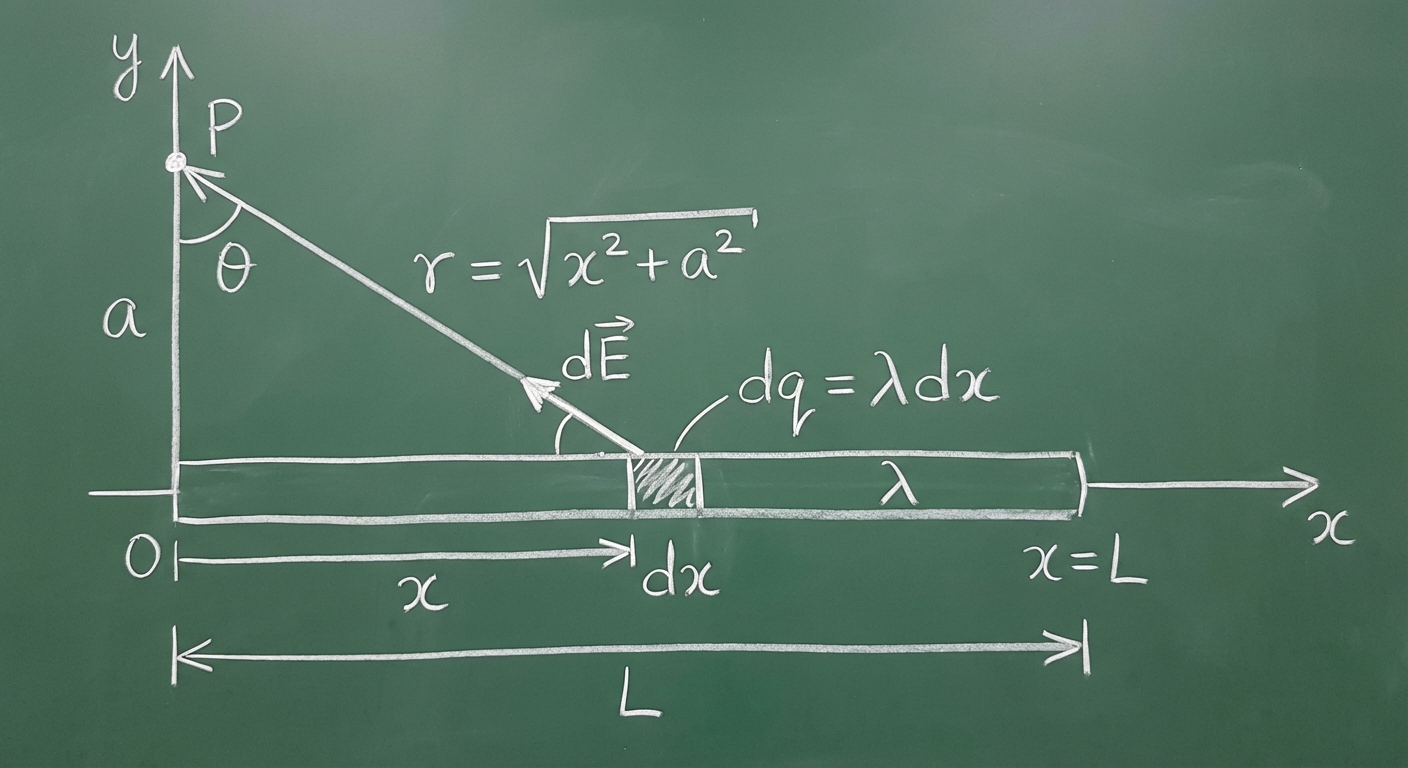
In AP Physics C, charges are often distributed over a length, area, or volume rather than existing as points. To find the total field, we treat the object as a collection of infinitesimal point charges ($dq$) and integrate.
Step-by-Step Approach for Integration:
- Define $dq$: Relate the infinitesimal charge to the geometry using charge density.
- Linear Charge Density ($\lambda$): $dq = \lambda dl$ (for rods, rings, arcs).
- Surface Charge Density ($\sigma$): $dq = \sigma dA$ (for disks, sheets, uncharged shells).
- Volume Charge Density ($\rho$): $dq = \rho dV$ (for solid spheres, cylinders).
- Set up the differential field $dE$: Treat $dq$ as a point charge.
- Check Symmetry: Determine if components cancel out (e.g., if finding the field on the axis of a ring, the perpendicular components cancel, leaving only vertical components).
- Integrate: sum up the components.
Example: E-Field on the axis of a Ring
For a ring of radius $R$ and total charge $Q$, at a distance $x$ along the central axis:
Using geometry where $r = \sqrt{R^2 + x^2}$ and $\cos\theta = x/r$:
Gauss's Law
Gauss's Law relates the electric flux passing through a closed surface to the charge enclosed by that surface. It is one of Maxwell's Equations and acts as a powerful alternative to Coulomb's Law for calculating fields of highly symmetrical objects.
Electric Flux ($\Phi_E$)
Electric flux is a measure of the number of electric field lines passing through a surface.
- The dot product means we care about the component of $\vec{E}$ equal to the normal vector of the area (perpendicular to the surface).
- If $\vec{E}$ is parallel to the surface, flux is zero (because it doesn't pierce the surface).
The Law
Applying Gauss's Law
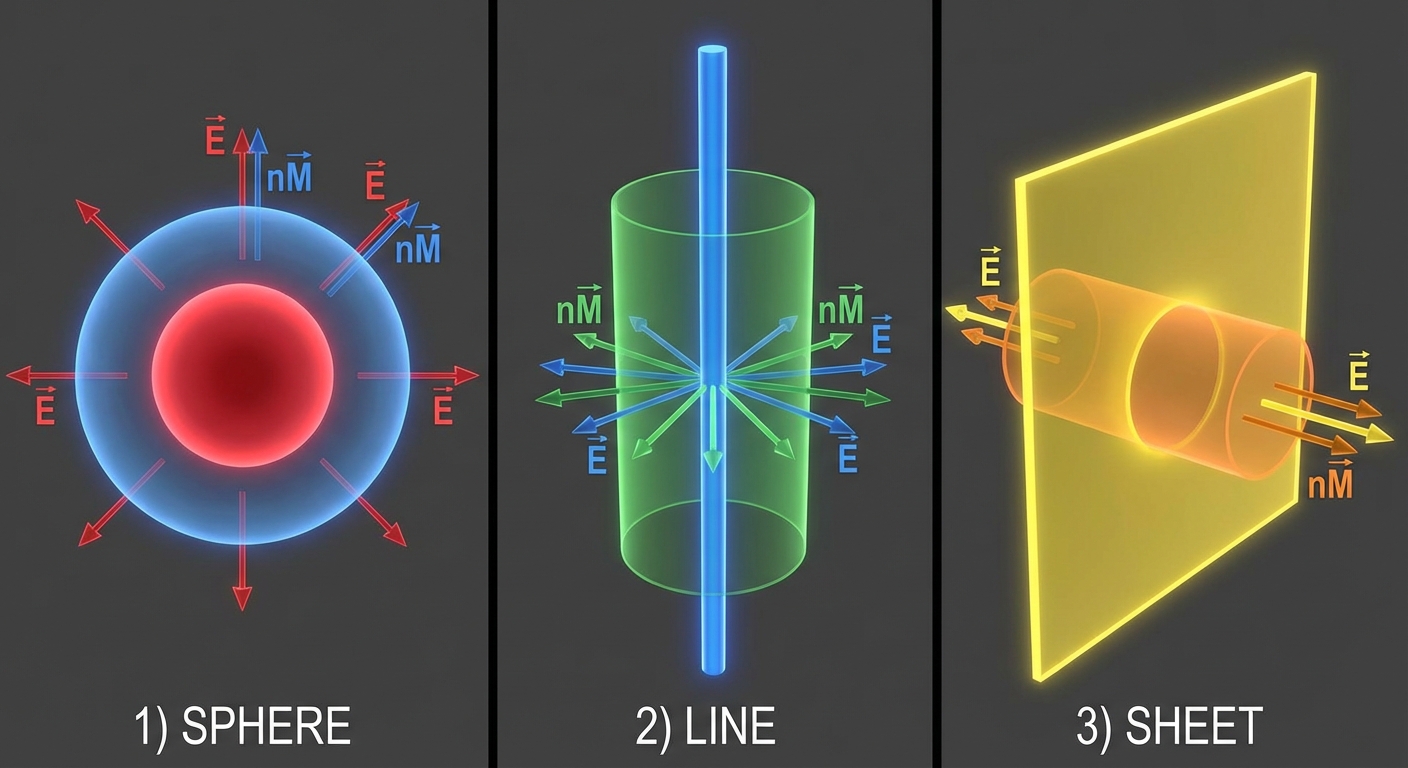
Gauss's law is valid for any surface, but it is only useful for calculating $E$ when the system has high symmetry. The goal is to choose a "Gaussian Surface" where $E$ is constant magnitude and parallel to $d\vec{A}$ everywhere on the surface.
Common Geometries Table:
| Symmetry Type | Gaussian Surface Shape | Area Formula in Flux Integral | Resulting Field Relationship |
|---|---|---|---|
| Spherical | Concentric Sphere | $4\pi r^2$ | $E \propto 1/r^2$ (outside) |
| Cylindrical | Coaxial Cylinder | $2\pi r L$ | $E \propto 1/r$ (outside) |
| Planar | Pillbox or Rectangular Box | $2A$ (top + bottom) | $E = \text{constant}$ |
Example: Non-Conducting Solid Sphere (Uniform $\rho$)
- Outside ($r > R$): Behaves like a point charge. $E = kQ/r^2$.
- Inside ($r < R$): The enclosed charge is a fraction of the total based on volume ratio.
(Linear relationship inside the sphere!)
Electric Potential and Potential Energy
While Force and Field are vectors, Potential Energy and Potential are scalars. This often makes complex calculation problems much easier to solve.
Electric Potential Energy ($U_E$)
The work done by an external agent to bring a system of charges from infinity to their current configuration against the electrostatic force.
For two point charges:
- Sign Matters:
- Like charges ($++$ or $--$): $U_E > 0$ (Repulsive, store energy).
- Opposite charges ($+-$): $U_E < 0$ (Attractive, bound system).
Electric Potential ($V$)
Electric potential is defined as the potential energy per unit charge. It is intrinsic to the source charge distribution.
For a single point charge:
Superposition for Potential:
Total potential is the simple arithmetic sum (scalars!) of individual potentials:
Relationship Between E and V
The Electric Field is the negative gradient of the Electric Potential. Physically, field lines point "downhill" from high potential to low potential.
Calculus Definitions:
- Finding $V$ from $E$:
- Finding $E$ from $V$:
In vector notation: $\vec{E} = -\vec{\nabla}V$
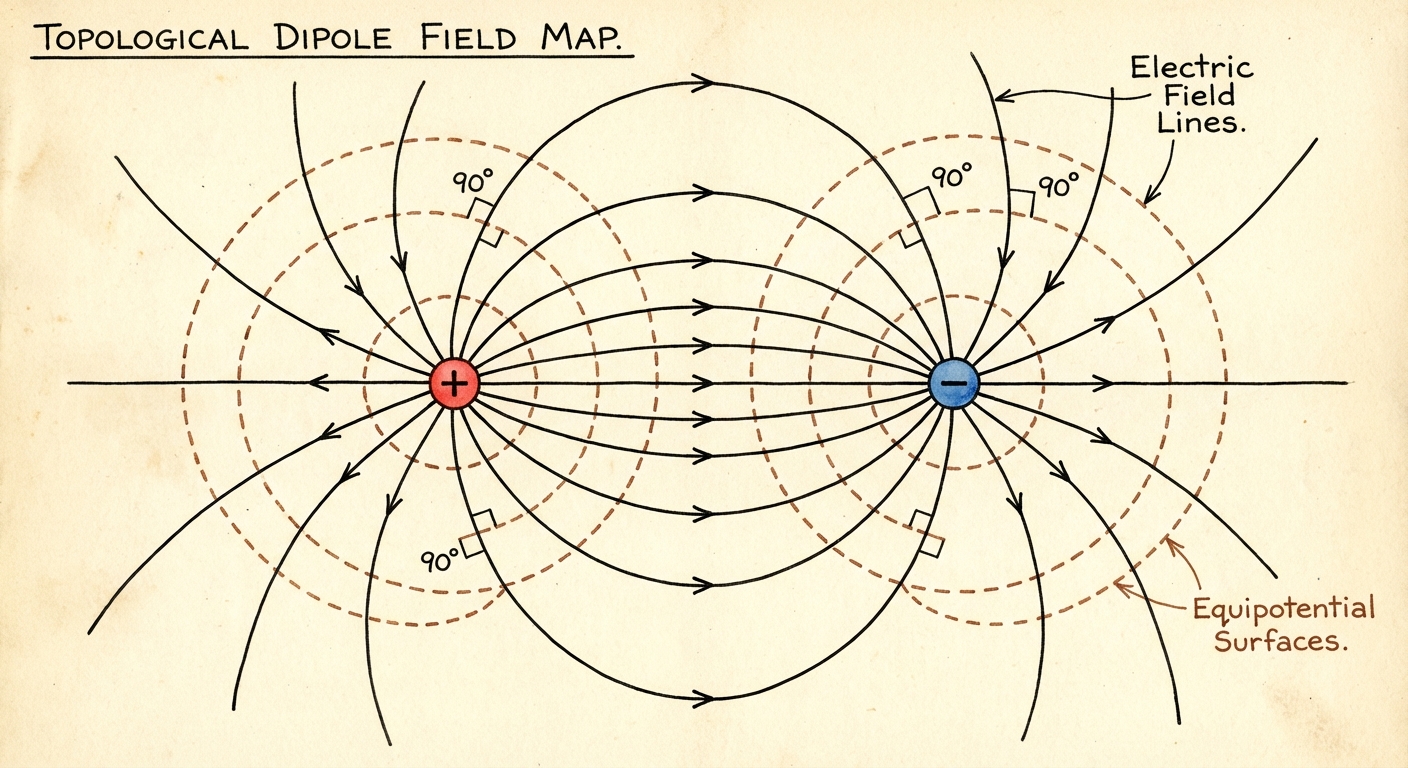
Equipotential Surfaces
- Lines (2D) or surfaces (3D) where the potential is constant.
- Rule: Electric field lines are always perpendicular to equipotential surfaces.
- Moving a charge along an equipotential line requires zero work.
Conductors in Electrostatic Equilibrium
A conductor contains free charge carriers (electrons) that move freely. When a conductor reaches equilibrium (net motion of charge ceases), it exhibits specific properties:
- Electric Field Inside is Zero: If there were a field inside, charges would move ($F=qE$), which contradicts the assumption of equilibrium.
- Excess Charge Resides on the Surface: Due to repulsion, excess charges push themselves as far apart as possible (to the skin of the object).
- Electric Field is Perpendicular to the Surface: If there were a parallel component, charges would flow along the surface.
- Magnitude of Field at Surface: $E = \sigma / \epsilon_0$.
- Entire Conductor is an Equipotential: Since $E=0$ inside, no work is done moving charge inside. Therefore, potential $V$ is constant throughout the volume and on the surface.
Common Mistakes & Pitfalls
Confusing $1/r$ and $1/r^2$ Logic:
- Forces ($F$) and Fields ($E$) for point charges drop off as $1/r^2$.
- Energy ($U$) and Potential ($V$) for point charges drop off as $1/r$.
- Mnemonic: If you are dealing with Vectors (Force/Field), use the squared distance ($r^2$). If you are dealing with Scalars (Energy/Potential), use $r$.
Ignoring Vector Components:
- When calculating $E{net}$ or $F{net}$, you cannot simply add magnitudes. You must decompose vectors into x and y components unless they are along the same line.
- However, when calculating Potential ($V$), you never use components. Just sum the numbers.
Gaussian Surface vs. Real Surface:
- Students often confuse the radius of the charged object ($R$) with the radius of the Gaussian surface ($r$).
- Correct approach: Gauss's law integrates over the arbitrary surface $r$. The charge enclosed ($Q_{enc}$) depends on how $r$ compares to $R$.
Integration Limits:
- When calculating Potential from infinity: $V(r) = -\int_{\infty}^r \vec{E} \cdot d\vec{r}$.
- Common error: Swapping limits results in a sign error.
Shell Theorem Misunderstanding:
- Inside a uniformly charged spherical shell, the Electric Field is zero everywhere. However, the Electric Potential is non-zero; it is constant and equals the potential at the surface ($kQ/R$). Students frequently think $V=0$ just because $E=0$.